Richard Halliburton
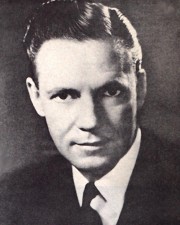 Richard Halliburton born 9 January 1900 (d. 1939)
Richard Halliburton was an American explorer, athlete, and author.
Halliburton was born in Brownsville, Tennessee and raised in Memphis. He attended the all-boys college preparatory school Memphis University School. He went to Princeton University and graduated but he was not a model student and soon found he didn't fit into a structured life, instead desiring spontaneity and adventure.
At Princeton, Field and Stream Magazine bought an article of his for $150, which encouraged him to lead an unpractical life of travelling and working through paid correspondence. He had marginal success as a writer at first, and tried talking about his travels on the public speaking circuit.
On March 3, 1939, Halliburton began a new journey in which he attempted to pilot a junk eastward across the Pacific. He departed from Hong Kong aboard a custom-built Chinese junk, intending to sail to San Francisco in time for the Golden Gate International Exposition. On March 24, a typhoon struck unexpectedly and Halliburton, his ship, and crew, failed to return (despite an extensive search, no trace was ever found).
While many of Halliburton's stories recount his own irresponsibility and document attitudes which today would almost universally be condemned as racist, his books continue to be of great interest for their romantic recountings of escapades ranging from making the first documented winter ascent of Mount Fuji to being the first and only person to swim the the length of the Panama Canal, registering as a ship and paying a toll of 36 cents, based on his weight of 140 pounds. In his first book of marvels, where the story of the Panama Canal is recounted, he also reenacted the ritual of Mayan sacrifice by diving into the well that virgins were thrown down through.
In his Second Book of Marvels, he stated, 'Astronomers say that the Great Wall is the only man-made thing on our planet visible to the human eye from the moon.' Although untrue, this statement was possibly source for the urban legend that the Great Wall of China could be seen from space. He also personally met the last emperor of China.
In The Royal Road to Romance, he recounted being arrested for taking photos of the guns at Gibraltar. Enamored of seeing a sunset from the Taj Mahal, he hid himself on the grounds and swam in a pool by moonlight.
 Although he was a writer, Halliburton made more money from his public speaking engagements. He was a popular figure, handsome and romantic, and was renowned in the period between the two World Wars.
In his youth he courted girls and was seriously infatuated with at least two, as revealed by his letters to them. As he matured, he became bisexual, as observed by at least one travelling companion. Halliburton kept his sexual orientation secret from his public and his parents, who longed for grandchildren. His correspondence and his relations clearly offer this view of his orientation. He was a friend, and may have been a lover, of one of the first openly gay film stars, Ramon Novarro. A biographer of Novarro asserts that Halliburton chose Paul Mooney as crew for his fatal final voyage because the pair were lovers.
Halliburton commissioned a modernist house from William Alexander Levy, a 27 year old architect. Levy was lovers with Paul Mooney, Halliburton's editor and ghostwriter, and the house was built with three bedrooms, one for each of the men. The concrete box house, suspended between canyon and ocean in Laguna Beach, California, was soon dubbed 'Hangover House'. It was used under the name of the Heller House by Ayn Rand in The Fountainhead (1943).
Labels: Bisexuals, Death by accident, Explorers, Sexuality Disputed, Travel writers, Writers
posted by Peter Jacobs at 12:01 am




4 Comments:
Thanks, Peter, for highlighting the fascinating and short life of Richard Halliburton. I have been orbiting around doing a biography of RH for years, collecting information about his life, including his own books and Halliburton: The Magnificent Myth, by the late Jonathan Root. Internet sources such as your blog seem to take it for granted that RH was gay -- one of his lovers, for example, is said to have been Ramon Navarro -- though I'm missing the evidence, somehow. You say it is "abundantly clear from his correspondence". Sorry, I can't spot it. I'm not disputing your conclusion, just missing it. Root's biography doesn't address the question, perhaps out of sensitivity to RH's surviving family, friends and lovers, or maybe out of the political tenor of the times. Yet surely Halliburton's homosexuality, and the need for him, as a public figure in the 1920s and 30s, to suppress it, must have been major factors in his life and should be dealt with sympathetically in any biography. I really need to know more. Can you help me by pointing to a few evidentiary sources?
Well, the main source I used is Wikipedia - rather than my own independent research. What pointed me towards Halliburton was a 1982 book by Martin Greif called The Gay Book of Days, which references Playing The Game by Roger Austen, mentioning 'affairs' with Rod La Roque and Ramon Navarro, and saying that he "settled down with another bachelor in Laguna Beach". and quotes John Paul Hudson as follows: "Halliburton certainly did a lot of straight-approved things, though his exploits were self-stretching and not competitive - which is the gay way". Hardly conclusive, but I have no idea what else Husdon had to say on the subject.
For fuck's sake!
Halliburton certainly was gay. I spent three days traveling with and interviewing Bill Alexander Levy at his Hollywood Hills home and in Laguna concerning his connections with Richard. Bill verified that Richard was gay as did Moye Stephens’s son, Moye Junior, in an interview I had with him. In the over fifteen years of research I conducted before writing “A Shooting Star Meets the Well of Death, Why and How Richard Halliburton Conquered the World,” Moonshine Cove Publishers, 2013, there were other contacts I had who verified Richard’s sexual preference.
As far as Root’s book not dealing with Richard’s gayness, my book has the following as quoted from in an interview I had with Richard’s first cousin, Juliet Halliburton Davis.
"Root sent a proof of his book to James Cortese but not to Uncle Wesley. After reading it, Cortese contacted my brother John to tell him there were things in the book that would really bother Uncle Wesley. Now, I suspect, the 'things' referred to Richard's homosexuality. John, who at that time was Vice President of Eastern Airlines Operations, had frequent meetings in New York. I believe the next time he went there he stopped by the publisher's office and told them he would sue if the book came out as it was written. That must have had some effect because the published version did not have the objectionable parts referred to."
In relation to the stories that Halliburton had been involved with Ramon Navarro, I never found any credible evidence that this was the case so I never dealt with it in my book.
William R. (Bill) Taylor, www.rhalliburtonstar.com.
Post a Comment
<< Home