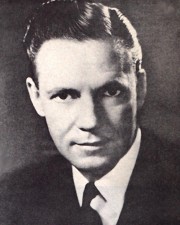
László Almásy
 born 22 August 1895 (d. 1951)
Count László Ede Almásy de Zsadány et Törökszentmiklós was an Hungarian aristocrat, motorist, desert researcher, aviator, Scout-leader and soldier who also served as the basis for the protagonist in Michael Ondaatje's 1992 novel
The English Patient and the movie based on it.
Almásy was born in Borostyánkő in the Austrian-Hungarian monarchy (modern-day Bernstein in Austria), into a non-titled Hun noble family. He was educated by a private tutor in Eastbourne from 1911 to 1914. During World War I, he served with the Austro-Hungarian Imperial and Royal Aviation Troops. He returned after the war to join Eastbourne Technical Institute while lodging again at the same address from November 1921 to June 1922. He was a member of the pioneering Eastbourne Flying Club.
After the war, Almásy continued to support King Karl of Austria, and, on two occasions, drove him to Budapest when he tried to get his throne back. It may be that Karl bestowed him unofficially with the title of count that Almásy only used outside of Hungary.
After 1921, Almásy worked as a representative of an Austrian car firm Steyr Automobile in Szombathely, and won many car races in their colours. He also organised hunting trips in Egypt for visiting Europeans. During his drive from Egypt to Sudan along the Nile in 1926, he developed an interest in the area and later returned there to drive and hunt. He also demonstrated Steyr vehicles in desert conditions in 1929 with two Steyr lorries and led his first expedition to the desert.

In 1932, he left to find the legendary Zerzura, the Oasis of the Birds, with three Britons, Sir Robert Clayton, Commander Penderel and Patrick Clayton, who were sponsored by Prince Kemal el Din. The expedition used both cars and a plane. They discovered prehistoric rock art sites in Uweinat and Gilf Kebir, and Almasy claimed that in 1933 he found the third valley of Zerzura in Wadi Talh.
He also discovered the magyarab tribe in Nubia, who speak Arabic but believe that they are the descendants of Hungarian soldiers who served in the army of Turkey in the 16th century.
Almásy had succeeded in turning into a serious explorer. Almásy, was given the nickname Abu Ramla (Father of the Sands) by his Bedouin friends. However, in the mid-1930s, the time for research and adventure was drawing to a close. In 1932 his former sponsor Clayton died — not from a crash-landing as described in
The English Patient — but of an infection from a desert fly contracted in the Gilf Kebir region. However, Clayton's wife did die one year later (1933) in a mysterious plane crash.
Almásy recorded some of his adventures in the book
Az ismeretlen Szahara (The Unknown Sahara), first published in 1934 in Budapest. The German edition, under the title
Unbekannte Sahara. Mit Flugzeug und Auto in der Libyschen Wüste (The Unknown Sahara. By Airplane and Car in the Libyan Desert), was published five years later (1939) by Brockhaus in Leipzig. It contains accounts of his most sensational discoveries like the one of the Jebel Uweinat (the highest mountain of the Eastern Sahara desert), of the rock paintings in the Gilf Kebir and of the lost oasis of Zerzura.
Almasy's role in relation to the Gilf Kebir was not that of a discoverer. The Bedouins already knew it was there, but tended to avoid the caves except when searching for stray livestock, attributing the cave paintings inside to unpredictable spirits. Egyptian Prince Kemal ed Din wrote an article about Gilf Kebir for
National Geographic in 1921. What Almásy did was to map and enter each cave and draw the paintings inside.

In the following years, Almásy led archaeological and ethnographical expeditions with the German ethnographer Leo Frobenius. He also worked in Egypt at Al Maza airfield as a flying instructor. After the outbreak of World War II in 1939, he had to return to Hungary. The British suspected that he was a spy for the Italians — and vice versa. In fact he was a Hungarian who worked for which ever colonial power offered him the best surveying contract. Hungary formally joined the Axis powers by signing the Tripartite Pact in November of 1940.
The Abwehr (German military intelligence service) recruited him in Budapest. As a Hungarian reserve officer, he was assigned to the Luftwaffe as a Hauptmann (captain) and assigned to the Afrika Korps. In 1941–1942, he worked with the German troops of Erwin Rommel using his desert experience and led military missions, including Operation Salaam, to infiltrate two German spies through enemy lines in a manner similar to the allied Long Range Desert Group. This was not a covert operation: Almásy and his team wore German uniforms, although they used American vehicles with German crosses surreptitiously incorporated as part of the vehicles camoflage pattern. Almásy delivered the German (Abwehr) agents Hans Eppler and Peter Stanstede to Cairo in the same way. Rommel subsequently promoted Almásy to major.
The details of Almásy's role in World War II are likely to remain unclear. For delivering spies, he received the Iron Cross (Eisernes Kreuz) from Rommel. He was, however, never a spy nor a Nazi.

The real Almásy was a far cry from the character portrayed by Ralph Fiennes in the film based on Michael Ondaatje's novel, a dashing explorer who falls in love with another man's wife while working with the Royal Geographical Society in North Africa, and who helps the Nazis only as a way to be united with his love.
In real life he was an intrepid explorer, but he was also a homosexual who wrote passionate letters to a young German officer he tried to help avoid going to the Russian front. And he was a monarchist, obsessed with the idea of returning the Hapsburgs to the throne even when it was clear the empire was beyond redemption.
After the end of the desert war, Almásy relocated to Turkey where he became involved in a plan to cause an Egyptian revolt which never materialised. He then returned to Budapest where with his contacts from the Roman Catholic Church he helped save the lives of several Jewish families at a time when Jews were being sent to concentration camps.
After the war he was arrested in Hungary and ended up in a Soviet prison. After Communists took over in Hungary, Almásy was tried for treason in the Communist People's Court but was eventually acquitted. He escaped the country reputedly with the aid of British intelligence and they spirited him into British occupied Austria and were chased by a KGB 'hit squad' until they got him on a aeroplane to Cairo. They bribed Hungarian Communist officials to enable his release. He returned to Egypt at the invitation of King Faruk and became the technical director of the newly founded Desert Institute. He could not continue directing expeditions into the desert to search for King Cambyses' 'Lost Army' of history, the legendary Persian King whose army of 10,000 men had apparently vanished in the 'Sand Sea' that Almásy so loved.
Almásy became ill in 1951 during his visit in Austria. He died of dysentery in a hospital in Salzburg, where he was then buried. The epitaph on his grave, erected by Hungarian patriots in 1995, honours him as a 'Pilot, Saharaforscher und Entdecker der Oase Zarzura' (Pilot, Sahara Explorer, and Discoverer of the Zerzura Oasis).
Labels: Aristocrats, Explorers, Military Men, Spies/Traitors
 Sir Richard Burton born 19 March 1821 (d. 1890)
 Firstly, in a society where sexual repression was the norm, Burton's writing was unusually open and frank about his interest in sex and sexuality. His travel writing is often full of details about the sexual lives of the inhabitants of areas he travelled through and many of these details would have been shocking to the average Victorian. Burton's interest in sexuality led him to make measurements of the penis lengths of the inhabitants of various regions, which he includes in his travel books. He also describes sexual techniques common in the regions he visited, often hinting that he had participated, hence breaking both sexual and racial taboos of his day.
 Allegations of homosexuality 'dogged' Burton throughout most of his life, a particularly serious accusation as it was a criminal offence in Victorian England. Biographers disagree on whether or not Burton ever experienced homosexual sex (he never directly admits to it in his writing but he would hardly be expected to). These allegations began in his army days when General Sir Charles James Napier requested that Burton go undercover to investigate a male brothel reputed to be frequented by British soldiers. It has been suggested that Burton's detailed report on the workings of the brothel may have led some to believe he had been a customer. His later writings on the subject of pederasty and the fact that he and his wife, Isabel, remained childless gave further ground for speculation.