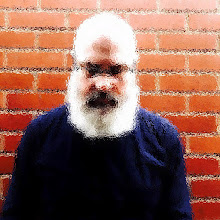
Quentin Crisp
 born 25 December 1908 (d. 1999)
Quentin Crisp was an English writer, artist's model, actor and raconteur known for his memorable and insightful witticisms. He became a gay icon in the 1970s after publication of his memoir
The Naked Civil Servant brought to the attention of the general public his defiant exhibitionism and long-standing refusal to conceal his homosexuality.
Born Denis Charles Pratt in Sutton, Surrey, he changed his name to Quentin Crisp in his twenties after leaving home and cultivating his outlandishly effeminate appearance to a standard that both shocked contemporary Londoners and provoked homophobic attacks.
By his own account, Crisp was effeminate in behaviour from an early age and found himself the object of teasing at Kingswood Preparatory School in Epsom, from where he won a scholarship to Denstone College, near Uttoxeter in 1922. Whilst in the sixth form, Crisp served in and eventually commanded a squad in the Officer's Cadet Force. After leaving school in 1926, Crisp studied journalism at King's College London but failed to graduate in 1928, going on to take art classes at Regent Street Polytechnic.

Around this time, Crisp began frequenting the cafés of Soho – his favourite being The Black Cat in Old Compton Street – meeting other young gay men and rent-boys, and experimenting with make-up and women's clothes. For six months he worked as a prostitute, looking for love, he said in a 1999 interview, but only finding degradation.

Crisp left home to move to the centre of London at the end of 1930 and, after living in a succession of flats, found a bed-sitting room in Denbeigh Street, where he held court with London's brightest and roughest characters. His outlandish appearance – he wore bright make-up, dyed his long hair crimson, painted his fingernails and wore sandals to display his painted toenails – brought admiration and curiosity from some quarters but generally attracted hostility and violence from strangers passing him in the streets.
Crisp attempted to join the army at the outbreak of the Second World War, but was rejected and declared exempt by the medical board on the grounds that he was 'suffering from sexual perversion'. He remained in London during the 1941 Blitz, stocked up on cosmetics, purchased five pounds of Henna and paraded through the blackout, picking up GIs, whose kindness and open-mindedness inspired his love of all things American.
In 1940 he moved into the bed-sitting room he would occupy for the next forty years, the first floor apartment at 129 Beaufort Street, London. Here he stayed until he emigrated to the United States in 1981. In the intervening years he never attempted any housework, saying famously in his memoir that the dirt didn't get any worse after the first four years.
He left his job as engineer's tracer in 1942 to become a model in life classes in London and the Home Counties, and continued posing for artists for the next three decades. 'It was like being a civil servant,' he explained in his autobiography, 'except that you were naked.'
Crisp had published three short books by the time he was commissioned by the director of Jonathan Cape to complete what would become
The Naked Civil Servant. Having heard Crisp interviewed on radio in 1964 he was keen to produce something of his in print. The book appeared in 1968 to respectable reviews. When the book was reprinted in 1975 on the strength of the success of the television version of
The Naked Civil Servant,
Gay News commented that the book should have been published posthumously. Quentin said this was a polite way of their telling him to drop dead.
Subsequently, Crisp was approached by documentary maker Denis Mitchell to be the subject of a short film in which he was expected to talk about his life, voice his opinions and sit around in his Beaufort Street apartment filing his nails. The broadcast brought enough attention to Crisp and his book that he soon entered talks about a dramatisation of his book starring John Hurt as Quentin Crisp [below].

The successful screening of
The Naked Civil Servant launched Crisp in another new direction: that of performer and lecturer. He devised a one-man show and began touring the country with it. The first half of the show was an entertaining monologue loosely based on his memoirs, the second half was a question and answer session with Crisp picking the audience's written questions out at random and answering them in an amusing manner. In 1978 Crisp sold out the Duke of York's Theatre in London, then took the show to New York, where he eventually decided to move. His first stay there, in the Hotel Chelsea, coincided with a fire, a robbery, and the death of Nancy Spungen. He set about making arrangements to move to New York permanently and in 1981 he arrived with few possessions and found a small apartment in Manhattan's Lower East Side.
He continued to perform his one-man show, published books on etiquette and supported himself by accepting social invitations and writing movie reviews and columns for US and UK magazines and newspapers. He said that provided one could exist on peanuts and champagne, one could quite easily live by going to every cocktail party, premiere and first night to which one was invited. As he had done in London, Crisp allowed his phone number to be listed in the Manhattan telephone directory and saw it as his duty to converse with anyone who called him.
In addition to his listed phone number, Mr Crisp would accept dinner invitations from almost anyone. While it was expected that the inviter would pay for dinner, Mr Crisp did his best to 'sing for his supper' by regaling his hosts with wonderful stories and yarns much as he did in his theatre performances. Dinner with Quentin Crisp was said to be one of the best shows in New York.

During the 1980s and 1990s Crisp gained worldwide recognition when Sting dedicated his song
Englishman In New York to him. Sting wrote the song not long after Crisp moved from London to an apartment in New York's Bowery. In late 1986 Sting visited Crisp in his apartment in New York and was told over dinner — and the next three days — what life had been like for a homosexual man in the homophobic Great Britain of the 1920s to the 1960s. Sting was shocked and fascinated at the same time and decided to write the song. In his 1995 autobiography
Take It Like A Man Boy George tells about how he had always felt very close to Crisp during his childhood since he was facing similar problems as a young homosexual living in a homophobic surrounding.
Crisp remained fiercely independent and unpredictable into old age. He caused controversy and confusion in the gay community by calling AIDS 'a fad', and homosexuality 'a terrible disease', and famously commented 'disrespectfully' on the death of Diana, Princess of Wales. However, he was continually in demand from journalists requiring a sound-bite, and throughout the nineties his commentary was sought on any number of topics.

The year after
The Naked Civil Servant was broadcast on British and American television and made both actor John Hurt and Crisp himself into stars, the former nude model & prostitute, now theatre-filling rancoteur, himself made his debut as a film actor in the Royal College of Art's low-budget production of
Hamlet (1976). Crisp played Polonius in the 65-minute adaptation of one of Shakespeare's greatest works, in support of Helen Mirren, who doubled as Ophelia and Gertrude. It would be nine years before his next turn before the cameras, in the 1985 film
The Bride, which brought him into contact with Sting, who played the lead role of Baron Frankenstein.
In 1992, he was persuaded by Sally Potter to play Elizabeth I in the film
Orlando. Although he found the role taxing, he won acclaim for a dignified and touching performance. Crisp next had an uncredited cameo in the controversial 1993 AIDS drama
Philadelphia. He was chosen by Channel Four to deliver the first 'Alternative Christmas Speech', a counterpoint to the Queen's Christmas speech, in 1993.
In 1996 he was among the many people interviewed for the historical documentary on how Hollywood films have depicted homosexuality, entitled
The Celluloid Closet. In his final volume of memoirs,
Resident Alien, published in the same year, Crisp stated that he was close to the end of his life. However, a humorous pact he had made with Penny Arcade to live to one hundred, with ten years off for good behaviour proved prophetic.
In June 1996 he was one of the guest entertainers at the second Pride Scotland festival in Glasgow.
Crisp died shortly before his ninety-first birthday in Chorlton-cum-Hardy, Greater Manchester, on the eve of a nationwide revival of his one-man show. His body was cremated with a minimum of ceremony, and his ashes flown back to New York and scattered over Manhattan.
Quentin Crisp's comment following the death of Princess Diana was as follows --
"She could have been Queen of England -- and she was swanning about Paris. What disgraceful behavior. Going about saying she wanted to be the queen of hearts. The vulgarity of it is so overpowering." (Atlanta Southern Voice, 1 July 1999).Labels: Film, Hustlers/Prostitutes, Leftfield/Avant-Garde, Models, Television, Theatre, Writers
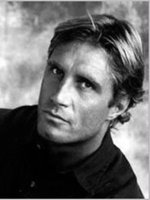 Antony Hamilton born 4 May 1952 (d. 1995)
 His handsome looks and dance training made the move into acting inevitable and after several TV specials, Hamilton was offered the role of male model/undercover agent in hit TV show Undercover, as a replacement for Jon Erik Hexum, who had been killed in a tragic on-set accident.