Tuesday, May 03, 2011

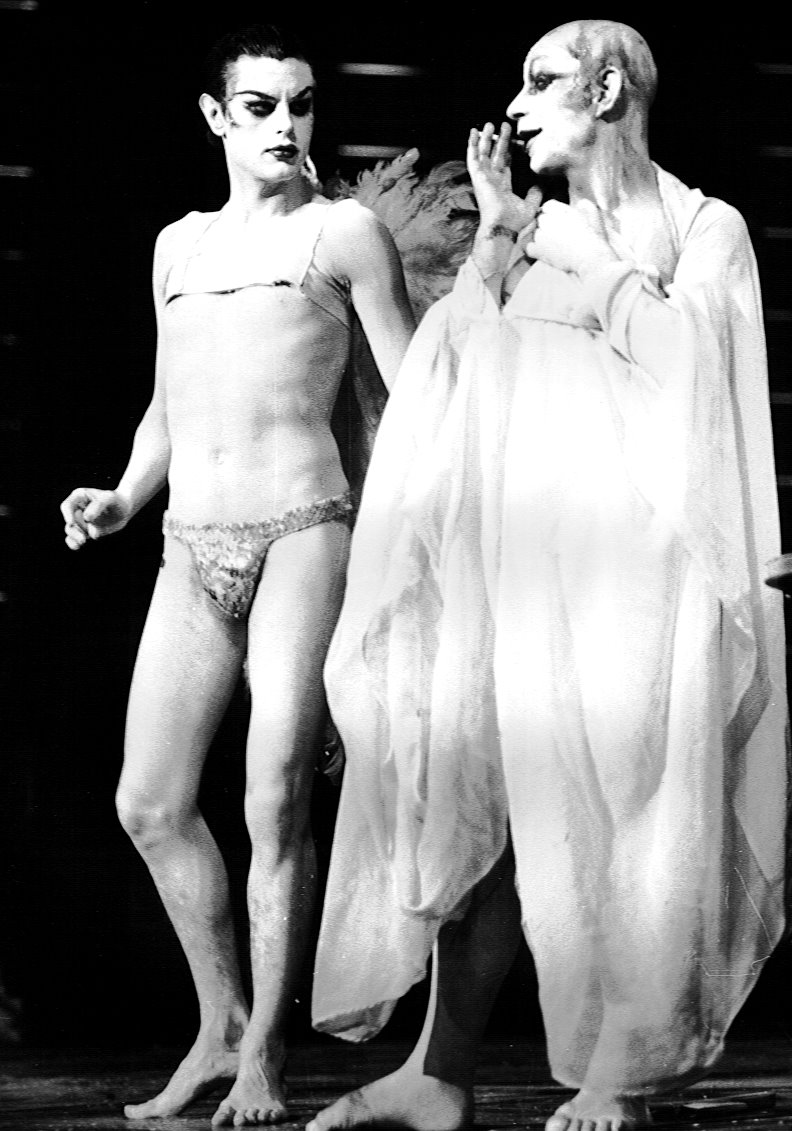
Lindsay Kemp

Lindsay Kemp born 3 May 1938

Lindsay Kemp is a British dancer, actor, teacher, mime artist and choreographer.

Born in South Shields, Kemp was raised in Yorkshire and attended Bradford Art College before studying dance with Hilde Holger and mime with Marcel Marceau.

Kemp formed his own dance company in the early sixties and first attracted attention with an appearance at the Edinburgh Festival in 1968. Despite thirty years of worldwide touring with his company and the occasional film and television appearances, Kemp is ironically best known by devotees of Kate Bush and David Bowie, both former students and, briefly, members of Kemp's company (Bowie as a performer, Bush as a wardrobe assistant). Indeed, it is rumoured - a rumour begun by Kemp himself - that he had a brief but volatile affair with Bowie in the late sixties, culminating in a failed suicide attempt more notable for its melodrama than sincerity of purpose.

Kemp’s style of performance, a unique and seductive blend of Butoh, Mime, Burlesque, Drag and Music Hall, has at different times been described as fascinating, colourful and self-indulgent, but rarely fails to attract critical acclaim and a loyal fanbase.

He staged and performed in David Bowie's Ziggy Stardust concerts at London's Rainbow Theatre in August 1972, and, with Jack Birkett (more on him below), appears in the promotional video for Bowie's single John, I'm Only Dancing.

Kemp’s film roles include a dancer and cabaret performer in Derek Jarman’s Sebastiane (1976) and Jubilee (1977) respectively, a pantomime dame in Todd Haynes’ Velvet Goldmine (1998) and the wonderfully camp pub landlord Alder MacGregor in Anthony Shaffer's The Wicker Man (1973).

During the early 70s, Kemp was a popular and inspirational teacher of dance/mime with a regular two and a half hour session at the Dance Centre in Floral Street, Covent Garden. This was in the days before the Dance Centre became an up-market private club, and anyone could and did drop in. Classes were sometimes taken by Lindsay's unsighted friend Jack Birkett (aka 'The Incredible Orlando') whose flamboyance and mastery was such that uninitiated newcomers could go through a whole session without realising that they were being taught (and corrected) by a blind teacher. It was said that Lindsay had 'saved' Birkett from despair by re-training him after he lost his sight.

Lindsay Kemp now lives near Rome, Italy.

Labels: , , , , , ,

Friday, April 29, 2011

Michael Alig

Michael Alig born 29 April 1966

Michael Alig (born South Bend, Indiana) was a founding member of the notorious Club Kids, a group of young clubgoers led by Alig in the late 1980s and early 1990s.

Alig came to New York and started out at as a busboy at Danceteria in 1983. A natural at throwing parties with little or no resources he soon began to rise in New York's party scene. Alig was mentored by socialite James St James and club owner Peter Gatien, while rising in popularity and prominence in the national underground club scene. Alig was also influential in the early promotion of Superstar DJ Keoki (whom he dated on and off). Other protegés included Gitzie, Jennytalia, Freeze, Richie Rich, Amanda Lepore and many other Club Kid personalities. The Club Kids' outrageousness resulted in their appearing on the news and the television talk show circuit.

Alig's most notorious parties were held at The Limelight, owned by Gatien and designed by Ari Bahat. The Limelight was closed by the police for supposed drug trafficking, but subsequently reopened several times during the 1990s.

He found a whole new level of notoriety in 1996 when, increasingly affected by substance abuse, Alig and his friend Robert 'Freeze' Riggs murdered their drug dealer Andre 'Angel' Melendez.

Melendez was murdered by Alig and Riggs after going to Alig's apartment to collect on a longstanding drug debt. After getting into a struggle with Alig he was hit on the head with a hammer, restrained with duct tape and either injected with or forced to drink Drano, a highly caustic drain cleaner. Later - after the body had begun to decompose in their apartment - they attempted to dismember it by cutting off Melendez's legs. They then put the body in a cardboard box and threw it into the Hudson River.

Alig 'jokingly' mentioned the murder while filming a documentary, presumably to shake off persistent rumours of the yet unproven incident. The media presumed it was a publicity stunt until Melendez's body washed ashore. In December 1996, Alig was sentenced to 10 to 20 years in prison for Melendez's murder. Alig was eligible for parole in November 2006, but was denied. He was again denied in September 2008, and was not eligible again until his conditional release date in March 2010. Due to him receiving another ticket for prescription drug use, Michael Alig could not be released in March, 2010. Alig was released on 5 May, 2014.

The events of Alig's years as a club promoter up to his arrest were portrayed in the 1998 documentary Party Monster, and recreated in a 2003 film of the same name starring Macaulay Culkin as Alig and Seth Green as St James. The events are also covered in St James's memoir, Disco Bloodbath.

Party Boy in a Cage

Labels: , , ,

Saturday, March 26, 2011

Leigh Bowery

Leigh Bowery born 26 March 1961 (d. 1994)

Leigh Bowery born in Sunshine, a suburb of Melbourne, Australia was a performance artist, club creature, and clothing designer.

After attending Melbourne High School, and having abandoned his home in Australia and a fashion course there he had a colourful exhibitionist career following his arrival in London in 1980, making a name for himself by dramatic performances of dance, music and simple exhibitionism, while wearing bizarre and very original outfits of his own design. He was frequently seen performing in Taboo, a fashionable night club he operated, (after years brightening the doorways of other people's events) near Leicester Square and is frequently identified as a key influence on the style of the New Romantic music movement that was popular in Britain during the early 1980s. Though perhaps he is more properly placed within the context of 'The Cult With No Name' as the activities of the pansexual set of young Londoners had already been dubbed.

A large man, he used his costumes to exaggerate his size and the effects were frequently overpowering and unforgettable for those who encountered him, the more so because of his confrontational style. A wallflower he was not.

In the late 1980s, Bowery collaborated as a dancer with the post-Punk ballet dancer Michael Clark, after having been his costume-designer for a number of years. He also participated in multi-media events like I Am Kurious Oranj and the play Hey, Luciani, with Mark E. Smith and The Fall.

In 1988 he had a week-long show in Anthony d'Offay's prestigious Dering Street Gallery in London's West End, in which he lolled on a chaise longue behind a two-way mirror, primping and preening in a variety of outfits while visitors to the gallery looked on. The insouciance and audacity of this overt queer narcissism captivated gallery goers, critics and other artists. Bowery's exquisite appearance, silence and intense self-absorption was further accentuated by his own recordings of random and abrasive traffic noises which were played for the show's duration. The very intimate and private was flung in the face of the public complete with a 'Street Life' sound track, hinting perhaps at something still darker. In some outfits he appears like some strange roadside creature, like a cat that finally got the cream (of art world attention), in others he is the 'Satan's Son' that he would whisper, years later, on his deathbed.

The difficulty of engaging in such an hedonistic and wilfully original life and artistic practice without independent financial means has long been the curse of the both the innovator and bohemian. For all his art world exposure and contacts it seems peculiar now that no-one suggested to Bowery that he might adopt the very viable strategy of Gilbert and George - an earlier generation's living sculpture - and derive an income from selling images of himself rather than rely on occasional commissions, modelling work for Lucian Freud, or design consultancy for Rifat Ozbek. In the later years of his life the advantages of having an independent income started to become more obvious and Bowery looked to music, in the form of art rock/pop group Minty, to possibly provide this independent income stream. 'I have a profile,' he confided to flatmate and fellow Australian Anne Holt, 'But I have no money.' Minty he hoped would provide a solution to this crux.

He outraged the London gay scene with a performance at SMact, a short lived SM Night at Bar Industria. Using Nazi costumes with a lesbian friend named Barbara, they turned concentration camp experimentation into SMart. The readers of Capital Gay, the London weekly newspaper, turned on fellow performer Berkley, who had played the victim, and Barbara and Leigh weathered the storm. He was after all, 'the punk of the eighties' and longtime darling of the international avant garde.

In 1993 Leigh formed Raw Sewage with Sheila Tequila and Stella Stein. They performed in 18" platforms at the Love Ball in Amsterdam, but the collaboration ended in dramas. Leigh went on to appear as 'Madame Garbo' in The Homosexual (or the difficulty of sexpressing oneself) by Copi at Bagleys Warehouse in London's King's Cross.

During 1994 Leigh performed the Fete worse than death in Hoxton Square, Leigh and Nicola Bateman (later, Nicola Bowery) showed their classic 'Birth Show' in which Leigh gives birth to Nicola, using a specially designed harness which holds her upside down to his belly under his costume.

In November 1994 Minty began a two week show at London's Freedom Cafe, watched by the young Alexander McQueen but it was too much for Westminster City Council who closed the show down after only one night.

He married his long-term female companion Nicola Bateman on May 13, 1994, only months before his death from AIDS-related illness at UC Hospital London on New Year's Eve 1994, after a five week battle that only a handful of friends were informed about. 'Tell them I've gone pig farming in Bolivia' is one reported death bed pronouncement which is illustrative of the gallows humour and dark irony that can be traced in much of his work.

Glimmers of the influences of film maker John Waters and artist Andy Warhol can be seen in his keen appreciation of bad taste, truly outlandish self presentation and a deep desire to shock and confuse. 'I want to be the Andy Warhol of London' he once said. 'Dressed-up' he was obviously 'Modern Art on legs' (as Boy George commented), but in daytime attire the badly-fitting, obvious, disturbing wigs are a nod to Warhol's self-presentation strategies that has thus far seemed invisible to both critics and friends alike.

He became known to a wider audience by appearing in a Post-Modernist/Surrealist series of television and cinema and commercials for the Pepe jeans company, MTV London and other commissions such as stage work for rock band U2. He also appeared regularly in articles, vox pops and as cover star in London's i-D magazine. Tired brands in need of fresh ideas tended to covet his dazzling originality.


Bowery was painted in a series of nude portraits by Lucian Freud [above and left], and travelled internationally to the opening events of his exhibitions. This modelling work provided him with an income of sorts for a period and he certainly relished Freud's connections to the British establishment, though it seems strange now that such an explosively original and inventive artist like Bowery would subordinate himself to the likes of Freud.

Bowery received posthumous exposure in the form of the West End and Broadway musical, Taboo starring Boy George, which transferred to Broadway after running for 16 months in London - Bowery was played by Boy George [pictured as Bowery] and subsequently Matt Lucas. Bowery's career is described more straightforwardly in a 2002 documentary The Legend of Leigh Bowery, directed by Charles Atlas.

Labels: , , , ,

Monday, March 21, 2011

Gavin Arthur

Gavin Arthur born 21 March 1901 (d. 1972)

Gavin Arthur, an astrologer and occultist, was born Chester Alan Arthur III, the grandson and namesake of the 21st President of the United States. He grew up in wealth, but did not pursue a career in the professions, choosing instead to join the Merchant Marines. He later panned for gold and sold newspapers.

In the 1930s he travelled widely and came to know many of the counterculture elite of his day. Among his acquaintances were pioneer sexologists Edward Carpenter, Havelock Ellis and Alfred Kinsey.

Arthur is a key figure in what has come to be called the gay 'apostolic succession' from Walt Whitman through Allen Ginsberg, via Carpenter, Arthur, Neal Cassidy and on to William Burroughs and beyond...

He was unashamedly gay and a forerunner of gay activism. He helped Kinsey with his groundbreaking research into male sexuality.

In the 1950s he settled in San Francisco and devoted his time to astrology. He began to move in the alternative spirituality and sexuality community that first became known for its identification with beat Zen, and he became well-known as an astrological counsellor. He began to develop a perspective on astrology that, contrary to the mainstream of astrological writing, took account of homosexual and bisexual gender preferences. His ruminations culminated in 1966 with his major writing, The Circle of Sex.

Arthur moved beyond traditional observations on sexual roles (that continue to dominate astrology books) that treat issues of sexual attraction and compatibility to argue that each person possesses a distinct combination of Yin and Yang. We attract and repel others as they tend to balance our own combination of male/female attributes. He then placed this under-standing that allowed for women with much Yang and men with much Yin, into a complex system of correspondences that involve the astrological signs, the planets, and houses of the horoscope.

Drawing on his reading of gay writers, Arthur concluded that sexuality needs to be separated from the single need to procreate. Heterosexuals need to be free of the constraints of marriage, for only then will the transgendered, homosexuals, and bisexuals be liberated. Or something .

Labels: , , ,

Saturday, March 12, 2011

Gregory Markopoulos

Gregory Markopoulos born 12 March 1928 (d. 1992)

Gregory Markopoulos was an American experimental filmmaker.

Born in Toledo, Ohio to Greek immigrant parents, Markopoulos began making 8mm films at an early age. He attended USC Film School in the late 1940s, and went on to become a notable member of the New American Cinema movement, a contributor to Film Culture magazine, and an instructor at the Art Institute of Chicago.

Markopoulos's contributions to film form begin with his earliest work of the 1940s, develop through the subsequent decades, and culminate in ENIAIOS, on which he worked during the final years of his life. His important innovations, such as editing with the smallest unit of film (the single frame), and the simultaneous narrative of past, present, and future, or his most individual use of colour, are all directed towards the representation and resolution of complex emotions. These innovations prefigure many contemporary practices in the arts. His influence is comparable with that of a Warhol as a filmmaker.

His best known film is perhaps The Illiac Passion (1964–67). The Illiac Passion is a radical interpretation of Aeschylus's Prometheus Bound that re-images the classical text within the realm of postwar American film and culture. Figures from New York's avant-garde community are cast as mythical beings, including Gerard Malanga (Ganymede), Jack Smith (Orpheus), Taylor Mead (The Demon or Sprite) and Andy Warhol (Poseidon) who rides an exercise bike over a sea of plastic sheeting. Markopolous’s most critically acclaimed film features hypnotic imagery and a sparse soundtrack that includes the director reading Thoreau's translation of the Aeschylus text and musical excerpts from Bartok.

In 1967, he and his partner Robert Beavers left the United States for permanent residence in Europe. Once ensconced in self-imposed exile, Markopoulos withdrew his films from circulation, refused any interviews, and insisted that a chapter about him be removed from the 2nd edition of Visionary Film, P. Adams Sitney's seminal study of American Avant-Garde Cinema.

It could be that one of the reasons for his self-imposed exile was the negative response of American critics and curators to the homosexual content of his films.

While he continued to make films, his work went largely unseen for almost thirty years.

Markopoulos died in Germany in 1992 after a long illness. In 1994 Robert Beavers set up Tenemos, Inc, a not-for-profit organisation dedicated to the development of individual and noncommercial filmmaking through the restoration and exhibition of films by Markopoulos and Beavers.

Since the mid-1990s, the films of Gregory Markopoulos have received renewed public recognition through their exhibition by numerous institutions, including the New York Film Festival 1997; Rotterdam International Film Festival 1999; Istanbul Biennial 1999, Auditorium du Louvre 1998, 2000, and 2002; and the Whitney Museum of American Art 1996 (retrospective exhibition), 1999, and 2000. All events have been coordinated by Robert Beavers through the Temenos Archive.

The Temenos

Labels: , ,

Sunday, March 06, 2011

Parker Tyler


Parker Tyler born 6 March 1904 (d. 1974)

Harrison Parker Tyler, better known as Parker Tyler was an American author, poet and film critic. Tyler lived with filmmaker Charles Boultenhouse (1926-1994) from 1945 until his death.

Born March 6, 1904, in New Orleans, the son of an insurance salesman, Tyler lived a childhood on the move, living in larger cities all over the eastern United States. He completed high school but refused to enter college, determined to continue his education as a poet on the streets of New York, where he arrived in 1924.

By the time he began corresponding with Charles Henri Ford a few years later, Tyler had already published scores of book reviews and hundreds of poems, many of which received their first public hearing in the basement clubs of Greenwich Village, where Tyler lived. Tyler was known in the neighbourhood as a dandy, going about in mascara and attired in cast-off clothing from the second-hand shops of the Lower East Side.

Tyler's letters apparently ignited in Ford a similar desire for the bohemian life, and in January 1930 he set out for New York. Tyler was waiting at the pier when Ford disembarked.

Ford had arrived in New York at a curious moment in time. With the stock market crash of 1929 only a few months in the past, the Depression was beginning to deepen. Nobody, it seemed, had any money or prospects, certainly not Ford or Tyler. Prohibition was still in full swing, though it was openly flouted by many, including New York's mayor Jimmy Walker.

Out of Prohibition came speakeasies, illegal quasi-private clubs, a number of which in the Village were sufficiently sheltered from scrutiny to become some of the first specifically gay and lesbian gathering places in North America. The more visible congregation of gay men in public places led to a vogue among New Yorkers for these 'strange brothers' - the so-called pansy craze.

He co-authored The Young and Evil (Obelisk Press, 1933) with Charles Henri Ford, an energetically experimental novel with obvious debts to fellow Villager Djuna Barnes, and also to Gertrude Stein. Tyler and Ford co-edited the Surrealist magazine View until it folded in 1947.

A writer for the journal Film Culture, Tyler is one of the few film critics to write extensively on experimental film and underground film. His Screening the Sexes (1972) is thought to be the first book-length study of homosexuality in film. Other books of film criticism by Tyler include The Hollywood Hallucination (1944), Magic and Myth of the Movies (1947), Classics of Foreign Film (1962), Sex Psyche Etcetera in the Film (1969), and The Shadow of an Airplane Climbs the Empire State Building (1973).

Pictured: Parker Tyler and Andy Warhol photographed by Gerard Malanga - worth clicking on for the larger image

Tyler's books became popular - and some old titles reissued after being out-of print for years - after he was mentioned several times in the novel Myra Breckinridge (1968) by Gore Vidal.

Parker Tyler died of prostate cancer in New York in 1974.

Labels: , , , , ,

Saturday, March 05, 2011

Pier Paolo Pasolini

Pier Paolo Pasolini born 5 March 1922 (d.1975)

Pasolini distinguished himself as a philosopher, linguist, novelist, playwright, filmmaker, newspaper and magazine columnist, actor, painter and political figure. He demonstrated a unique and extraordinary cultural versatility, in the process becoming a highly controversial figure.

Pier Paolo Pasolini is unquestionably one of the most important cultural figures to emerge from post-World War II Italy. But it is with film that he made his greatest impact.

Born in Bologna in 1922, Pasolini grew up in Friuli. While openly gay from the very start of his career (thanks to a gay sex scandal that sent him packing from his provincial hometown to live and work in Rome), Pasolini rarely dealt with homosexuality in his movies.

The subject is featured prominently in Teorema (1968); passingly in Arabian Nights (1974), in an idyll between a king and a commoner that ends in death; and, most darkly of all, in Salo (1975), his infamous rendition of the Marquis de Sade's compendium of sexual horrors, The 120 Days of Sodom.

Pasolini never saw himself as a 'gay artist'. Indeed, he explicitly rejected the assimilated gay middle-class he saw emerging just prior to his untimely death in 1975.

He began his career as a scriptwriter. When he broke out on his own as a writer-director with Accatone (1961) and Mamma Roma (1962), he was apparently styling himself after the masters of Italian neo-realism, especially Roberto Rossellini.

But in 1964 he found his moviemaking 'voice' with The Gospel According to St. Matthew. With a non-professional cast and a quasi-documentary shooting style, Pasolini retold the familiar story of the life of Christ in the simplest, least-Hollywood-like style imaginable.

While its musical score was fairly avant-garde, featuring as it did excerpts from the African Missa Luba, Prokofiev's Alexander Nevsky, and Mahalia Jackson singing Sometimes I Feel Like a Motherless Child, the movie was accessible to audiences of all kinds.

Gospel was followed by The Hawks and the Sparrows (1966), a comic fable about the adventures of a Chaplinesque father and son team, played by the great Italian star Toto and Ninetto Davoli, a young former lover of Pasolini's who was to appear in many of the filmmaker's works.

Not one to stick to the 'expected', Pasolini next turned to Sophocles' Oedipus Rex (1967), presenting the drama as a fable set in the wilds of North Africa and modern Rome.

After that came Teorema (1968), one of Pasolini's most controversial works, in which a sexual 'exterminating angel' (Terence Stamp) has his way with an entire Italian family.

Questions were raised when Pasolini cast Maria Callas in his rendition of Medea (1970), a film in which the legendary diva was not required to sing a note.

But a sudden turn of popular fortune came when Pasolini made The Decameron (1971), The Canterbury Tales (1972), and Arabian Nights (1974). They are as uncompromising as any of his films, but their comic spirit, frequent sexual interludes, and abundant nudity pleased moviegoers as no Pasolini work had done before.

And then came the posthumously released Salo. Most of the critics responded as though the horrors displayed in the film came directly from the gay Italian's feverish imagination. But all Pasolini did was extract selected passages of Sade and reset them in the last days of the fascist republic of Salo, the state-within-a-state established in the twilight of Mussolini's Italy.

His most visually elegant and dramatically reserved work, Salo offers Sade's vision of old, wealthy, evil authorities (politicians, lawyers and bishops) having their way with nude and compliant youths and maidens of the lower classes as simply standard operational procedure for the powers that be.

Despite the outrage of some critics who complained of the director's decadence and depravity, the film actually presents a scrupulous version of the everyday reality of man's inhumanity to man.

Pasolini died on November 2, 1975 at the beach of Ostia, near Rome, in a location typical of his novels. He was murdered brutally by being run over several times with his own car. Giuseppe Pelosi, a hustler, was arrested and confessed to murdering Pasolini. In May 2005, he retracted his confession, claiming that unidentified men had killed Pasolini (he spoke of three strangers, with a southern Italian accent, insulting Pasolini as a 'filthy communist'). He gave threats of violence against his family as the reason for his erstwhile confession. The investigation into Pasolini's death was reopened following Pelosi's recantation.

His murder is still not completely explained: some contradictions in the declarations of Pelosi, a strange intervention by Italian secret services during the investigations and some lack of coherence of related documents during the different parts of the judicial procedures brought some of Pasolini's friends to suspect that his murder had been commissioned. An enquiry of Pasolini's friend Oriana Fallaci brought up the inefficiency of the investigations; many clues indicate as unlikely that Pelosi killed Pasolini alone. It is true, indeed, that Pasolini, in the months just before his death, had seen many politicians, telling them that he was aware of certain crucial secrets. Following Pelosi's statement of May 2005, the Rome police reopened the murder case; judges, however, considered the new elements insufficient to continue.

Evidence uncovered in 2005 points to Pasolini being murdered by an extortionist. Testimony by Pasolini's friend Sergio Citti indicates that some of the film rolls from Salò were stolen and Pasolini was going to meet with the thieves. He told others that he knew he would be murdered by the Mafia. Shortly after he was found dead.

Labels: , , ,

Sunday, February 27, 2011

Peter Christopherson

Peter Christopherson born 27 February 1955 (d. 2010)

Peter Martin Christopherson, aka Sleazy is a musician, video director and designer, and former member of the influential British design agency Hipgnosis.

He was one of the original members of the infamous Industrial Records band, Throbbing Gristle. Along with Chris Carter, Christopherson claims to have custom made a keyboard-triggered sampler before the first sampler (Fairlight) was available in UK. He's also participated in two other famous industrial bands, Psychic TV and Coil.

Peter Christopherson was a founding member of Throbbing Gristle and created the genre industrial music along with the group. Throbbing Gristle disbanded in 1981. Throbbing Gristle members Chris Carter and Cosey Fanni Tutti formed their own group while Peter Christopherson and TG's other member Genesis P-Orridge formed Psychic TV along with other musicians.

John Balance met Christopherson as a Throbbing Gristle fan and the two became a couple. Christopherson worked on the first two Psychic TV albums, Force The Hand Of Chance and Dreams Less Sweet, joined by Balance on the second one. The two played several times live with Psychic TV then decided to collaborate on their own personal project, forming Coil, who lasted 23 years until Balance's death.

Despite Christopherson's long and extensive history as a musical artist, he has only released a single track under the name Peter Christopherson. The song, In My Head A Crystal Sphere Of Heavy Fluid, appeared on the compilation Foxtrot, a benefit album for former partner John Balance's alcohol addiction.

In 2005, Christopherson relocated from England to Krung Thep, Thailand and undertook the project The Threshold HouseBoy's Choir. Since Christopherson's relocation he has released the final Coil CDs: The Ape Of Naples, The Remote Viewer, Black Antlers, and reissued Musick To Play In The Dark Vol. 1 and Musick To Play In The Dark Vol. 2, which were formerly being manufactured in England.

2005 also marked the reuniting of Throbbing Gristle for a few concerts. Throbbing Gristle announced a new album Part Two. The group announced several additional concerts in 2007 to promote the album.

In 2007 Christopherson released the debut album of his solo effort The Threshold HouseBoys Choir. The album, Form Grows Rampant, is broken down into five 'parts' or songs, and includes a DVD of the album set to video of Thai rituals in Krung Thep.

He was a guest and jury head of the 2007 Melbourne Underground Film Festival.

In 2008 Christopherson and Ivan Pavlov (aka COH) started a new project called Soisong. The band officially premiered in Tokyo on 9 March 2008 and later toured Europe with several shows, having self-released their debut EP. In April of the same year Christopherson and Pavlov, alongside David Tibet, Othon Mataragas and Ernesto Tomasini, performed a live soundtrack for Derek Jarman's The Angelic Conversation in Turin, Italy.

Christopherson died in his sleep on November 24, 2010.

Labels: , , ,

Wednesday, February 16, 2011

John Balance

John Balance born 16 February 1962 (d. 2004)

John Balance - first name later spelled Jhon and Jhonn; born Geoff Burton, later Rushton following his mother's remarriage, in Mansfield, England, was the founder of the experimental music group Coil, along with lover Peter Christopherson. They met while working together as members of Psychic TV.

He was responsible for vocals, lyrics, chants, synthetics and various esoteric sound-making instruments and devices. Outside of Coil he collaborated with Nurse With Wound, Death In June, Psychic TV, Current 93, Thighpaulsandra, and produced a couple of Nine Inch Nails remixes. His early work and wide-ranging collaborations made him one of the most influential figures in the industrial, experimental minimalist and neofolk music scenes.

Balance was considered by many to be one in a long line of magicians and occultists such as Brion Gysin, John Dee, William Burroughs, Aleister Crowley and Austin Osman Spare. He drew on the works of Crowley, Dee, Spare, Ex-Velvet Underground member/mystical poet/percussionist Angus Maclise, poet/painter William Blake and Surrealist painter/sculptor Max Ernst for inspiration and guidance. He blended belief systems such as Shamanism, Christianity, Buddhism, Paganism, Hermeticism and Gnosticism and imbued Coil's vast output with a magickal current designed to have a functionally transcendent effect on listeners. He employed magick devices such as sigils in and around the music to create the sense of an otherworldly 'presence'. Balance's musical concepts were a kind of sonic alchemy, combining the mechanics of avant electronic music and archaic synthesizers with the physics of magick and mysticism. This would define much of Coil's sound.

He had long struggled with alcoholism, which was cited as one of the major contributing factors to the breakup of his long-standing relationship with Industrial Records co-founder Peter Christopherson, and was a recurring theme in his later musical work. He died after apparently losing his balance [sic] and tipping over the banisters at his home while drunk. Peter Christopherson - they remained good friends after their split - was watching TV in another room in the house and heard the crash. Balance was rushed to hospital, but he did not regain consciousness. His condition deteriorated over the next few hours, and at 9.20 pm on 13 November 2004 he was pronounced dead.

Labels: , , , ,

Saturday, February 05, 2011

William S Burroughs

Willam S Burroughs born 5 February 1914 (d. 1997)

In his novels as in his life, William S Burroughs was an outlaw and a provocateur. Beginning with Naked Lunch (1959), his fiction was distinguished by violently hallucinatory images, rendered in prose that brilliantly mimics the speech of criminals, redneck sheriffs, bureaucrats, political extremists, and hipsters. A series of later writings applied collage techniques to the novel form.

Burroughs always incorporated transgressive sexual imagery and situations into his writing. In this, he went far beyond the acknowledgment, in the 1950s, of his own homosexuality. His novels contain representations of such practices as autoerotic asphyxiation and sadomasochism. Primarily a satirist, Burroughs treated both sexuality and language as manifestations of social power - and as sites of conflict.

Born in St Louis, Missouri, to a wealthy family, William Burroughs studied English, medicine, and anthropology at Harvard and the University of Vienna before becoming addicted to narcotics in the mid-1940s. Following an arrest for heroin and marijuana possession, he fled to Mexico. There, in 1951, he accidentally shot his wife, Joan Burroughs, during a drunken imitation of William Tell. He spent much of the 1950s recovering from heroin addiction and brooding over the act of violence that ended his companion's life.

Life in the underworld of addicts and petty criminals is the basis of his first published novel, Junkie (1953), written in a 'hardboiled' style and published under the pseudonym of 'Bill Lee' (his mother's maiden name). During this period, Burroughs started another novel, in the same stylistic vein, describing the gay demimonde; this unfinished manuscript was published, much later, as Queer (1985).

With Naked Lunch (1959), Burroughs abandoned the naturalistic depiction of 'outsider'" subcultures and began to write in a surrealistic and bitterly satirical mode. This novel incorporated characters and scenarios Burroughs had created while improvising skits to amuse his friends (including Allen Ginsberg and Jack Kerouac, fellow members of the Beat Generation literary group).

Often highly scatological, laced with the slang of various underworlds Burroughs had encountered in his travels, the paranoiac and hallucinatory scenes in Naked Lunch treated addiction as a complex metaphor for all varieties of domination and control. The novel was subject to a number of court cases for obscenity.

In a trilogy of novels - The Soft Machine (1961), The Ticket That Exploded (1962), and Nova Express (1964) - Burroughs developed an elaborate mythology of addiction, involving intergalactic conspiracies and secret agencies at war to control the drug trade. These books scrambled narrative and character, fracturing syntax and the arrangement of text on the printed page; they sought to break up the reader's habits of perception in order to permit a 'return of the repressed' into the literary work.

Burroughs often drew on the paraliterature of 'pulp' or genre fiction - such as detective novels, science fiction, spy thrillers, and westerns - but the conventions of these genres were violently distorted in his hands. Influenced by dissident psychoanalytic theorist Wilhelm Reich, Burroughs focused on sexual repression as the fundamental element of social control.

Works of genre literature usually conform to the stereotypes of the dominant culture, including, typically, homophobia. By incorporating the 'deviant' perspectives of the drug addict or the sexual outlaw into novels with 'pulp' qualities, Burroughs produced fiction that, if never 'political' in any ordinary sense, is certainly subversive. For instance, The Wild Boys (1971) fuses pornographic scenes into its science-fiction treatment of a band of homosexual terrorists rampaging through the near future.

Combining pop-culture materials with avant garde experiments, Burroughs's writings were an early instance of post-modernism, especially in their fragmentary quality, which dispenses with linear narrative and realistic character portraiture. And with his conception of language itself as a force beyond conscious control, Burroughs likewise anticipated such post-structuralist thinkers as Michel Foucault and Jacques Derrida.

To emphasise this sense of discourse as a power strangely alien to human will, Burroughs once wrote, 'Language is a virus from outer space'. This imagery was refigured in the prophetic novel Cities of the Red Night (1981), where a virally transmitted disease induces sexual delirium and violent death.

The best overview of Burroughs's cultural politics and rather eccentric cosmology may be found in a set of interviews, The Job (1970), whereas The Adding Machine (1986) gathers various essays on sex, addiction, and writing. The Burroughs File (1984) collects fictional texts and short autobiographical works originally published as pamphlets or in the underground press. With Place of Dead Roads (1983) and The Western Lands (1987), Burroughs approached the end of his career as novelist.

During the 1980s, Burroughs began performing with some regularity in films and on television, and several recordings have been made of the writer reading portions of his work. David Cronenberg's film adaptation of Naked Lunch (1992) treated the novel as a story of the author's literary and sexual self-discovery. Burroughs's work has been influential for several generations of novelists, poets, performance artists, and queer theorists.

Labels: , , , ,

Thursday, February 03, 2011

Kenneth Anger

Kenneth Anger born 3 February 1927

Kenneth Anger is an American underground avant-garde film-maker and author.

Born in Santa Monica, California as Kenneth Wilbur Anglemyer, as a child he played the child prince in the 1935 version of A Midsummer Night's Dream and attended dancing school with Shirley Temple.

He gained fame and notoriety from the publication of the French version of Hollywood Babylon in Paris in 1958, a tell-all book of the scandals of Hollywood's rich and famous. (The US version wasn't published until 1974.)

He became fascinated with the supernatural and Aleister Crowley (as well as becoming an adherent of Crowley's religion of Thelema) sometime in his late teens and many of his films reflect occult themes. He began making films around age 11, but his early films were mostly destroyed. His first film to see distribution was Fireworks, filmed in Los Angeles in 1947, which gained the attention of Jean Cocteau, who then invited him to go to Paris. While most of his films are short subject (ranging from 3.5 minutes to 30 minutes) mood pieces, in 1955 he made a documentary film of the ruins of Crowley's Thelema abbey in Cefalù, Sicily, which has since been lost.

Anger was one of America's first openly gay filmmakers, and certainly the first whose work addressed homosexuality in an undisguised, self-implicating manner. He developed a close friendship with Dr Alfred Kinsey of the Institute for Sex Research. Anger would later recall that Kinsey was his first customer after Kinsey purchased a copy of Fireworks when they first met in 1947. Anger eventually helped Kinsey build his film archive. The Anger Collection includes correspondence between the two men, as well as letters to and from former Institute director John Bancroft. Anger would later speak openly of his participation in Kinsey's research, including being filmed masturbating.

During the late 1960s he associated with The Rolling Stones, Mick Jagger and convicted first degree murderer Bobby Beausoleil of the Charles Manson family, who starred in Anger's 1969 film Invocation of My Demon Brother.

Kenneth Anger had a widely publicised spat with Led Zeppelin guitarist Jimmy Page over the Lucifer Rising soundtrack. Anger claimed Page took three years to deliver the music, and the final product was only 25 minutes of droning and was useless. Anger also accused Page of 'having an affair with the White Lady' and being too strung out on drugs to complete the project. Page countered claiming he had fulfilled all his obligations, even going so far as to lend Anger his own film editing equipment to help him finish the project. Page's music was dumped eventually and replaced by music written by Beausoleil, completed in 1980 from prison.

For 20 years from the early eighties, Anger released no new material. In the new millennium he has since returned to filmmaking. He also performs as Technicolor Skull with Brian Butler.

In a scene in John Waters's 2000 movie Cecil B. Demented, the characters are introducing themselves and each one shows the name of an independent director tattooed on his/her arm. One of the characters has Kenneth Anger.

Anger makes an appearance in the 2008 feature documentary by Nik Sheehan about Brion Gysin and the Dreamachine entitled FLicKeR.

In 2009 his work was featured in a retrospective exhibition at the P.S. 1 Contemporary Art Center in New York

Anger has finished writing Hollywood Babylon III, but has not yet published it, fearing severe legal repercussions if he did so.


Labels: , , , ,

Monday, January 31, 2011

Derek Jarman

Derek Jarman born 31 January 1942 (d. 1994)

Derek Jarman was an English film director, stage designer, artist, and writer.

Jarman was born in Northwood, Middlesex, boarded at Canford School in Dorset and from 1960 studied at King's College London. This was followed by four years at the Slade School of Art, starting in 1963. He had a studio at Butler's Wharf, London, and was part of the Andrew Logan social scene in the 1970s.

On December 22, 1986 he was diagnosed HIV positive, and was notable for later discussing his condition in public. His illness prompted him to move to Prospect Cottage, Dungeness, near to the nuclear power station.

Jarman's first films were experimental super 8mm shorts, a form he never entirely abandoned, and later developed further (in his films Imagining October (1984), The Angelic Conversation (1985), The Last Of England (1987) and The Garden (1990)) as a parallel to his narrative work.

Jarman first became known as a stage designer getting a break into the film industry as production designer for Ken Russell's The Devils (1970), and later made his debut in 'overground' narrative filmmaking with the groundbreaking Sebastiane (1976) [right], arguably the first British film to feature positive images of gay sexuality, and the first film entirely in Latin.

He followed this with the film many regard as his first masterpiece, Jubilee (shot 1977, released 1978), in which Queen Elizabeth I is transported forward in time to a desolate and brutal wasteland ruled by her twentieth century namesake. Jubilee was arguably the first UK punk movie, and among its cast featured punk groups and figures such as Jayne/Wayne County, Jordan, Toyah Willcox, and Adam Ant.

After making the unconventional Shakespeare adaptation The Tempest in 1979, Jarman spent seven years making experimental super 8mm films and attempting to raise money for Caravaggio (he later claimed to have rewritten the script seventeen times during this period). Finally released in 1986, the film attracted a comparatively wide audience (and is still, barring the cult hit Jubilee, probably his most widely-known work), partly due to the involvement, for the first time, of the British television company Channel 4 in funding and distribution. This marked the beginning of a new phase in Jarman's filmmaking career: from now on all his films would be partly funded by television companies, often receiving their most prominent exhibition in TV screenings. Caravaggio also saw Jarman work with actress Tilda Swinton for the first time.

The conclusion of Caravaggio also marked the beginning of a temporary abandonment of traditional narrative in Jarman's work. Frustrated by the formality of 35mm film production, and the institutional dependence and resultant prolonged inactivity associated with it (which had already cost him seven years with Caravaggio, as well as derailing several long-term projects), Jarman returned to and expanded the super 8mm-based form he had previously worked in on Imagining October and The Angelic Conversation.

The first film to result from this new semi-narrative phase, The Last of England told the death of a country, ravaged by its own internal decay and Thatcher's economic restructuring. '"Wrenchingly beautiful … the film is one of the few commanding works of personal cinema in the late 80s - a call to open our eyes to a world violated by greed and repression, to see what irrevocable damage has been wrought on city, countryside and soul, how our skies, our bodies, have turned poisonous,' wrote The Village Voice.

During the 1980s Jarman was still one of the few openly gay public figures in Britain and so was a leading campaigner against anti-gay legislation and to raise awareness of AIDS.

During the making of The Garden, Jarman became seriously ill. Although he recovered sufficiently to complete the film, he never attempted anything on a comparable scale afterwards, returning to a more pared-down form for his concluding narrative films, Edward II (perhaps his most politically outspoken work, informed by his Queer activism) and the Brechtian Wittgenstein, a delicate tragicomedy based on the life of the eponymous philosopher. It was a later complaint of Jarman's that with the disappearance of the independent film sector it had become impossible for him to get finance. Jarman made a side income by directing music videos for various artists including Marianne Faithfull, The Smiths and the Pet Shop Boys.

At the time when he made the film Blue, he was blind and dying of AIDS-related complications. Blue consists of a single shot of saturated blue colour filling the screen, as background to a soundtrack composed by Simon Fisher Turner featuring original music by Coil and other artists, where Jarman describes his life and vision. When it was shown on British television, Channel Four carried the image whilst the soundtrack was broadcast simultaneously on BBC Radio 3, a collaborative project unique for its time.

His final testament as a film-maker was the film Glitterbug made for the Arena slot on BBC2, and broadcast shortly after Jarman's death. Compiled and edited from many hours of super 8 footage shot with friends and companions throughout his career it is a moving collage of memories, people and moments lost in time, accompanied by a specially commisioned soundtrack from Brian Eno.

Jarman's work broke new ground in creating and expanding the fledgling form of 'the pop video' in England, and as a forthright and prominent gay rights activist. Several volumes of his diaries have been published.

Jarman also directed the 1989 tour by the UK duo Pet Shop Boys. By pop concert standards of the time this was a highly theatrical event with costumes and specially shot films accompanying the individual songs.

He is also remembered for his famous shingle cottage-garden, created in the latter years of his life, in the shadow of the Dungeness power station. The house was built in tarred timber. Its beach garden was made using local materials and has been the subject of several books. At this time, he also began painting again.

Jarman was the author of four books: Dancing Ledge, The Last of England, Modern Nature, and At Your Own Risk.

Derek a new documentary on Jarman's life and work, premiered on More4 on 19 February 2008.

Against the tide - Punk Britain, gay Britain, Thatcher's Britain - film-maker Derek Jarman tackled the lot. Jon Savage hails the resurrection of an irrepressible artist - The Guardian

Labels: , , , , ,

Monday, January 24, 2011

Klaus Nomi

Klaus Nomi born 24 January 1944 (d. 1983)

Klaus Nomi was a German countertenor noted for remarkable vocal performances and an unusual, elfin stage persona. Nomi is remembered for bizarrely theatrical live performances, heavy make-up, unusual costumes, and a highly stylised signature hairdo which flaunted a receding hairline. His songs were equally unusual, ranging from synthesiser-laden interpretations of classic opera to covers of 1960s pop standards like Chubby Checker's The Twist and Lou Christie's Lightning Strikes.

Nomi was born Klaus Sperber in Immenstadt, Germany. His birthday is commonly observed as January 24, 1944, though the director of The Nomi Song stated at the New York City premiere of the documentary that Sperber's exact birthday is unknown.

Nomi moved from Germany to New York City in the mid-1970s. He began his involvement with the art scene based in the East Village. According to Andrew Horn's documentary film, Nomi took singing lessons and supported himself working as a pastry chef. Nomi moved in gay circles and in the performance underground.

After a chance meeting in a nightclub, David Bowie hired Nomi and drag-diva Joey Arias as back-up singers and consultants on costume design for a performance on Saturday Night Live which aired on December 14, 1979.

Nomi also collaborated with producer Man Parrish.

The 1981 rock documentary film, Urgh! A Music War features Nomi's live performance of Total Eclipse.

Many consider Nomi an important part of the 1980s East Village scene, which was a hotbed of development for punk rock, music, the visual arts, and the avant-garde. Although Nomi's work was not met with national commercial success at the time, he garnered a cult following, mainly in New York and in France.

In 2004 Andrew Horn made a feature documentary about Nomi's life, work and influence called The Nomi Song.

Nomi died on August 6, 1983 in New York City, one of the first celebrities to die of an illness complicated by AIDS.


The Nomi Song website

The middle video is Klaus Nomi's remarkable interpretation of Henry Purcell's The Cold Song from the opera King Arthur.

Labels: , , , ,

Monday, January 10, 2011

Dennis Cooper

Dennis Cooper born 10 January 1953

Dennis Cooper is a poet, writer and performance artist, most noted for transforming the visual/verbal aesthetic of punk into its written counterpart.

Cooper grew up the son of a wealthy businessman in Pasadena, California. His literary aspirations were explored early on and often took the form of imitations of Rimbaud, Verlaine, De Sade, and Baudelaire. He wrote poetry and stories in his early teens that explored scandalous and often extreme subjects. As a teenager, Cooper was an outsider and the leader of a group of poets, punks, stoners and writers. After high school he attended Pasadena City College and later Pitzer College where he encountered a poetry teacher who was to inspire him to pursue his writing outside of institutions of higher learning.

In 1976 Cooper came to England to become involved in the nascent punk scene In the same year he began Little Caesar Magazine which included among other things an issue on and dedicated to Rimbaud. In 1978 with the success of the magazine, Cooper was able to found Little Caesar Press.

In 1979, Cooper became the director of programming at an alternative poetry space, Beyond Baroque, in Venice, California. In 1984, Cooper moved to New York City. In 1987 he moved to Amsterdam where he finished writing Closer which took as inspiration a postcard that featured an image of Mickey Mouse carved onto the back of a young boy.

While in Amsterdam he also wrote articles for different American magazines including Art in America, The Advocate, the Village Voice and others. He returned to New York in 1987 and began writing articles and reviews for Artforum, eventually becoming a Contributing Editor of the magazine. He began working on his next novel, Frisk. In the next few years Cooper worked on several different art and performance projects including co-curating an exhibit at LACE (Los Angeles Contemporary Exhibitions) with Richard Hawkins entitled AGAINST NATURE: A Group Show of Work by Homosexual Men.

After moving to Los Angeles from New York in 1990, Cooper collaborated with a number of artists, including composer John Zorn, painter Lari Pittman, sculptors Jason Meadows and Nayland Blake, and others. He has edited a number of collections of new writing. He completed his renowned, ten years in the writing sequence of five interconnected novels, 'The George Miles Cycle,' in the year 2000 - Closer, Frisk, Try, Guide, and Period. Since then he has written three novels: My Loose Thread, The Sluts (winner of the Lammy Award for best book of gay fiction of 2005), and God Jr.

Since the summer of 2005, Cooper has spent most of his time in Paris, France. While there, he has worked on his wildly popular blog, which Cooper considers his current major artistic project, and has collaborated with the French theatre director Gisele Vienne and composer Peter Rehberg on four works for the theatre, I Apologize (2004), Un Belle Enfant Blonde (2005), KIndertotenlieder (2007), and a stage adaption of his novella Jerk (2008). These theatre works have been highly acclaimed and have toured extensively in Europe and the UK. While in France, Cooper finished a new book of poetry, The Weaklings, which was published in a limited edition by Fanzine Press in March 2008, and a collection of short fiction titled Ugly Man which was published by Harper Perennial in 2009.

As of late 2009, Cooper was completing his ninth novel, tentatively titled The Marbled Swarm. 2010 will see the publication of three books by Cooper: a volume of his selected non-fiction pieces entitled Smothered in Hugs: Essays, Interviews, Feedback Obituaries, an expanded paperback edition of his 2008 poetry collection The Weaklings, and the reissue of his and the artist Keith Mayerson's 1997 graphic novel Horror Hospital Unplugged. In addition, This Is How You Will Disappear, Cooper's fifth theatre work created in collaboration with the French director Gisele Vienne and the musician and composer Stephen O'Malley will premiere at Festival de l'Avignon in July followed by a European and Asian tour beginning in autumn 2010.

Labels: , , , ,

Saturday, January 08, 2011

George Passmore

George Passmore born 8 January 1942

George Passmore is an English artist and is the George in Gilbert and George.

George was born in Plymouth in the United Kingdom, and first studied art at the Dartington Hall College of Art and the Oxford School of Art, then part of the Oxford College of Technology.

George first met Gilbert Proesch on 25th September 1967 while studying sculpture at St Martins School of Art, London. The two claim they came together because George was the only person who could understand Gilbert's rather poor spoken English. In a 2002 interview with the Daily Telegraph they said of their meeting: 'it was love at first sight'. (Telegraph, 2002.05.28). It is widely assumed that Gilbert & George are lovers, although they always dismiss questions about their sex lives.

They were initially known as performance artists. While still students they made The Singing Sculpture (1970), for which they covered themselves in gold metallic paint, stood on a table, and mimed to a recording of Flanagan and Allen's song Underneath the Arches, sometimes for hours at a time.

A number of works from the early 1970s consisted of the two of them getting drunk, usually on gin. Smashed (1973) was a set of photographs documenting a drunken evening, while Gordon's Makes Us Drunk is a film of the pair drinking Gordon's gin and listening to Elgar and Grieg, occasionally saying 'Gordon's makes us very drunk' or a slight variant thereof. This work, in common with many others by Gilbert and George, is executed in a completely deadpan way.

The matching business suits which they wore for these performances became a sort of uniform for them, and they rarely appear in public unless wearing them. It is also virtually unheard of for one of the pair to be seen without the other. They refuse to disassociate their performances from their everyday lives, insisting that everything they do is art. The pair regard themselves as 'living sculptures'.

The pair are perhaps best known for their large scale photo-montages, such as Cosmological Pictures (1993), frequently tinted in extremely bright colours, backlit, and overlaid with black grids so as to resemble stained glass windows. Gilbert & George themselves often feature in these works, along with flowers and youths, their friends, and echoes of Christian symbolism. The early works in this style were in black and white, with red and yellow touches in later series. Later these works moved to use a range of bold colours. Their 2005 work, Sonofagod, has returned to a more sombre and darker palette.

Some series of their pictures have attracted media attention through including potentially shocking imagery, including nudity, depictions of sexual acts, and bodily fluids, such as faeces, urine and semen. The titling of their series, such as 'Naked Shit Pictures' (1995), has also contributed to media attention. In 1986 Gilbert and George attracted criticism from left-wing commentators for a series of works seemingly glamorising 'rough types' of London's East End such as skinheads, while a picture of an Asian man bore the derogatory title 'Paki'.

For many years they have been residents of Fournier Street, Spitalfields, East London.

They won the Turner Prize in 1986, and represented the UK at the 2005 Venice Biennale. Their 2007 retrospective at Tate Modern was the largest of any artist held at the gallery.

In December 2008 Gilbert & George were awarded an Honorary Doctorate by London Metropolitan University. In October 2010, Gilbert & George were awarded the honorary title 'Magister Artium Gandensis' by University College Ghent. In November 2010 Gilbert & George were conferred with Honorary Doctorates by the University of East London

Labels: ,

Sunday, January 02, 2011

Todd Haynes

Todd Haynes born 2 January 1961

Maverick, one-time New Queer Cinema director Todd Haynes was born in Encino, California, and has had a controversial career.

His 1987 film, Superstar: The Karen Carpenter Story (which chronicles the life of American singer Karen Carpenter using Barbie dolls as actors) caused Richard Carpenter to sue him and was removed from distribution.

His 1991 debut, Poison, based on the writings of Jean Genet, and partly funded by the National Endowment for the Arts, was targeted by the American Family Association's, Rev. Donald Wildmon as inappropriately federally funded 'filth'. Poison won the Grand Jury prize at the Sundance Film Festival 1991. His second effort, 1995's Safe, confirmed him as a maverick director capable of dealing with more issues than his new queer cinema tag might indicate.

He also directed the glam rock-inspired Velvet Goldmine (1998), and the Douglas Sirk-inspired Far From Heaven (2002).

Only Poison, Velvet Goldmine, and Far from Heaven deal directly with homosexuality. But all of Haynes' films subvert conventional narrative structure, a structure he associates with the dominant heterosexual culture and its artifacts. The experimental, non-linear, and complex narrative designs of his films qualify them all as queer, according to Haynes. Each of Haynes' films is unique, each employing a distinctly experimental structure. Yet they are united by a common concern with the problem of identity and by their relentless opposition to the dominant discourses and images of heterosexual Hollywood.

During the 2007 Toronto International Film Festival, Haynes premiered I'm Not There, an experimental film based on the life and legends of Bob Dylan, with the singer-songwriter being portrayed by six actors: Richard Gere, Cate Blanchett, Marcus Carl Franklin, Heath Ledger, Ben Whishaw and Christian Bale.

Haynes' current project is a five-hour miniseries for HBO of Mildred Pierce based on the novel by James M. Cain and the 1945 film starring Joan Crawford. The cast stars Kate Winslet in the title role. Filming was completed in mid 2010 and the series is scheduled to air on HBO in Spring 2011.

Haynes is a semiotics graduate of Brown University, and received an MFA from Bard College. He currently lives in Portland, Oregon.

Photograph of Todd Haynes by Joyce George

Labels: , ,

Thursday, December 16, 2010

Ron Athey

Ron Athey born 16 December 1961

Ron Athey is an American artist associated with body art and with extreme performance art. He has performed in the US and internationally (especially in the UK and Europe).

As an artist, Athey uses his body to explore controversial subject matters such as the relationship between desire, sexuality, and self-mutilation. Much of his work uses the dynamics of S&M in order to confront pre-conceived ideas about the body in relation to masculinity and religious iconography. Athey's emphasis on sexuality and the queer body made him a target for the Far Right in the 1990s.

Even though Athey had received only $150 of financial support for his work from the National Endowment for the Arts via his 1994 performance at the Walker Art Center, during the 1990s his name was raised in public debates about state sponsorship of art about sexuality and AIDS. In many ways, these events continue to shape public perception of his work, even though he has not since been the recipient of public funding in the United States.

Athey's work is informed by his pentecostal upbringing and frequently explores religious subjects.

Athey engages with the ideas of queer philosophers and artists like Georges Bataille, Pierre Molinier and Pier Paolo Pasolini. Athey's performance Solar Anus refers directly to one of Bataille's essays, and in 2002 Athey curated an endurance/performance festival inspired by Pasolini's films. The Solar Anus performance is included as part of Athey's starring role in the Danish feature film HotMen CoolBoyz (2000), directed by Knud Vesterskov and produced by Lars von Trier's company Zentropa. The film was nominated for five GayVN Awards, including a Best Solo Performance nomination for Ron Athey.

He has also, with Vaginal Davis, curated performance art festivals in the US and in Europe.

Athey has been a regular contributor to magazines and newspapers including Honcho and the L.A. Weekly, and occasionally teaches performance studies.

After spending 47 years in California, Athey is now based and living in London, teaching, mentoring and creating new performance works.

In 2010 Athey created a performance piece with a larger cast called Gifts of the Spirit: Automatic Writing Study and A Score) focused upon notions of channelling through automatic writing, at the Queen Mary, University of London. In June 2011, he created a new version of this piece performed at the University of Manchester, featuring 16 automatic writers with a team of editors and typists, a musician and an ecstatic choir. I was one of those automatic writers.

ronathey.com
http://ronatheynews.blogspot.com/

Labels: , ,

Saturday, September 11, 2010

Gilbert Proesch

Gilbert Proesch born 11 September 1943

Gilbert Proesch is an Italian-born artist and is the Gilbert in Gilbert and George.

Gilbert was born in San Martino, Italy, and studied art at the Wolkenstein School of Art and Hallein School of Art, Austria and the Akademie der Kunst, Munich, before moving to England.

Gilbert first met George Passmore on 25th September 1967 while studying sculpture at St Martins School of Art, London. The two claim they came together because George was the only person who could understand Gilbert's rather poor spoken English.

They were initially known for being performance artists early in their career but are now best known for their their large scale photo-montages, frequently tinted in extremely bright colours, backlit, and overlaid with black grids so as to resemble stained glass windows. Gilbert & George themselves often feature in these works, along with flowers and youths, their friends, and echoes of Christian symbolism. The early works in this style were in black and white, with red and yellow touches in later series. Later these works moved to use a range of bold colours. Their recent work has returned to a more sombre and darker palette.

The matching business suits which they wore for these performances became a sort of uniform for them, and they rarely appear in public unless wearing them. It is also virtually unheard of for one of the pair to be seen without the other. They refuse to disassociate their performances from their everyday lives, insisting that everything they do is art. The pair regard themselves as 'living sculptures'.

Labels: ,

Wednesday, September 08, 2010

Alfred Jarry

Alfred Jarry born 8 September 1873 (d. 1907)

Alfred Jarry was a French writer born in Laval, Mayenne, France, not far from the border of Brittany; he was of Breton descent on his mother's side.

Best known for his play Ubu Roi (1896), which is often cited as a forerunner to the theatre of the absurd, Jarry wrote in a variety of genres and styles. He wrote plays, novels, poetry, essays and speculative journalism. His texts present some pioneering work in the field of absurdist literature.

A precociously brilliant student, Jarry enthralled his classmates with a gift for pranks and troublemaking.

At the lycée in Rennes when he was 15, he led of a group of boys who devoted much time and energy to poking fun at their well-meaning, obese and incompetent physics teacher, a man named Hébert. Jarry and a classmate wrote a play they called Les Polonais and performed it with marionettes in the home of one of their friends. The main character, Père Heb, was a blunderer with a huge belly; three teeth (one of stone, one of iron, and one of wood); a single, retractable ear; and a misshapen body. In Jarry's later work Ubu Roi, Père Heb would develop into Ubu, one of the most monstrous and astonishing characters in French literature.

At 17 Jarry passed his baccalauréat and moved to Paris to prepare for admission to the École Normale Supérieure. Though he was not admitted, he soon gained attention for his original poems and prose-poems. A collection of his work, Les minutes de sable mémorial, was published in 1893.

That same year, both his parents died, leaving him a small inheritance which he quickly spent.

Jarry had meantime discovered the pleasures of alcohol, which he called 'my sacred herb' or, when referring to absinthe, the 'green goddess'. A story is told that he once painted his face green and rode through town on his bicycle in its honour (and possibly under its influence).

Drafted into the army in 1894, his gift for turning notions upside down defeated attempts to instill military discipline. The sight of the small man in a uniform much too large for his less than 5-foot frame—the army did not issue uniforms small enough—was so disruptively funny that he was excused from parades and marching drills. Eventually the army discharged him for medical reasons. His military experience eventually inspired the novel, Days and Nights.

Jarry returned to Paris and applied himself to drinking, writing, and the company of friends who appreciated his witty, sweet-tempered, and unpredictable conversation. This period is marked by his intense involvement with Remy de Gourmont in the publication of L'Ymagier, a luxuriously produced 'art' magazine devoted to the symbolic analysis of medieval and popular prints. Symbolism as an art movement was in full swing at this time and L'Ymagier provided a nexus for many of its key contributors. Jarry's play Caesar Antichrist (1895) drew on this movement for material. This is a work that bridges the gap between serious symbolic meaning and the type of critical absurdity with which Jarry would soon become associated. Using the biblical Book of Revelation as a point of departure, Caesar Antichrist presents a parallel world of extreme formal symbolism in which Christ is resurrected not as an agent of spirituality but as agent of the Roman Empire that seeks to dominate spirituality. It is a unique narrative that effectively links the domination of the soul to contemporaneous advances in the field of Egyptology such as the 1894 excavation the Narmer Palette, an ancient artifact used for situating the rebus - use of symbols to represent abstract or difficult ideas - within hermeneutics - the study of theories to interpret texts.

The spring of 1896 saw the publication, in Paul Fort's review Le Livre d'art, of Jarry's 5-act play Ubu Roi — the rewritten and expanded Les Polonais of his school days. Ubu Roi's savage humour and monstrous absurdity, unlike anything thus far performed in French theatre, seemed unlikely to ever actually be performed on stage. However, impetuous theater director Aurélien-Marie Lugné-Poe took the risk, producing the play at his Théâtre de l'Oeuvre.

On opening night (December 10, 1896), with traditionalists and the avant-garde in the audience, King Ubu (played by Firmin Gémier) stepped forward and intoned the opening word, 'Merdre!' (Shittr'). A quarter of an hour of pandemonium ensued: outraged cries, booing, and whistling by the offended parties, countered by cheers and applause by the more forward-thinking contingent. Such interruptions continued through the evening. At the time, only the dress rehearsal and opening night performance were held, and the play was not revived until 1907. [picture from a 1964 production of Alfred Jarry's Ubu Roi]

The play brought fame to the 23-year-old Jarry, and he immersed himself in the fiction he had created. Gémier had modelled his portrayal of Ubu on Jarry's own staccato, nasal vocal delivery, which emphasised each syllable (even the silent ones). From then on, Jarry would always speak in this style. He adopted Ubu's ridiculous and pedantic figures of speech; for example, he referred to himself using the royal we, and called the wind 'that which blows' and the bicycle he rode everywhere 'that which rolls'.

Jarry moved into a flat which the landlord had created through the unusual expedient of subdividing a larger flat by means of a horizontal rather than a vertical partition. The diminutive Jarry could just manage to stand up in the place, but guests had to bend or crouch. Jarry also took to carrying a loaded pistol. In response to a neighbour's complaint that his target shooting endangered her children, he replied, 'If that should ever happen, ma-da-me, we should ourselves be happy to get new ones with you' (though he was not at all inclined to engage with females in the manner implied).

Living in worsening poverty, neglecting his health, and drinking excessively, Jarry went on to write what is often cited as the first cyborg sex novel, The Supermale, which is partly a satire on the Symbolist ideal of self-transcendence.

Unpublished until after his death, his fiction Exploits and Opinions of Dr Faustroll, pataphysician (Gestes et opinions du docteur Faustroll, pataphysicien) describes the exploits and teachings of a sort of antiphilosopher who, born at age 63, travels through a hallucinatory Paris in a sieve and subscribes to the tenets of 'pataphysics'. 'Pataphysics deals with 'the laws which govern exceptions and will explain the universe supplementary to this one'. In 'pataphysics', every event in the universe is accepted as an extraordinary event.

In his final years, he was a legendary and heroic figure to some of the young writers and artists in Paris. Guillaume Apollinaire, André Salmon, and Max Jacob sought him out in his truncated apartment. After his death, Pablo Picasso, fascinated with Jarry, acquired his pistol and wore it on his nocturnal expeditions in Paris, and later bought many of his manuscripts as well as executing a fine drawing of him.

Jarry lived in his 'pataphysical' world until his death in Paris on November 1, 1907 of tuberculosis, aggravated by drug and alcohol use. It is recorded that his last request was for a toothpick. He was interred in the Cimetière de Bagneux, near Paris.

Labels: , , , ,