Monday, April 25, 2011

Edward II

Edward II born 25 April 1287 (d. 1327)

Edward II of Caernarfon, was King of England from 1307 until deposed in January 1327. His tendency to ignore his nobility in favour of low-born favourites led to constant political unrest and his eventual deposition.

Edward lacked the drive and ambition of his overbearing father, who was a notable military leader. His main interest was in entertainment, though he also took pleasure in athletics and mechanical crafts. He had been so dominated by his father that he had little confidence in himself, and was often in the hands of a court favourite with a stronger will than his own.

Edward is perhaps best remembered for his murder - the details of which are unsubstantiated by contemporary accounts - and his 'alleged' homosexuality and relationship with his 'favourite', a Gascon knight named Piers Gaveston. Edward also managed to produce an heir - Edward III - another son and two daughters with his wife, Isabella of France, and even produced an illegitimate son.

Edward II was the first monarch to establish colleges in the universities of Oxford and Cambridge; he founded Cambridge's King's Hall in 1317 and gave Oxford's Oriel College its royal charter in 1326.

The most famous fictional account of Edward II's reign is Christopher Marlowe's play Edward II. Edward has long been regarded as something of a gay martyr, and Derek Jarman's cinematic version of the play utlilised 20th century clothing and gay rights marches as an aspect of the story.

Labels: , , ,

Tuesday, March 08, 2011

Elagabalus (Marcus Aurelius Antoninus)

Elagabalus, also known as Heliogabalus or Marcus Aurelius Antoninus born 8 March AD 204 (d. AD 222).

One of the more debauched emperors of Rome, his brief reign was marked by five marriages to different women, extravagant homosexual orgies, a double 'wedding' to a well-hung blond charioteer named Hierocles and a boy named Gorianus and many other rum goings on, including prostituting himself in taverns and brothels. He was also partial to make-up.

He was murdered in a most unpleasant manner, along with his mother, his body dragged through the streets and dumped in a sewer; it didn't fit, so they weighed him down and dumped him in the Tiber. He was just 18 years old.

His reign did not leave Rome with much of a legacy but it sounds like fun while it lasted...

Elagabalus from Wikipedia

Labels: , ,

Saturday, March 05, 2011

Pier Paolo Pasolini

Pier Paolo Pasolini born 5 March 1922 (d.1975)

Pasolini distinguished himself as a philosopher, linguist, novelist, playwright, filmmaker, newspaper and magazine columnist, actor, painter and political figure. He demonstrated a unique and extraordinary cultural versatility, in the process becoming a highly controversial figure.

Pier Paolo Pasolini is unquestionably one of the most important cultural figures to emerge from post-World War II Italy. But it is with film that he made his greatest impact.

Born in Bologna in 1922, Pasolini grew up in Friuli. While openly gay from the very start of his career (thanks to a gay sex scandal that sent him packing from his provincial hometown to live and work in Rome), Pasolini rarely dealt with homosexuality in his movies.

The subject is featured prominently in Teorema (1968); passingly in Arabian Nights (1974), in an idyll between a king and a commoner that ends in death; and, most darkly of all, in Salo (1975), his infamous rendition of the Marquis de Sade's compendium of sexual horrors, The 120 Days of Sodom.

Pasolini never saw himself as a 'gay artist'. Indeed, he explicitly rejected the assimilated gay middle-class he saw emerging just prior to his untimely death in 1975.

He began his career as a scriptwriter. When he broke out on his own as a writer-director with Accatone (1961) and Mamma Roma (1962), he was apparently styling himself after the masters of Italian neo-realism, especially Roberto Rossellini.

But in 1964 he found his moviemaking 'voice' with The Gospel According to St. Matthew. With a non-professional cast and a quasi-documentary shooting style, Pasolini retold the familiar story of the life of Christ in the simplest, least-Hollywood-like style imaginable.

While its musical score was fairly avant-garde, featuring as it did excerpts from the African Missa Luba, Prokofiev's Alexander Nevsky, and Mahalia Jackson singing Sometimes I Feel Like a Motherless Child, the movie was accessible to audiences of all kinds.

Gospel was followed by The Hawks and the Sparrows (1966), a comic fable about the adventures of a Chaplinesque father and son team, played by the great Italian star Toto and Ninetto Davoli, a young former lover of Pasolini's who was to appear in many of the filmmaker's works.

Not one to stick to the 'expected', Pasolini next turned to Sophocles' Oedipus Rex (1967), presenting the drama as a fable set in the wilds of North Africa and modern Rome.

After that came Teorema (1968), one of Pasolini's most controversial works, in which a sexual 'exterminating angel' (Terence Stamp) has his way with an entire Italian family.

Questions were raised when Pasolini cast Maria Callas in his rendition of Medea (1970), a film in which the legendary diva was not required to sing a note.

But a sudden turn of popular fortune came when Pasolini made The Decameron (1971), The Canterbury Tales (1972), and Arabian Nights (1974). They are as uncompromising as any of his films, but their comic spirit, frequent sexual interludes, and abundant nudity pleased moviegoers as no Pasolini work had done before.

And then came the posthumously released Salo. Most of the critics responded as though the horrors displayed in the film came directly from the gay Italian's feverish imagination. But all Pasolini did was extract selected passages of Sade and reset them in the last days of the fascist republic of Salo, the state-within-a-state established in the twilight of Mussolini's Italy.

His most visually elegant and dramatically reserved work, Salo offers Sade's vision of old, wealthy, evil authorities (politicians, lawyers and bishops) having their way with nude and compliant youths and maidens of the lower classes as simply standard operational procedure for the powers that be.

Despite the outrage of some critics who complained of the director's decadence and depravity, the film actually presents a scrupulous version of the everyday reality of man's inhumanity to man.

Pasolini died on November 2, 1975 at the beach of Ostia, near Rome, in a location typical of his novels. He was murdered brutally by being run over several times with his own car. Giuseppe Pelosi, a hustler, was arrested and confessed to murdering Pasolini. In May 2005, he retracted his confession, claiming that unidentified men had killed Pasolini (he spoke of three strangers, with a southern Italian accent, insulting Pasolini as a 'filthy communist'). He gave threats of violence against his family as the reason for his erstwhile confession. The investigation into Pasolini's death was reopened following Pelosi's recantation.

His murder is still not completely explained: some contradictions in the declarations of Pelosi, a strange intervention by Italian secret services during the investigations and some lack of coherence of related documents during the different parts of the judicial procedures brought some of Pasolini's friends to suspect that his murder had been commissioned. An enquiry of Pasolini's friend Oriana Fallaci brought up the inefficiency of the investigations; many clues indicate as unlikely that Pelosi killed Pasolini alone. It is true, indeed, that Pasolini, in the months just before his death, had seen many politicians, telling them that he was aware of certain crucial secrets. Following Pelosi's statement of May 2005, the Rome police reopened the murder case; judges, however, considered the new elements insufficient to continue.

Evidence uncovered in 2005 points to Pasolini being murdered by an extortionist. Testimony by Pasolini's friend Sergio Citti indicates that some of the film rolls from Salò were stolen and Pasolini was going to meet with the thieves. He told others that he knew he would be murdered by the Mafia. Shortly after he was found dead.

Labels: , , ,

Wednesday, March 02, 2011

Marc Blitzstein

Marc Blitzstein born 2 March 1905 (d. 1964)

Marc Blitzstein was an American composer.

Marc Blitzstein composed in a variety of forms, but is best known today for his opera scores, especially The Cradle Will Rock (1936). Although none of his operas is in the standard repertory or often performed, he had a major influence on other composers who aspired to blend classical and popular forms, especially Leonard Bernstein and Stephen Sondheim.

Blitzstein was born in Philadelphia into an affluent Jewish banking family. He began playing piano at the age of three and began composing when he was seven. He attended the University of Pennsylvania briefly. He studied privately in New York City, enrolled in the Curtis Institute of Music in Philadelphia upon its founding in 1924, and then studied with Arnold Schoenberg in Berlin and Nadia Boulanger in Paris.

Upon returning to the United States, he performed his own Piano Sonata (1927) in New York in 1928. He began work as a music critic for Modern Music at this time, and eventually wrote for Musical Quarterly and New Masses as well.

Although he originally followed the 'art for art's sake' doctrine prevalent in America, writing intellectually challenging music for a select elite, as he adopted more radical political positions (and joined the Communist Party - he cited his homosexuality as the reason for discontinuing his membership in the Communist Party, which did not consider homosexuality compatible with the party's ideals) he came to espouse the doctrines of Kurt Weill, Bertolt Brecht, and Hanns Eisler, who were responsible for creating socially conscious, popular theatre in Germany.

Blitzstein thus began to embrace the philosophy of 'music for the people', the immediate result of which was the opera The Cradle Will Rock (1936), a politically charged work about labour unionism.

The first production was directed by Orson Welles in New York and produced by John Houseman under the auspices of the Federal Theater Project (FTP). Its legendary first performance was a sensation, in part because the Works Progress Administration (WPA), which administered the FTP, was under attack by the US government for its pro-labour stance. The WPA had its budget cut just before the premiere of the opera. The show went on without orchestra, sets, costumes, lights, or union actors, staged in a theatre that had been procured the evening of the performance.

The success (and notoriety) of the impromptu production made Blitzstein famous as a leading exponent of politically committed musical theatre. Leonard Bernstein, who saw a 1938 production of the opera on Broadway, produced it at Harvard and became a friend and protégé of the composer.

In 1951 Blitzstein was subpoenaed to appear before the House Committee on Un-American Activities. In closed session he admitted having been a member of the Communist Party and then refused to 'name names', and wound up not being called upon to testify publicly. However, he was blacklisted by the movie studio bosses.

Other important Blitzstein works include his The Airborne Symphony (1946), written while the composer was stationed in Great Britain during World War II and first performed in New York under the baton of Leonard Bernstein; his ambitious opera Regina (1949), based on Lillian Hellmann's play The Little Foxes; an influential and altogether successful adaptation and translation of Weill and Brecht's The Threepenny Opera (1952) - which spawned the pop hit Mack the Knife covered by Bobby Darin and Robbie Williams amongst many others; and the opera Juno (1959), based on Sean O'Casey's play Juno and the Paycock.

Although necessarily publicly closeted, Blitzstein was honest about his homosexuality with his friends and colleagues. However, in 1933, he married critic and writer Eva Goldbeck (1901-1936), who seems to have been aware of his homosexuality; nevertheless, they had a deep relationship until her death three years later.

Subsequently, his erotic life seems to have been exclusively homosexual. His homosexuality probably inspired the sympathy for outsiders that motivated his political activism.

Blitzstein's death came in Martinique where he was wintering in 1963. He apparently made sexual advances to three Portuguese sailors whom he had picked up. What exactly happened next is unclear, but Blitzstein was robbed, beaten, and stripped. Found the next morning, he was immediately taken to a hospital where he died of internal bleeding on January 22, 1964.

Although interest in Blitzstein and his work declined in the 1960s and 1970s, more recently he has come to be recognised as a significant figure in the history of American musical theatre. Renewed attention to Blitzstein also resulted from Tim Robbins' film Cradle Will Rock (1999), which took as its subject the creation of The Cradle Will Rock.

Labels: , , ,

Sunday, February 06, 2011

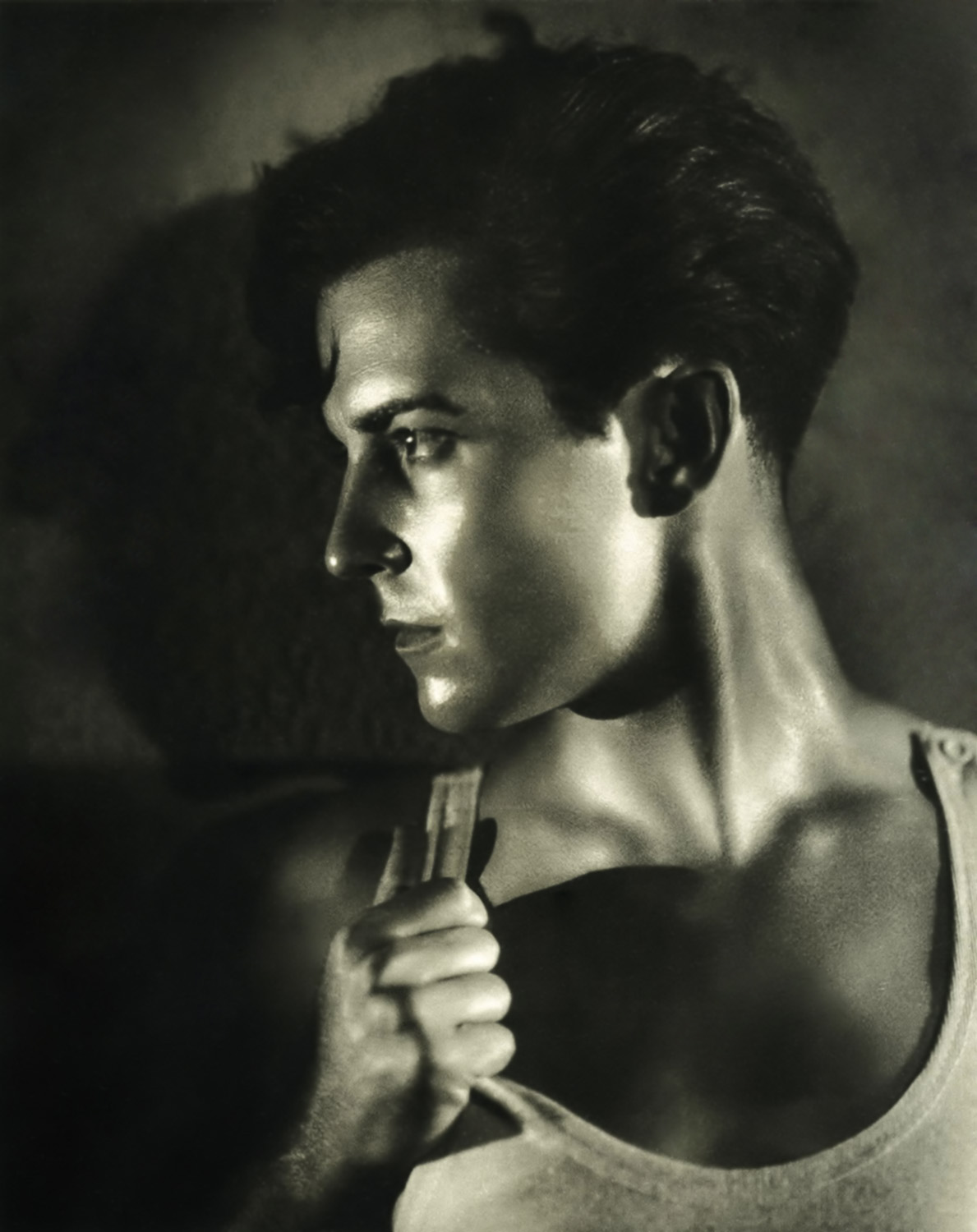
Ramón Novarro

Ramón Novarro born 6 February 1899 (d. 1968)

Ramón Novarro was a Mexican of Hollywood who achieved fame as a 'Latin lover' in silent films.

Born José Ramón Gil Samaniego in Durango, Mexico, he moved with his family to Los Angeles, California to escape the Mexican Revolution in 1913. A second cousin of the Mexican actress Dolores del Río, he entered films in 1917 playing bit parts, and supplemented his income by working as a singing waiter. His friends, the actor and director Rex Ingram and his wife, the actress Alice Terry, began to promote him as a rival to Rudolph Valentino and Ingram suggested he change his name to 'Novarro'. From 1923, he began to play more prominent roles. His role in Scaramouche (1923), brought him his first major success.

In 1925, he achieved his greatest success in Ben-Hur, with his revealing costumes causing a sensation, and Novarro was elevated into the Hollywood elite. With Valentino's death in 1926, he became the screen's leading Latin actor, though ranked behind his MGM stablemate, John Gilbert, as a model lover. He was popular as a swashbuckler in action roles, and was also considered one of the great romantic lead actors of his day. Novarro appeared with Norma Shearer in The Student Prince in Old Heidelberg (1927) and appeared with Joan Crawford in Across to Singapore in 1928. He made his first talking film, starring as a singing French soldier, in Devil-May-Care (1929). Novarro starred with Greta Garbo in Mata Hari in 1932 and was a qualified success opposite Myrna Loy in The Barbarian (1933).

Almost as big a star as Valentino at the height of his fame, Novarro's almost androgynous male beauty - not helped by the heavy make-up and overly dramatic acting demanded by the silent cinmea - has led him to becoming largely forgotten and overlooked. He certainly looks a lot 'gayer' and more effeminate through the lens of history than he did at the time of his fame.

When Novarro's contract with MGM Studios expired in 1935, the studio did not renew it. He continued to act sporadically, appearing in films for Republic Pictures, a Mexican religious drama, and a French comedy. Later in the 1940s, he had several small roles in American films. He was considered for a role in the pilot television series The Green Peacock with Howard Duff and Ida Lupino, after the demise in 1958 of their CBS sitcom Mr. Adams and Eve. The project, however, never materialised. A Broadway tryout was aborted in the 1960s, but Novarro kept busy on television, appearing in hit cowboy series The High Chaparral as late as 1968.

At the peak of his success in the late 1920s and early 1930s, he was earning more than US$100,000 per film. He invested some of his income in real estate. His Hollywood Hills residence is one of the more renowned designs (1927) by architect Lloyd Wright. After his career ended, he was still able to maintain a comfortable lifestyle.

Novarro had been troubled all his life as a result of his conflicting views over his Roman Catholic religion and his homosexuality. His life-long struggle with alcoholism is often traced to his issues surrounding his sexuality. MGM mogul Louis B. Mayer reportedly tried to coerce Novarro into a lavender marriage, which he refused. He was a friend of adventurer and author Richard Halliburton, also a celebrity in the closet, and was romantically involved with journalist Herbert Howe, who was also his publicist during the late 1920s.

Novarro was murdered by two brothers, Paul and Tom Ferguson (aged 22 and 17 respectively) whom he had hired from an agency to come to his Laurel Canyon home for sex. According to the prosecution in the murder case, the two young men believed that a large sum of money was hidden in Novarro's house. The prosecution accused them of torturing Novarro for several hours to force him to reveal where the nonexistent money was hidden. They left with a mere twenty dollars they took from his bathrobe pocket before fleeing the scene. Novarro allegedly died as a result of asphyxiation, choking to death on his own blood after being brutally beaten. Popular legend reports that the object used to murder Novarro was a black lead dildo modelled on Rudolph Valentino, given to him by a former lover, but this is a Hollywood urban legend.

The two brothers were later caught and sentenced to long prison terms, but were quickly released on probation. Both were later rearrested for unrelated crimes, for which they served longer terms than for their murder conviction.

Novarro is buried in Calvary Cemetery in Los Angeles. Ramón Novarro has a star on the Hollywood Walk of Fame at 6350 Hollywood Boulevard.

Labels: , , ,

Monday, January 10, 2011

Sal Mineo

Sal Mineo born 10 January 1939 (d. 1976)

Salvatore 'Sal' Mineo, Jr. was an American movie and stage actor, best known for his Academy Award-nominated performance opposite James Dean in the film Rebel Without a Cause.

Mineo had his first stage appearance in The Rose Tattoo (1950), a play by Tennessee Williams. He also played the young prince opposite Yul Brynner in the stage musical The King and I.

After a few more film and television appearances his breakthrough was Rebel Without A Cause (1955) in which he gave an impressive performance as John 'Plato' Crawford, the sensitive teenager smitten with James Dean's Jim Stark. Mineo was later reunited with Dean in Giant (1956), although only in a few scenes.

Many of his subsequent roles were variations of his role in Rebel Without a Cause and he often played juvenile delinquents. By the late 1950s the actor was a major celebrity, sometimes referred to as the 'Switchblade Kid'.

In 1957, Mineo made a brief foray into music by recording a handful of songs and an album. Two of his singles reached the US Top 40 pop charts. He starred as drummer Gene Krupa in the movie The Gene Krupa Story (1959).

Meanwhile, Mineo made an effort to break his typecasting. His acting ability and exotic good looks earned him not only roles as a Native American boy in Tonka, but also as a Jewish emigrant in Otto Preminger's Exodus (1960) for which he received another Academy Award nomination as Best Supporting Actor (and reportedly was bitterly disappointed when he didn't win.)

By the early 1960s he was getting too old to play the types that had made him famous and for a variety of reasons wasn't considered appropriate for leading roles. He auditioned for David Lean's film Lawrence of Arabia but wasn't hired. Mineo was baffled by his sudden loss of popularity, later saying, 'One minute it seemed I had more movie offers than I could handle, the next, no one wanted me.'

His role as a stalker in Who Killed Teddy Bear? (1965) didn't seem to help. Although his performance was praised by critics, he found himself typecast anew, now as a deranged criminal. He returned to the stage to produce the gay-themed Fortune and Men's Eyes (1971), starring Don Johnson of later Miami Vice fame. Although the play got positive reviews in Los Angeles, it was panned during a run in New York and its expanded prison rape scene was criticised as excessive and prurient. A string of failed projects and flops followed. A small role in Escape from the Planet of the Apes (1971) as chimpanzee Dr Milo turned out to be Mineo's last movie appearance.

By 1976 Mineo's career seemed to be turning around again. Playing the role of a gay burglar in a San Francisco run of the stage comedy P.S. Your Cat Is Dead, he received substantial publicity from many positive reviews and moved on to Los Angeles with the play. Arriving home after a rehearsal on February 12, 1976, Mineo was stabbed to death in the alley behind a West Hollywood apartment building. He was 37 years old.

A career criminal named Lionel Ray Williams was later sentenced to life in prison for killing Mineo. Although there was considerable confusion relating to what witnesses had seen in the darkness the night Mineo was murdered, Williams was reported to have boasted of the crime, which turned out to be a botched mugging - despite years of speculation that the murder had a 'homosexual' motive. At the time of the murder, Williams had no idea who Sal Mineo was. Williams was paroled in 1990, after serving 12 years, but was jailed numerous times afterwards for parole violations.

Mineo is interred in the Cemetery of the Gate of Heaven in Hawthorne, New York.

Labels: , , ,

Saturday, January 01, 2011

Joe Orton

Joe Orton born 1 January 1933 (d. 1967)

Joe Orton was a satirical modern playwright.

In a short but prolific career from 1964 until his death, he shocked, outraged and amused audiences with his scandalous black comedies. Ortonesque became a recognised term for 'outrageously macabre'.

John Kingley Orton was born in Leicester to a working class family. He failed the eleven-plus exam after extended bouts of asthma, and attended the private Clark's College from 1945 to 1947 before starting menial work as a junior clerk on £3 a week.

Orton became interested in performing in the theatre around 1949 and joined a number of different dramatic societies, including the prestigious Leicester Dramatic Society. While working on amateur productions he was also determined to improve his appearance and physique, buying body-building courses, taking elocution lessons, and also trying to redress his lack of education and culture. He lost his job and, still 'stage-struck', applied for a scholarship at the Royal Academy of Dramatic Art (RADA) in November 1950. He was accepted, and left the East Midlands for London with little regret. His entrance into RADA was delayed by appendicitis and he only joined in May 1951.

Orton met Kenneth Halliwell [left] at RADA in 1951, moving into a West Hampstead flat with him, and two other students, in June of that year. Halliwell was seven years older than Orton and of independent means, having a substantial inheritance. They quickly formed a strong relationship and became lovers, despite Orton's claims of sexual incompatibility. Neither did well in their two years at the academy although Orton gained a better qualification than Halliwell.

After graduating, both went into a regional repertory work; Orton spent four months in Ipswich as an assistant stage manager, Halliwell in Llandudno, Wales. Both returned to London and 'their dreams shifted from the stage to the page'. They collaborated on a number of unpublished novels (often imitating Ronald Firbank), and had little success, but some encouragement. The rejection of their great hope, The Last Days of Sodom, in 1957 led them to solo works.

They refused to work for long periods, confident of their 'specialness'; they subsisted on Halliwell's money, (as well as the dole), and were forced to follow a quite ascetic life in order to restrict their outgoings to £5 a week. From 1957-59, they worked in six-month stretches at Cadbury's to raise money for a new flat; they moved into the small and austere flat on Noel Road in Islington in 1959.

A lack of serious work led them to amuse themselves with pranks and hoaxes. Orton created Edna Welthorpe, an elderly 'outraged of-' whom he would later revive to stir controversy over his plays.

In another episode, Orton and Halliwell stole books from the local library, and would subtly modify the cover art or the blurbs before returning them to the library. A volume of poems by John Betjeman, for example, was returned to the library with a new dustjacket featuring a photograph of a nearly naked, heavily tattooed middle-aged man. The couple took many of the prints to decorate their flat. They were eventually discovered, and prosecuted for this in May, 1962.

The incident was reported in the national newspaper the Daily Mirror as 'Gorilla in the Roses'. They were charged with five counts of theft and malicious damage, admitted damaging more than seventy books, and were jailed for six months (released September 1962) and fined £262. The books that Orton and Halliwell vandalised have since become the most valued of the Islington Library service collection.

In the early 1960s Orton began to write plays. He wrote his last novel in 1961 (Head to Toe), and soon afterward had his writing accepted. In 1963 the BBC paid £65 for the radio play The Boy Hairdresser, broadcast on 31 August 1964, as The Ruffian on the Stair. It was substantially rewritten for the stage in 1966.

Orton revelled in his achievement and poured out new works. He had completed Entertaining Mr Sloane by the time The Ruffian on the Stair was broadcast. He sent a copy to the theatre agent Peggy Ramsay in December 1963. She was quick to appreciate its qualities and sent it to Michael Codron of the New Arts Theatre, who took up the play for an April/May run in January 1964. It premiered on 6 May 1964, reviews ranging from praise to outrage. Certain influential theatre figures such as Terence Rattigan ensured that Orton's work was performed, however, and there was a clear expectation of good things to come.

Entertaining Mr Sloane lost money in its three week run, but Rattigan invested £3,000 and the play transferred to Wyndham's Theatre in the West End at the end of June and to the Queen's Theatre in October. Sloane tied for first in the Variety Critics' Poll for Best New Play and Orton came second for Most Promising Playwright. Within a year, Sloane was being performed in New York (it did very poorly)and elsewhere, as well as being made into a film, and a television play.

The chronology of Orton's works thereafter becomes confusing, as his next major success, Loot, was written later, but performed earlier, than the two television plays, The Good and Faithful Servant and The Erpingham Camp. Hence material that seems less Ortonesque, a backwards step in development and skill, is misleadingly positioned.

Orton's next performed work was Loot. The first draft was written between June and October 1964 and entitled Funeral Games, a title Orton would drop for Halliwell's suggestion but would later reuse. The play is a wild parody of detective fiction, adding the blackest farce and jabs at established ideas on death, the police, religion and justice. Orton offered the play to Codron in October 1964 and it underwent sweeping rewrites before it was judged fit for the West End.

Codron had manoeuvred Orton into meeting his colleague Kenneth Williams in August 1964. They were 'immediately sympatico' and Orton reworked Loot with Williams in mind for Inspector Truscott.

With the success of Sloane evident, Loot was hurried into pre-production, despite its obvious flaws. Rehearsals began in January 1965 with a six-week tour culminating in a West End debut planned. The play opened in Cambridge on 1 February to disastrous and scathing reviews, not for the content but for the plot, the acting, the bright white set, the entire quality of the piece.

Orton, at odds with director Peter Wood over the plot (or lack of same), still tore at the play, producing 133 pages of new material to replace, or add, to the original ninety. The cast were demoralised in rehearsal and uneven and tentative on stage. They were, however, impressed by Orton's energy and efforts. The play staggered on to more poor reviews in Brighton, Oxford, Bournemouth, Manchester, and finally Wimbledon in mid-March. 'Loot was a dead horse, but it continued to be flogged.' Orton retired from the fray for a promiscuous, hashish-filled, eighty-day holiday in Tangier, Morocco.

In January 1966 Loot was revived in Manchester. Orton's growing experience led him to cut over six hundred lines, raising the tempo and improving the characters' interactions.

Directed by Braham Murray, with a more sympathetic and less abstract set, the tuned play garnered more favourable reviews. Lewenstein was still a little cool, however, and put the London production in a 'sort of Off-West End theatre'.

Orton continued his habit of clashing with his director, but the additional cuts agreed to further improved the play. The London premiere was 27 September 1966, the reviews producing 'stunned delight' in Orton. Loot moved to the Criterion Theatre, Holborn in November, raising Orton's confidence to new heights, 'a weird, thrilling, slightly unnerving state of grace', while he was in the middle of writing What the Butler Saw.

Loot went on to win several awards — which had a pleasing effect on the box office — and firmly established Orton's fame. He sold the film rights for £25,000, although he was certain it would flop; it did, and Loot on Broadway repeated the failure of Sloane. Orton was still on an absolute high, however, and over the next ten months revised The Ruffian on the Stair and The Erpingham Camp for the stage as a double called Crimes of Passion, wrote Funeral Games, the screenplay Up Against It for the Beatles, and worked on What the Butler Saw.

The Good and Faithful Servant was a work of transition for Orton. A one-act television play, it was completed by June 1964 but first broadcast in 1967. With its low-key bitterness and regret, and its genuine poignance, it is tame and naturalistic compared to the joyful, macabre heights of his later modern farces, including those which premiered earlier.

Funeral Games is the real linking work between Loot and What the Butler Saw. It was written and re-written (four times) in July - November, 1966. Created for a Yorkshire Television series, The Seven Deadly Virtues, Orton's play dealt with charity — especially Christian charity — in a mad confusion of adultery and murder.

In March 1967 Orton and Halliwell had intended another extended holiday in North Africa – Libya on this occasion, but the relationship between them had deteriorated so far that they returned home after barely a day. Orton was working hard, energised and happy; Halliwell was increasingly depressed, argumentative, and plagued with mystery ailments.

Orton's controversial farce What The Butler Saw debuted in the West End after his death in 1969. It opened at the Queen's Theatre with Sir Ralph Richardson, Coral Browne, Stanley Baxter, and Hayward Morse. It was booed so loudly by gallery first nighters that the critics could not hear the lines.

During the night of August 9, 1967, Halliwell bludgeoned the 34-year-old Orton to death with nine hammer blows to the head, and then committed suicide with an overdose of Nembutal tablets.

The Sunday Times magazine issue November 22, 1970 reported that on Saturday, August 5, four days before the murder, Joe went to the Chelsea Potter pub in the King's Road. He met friend Peter Nolan who later gave evidence at the inquest that Orton told him that he had another boyfriend, that he wanted finally to get rid of Halliwell but didn't know how to go about it.

The last person to speak to Halliwell was his doctor. He had arranged for a psychiatrist to see him the following morning. He spoke to Halliwell three times on the telephone. The last call was at 10 o'clock. Halliwell took the pyschiatrist's address and said, 'Don't worry, I'm feeling better now. I'll go and see the doctor tomorrow morning.'

Halliwell had felt increasingly threatened and isolated by Orton's success, and had come to rely on anti-depressants and barbiturates. The bodies were discovered the following morning when a chauffeur arrived to take Orton to a meeting to discuss a screenplay he had written for The Beatles.

Halliwell left a suicide note, informing police that all would be explained if they read Orton's diaries, 'especially the latter part'. The diaries have since been published, but do not offer the promised insight, unless Halliwell was referring to Orton's tireless promiscuity.

A biography, entitled Prick Up Your Ears, a title Orton himself had considered using was published in the 1970s by John Lahr (son of cowardly lion Bert Lahr).

The 1987 film Prick Up Your Ears is based on Orton's diaries and Lahr's research. Directed by Stephen Frears, it starred Gary Oldman, Alfred Molina, and Vanessa Redgrave. Alan Bennett wrote the screenplay.

Joe Orton Official Website

Labels: ,

Friday, June 11, 2010

Richard Loeb

Richard Loeb born 11 June 1905 (d. 1936)

Richard A. Loeb [pictured left] and Nathan Freudenthal Leopold, Jr., more commonly known as Leopold and Loeb, were two wealthy University of Chicago students who murdered 14-year-old Bobby Franks in 1924, and received sentences of life in prison.

Their crime was notable in being largely motivated by an apparent need to prove the duo's belief that their high intellects made them capable of committing a perfect crime, and also for its role in the history of American thought on capital punishment.

Leopold, who was 19 at the time of the murder, and Loeb, 18, believed themselves to be Nietzschean supermen who could commit a 'perfect crime' (in this case a kidnapping and murder) without fear of being apprehended.

The friends were exceptionally intelligent: Leopold had already completed college and was attending law school at the University of Chicago. He spoke five languages and was an expert ornithologist, while Loeb was the youngest graduate in the history of the University of Michigan. Leopold planned to transfer to Harvard Law School in September, after taking a trip to Europe. Loeb planned to enter the University of Chicago Law School after taking some post graduate courses.

Both Leopold and Loeb lived in the wealthy Jewish neighborhood of Kenwood, Chicago. Loeb's father, Albert, began his career as a lawyer and became the Vice President of Sears and Roebuck. Besides owning an impressive mansion in Kenwood, two blocks away from the Leopold home, the Loeb family also had a summer estate in Charlevoix, Michigan.

The pair had worked themselves up to committing the crime for months, starting out with petty theft.

On Wednesday, May 21, 1924, they put their plot in motion. The pair lured Franks, a neighbour and distant relative of Loeb's, into a rented car. Loeb first struck Franks with a chisel. Leopold and Loeb then suffocated Franks. After concealing the body in a culvert under a railroad track outside of Chicago - the body was burned with acid to make identification more difficult — they did their best to make it seem that a kidnapping for ransom had taken place; the Franks family had enough money that a request for $10,000 in ransom was plausible.

Before the family could pay the ransom, though, the body was found. Investigators saw at once that this could not be a mere kidnapping, since there would have been no reason for a kidnapper to kill Franks.

A pair of eyeglasses found with the body was eventually traced back to Nathan Leopold. The ransom note had been typed on a typewriter that Leopold had used with his law school study group. During police questioning, Leopold's and Loeb's alibis broke down and each confessed. Although their confessions were in agreement about most major facts in the case, each blamed the other for the actual killing.

They had spent months planning the crime, working out a way to get the ransom money without risking being caught. They had thought that the body would not be discovered until long after the ransom delivery. Regardless, the ransom was not their primary motive. In fact, they admitted that they were driven by the thrill. For that matter, they basked in the public attention they received while in jail; they regaled newspaper reporters with the crime's lurid details again and again.

The murder and subsequent trial received worldwide publicity, and part of the fascination was based on public perception of the crime as a 'Jewish' crime. In 1924, Chicago was consummately an ethnic city, where the majority of residents were immigrants or the children of immigrants, and in which politics, neighbourhoods, and institutions often carried ethnic labels. Neither defendant was a practising Jew. Loeb's mother was Catholic and his father was Jewish. Bobby Franks' parents, while ethnically Jewish, were converts to Christian Science.

Leopold and Loeb both admitted to the press that they had a sexual relationship, and this increased the lurid (for that time) aspects of the crime considerably.

The trial [Loeb pictured left] proved to be a media spectacle; it was one of the first cases in the USA to be dubbed the 'Trial of the Century'. Loeb's family hired 67-year-old Clarence Darrow — who had fought against capital punishment for years — to defend the boys against the capital charges of murder and kidnapping. While the media expected them to plead not guilty (by reason of insanity), Darrow surprised everyone by having them both plead guilty. In this way, Darrow avoided a jury trial which, due to the strong public sentiment against his clients, would most certainly have resulted in a conviction and perhaps even the death penalty. Instead, he was able to make his case for his clients' lives before a single person, Cook County Circuit Court Judge John R. Caverly.

Darrow gave a twelve-hour speech, which has been called the finest of his career. The speech included: "this terrible crime was inherent in his organism, and it came from some ancestor … Is any blame attached because somebody took Nietzsche’s philosophy seriously and fashioned his life upon it? … it is hardly fair to hang a 19-year-old boy for the philosophy that was taught him at the university."

It may be, in fact, that Darrow accepted the case because it offered a huge public platform for such a speech; he knew that his strong argument against capital punishment would be reprinted in newspapers around the world. And if he could successfully reason that such heinous murderers should not be executed, perhaps he would make other capital punishment cases more difficult to prosecute. In the end, Darrow succeeded; the judge sentenced Leopold and Loeb each to life in prison (for the murder), plus 99 years each (for the kidnapping).

In prison (the Illinois State Penitentiary), Leopold and Loeb used their educations to good purpose, teaching classes in the prison school. In January of 1936, at age 30, Loeb was attacked by fellow prisoner James Day with a straight razor in the prison's shower room, and died from his wounds. Day claimed afterwards that Loeb had attempted to sexually assault him; an inquiry accepted Day's testimony, and the prison authorities ruled that Day's attack on Loeb was self-defence.

The story of the Leopold and Loeb case has become ingrained in popular culture and is often used or referred to in film and television. The crime was also inspiration for Alfred Hitchcock's film Rope [1948], and Tom Kalin's more openly gay-themed Swoon (1992) as well as Murder by Numbers (2002), the 1985 play Never The Sinner by John Logan, and the off-Broadway musical Thrill Me by Stephen Dolginoff.

Labels: ,

Wednesday, June 09, 2010

Ossie Clark

Ossie Clark born 9 June 1942 (d. 1996)

Raymond 'Ossie' Clark was an English fashion designer who was a major figure in the Swinging Sixties scene in London and the fashion industry in that era. As a result, Ossie Clark is now extremely well renowned for his vintage designs, the contemporary fashion era being characterised by past influences and a retro feel to design.

Clark is compared to the 1960s fashion greats Mary Quant and Biba. Ossie Clark was a key figure in the world of photographers, designers, rock stars and other celebrities who took London by storm in the 60s and 70s. The famous and the fashionable wore Ossie Clark’s designs including Marianne Faithfull, Jimi Hendrix and Patti Boyd. He created jumpsuits for Mick Jagger, silk dresses for Bianca Jagger and dressed Eartha Kitt in snakeskin.

Ossie Clark is featured in David Hockney's 1970 painting Mr and Mrs Clark and Percy [pictured below]. It now hangs in the Tate Britain gallery on Millbank and is one of the most visited paintings in Britain. His diaries, which he began in 1971, were published posthumously by his close friend Lady Henrietta Rous in 1998 as The Ossie Clark Diaries. A retrospective of his work was held at London's V&A museum in 2003.

Born in Warrington, Lancashire, Raymond Clark's parents, moved to Oswaldtwistle during the war, hence his nickname, 'Ossie'. Young Ossie would make clothes for his nieces and nephews. He practiced tailoring clothing on his dolls and designed swimsuits for the neighbourhood girls when not yet ten years old. The art teacher at Ossie's secondary school recognised Ossie's creative flair and gave him a large collection of Vogue and Harper's Bazaar magazines. Clark poured over these magazines and took in all the glamour and cutting-edge fashion.

Soon after leaving school, Clark attended the Regional College Of Art in Manchester at age sixteen. Ossie had to get up very early in the morning to make the long trip from home to college each day. His mother would give Ossie prescribed pills to keep him awake and alert. This would be the start of a life-long addiction to both prescribed and illegal drugs.

While attending college in Manchester, Clark was introduced to Celia Birtwell by a close friend and classmate. The pair started out as just good friends but that friendship soon developed into a love affair. Ossie also became good friends with artist David Hockney during this period. Clark and Hockney took a inspirational trip to New York together while still at college where they made many valuable connections in the fashion, art, and entertainment communities. The friends are widely rumoured to have been lovers with a volatile relationship.

Clark graduated in 1958 and then attended the Royal College of Art in London and achieved a first-class degree in 1965. While attending college in London Celia Birtwell came to live with Ossie in his small Notting Hill flat. Ossie's degree fashion show at the RCA was a huge success. At this time Ossie's design style was heavily influenced by Pop Art and Hollywood glamour. The final line-up featured a dress with flashing lightbulbs down the front which was shown in every major newspaper and fashion publication the following day. In August that year he had his first feature in British Vogue.

He quickly began to make his mark in the fashion industry, with Alice Pollock's exclusive boutique Quorum featuring his designs in 1966. Ossie had met Pollock at a party on the King's Road and so taken with the young designer was she that she immediately ordered a whole collection of dresses for her boutique. Ossie presented a collection of white and cream chiffon garments that sold fast. Pollock wanted Clark's clothes to have a more organic feel and so commissioned Celia Birtwell to produce special textiles for the next collection. In this way, one of fashions most famous collaborations was born: with Osssie Clark designing clothes and Celia Birtwell desiging prints. This partnership would last for almost all of Clark's career in fashion.

The period from 1965 to 1974 is regarded as his zenith, during which time he had many famous clients.

In the late 1960s, Clark hit a rich vein for his flamboyant clothing range. The fashion press dubbed Ossie 'The King Of King's Road'. Clark launched his menswear line in 1968, which reflected the period's more relaxed attitude to male dressing. Clark's great idol was the famous dancer Nijinsky and his love of dance inspired his clothes to be free moving and not to restrict the female form. This style of dressing became quite popular in the 1970s thanks in large part to the popularity of Clark's clothing. Ossie Clark is well known for his use of muted colours and moss crepe fabric.

Celia would work up several prints of her own design and liking, with no imput from Ossie as to their colour or design. The prints were usually based upon Birtwell's interpretations of the natural world. Clark would then design clothing based around and inspired by these designs.

In 1969, he married Celia Birtwell. Ossie remained openly bisexual and carried on many affairs with men; he and Birtwell had two sons together. Clark had long hoped for a large family of his own and his children were a great joy in his life.

Clark was not just popular in London, but also in New York and Paris. He dressed the rich and famous who inhabited the beau monde of the late 1960s and early 1970s of London. Clark got in on the ground floor with many of the popular performers and actors of the period and was accepted in their circles when many other designers were not. This gave him many advantages to dress the rich and famous. Clark made many stage costumes for Mick Jagger, the Beatles, Marianne Faithfull and Liza Minnelli, among others.

Although society and celebrities accepted Clark as one of their own, Ossie always felt less appreciated artistically and financially than some of the people he was surrounded by. This feeling would lead to many personal frustrations. More and more Ossie would work less and party more and his work began to suffer. Clark freely adopted the hedonistic lifestyle of the 1960s and 1970s: his drug use greatly impacted on his emotional state and finances. Clark and Birtwell divorced in the 1970s. This started a slow downward spiral for Ossie, who never recovered emotionally from the separation from Birtwell and his two children. With his family structure and work stability now gone, his creative output became strained.

Going into the 1980s, fashion — British fashion in particular — turned towards the new punk style. Clothing from Vivienne Westwood's shop on the King's Road became the most popular look. Ossie Clark's romantic flowing gowns were no longer in fashion. His business declined and Clark went bankrupt and eventually was forced to close his business. Although technically out of business, Ossie would design freelance and do one-off dresses for friends and loyal fans. He taught at the RCA and launched a lingerie company in partnership with Gina Fratini, trading under the name Rustle. He also trained the designer Bella Freud to pattern-cut in the early 1990s

In 1996, Ossie was stabbed 57 times in his Holland Park apartment by his former lover, Diego Cogolato. Cogolato then broke Clark's skull with a teracotta pot, killing him. Cogolato was convicted of manslaughter and jailed for six years.

Labels: , , ,

Tuesday, December 01, 2009

Matthew Shepard

Matthew Shepard born 1 December 1976 (d. 1998)

Matthew Wayne Shepard was an American student at the University of Wyoming.

Shortly after midnight on October 7, 1998, 21-year-old Shepard met Aaron McKinney and Russell Henderson in a bar. According to McKinney, Shepard asked them for a ride home. Subsequently, Matthew was robbed, severely beaten, tied to a fence and left to die. McKinney and Henderson also found out his address, intending to burglarise his home. Shepard was discovered by a cyclist 18 hours later, still alive but unconscious. At first he mistakenly thought that Matthew's broken body was a scarecrow.

Matthew Shepard suffered a fracture from the back of his head to the front of his right ear. He had severe brain damage. There were also about a dozen small lacerations around his head, face and neck. He had been beaten with a handgun. His injuries were deemed too severe for doctors to operate. Matthew never regained consciousness and remained on full life support. He was pronounced dead at 12:53 a.m. on October 12 at Poudre Valley Hospital in Fort Collins.

Police arrested McKinney and Henderson shortly thereafter, finding the bloody gun as well as the victim's shoes and wallet in their truck. The two men had attempted to get their girlfriends to provide alibis.

After the attack, the prosecutor told reporters that Shepard's friends had been vocal about Matthew Shepard's sexuality: 'They were calling the County Attorney's office, they were calling the media and indicating Matthew Shepard is gay and we don't want the fact that he is gay to go unnoticed.'

During court cases both of the defendants used varying stories to defend their actions. They attempted to use the 'gay panic defence', arguing that they were driven to temporary insanity by Shepard's alleged sexual advances toward them. At another point they stated that they had only wanted to rob him and never intended to kill him.

The prosecutor in the case charged that McKinney and Henderson pretended to be gay in order to gain Matthew's trust to rob him. During the trial, Chastity Pasley and Kristen Price (the pair's then-girlfriends) testified under oath that Henderson and McKinney both plotted beforehand to rob a gay man. McKinney and Henderson then went to the Fireside Lounge, a gay hangout, and selected Matthew as their target. After befriending him, they took him to a remote area of Laramie where they robbed him, viciously beat him and left him for dead.

Henderson and McKinney were not charged with a hate crime - laws at the time did not support such a charge. Many people think the case should have been dealt with as a hate crime, particularly those who believe that Matthew Shepard was targeted on the basis of his sexual orientation. Attempts were made made to change the law subsequently for years without success.

The convicted murderers are currently serving two life sentences without parole in Wyoming State Penitentiary.

The homophobic murder of Matthew Shepard - and the inability of the law to recognise the attack as a hate crime has made him a modern gay martyr and come to symbolise the inhumane, brutal and discriminatory treatment faced by gay people. Several films and a play have been made about the events of that night and artists as diverse as Melissa Etheridge, Elton John, Tori Amos, Cyndi Lauper, Trivium and others have written and dedicated songs to Matthew Shepard. A foundation has been set up in his name, and his parents Judy and Dennis have dedicated their lives to gay rights and campaigning for tolerance.

In 2009, after years of campaigning and controversy, the Matthew Shepard Act was passesd into law as an amendment to US hate crimes legislation.


Matthew Shepard Foundation

Labels:

Friday, May 22, 2009

Harvey Milk

Harvey Milk born 22 May 1930 (d. 1978)

Harvey Bernard Milk an American politician and gay rights activist, was the first openly gay city supervisor of San Francisco, California. He and Mayor George Moscone were assassinated in 1978. His assassin, Dan White, was sentenced to seven years in prison. Outrage over the verdict led to the White Night Riots in San Francisco by enraged citizens. Milk is seen by some to be a martyr to the LGBT community.

MIlk's grandfather, Morris Milk was the owner and namesake of Milk's Department Store in Woodmere, New York; 'Glimpy' was Harvey Milk's nickname because as a child and adolescent, he was considered odd-looking because of his large ears, nose, and feet. He was born in Woodmere. He graduated from Bay Shore High School, Bay Shore, NY in 1947, graduated from University at Albany in 1951 and joined the United States Navy, serving on active duty in the Korean war; he was honorably discharged.

Following his service in the Navy, Milk lived for a time in Dallas, Texas. Eventually he relocated to New York City and took a job on Wall Street. He also became involved with theatre, serving as Assistant Director alongside Tom O'Horgan for a number of plays including Lenny and the musical Jesus Christ Superstar.

In 1972, Milk moved to San Francisco. He settled with his partner Scott Smith and opened a camera store, Castro Camera, in the Castro gay village. He emerged as a community leader, founding the Castro Valley Association of local merchants, and represented the neighbourhood businesses in dealing with the city government.

Milk ran for the San Francisco Board of Supervisors unsuccessfully twice, in 1973 and 1975. He emerged as a figurehead for San Francisco's large gay community, and was known as the 'Mayor of Castro Street', a title which he himself coined. With each campaign, he garnered a larger number of supporters.

After San Francisco switched from at-large to district elections, Milk was elected to the Board of Supervisors on his third attempt in 1977, the first openly gay elected official of any large city in the United States, and only the third openly gay elected official in all of the US, the first man. Milk represented District 5, which included the Castro.

In his eleven months as a Supervisor, he sponsored a gay rights bill for the City as well as – famously – a pooper-scooper ordinance. He was also instrumental in defeating Proposition 6, The Briggs Initiative, backed by State Senator Briggs, which would have allowed openly gay men and lesbians who were teachers to be fired based on their sexuality. In November 1978, Proposition 6 was soundly voted down by Californians.

Milk was also successful in reaching out and making alliances among the city's ethnic populations and among labour union leaders but not among the rank and file members.

On September 22, 1975 former marine Oliver Sipple saved the life of President Gerald Ford for which he was highly praised by law enforcement in the media as well as in a personal letter from the President. Milk outed Sipple, despite Sipple's insistence to reporters that his sexuality was to be kept confidential, proclaiming Sipple a 'gay hero', and stating (this) 'will help break the stereotype of homosexuals'. This action had a disastrous effect on the life of Sipple himself.

Late in 1978, Supervisor Dan White, an acrimonious political opponent of Milk's, resigned from the Board of Supervisors. His resignation meant that Moscone would choose White's successor, and thus could tip the Board's balance of power in Moscone's favour. Recognising this, those who supported a more conservative agenda, including board ally Dianne Feinstein, talked White into changing his mind. White requested that Moscone re-appoint him to his former seat. Moscone originally indicated a willingness to do so, but more liberal city leaders, including Milk, lobbied him against the idea, and Moscone ultimately decided not to re-appoint White.

On November 27, 1978, White went to San Francisco City Hall to meet with Moscone and make a final plea for re-appointment. When Moscone refused to yield, White shot Moscone to death, then went to Milk's office and also shot Milk to death. White later turned himself in at the police station where he was formerly an officer. Even though he had carried a gun, 10 extra rounds, and crawled through a window to avoid metal detectors, White denied premeditation. Thousands attended a spontaneous candlelight memorial vigil the night of Milk's funeral. Milk had foreseen his risk of assassination and had recorded several audio tapes to be played in that event. One of the tapes included his now-famous quote, 'If a bullet should enter my brain, let that bullet destroy every closet door.'

Dan White's trial, which began four months after the killings, was one of the most closely watched trials in California at that time. The prosecution claimed that White's motive was revenge. But White's attorney, Douglas Schmidt, claimed that White was a victim of pressure and had been depressed, a state exacerbated by his consuming a large quantity of junk food before the murders; this became known as the 'Twinkie defence'. Schmidt also told the jury and the press that White carried all that ammunition on him not so much out of hatred but out of impulse from his experience as an ex-police officer.

Finally, the jury heard what the prosecution hoped it would be its most damaging piece of evidence — Dan White's tape-recorded confession which was taped the day after the murders. What was notable about this confession was that the police didn't seem to ask White any questions about the crime and just let him talk. Instead, White tearfully talked of how Moscone and Milk refused to give him his supervisor's job back.

White was convicted of voluntary manslaughter on the grounds of diminished capacity and sentenced to seven years and eight months, a sentence widely denounced as lenient and motivated by homophobia. During jury selection, defence attorneys had excluded candidates they deemed 'pro-gay'.

After the sentence, the gay community erupted into what became known as the White Night Riots. As soon as the sentence was announced, word ran through the gay community and groups of people began walking quickly to the Civic Center and by 8pm, there was a sizeable mob formed. According to the documentary, The Times of Harvey Milk, the enraged crowd started by screaming at police officers calling for revenge and death. Then, riots began to break out with the mob setting ablaze a number of police vehicles, disrupting traffic, smashing windows of cars and stores, buses had their overhead wires ripped down, and physical violence resulted against the outnumbered police officers.

Many rioters were arrested but the Chief of Police, Charles Gain, was blamed for being too weak in his response and holding back his officers when he should have been more proactive and defended lives and property. He defended himself by pointing out that no one was dead and only a few had minor injuries. More than 160 people were hospitalised because of the rioting.

Dan White served a little more than five years for the double murder of Moscone and Milk. On October 22, 1985, a year and a half after his release from prison, White was found dead in a running car in his ex-wife's garage. He was 39 years old. His defense attorney told reporters that he had been despondent over the loss of his family, and the situation he had caused, adding 'This was a sick man.'

Harvey Milk is widely regarded as a martyr for the gay community and the gay rights movement. Many gay and lesbian community institutions are named for Milk, including the Harvey Milk Institute and the Harvey Milk Lesbian/Gay/Bisexual/Transgendered Democratic Club in San Francisco, as well as a number of alternative schools in the United States, including Harvey Milk High School in New York City. Oakes College at the University of California, Santa Cruz has an on-campus apartment building named Harvey Milk.

Harvey Milk has been the subject of several documentaries, films, tribute songs and plays. A major feature film based on the life and death of Harvey Milk was in the offing for several years and finally appeared in late-2008, directed by Gus Van Sant and starring Sean Penn as Milk, who was Oscar-nominated for the role.

Pioneering gay journalist Randy Shilts wrote a major investigative biography entitled The Mayor of Castro Street: The Life and Times of Harvey Milk.

Labels: , ,

Tuesday, December 02, 2008

Gianni Versace

Gianni Versace born 2 December 1946 (d. 1997)

Giovanni 'Gianni' Versace was a charismatic and accomplished Italian designer of clothing and theatre costumes. He was influenced by Andy Warhol and modern abstract art; and considered one of the most colourful and talented designers of the late 20th century.

Gianni, Santo and Donatella Versace were brought up in Reggio Calabria, by their father and dressmaker mother, Francesca. Gianni began his apprenticeship at a young age, helping his mother find precious stones and gold braid with which to embroider dresses. He studied architecture before moving to Milan at the age of 25 to work in fashion design. In the mid-Seventies, his designs drew the attention of various fashion houses, and a few years later, encouraged by his success Versace presented his first signature collection for women at the Palazzo della Permanente Art Museum of Milan. His first menswear collection followed in September of the same year.

In less than 10 years, Versace built an empire worth $808 million. He used celebrities, including Madonna, Jon Bon Jovi, Tina Turner, and even Tupac Shakur as models for both the runway and print ads.

He was one of the first Italian designers to hire world-class photographers such as Richard Avedon to photograph his advertising campaigns, also using the top fashion models for these ads - Versace was instrumental in the development of the concept of the Supermodel in the 1980s. Versace has been referred to as the rock-and-roll designer and clients include Phil Collins, Bruce Springsteen, George Michael, Eric Clapton, Elton John, and Michael Jackson. He also made clothes for Diana, Princess of Wales and Caroline, Princess of Hanover.

Always open about his sexuality, he often used homoerotic images in his advertising and produced a coffee table book Men Without Ties. His lifestyle was lavish and glamorous.

In 1982, Versace opened a new chapter in his career, making costumes for the cinema, theatre, opera and ballet. He went on to design accessories, jewellery, furnishings, and china. He was also hired as a costume designer on the TV series Miami Vice. This led to his relocation to Miami Beach.

The designer battled with a rare cancer of the inner ear. He was presumed to be in remission when, one July morning in the summer of 1997, returning from his customary walk on Ocean Drive, he was gunned down outside his ocean-front mansion in Miami Beach, Florida. He was murdered by spree killer Andrew Cunanan, who committed suicide shortly after the murder. Police reported that Andrew Cunanan had committed suicide using the same handgun that had been used to murder Gianni Versace.

In September 1997, Versace's brother Santo Versace was announced as the new CEO of the Versace holding. Gianni's sister Donatella Versace, who had always worked closely with him on his designs, is the new head of design.

A distraught Elton John was famously seen at Versace's funeral being comforted by Diana, Princess of Wales.

In 1982, Versace was introduced to a young fashion promoter named Antonio D'Amico and eventually embarked on a long-term relationship that lasted 14 years, until Versace's untimely death. During that time he worked as designer for the Versace sports line.

Versace's will left D'Amico with a lifelong income and the right to live in any of Versace's homes in Italy and the United States. However, the police refused to allow him to accompany Versace to the hospital after the shooting as he wasn't a relative or wife, instead questioning him for hours as he had heard the shot and seen Cunanan flee the scene. Elton John recalled later that D'Amico was not mentioned throughout the Catholic funeral service and he has credited the friendship of Elton John and David Furnish with helping him cope with the aftermath and supporting his new life and career post-Versace.

D'Amico now runs his own fashion design company.

Labels: , , ,