Sunday, May 22, 2011

Tom Driberg

Tom Driberg born 22 May 1905 (d. 1976)

Thomas Edward Neil Driberg, Baron Bradwell was a British journalist and politician who was an influential member on the left of the Labour Party from the 1950s to the 1970s. He was revealed as a spy for the Soviet Union by Vasili Mitrokhin.

Tom Driberg was born at Crowborough, Sussex. Having studied Classics at Christ Church, Oxford (1924-1927) without taking a degree, Driberg worked on the Daily Express from 1928 and created the William Hickey diary and gossip column. He was also connected to the intelligence services of both the United Kingdom and Soviet Union, as demonstrated in the Mitrokhin archives.

In the autumn of 1935 he gave two unemployed miners a place with him in his bed, but when his hands began to wander the men went to report him at the local police station. On 12 November 1935 Tom Driberg ended up in court at the Old Bailey on a charge of indecent assault, but he was found not guilty. His boss at the Express, Lord Beaverbrook (Max Aitken), ensured that there was no press coverage, although Tom Driberg had to go to see the editor of The News of the World. Despite rumours on Fleet Street the story never made the papers.

He was first elected as a Member of Parliament for Maldon in a by-election in June 1942 as an independent candidate. He took the Labour whip in January 1945 and continued to sit for the seat until his retirement at the 1955 general election. He was MP for Barking from 1959 to February 1974. In 1957 he became chairman of the Labour Party.

He left the Express in June 1943 after being sacked by the editor who thought that his parliamentary activities conflicted with his journalism. He was then given a job by the editor of a left-wing Sunday newspaper belonging to the Co-operative movement. He wrote a column under his own name which was more political. The paper became the Sunday Citizen in 1962, but in 1966 Tom Driberg was sacked because the paper could no longer afford his salary. The paper closed in 1967. He subsequently worked freelance and contributed to the 'London Diary' of the New Statesman, and wrote book reviews.

He had a lucky escape when caught with a Norwegian sailor in an air raid shelter in Edinburgh. Fortunately the policeman was an avid reader of the William Hickey column and let him off. In fact the policeman and Tom Driberg became friends and exchanged letters. Tom Driberg related the story to his friends Harold Nicolson and Bob Boothby. It seems that Compton Mackenzie also heard about the story and used it as inspiration for his novel Thin Ice about the life of a homosexual politician.

He was created a Life peer, as Baron Bradwell, of Bradwell-juxta-Mare in the County of Essex, shortly before his death. His autobiography, Ruling Passions, was published posthumously and disclosed the conflict between the three passions that drove his life: his homosexuality (he pursued casual and risky encounters compulsively, going cottaging and using rent boys), his left-wing political beliefs, and his allegiance to the High Church tendency of the Church of England. His will insisted that at his memorial service, the reader excoriate him for his sins rather than praise him for his virtues.

Labels: , ,

Sunday, April 24, 2011

Brian Paddick

Brian Paddick born 24 April 1958

Brian Paddick is a British politician, and was the Liberal Democrat candidate for the London mayoral election, 2008, coming third behind Boris Johnson and Ken Livingstone. He was, until his retirement in May 2007, Deputy Assistant Commissioner in London's Metropolitan Police Service and the United Kingdom's most senior openly gay police officer.

Paddick was educated at Sutton Grammar School, Sutton then went on to study at Queen's College, Oxford (BA), the University of Warwick (MBA), and the University of Cambridge (Postgraduate Diploma in Criminology). When he was at Oxford, he was Captain of the University Swimming Team and Vice-Captain of his college’s Rugby team.

Paddick was a sergeant on the front line during the 1981 Brixton riots, an experience which undoubtedly shaped his attitudes about confrontational police action and strengthened his belief in community policing. He was later in charge of CID at Notting Hill and responsible for policing the Notting Hill Carnival. He was promoted to commander in December 2000, and fulfilled his ambition of becoming head of policing in Brixton.

In November 2003 Paddick was promoted to Deputy Assistant Commissioner, and in April 2005 he took over management of Territorial Policing across all 32 London Boroughs, with responsibility for 20,000 police officers and support staff. He was accountable for reducing 'volume crime' in London (all offences up to and including rape in terms of seriousness) and increasing the number of offenders brought to justice. He was the national lead for the police service on disability and mental health issues for a year and a half. He was also in the media spotlight as the senior Metropolitan Police Service spokesman for the funeral of Diana, Princess of Wales and after the 7 July 2005 London bombings.

Following a widely-publicised disagreement with Sir Ian Blair, the Commissioner of the Metropolitan Police, over the wrongful shooting of Jean Charles de Menezes at Stockwell Tube station on 22 July 2005, Paddick was assigned the position of group director of information management, which he considered a 'non-job'. Claiming that the Home Office had intervened for political reasons to ensure that Blair would not have to resign over the incident as it had occurred in the aftermath of 21 July 2005 London bombings, Paddick says he came to accept that his police career was over and that he would never achieve his goal of becoming a chief constable.

Between 1983 and 1988, Paddick was married. According to Paddick, it was 'a fairly conventional marriage' and his former wife said it was 'a wonderful marriage'. She did not know he was gay. He struggled with his sexuality until towards the end of his marriage in 1988. Since then he has been a vocal and visible advocate for gay rights and diversity.

He had a knack during his police career of attracting controversy over his policies, outspokenness and his sexuality but this seems to have done him no harm and has given him much credibility and popularity in his post-police political career, as he seems to a confident and charming man of integrity. Being somewhat handsome has probably not hurt either.

Paddick was a contestant on the eighth series of the ITV1 reality television show I'm a Celebrity... Get Me Out of Here! in 2008. On 1 December 2008, he became the sixth celebrity to be voted off the show. Interviewed by the show's hosts Ant & Dec after leaving the jungle, he explained his reasons for participating: "For a long time I've been doing serious stuff. Thirty years in the police and running for mayor. It's all bad news that they want me to comment on. So I thought why not come and do something trivial ... It's the hardest thing I've ever done in my life, anything after this is a breeze."

In 2008, Paddick was ranked number 101 in the annual Pink List of influential gay and lesbian people in Britain published by The Independent on Sunday, down from number 83 in 2007.

Paddick presently lives in Vauxhall, London, with his husband Petter Belsvik, a civil engineer from Oslo, Norway; they met in a bar while on holiday in Ibiza. They married in Oslo 9 January 2009.

He is a second cousin once removed of British comedy actor Hugh Paddick - best known for his 1960s Julian & Sandy radio partnership with Kenneth Williams.


Labels: ,

Thursday, March 31, 2011

Alan Duncan

Alan Duncan born 31 March 1957

Alan James Carter Duncan MP is a British Conservative politician, and Member of Parliament for Rutland and Melton. He was educated at Merchant Taylors' School and St John's College, Oxford, where he coxed the college's first eight crew and was elected President of the Oxford Union. He went on to win a Kennedy Scholarship to study at Harvard.

Alan Duncan was born in Rickmansworth, Hertfordshire, and before beginning his political career he worked as a trader of oil and refined products, first with Shell and latterly working as a self employed broker and consultant for Marc Rich, but he remained involved in politics as an active member of Battersea Conservative Association, except from 1984 to 1986 when he lived in Singapore.

Duncan first stood for Parliament as a Conservative candidate in the 1987 general election, unsuccessfully contesting the safe Labour seat of Barnsley West and Penistone. For the 1992 general election he was selected as the Conservative candidate for Rutland and Melton, a safe Conservative seat in rural Leicestershire.

From 1993 to 1995 Duncan sat on the Social Security Select Committee. His first governmental position was as Parliamentary Private Secretary to the Minister of Health, a position he obtained in December 1993 and resigned from in January 1994.

In July 1995 he was appointed Parliamentary Private Secretary to the Chairman of the Conservative Party, Dr Brian Mawhinney. In November 1995 Mr Duncan performed a citizen's arrest on an Asylum Bill protester who threw paint and flour at Brian Mawhinney on College Green.

In June 1997 Duncan was entrusted with the positions of Vice Chairman of the Conservative Party and Parliamentary Political Secretary to the Party Leader. Subsequently he has held various shadow cabinet posts, including health, constitutional affairs, international development and transport. After David Cameron won the party leadership in December 2005 he appointed Duncan Shadow Secretary of State for Trade and Industry. In July 2007 he was appointed Shadow Secretary of State for Business, Enterprise and Regulatory Reform, as new prime minister Gordon Brown had abolished the Department for Trade and Industry the previous week, replacing it with the aforementioned new department. In January 2009 he became Shadow Leader of the House of Commons.

Duncan was the first sitting Conservative MP voluntarily to acknowledge that he is gay; he did this in an interview with The Times on 29 July 2002, although he was open about the matter in private for several years before this.

Duncan was voted third most eligible bachelor and best looking male politician by the gay news website Pink News in a 2005 poll of their readers.

On 3 March 2008 it was announced in The Daily Telegraph that Duncan would be entering into a civil partnership with his partner James Dunseath. The ceremony took place in July 2008, making Duncan the first member of either the Cabinet or the Shadow Cabinet to be civilly partnered.

Duncan is currently a Minister of State in the Department for Intrenational Development, a post he has held sicen the General Election in May 2010.

Labels:

Tuesday, March 01, 2011

Oliver Baldwin

Oliver Baldwin born 1 March 1899 (d. 1958)

Oliver Ridsdale Baldwin, 2nd Earl Baldwin of Bewdley, known as Viscount Corvedale from 1937 to 1947, was a British politician who had a quixotic career at political odds to his father, three-time Prime Minister Stanley Baldwin.

Baldwin was educated at Eton College, and grew up in the shadow of his father's political career. He joined the Irish Guards in 1916 and served in France through the remainder of World War I. After the war he travelled extensively and worked as a journalist and travel writer. He was in Armenia with the job of an infantry instructor; there the Bolsheviks imprisoned him for two months and later he was imprisoned by the Turks for a further grim five months. Despite his Conservative family, he gradually grew to adopt left-wing views and eventually announced that he was a Marxist and joined the Labour Party. He frequently addressed crowds from a socialist platform at Hyde Park Corner.

At the 1924 elections Baldwin contested the seat of Dudley for Labour. By this time his father was leader of the Conservative Party and Prime Minister, and his candidacy naturally attracted press comment. At the 1929 election he won Dudley, and served as a backbench member of Ramsay MacDonald's Labour government, facing his defeated father across the House.

He remained on personal good terms with his father despite their different politics, as each regarded their differences as being of principle and not personality. Baldwin refrained from personally attacking his father, and when he visited him, there was a tacit agreement that politics was not a suitable subject for discussion. Lucy Baldwin, who was also a strong Conservative, came from a background where questioning received opinion was regarded as a good thing, supported her son - although she did not like to attend the House of Commons to see her son and husband on opposite sides.

Like other young left-wing Labour MPs, Baldwin was critical of MacDonald's insistence on strict financial management and refusal to launch large Keynesian public works programmes. Early in 1931 Baldwin resigned from the Labour Party and briefly associated with Oswald Mosley's New Party, but repudiated Mosley after one day and rejoined Labour. When MacDonald formed the National Government Baldwin remained with the opposition Labour Party and inevitably lost his seat in the 1931 general election. He returned to journalism.

Baldwin fought Paisley at the 1935 election. In 1937 Stanley Baldwin retired from politics and was created Earl Baldwin of Bewdley. As a result Oliver Baldwin acquired the courtesy title Viscount Corvedale, although he remained a commoner. In 1939 he rejoined the army, becoming a major in the Intelligence Corps and serving in Egypt, Palestine, Syria, Eritrea and Algeria.

Baldwin was homosexual, a fact well known within the family but not to the public (his mother was again supportive and both parents acknowledged his long term relationship with John Boyle).

At the 1945 general election, when Labour returned to power under Clement Attlee, Baldwin was elected for Paisley. In 1946 he was appointed Parliamentary Secretary to the Secretary for War, a post he held until 1947. But there was little chance that he would hold high office. His homosexuality was well-known, and Attlee held puritanical views on this issue: he kept Tom Driberg out of the government for the same reason.

When Stanley Baldwin died in 1947, Oliver succeeded him as Earl Baldwin of Bewdley. It was not possible at this time to renounce a peerage, and Baldwin had no choice but to leave the Commons and take his seat in the House of Lords. Later that year, presumably to give him a dignified exit from politics, he was appointed Governor of the Leeward Islands, a British colonial territory in the Caribbean. He created a minor scandal by taking John Boyle with him.

Partly for this reason, and partly because he made no secret of his continuing socialist views among the British planter elite in Antigua, Baldwin was recalled in 1950. He died in 1958 and was succeeded in the earldom by his brother.

A biography of Oliver Baldwin was published in 2003 Oliver Baldwin: A Life of Dissent by Christopher J Walker

Labels: , ,

Sunday, February 20, 2011

William Lygon, 7th Earl Beauchamp

William Lygon, 7th Earl Beauchamp born 20 February 1872 (d. 1938)

William Lygon, 7th Earl Beauchamp KG, KCMG, PC, British politician, succeeded his father as Earl Beauchamp in 1891, and was mayor of Worcester at age 23. A progressive in his ideas, he was surprised to be offered the post of Governor of New South Wales in May 1899. Though good at the job, he was unpopular in the colony, and Beauchamp returned to Britain in 1900, where he joined the Liberal Party.

Beauchamp was Lord Steward of the Household to King Edward VII and was made a Privy Counsellor in 1906. He served in the Liberal Government as Lord President of the Council from June to November 1910, First Commissioner of Works from 1910 to 1914, Lord President again from 1914 to 1915, and was Liberal Leader in the House of Lords from 1924, supporting the failing party with his substantial fortune.

Beauchamp was made Lord Lieutenant of Gloucestershire in 1911, carried the Sword of State at the coronation of King George V, was made Lord Warden of the Cinque Ports in 1913 and a Knight of the Garter in 1914.

He was also Chancellor of London University, a Six Master (Governor of RGS Worcester) and Captain of the Honourable Corps of Gentlemen-at-Arms.

In 1931, he was 'outed' as homosexual (despite his 7 children) to the King and Queen by his violently-Tory brother-in-law, the Duke of Westminster, who hoped to ruin the Liberal Party through Beauchamp. Homosexuality was a criminal offence at the time, and the King was horrified, infamously observing, 'I thought men like that shot themselves'.

To those in the know Beachamp was notorious for his weakness for footmen, and his children would warn their male friends to lock their doors at night if they stayed at Madresfield, the family estate. His second son, Hugh Lygon, was a close friend, probably a lover, of Evelyn Waugh, and is generally accepted to be one of the main inspirations for Sebastian Flyte in Waugh's novel Brideshead Revisited.

There was no public scandal, but Lord Beauchamp resigned all his offices, except Lord Warden of the Cinque Ports, and went into exile on the Continent. He died of cancer in New York City, aged 66.

Lord Beauchamp is generally supposed to have been the model for Lord Marchmain (who was also outed by his brother-in-law) in Brideshead Revisited.

Labels: , , , ,

Saturday, February 12, 2011

Prince Philip of Eulenburg

Prince Philip of Eulenburg born 12 February 1847 (d. 1921)

Philip Frederick Alexander, Prince of Eulenburg and Hertefeld, Count of Sandels, was a politician and diplomat of imperial Germany in late 1800s and early 1900s.

Count Philip of Eulenburg was born at Königsberg, Prussia in 1847. He became a close friend of Kaiser Wilhelm II, who was two years his junior, prior to Wilhem’s accession to the imperial throne. Eulenburg entered the diplomatic corps in 1877, becoming Prussia's ambassador to Bavaria and, subsequently, Germany's amabassador to Austria-Hungary.

Upon the accession of his friend Wilhelm to the thrones of Prussia and Germany, count Eulenburg assumed an unofficial position of immense influence, and among other things, was instrumental in the appointment of Bernhard von Bülow as head of the foreign office in 1897. Wilhelm II had long desired the appointment of 'his own Bismarck' - a powerful chancellor who would enact the Kaiser's will - and Eulenburg was the first to suggest Bülow for this role.

In 1900, count Philip was created Prince of Eulenburg and Hertefeld, and to continue his wife's otherwise soon-to-be-extinguishing comital name, also Count of Sandels.

Count Philip of Eulenburg married at Stockholm on 20 November 1875 Augusta Sandels, daughter of the last Count Sandels. Sources say that he continued his 'individual' lifestyle also after the marriage. They had eight children.

Although he was married, Eulenburg was connected in homosexual liaisons with members of the Kaiser’s inner circle, including count Kuno von Moltke, the military commander of Berlin. The public exposure of these liaisons in 1907 led to the Harden-Eulenburg Affair. In 1908, Eulenburg was placed on trial for perjury due to his denial of his homosexuality; the trial was repeatedly postponed due to Eulenburg’s claim of poor health.

With many of his closest advisors discredited by accusations of homosexuality, the Kaiser came to rely more on his military leaders. Prussian militarism culminated in Germany's involvement in the disastrous First World War in which over 3 million German men were killed and an additional 4 million wounded.

Eulenburg died in 1921.

Princess Sophie, Duchess in Bavaria, the current Hereditary Princess of Liechtenstein, is one of Philip Eulenburg's descendants, as are Sophie's children, of whom one son will succeed on the throne of Liechtenstein.

Eulenburg-Hertefeld, Philipp, Prince zu (1857-1921) - lgbtq encyclopedia

Labels: , , ,

Thursday, February 03, 2011

Francis Douglas, Viscount Drumlanrig

Pictured with his brother Lord Alfred Douglas [left]
Francis Douglas, Viscount Drumlanrig born 3 February 1867 (d. 1894)

Francis Archibald Douglas, Viscount Drumlanrig was a Scottish nobleman and politician, the eldest son of the 9th Marquess of Queensberry.

He was educated at Harrow School and later served as a private secretary to the Liberal politician Lord Rosebery. Thanks to Rosebery's patronage, on 22 June 1893 he was raised to the Peerage of the United Kingdom as Baron Kelhead, of Kelhead in the County of Dumfries. This provided him with a seat in the House of Lords.

Drumlanrig's father served in Parliament from 1872 to 1880 as a representative peer, but in 1880 he refused, as an atheist, to take the religious oath of allegiance to the Queen. He was not allowed to take his seat and was never again chosen as representative peer by the Scottish nobles. His son's accession to Parliament as the 1st Baron Kelhead precipitated a bitter dispute between them and also between Queensberry and Lord Rosebery, who became Prime Minister in 1894.

In October 1894, eighteen months after his ennoblement, Drumlanrig died in what may have been a hunting accident or suicide. He was unmarried and his younger brother Lord Percy Douglas became heir to his father's titles.

It was speculated at the time, and evidence suggests that Drumlanrig may have had a homosexual relationship with Rosebery, and further, that Queensberry had threatened to expose the Prime Minister's supposed proclivities if his government did not vigorously prosecute Oscar Wilde in the affair stemming from Wilde's relationship with Francis Douglas's younger brother Lord Alfred Douglas. Rosebery was, by most accounts, happily married until the death of his wife in 1890, though gossip that Rosebery was homosexual or bisexual was indeed widespread. Queensberry believed that, as he phrased it to Lord Alfred in a letter, 'Snob Queers like Rosebery' had corrupted his sons, and held the Prime Minister indirectly responsible for Drumlanrig's death.

Labels: , , , , ,

Tuesday, January 11, 2011

Chris Bryant

Chris Bryant born 11 January 1962

Christopher John Bryant is a British politician and is the Labour Member of Parliament for Rhondda, which he has held since 2001.

Chris Bryant was born in Cardiff to English parents. He was educated at Cheltenham College, and Mansfield College, Oxford where he received a BA degree in English in 1983 and the MA (Oxon). He then trained for the priesthood in the Church of England at Ripon College, Cuddesdon in Oxfordshire, where he obtained a further degree in theology. Although initially a member of the Conservative Party, and an elected office-holder in the Oxford University Conservative Association, OUCA, he joined the Labour Party in 1986 after leaving Oxford. From 1986 he served as a Curate at the Church of All Saints, High Wycombe and from 1989, as a Youth Chaplain in Peterborough.

In 1991 Bryant made a radical career move and began work as Agent to Holborn and St Pancras Constituency Labour Party, where he helped Frank Dobson hold his seat in the 1992 general election. From 1993 he was Local Government officer for the Labour Party; he lived in Hackney and was elected to Hackney Borough Council in 1993, serving until 1998. Also in 1993, he became the Chairman of the Christian Socialist Movement. He is also a member of the Labour Friends of Israel lobby group. From 1994 to 1996 he was London manager of the charity Common Purpose.

In 1996 he became a full time author, writing biographies of Stafford Cripps and Glenda Jackson. He was Labour candidate for Wycombe in the 1997 general election, and Head of European Affairs for the BBC from 1998.

His selection for the rock-solid Labour seat of Rhondda in South Wales in 2000 surprised many people given Bryant's background in the Church of England and former membership of the Conservative Party. He retained the seat comfortably with a 16,047 majority, one of the biggest in the country, although there was a swing to Plaid Cymru compared with the 1997 general election.

Bryant is a Christian Socialist, a member of the Co-operative Party (an organisation in electoral agreement to the Labour Party of which he is also a member), the Fabian Society, Amnesty International and the Trade Union Amicus. He is a strong supporter of British membership of the European Union, opposed to legalisation of drugs, strongly against fox hunting and in favour of an elected House of Lords.

Between the 2005 General Election and June 2006, he was the Parliamentary Private Secretary to the Secretary of State for Constitutional Affairs, Charlie Falconer.

On 5 September 2006 he and Siôn Simon co-ordinated a letter which was signed by 15 Labour backbenchers calling for Tony Blair's immediate resignation.

Bryant is openly gay, but he was ridiculed in the press when he was discovered to have a Gaydar profile featuring pictures of him wearing only underpants, whilst an MP. In an interview with Attitiude magazine he later described the incident as 'very, very, very, very unpleasant ... I didn’t sleep much for about three months.'

He later appeared looking very buff in swimming trunks at a parlimanetary swimming fundraiser.

Chris Bryant was the Parliamentary Private Secretary to Rt Hon Harriet Harman and was been deputy Leader of the House of Commons. This was followed by another move in the June 2009 reshuffle, when he moved to the Foreign and Commonwealth Office as the Parliamentary Under-Secretary of State for Foreign Affairs. In October 2009, he was appointed Minister of State for Europe. He is presently Shadow Minister for Political and Constitutional Reform.

Chris Bryant claimed over £92,000 in expenses over the five years leading up to the 2009 scandal over MPs' expenses. During that time he flipped his second-home expenses twice, claimed mortgage interest expenses that started at £7,800 per year before rising (after flipping) to £12,000 per year. He also claimed £6,400 in stamp duty and other fees on his most recent purchase, and £6,000 per year in service charges. A claim that he made for £58,493.26, almost three times the annual maximum, in 2004, was disallowed.

On 9 September 2010 Bryant was interviewed by Kay Burley of Sky News, regarding developments in the News of the World phone hacking affair, when she interrupted him with the words, "No, no, no, you can't say that, sir... No, no, no, no, I have to interrupt you, do you have evidence for that?... Pretty strong claim if you don't!" When Bryant responded that the evidence for his statement was clearly included in the parliamentary debate that Burley was actually covering in that section of the programme, she replied, "So you are in a position to have listened to the debate and read the report and as a result you are content to say that on telly?" Bryant responded, "I have just said that. You seem to be a bit dim, if you don't mind me saying so."

In early 2010 Bryant 'married' his partner Jared Cranney  in the first civil partnership to be held in the Houses of Parliament.

Labels:

Friday, September 24, 2010

Horace Walpole

Horace Walpole born 24 September 1717 (d. 1797)

Horatio Walpole, 4th Earl of Orford, more commonly known as Horace Walpole, was a politician, writer, architectural innovator and namesake of his cousin Horatio Nelson.

He was born in London, the youngest son of British Prime Minister Robert Walpole. He was educated at Eton College and King's College, Cambridge. His homosexuality revealed itself early, and he is believed to have had affairs with the poet Thomas Gray, and with Henry Fiennes Clinton, 9th Earl of Lincoln (later 2nd Duke of Newcastle). Gray accompanied Walpole on the Grand Tour, but they quarrelled, and Walpole returned to England in 1741 and entered parliament. He was never politically ambitious, but remained an MP even after the death of his father in 1745 left him a man of independent means.

Following his father's politics, he was a devotee of King George II and Queen Caroline, siding with them against their son, Frederick, Prince of Wales, about whom Walpole wrote spitefully in his memoirs.

Walpole's home, Strawberry Hill, near Twickenham, was a fanciful concoction of neo-Gothic which began a new architectural trend. In 1764, he published his Gothic novel, The Castle of Otranto, setting a literary trend to go with the architecture. Strawberry Hill is undergoing a major restoration project.

From 1762 on, he published his Anecdotes of Painting in England. His memoirs of the Georgian social and political scene, though heavily biased, are a useful primary source for historians. In one of the numerous letters, from January 28, 1754, he coined the word serendipity which he said was derived from a 'silly fairy tale' he had read, The Three Princes of Serendip. He also authored the often-quoted epigram, 'Life is a comedy to those who think and a tragedy to those who feel'.

His father was created Earl of Orford in 1742. Horace's elder brother, Robert Walpole, 2nd Earl of Orford (c.1701–1751), passed the title on to his son George Walpole, 3rd Earl of Orford (1730–1791). When George died 'unmarried', Horace Walpole became the 4th Earl of Orford. When Horace Walpole died in 1797 the title became extinct.

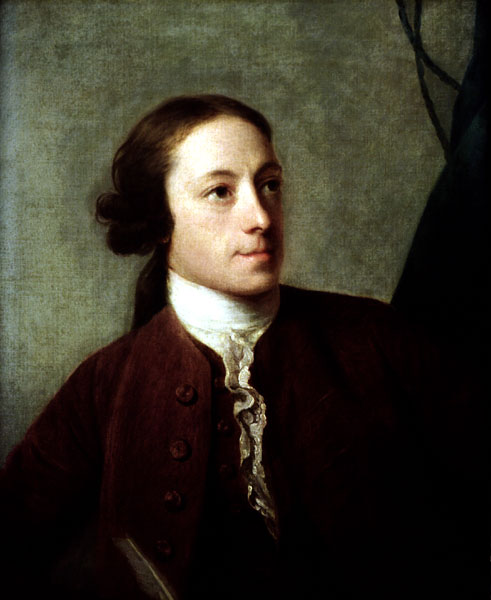
[Painting Horace Walpole, Fourth Earl of Orford (1717-1797), ca 1759 by Allan Ramsay (1713-1784)]

Labels: , , ,

Monday, August 30, 2010

Ben Bradshaw

Ben Bradshaw born 30 August 1960

Benjamin Peter James Bradshaw is a British politician and is the Labour Member of Parliament for Exeter

Under Tony Blair he was the Minister for Local Environment, Marine and Animal Welfare with the rank of Minister of State at the Department for Environment, Food and Rural Affairs. In June 2007 he was moved to the Department of Health, and was also Minister for the South West. He ended his Cabinet run as Secretary of State for Culture, Media and Sport.

When first elected in 1997, Ben Bradshaw was one of the first gay MPs to be out at the time he was initially elected, along with Stephen Twigg.

In 2009 he won 'Politician of the Year' at the annual Stonewall Awards.

He lives with his partner, Neal Dalgleish, who is a BBC producer. On 24 June 2006, Bradshaw and his partner undertook a civil partnership ceremony, the first MP to do so.

Labels:

Sunday, August 29, 2010

Edward Carpenter

Edward Carpenter born 29 August 1844 (d. 1929)

Born in Brighton, Carpenter was educated like all his brothers at Brighton College where his father was a governor. He then attended Trinity Hall, Cambridge before joining the Church of England as a curate.

Carpenter left the church in 1874 and became a lecturer in astronomy. During this period, he moved to Sheffield to live in a same sex relationship with George Merrill, a working class man he had met on a train. Two men of different classes living together fairly openly as a couple was almost unheard of in England in the 1890s, but they would remain partners for the rest of their lives. E M Forster was close friends with the couple, and he claimed that George Merrill was the inspiration for his novel Maurice. Carpenter was also a significant influence on the author D H Lawrence, whose Lady Chatterley's Lover can be seen as a heterosexualised Maurice.

In 1883, Carpenter joined the Social Democratic Federation, and in 1885 he left with William Morris to join the Socialist League. Never committing to any narrow doctrine, he dabbled in the Labour Church movement, and studied Eastern Religion, travelling to Ceylon and India in 1890. On his return he developed a kind of 'mystic socialism' which produced campaigns against air pollution and vivisection, promoted vegetarianism and 'rational dress', a reaction to Victorian clothing which included the making and wearing of sandals. These ideas were considered crackpot by many in the Left.

Later he became a founder member of the Independent Labour Party in 1893. His pacifism led him to become a vocal opponent of first the Second Boer War and then the First World War.

In the 1890s, Carpenter began to campaign against discrimination on the grounds of sexual orientation. He strongly believed that homosexuality was a natural orientation for people of a 'third sex'. His 1908 book on the subject, The Intermediate Sex, would become a foundational text of the LGBT movements of the 20th century. Carpenter also both supported and drew inspiration from the Women's movement.

He died in 1929, thirteen months after suffering a stroke, and was buried in Mount Cemetery at Guildford in Surrey.

Edmund Carpenter was the first gay activist of the modern age. A true pioneer.

Labels: , , , ,

Monday, August 02, 2010

Lord Ronald Gower

Lord Ronald Gower born 2 August 1845 (d. 1916)

Lord Ronald Charles Sutherland-Leveson-Gower was a British aristocrat, Liberal politician, sculptor and writer.

The youngest son of the 2nd Duke of Sutherland and the former Lady Harriet Howard, daughter of the 6th Earl of Carlisle, he was educated at Eton and at Trinity College, Cambridge.

He was a Liberal Member of Parliament for Sutherland from 1867-1874. He was a Trustee of the National Portrait Gallery, and of the Birthplace and Shakespeare Memorial Building at Stratford-on-Avon.

A sculptor, he also published a number of works on the fine arts. His most important sculpture was the statue of Shakespeare and four of his principal characters, erected in Stratford-upon-Avon. He also created a sculpture depicting Marie Antoinette on her way to the scaffold and another of a member of the Old Guard at Waterloo.

He also wrote biographies of Marie Antoinette and Joan of Arc, and a history of the Tower of London.

He never married, and was well known among the homosexual community of the time. Oscar Wilde's story The Portrait of Mr W.H. has been interpreted as a comment on Gower's social circle, and Gower is generally identified as the model for Lord Henry Wotton in The Picture of Dorian Gray. In 1879 hints of his homosexual liaisons published in the journal Man of the World led Gower to sue the paper, but later in the year the Prince of Wales sent him a letter accusing him of being 'a member of an association for unnatural practices', to which Gower wrote an angry reply. John Addington Symonds, who stayed with him once, stated that Gower 'saturates ones spirit in Urningthum [homosexuality] of the rankest most diabolical kind'.

Gower's most notable lover was the journalist Frank Hird, a relationship that lasted to the end of his life. Gower adopted Hird as his son, leading Wilde to remark on one occasion, 'Frank may be seen, but not Hird.'

Labels: , , ,

Friday, July 23, 2010

Chris Smith (Baron Smith of Finsbury)

Chris Smith (Baron Smith of Finsbury) born 23 July 1951

Christopher Robert 'Chris' Smith, Baron Smith of Finsbury, PC is a British Labour Party politician and former Member of Parliament and Cabinet minister.

Born in Barnet, Chris Smith attended Pembroke College, Cambridge, where he gained a first class honours degree in English and a PhD with a thesis on Coleridge and Wordsworth, and was president of the Cambridge Union Society. He worked for a housing charity and became a councillor in the London Borough of Islington before narrowly winning the seat of Islington South & Finsbury at the 1983 General election, defeating George Cunningham.

In 1984 he became Britain's first openly gay MP. There had been several gay MPs before this where their homosexuality had been common knowledge in some circles, including their constituents in some cases but they had not been completely open about it. During a rally in Rugby, Warwickshire against a possible ban on gay employees by the town council, he began his speech: 'Good afternoon, I'm Chris Smith, I'm the Labour MP for Islington South and Finsbury and I'm gay.'

He became an opposition whip in 1986, a shadow Treasury minister from 1987 to 1992, and shadowed the environment, heritage, pensions and health portfolios between 1992 and 1997. In 1997 he was appointed to Tony Blair's Cabinet as the first Secretary of State for Culture, Media and Sport. As a Minister known to have a close connection with the UK arts scene his time at DCMS is generally regarded as a success as many projects funded through the National Lottery came to fruition. There were controversies most notably his approval during his first week as minister of the appointment of Mary Allen to the Royal Opera House in which case a Select Committee report found that he had exceeded his authority and failed in not seeking advice from his Permanent Secretary. In 2000 he managed to secure a tax rebate that enabled many museums to give free admission. He held this position throughout the Labour government's first term, but was sacked and returned to the back benches after the 2001 election, replaced by the up-and-coming Tessa Jowell. Tony Blair later hinted at his regret at losing Smith's services, particularly his strong relationship with the arts world.

On 30 January 2005 Chris Smith revealed to the Sunday Times that he had HIV and was first diagnosed in 1987. He stated that he had decided to go public following Nelson Mandela's announcement of his son's death from AIDS. Private Eye, however, maintained that the genuine reason for Smith's decision to go public was taken in light of the fact that The Mail on Sunday had contacted him and told him it was preparing a story about his condition.

After over 20 years in Parliament, Smith stepped down from the House of Commons at the 2005 general election. It was announced on 30 April 2005 that he was to be created a life peer, as Baron Smith of Finsbury, of Finsbury in the London Borough of Islington. He took up a position as Director of the Clore Leadership Programme, an initiative aimed at helping to train and develop new leaders of Britain's cultural sector. He is also currently a board member of the Royal National Theatre and Chairman of the Wordsworth Trust. In November 2006, he was appointed as Chairman of The Advertising Standards Authority.

Smith is a keen mountaineer and in 2004 he was elected as the Ramblers' Association President. He is also a patron of London-based HIV charity, The Food Chain.

On the 8th May 2008 he was announced as the new Chairman of the Environment Agency.

Labels: ,

Friday, May 22, 2009

Harvey Milk

Harvey Milk born 22 May 1930 (d. 1978)

Harvey Bernard Milk an American politician and gay rights activist, was the first openly gay city supervisor of San Francisco, California. He and Mayor George Moscone were assassinated in 1978. His assassin, Dan White, was sentenced to seven years in prison. Outrage over the verdict led to the White Night Riots in San Francisco by enraged citizens. Milk is seen by some to be a martyr to the LGBT community.

MIlk's grandfather, Morris Milk was the owner and namesake of Milk's Department Store in Woodmere, New York; 'Glimpy' was Harvey Milk's nickname because as a child and adolescent, he was considered odd-looking because of his large ears, nose, and feet. He was born in Woodmere. He graduated from Bay Shore High School, Bay Shore, NY in 1947, graduated from University at Albany in 1951 and joined the United States Navy, serving on active duty in the Korean war; he was honorably discharged.

Following his service in the Navy, Milk lived for a time in Dallas, Texas. Eventually he relocated to New York City and took a job on Wall Street. He also became involved with theatre, serving as Assistant Director alongside Tom O'Horgan for a number of plays including Lenny and the musical Jesus Christ Superstar.

In 1972, Milk moved to San Francisco. He settled with his partner Scott Smith and opened a camera store, Castro Camera, in the Castro gay village. He emerged as a community leader, founding the Castro Valley Association of local merchants, and represented the neighbourhood businesses in dealing with the city government.

Milk ran for the San Francisco Board of Supervisors unsuccessfully twice, in 1973 and 1975. He emerged as a figurehead for San Francisco's large gay community, and was known as the 'Mayor of Castro Street', a title which he himself coined. With each campaign, he garnered a larger number of supporters.

After San Francisco switched from at-large to district elections, Milk was elected to the Board of Supervisors on his third attempt in 1977, the first openly gay elected official of any large city in the United States, and only the third openly gay elected official in all of the US, the first man. Milk represented District 5, which included the Castro.

In his eleven months as a Supervisor, he sponsored a gay rights bill for the City as well as – famously – a pooper-scooper ordinance. He was also instrumental in defeating Proposition 6, The Briggs Initiative, backed by State Senator Briggs, which would have allowed openly gay men and lesbians who were teachers to be fired based on their sexuality. In November 1978, Proposition 6 was soundly voted down by Californians.

Milk was also successful in reaching out and making alliances among the city's ethnic populations and among labour union leaders but not among the rank and file members.

On September 22, 1975 former marine Oliver Sipple saved the life of President Gerald Ford for which he was highly praised by law enforcement in the media as well as in a personal letter from the President. Milk outed Sipple, despite Sipple's insistence to reporters that his sexuality was to be kept confidential, proclaiming Sipple a 'gay hero', and stating (this) 'will help break the stereotype of homosexuals'. This action had a disastrous effect on the life of Sipple himself.

Late in 1978, Supervisor Dan White, an acrimonious political opponent of Milk's, resigned from the Board of Supervisors. His resignation meant that Moscone would choose White's successor, and thus could tip the Board's balance of power in Moscone's favour. Recognising this, those who supported a more conservative agenda, including board ally Dianne Feinstein, talked White into changing his mind. White requested that Moscone re-appoint him to his former seat. Moscone originally indicated a willingness to do so, but more liberal city leaders, including Milk, lobbied him against the idea, and Moscone ultimately decided not to re-appoint White.

On November 27, 1978, White went to San Francisco City Hall to meet with Moscone and make a final plea for re-appointment. When Moscone refused to yield, White shot Moscone to death, then went to Milk's office and also shot Milk to death. White later turned himself in at the police station where he was formerly an officer. Even though he had carried a gun, 10 extra rounds, and crawled through a window to avoid metal detectors, White denied premeditation. Thousands attended a spontaneous candlelight memorial vigil the night of Milk's funeral. Milk had foreseen his risk of assassination and had recorded several audio tapes to be played in that event. One of the tapes included his now-famous quote, 'If a bullet should enter my brain, let that bullet destroy every closet door.'

Dan White's trial, which began four months after the killings, was one of the most closely watched trials in California at that time. The prosecution claimed that White's motive was revenge. But White's attorney, Douglas Schmidt, claimed that White was a victim of pressure and had been depressed, a state exacerbated by his consuming a large quantity of junk food before the murders; this became known as the 'Twinkie defence'. Schmidt also told the jury and the press that White carried all that ammunition on him not so much out of hatred but out of impulse from his experience as an ex-police officer.

Finally, the jury heard what the prosecution hoped it would be its most damaging piece of evidence — Dan White's tape-recorded confession which was taped the day after the murders. What was notable about this confession was that the police didn't seem to ask White any questions about the crime and just let him talk. Instead, White tearfully talked of how Moscone and Milk refused to give him his supervisor's job back.

White was convicted of voluntary manslaughter on the grounds of diminished capacity and sentenced to seven years and eight months, a sentence widely denounced as lenient and motivated by homophobia. During jury selection, defence attorneys had excluded candidates they deemed 'pro-gay'.

After the sentence, the gay community erupted into what became known as the White Night Riots. As soon as the sentence was announced, word ran through the gay community and groups of people began walking quickly to the Civic Center and by 8pm, there was a sizeable mob formed. According to the documentary, The Times of Harvey Milk, the enraged crowd started by screaming at police officers calling for revenge and death. Then, riots began to break out with the mob setting ablaze a number of police vehicles, disrupting traffic, smashing windows of cars and stores, buses had their overhead wires ripped down, and physical violence resulted against the outnumbered police officers.

Many rioters were arrested but the Chief of Police, Charles Gain, was blamed for being too weak in his response and holding back his officers when he should have been more proactive and defended lives and property. He defended himself by pointing out that no one was dead and only a few had minor injuries. More than 160 people were hospitalised because of the rioting.

Dan White served a little more than five years for the double murder of Moscone and Milk. On October 22, 1985, a year and a half after his release from prison, White was found dead in a running car in his ex-wife's garage. He was 39 years old. His defense attorney told reporters that he had been despondent over the loss of his family, and the situation he had caused, adding 'This was a sick man.'

Harvey Milk is widely regarded as a martyr for the gay community and the gay rights movement. Many gay and lesbian community institutions are named for Milk, including the Harvey Milk Institute and the Harvey Milk Lesbian/Gay/Bisexual/Transgendered Democratic Club in San Francisco, as well as a number of alternative schools in the United States, including Harvey Milk High School in New York City. Oakes College at the University of California, Santa Cruz has an on-campus apartment building named Harvey Milk.

Harvey Milk has been the subject of several documentaries, films, tribute songs and plays. A major feature film based on the life and death of Harvey Milk was in the offing for several years and finally appeared in late-2008, directed by Gus Van Sant and starring Sean Penn as Milk, who was Oscar-nominated for the role.

Pioneering gay journalist Randy Shilts wrote a major investigative biography entitled The Mayor of Castro Street: The Life and Times of Harvey Milk.

Labels: , ,

Wednesday, December 17, 2008

Michael Cashman

Michael Cashman born 17 December 1950

Michael Cashman was a British actor and is now a Labour politician. He has been a Member of the European Parliament for the West Midlands constituency since 1999.

As an actor, he is possibly best known for his role as Colin Russell in BBC TV's EastEnders – a character famous for being the first man to kiss another man in a soap opera in the UK. He also played Mike Wallace in The Sandbaggers. He was also in the Doctor Who story entitled Time-Flight.

He appeared on stage opposite fellow activist Sir Ian McKellen in Martin Sherman's Bent in 1990

He has long been open about his homosexuality and regularly comments on government policy decisions relating to sexual orientation. He registered a civil partnership with Paul Cottingham, his partner of over twenty years, on 11 March 2006. He is also an Honorary Associate of the National Secular Society.

In the European Parliament he is Labour spokesperson on human rights and has also been rapporteur on an important initiative on funerals of those who die in third countries - an issue he was motivated to act on after the death of his own father.

He is a trenchant critic of discrimination against minorities within the European Union. A recent campaign has been to support the gay pride march in Warsaw, which he attended. He is also the President of the European Parliament's Intergroup on gay and lesbian issues.

He is the treasurer of Equity and lead the campaign to obtain pension rights for members.

Labels: , , ,

Friday, November 21, 2008

Harold Nicolson

Harold Nicolson born 21 November 1886 (d. 1968)

Sir Harold Nicolson was a British diplomat, author and politician. He was born in Tehran, the son of a diplomat father. He was educated at Wellington College and Balliol College, Oxford. In 1909 he joined the diplomatic service, in which he held various posts, participating in a junior capacity in the Paris Peace Conference in 1919.

In 1913, he married the writer Vita Sackville-West, who encouraged his literary ambitions. In 1921, he published a biography of French poet Paul Verlaine, to be followed by studies of other literary figures. In 1933, he wrote an account of the Paris conference entitled Peacemaking, 1919.

Both Nicolson and his wife practised what today we would call an open marriage. They each had a number of same-sex affairs, and once Harold had to follow Vita to France, where she had 'eloped' with Violet Trefusis, to try to win her back. However, they remained happy together – in fact, they were famously devoted to each other, writing almost every day when they were separated, for example, because of long diplomatic postings abroad. Eventually, he gave up diplomacy, partly so they could live together in England. They had two sons, Nigel, also a politician and writer, and Ben, an art historian.

In the 1930s, he and his wife acquired and moved to Sissinghurst Castle, where they created the gardens that are now famous and run by the National Trust.

In 1931, Harold Nicolson joined Sir Oswald Mosley and his recently formed New Party. He stood unsuccessfully for Parliament in the 1931 General Election and edited the party newspaper. Nicolson ceased to support Mosley when Mosley formed the British Union of Fascists in 1932. Nicolson entered the House of Commons as National Labour Party Member of Parliament for Leicester West in the 1935 general election. In the latter half of the 1930s he was among a relatively small number of MPs who alerted the country to the threat of fascism. A friend (though not an intimate) of Winston Churchill, he often supported his efforts in the Commons to stiffen British resolve and support rearmament. He served briefly as a Parliamentary Private Secretary in Churchill's 1940 war time government of national unity; thereafter he was a well-respected backbencher, especially on foreign policy issues given his early and prominent diplomatic career. He lost his seat in the 1945 election. Having joined the Labour Party, he stood in the Croydon North by-election in 1948, but lost once again. He was knighted in 1953, as a reward for writing the official biography of George V.

After his last attempt to enter parliament, he continued with an extensive social schedule and his writing, which included books, a regular weekly piece for The Spectator and book reviews.
Labels: , , , ,

Tuesday, October 21, 2008

Peter Mandelson

Peter Mandelson born 21 October 1953

Peter Benjamin Mandelson, Baron Mandelson, PC is a British Labour politician who is the serving Secretary of State for Business, Enterprise and Regulatory Reform, appointed on 3 October 2008. Mandelson is regarded as one of the main players, along with Tony Blair and Gordon Brown, of the modern Labour Party and its rebranding as 'New Labour'. He is often referred to by the nickname 'Mandy' by much of the British news media.

Having helped Labour come to power in 1997, he was then forced twice to resign from Tony Blair's government while holding Cabinet positions. After his second resignation he served as the European Commissioner for Trade for almost four years, before being brought back into mainstream British politics by Gordon Brown.

Before Labour came to power, he was author (with Roger Liddle) of The Blair Revolution (1996). More recently, he contributed to the book The City in Europe and the World (2005). Mandelson served as Member of Parliament for Hartlepool for twelve years, a seat he vacated in order to become a European Commissioner.

During his few months in Tony Blair's government, he was the centre of a great deal of media attention when Matthew Parris (openly gay former MP and then Parliamentary sketch writer of The Times) mentioned during a live interview on BBC2's Newsnight, in the wake of the resignation of Ron Davies, that 'Peter Mandelson is certainly gay'. Mandelson's homosexuality had been well-known but not widely publicised except on the front pages of the Sunday People, and Mandelson had not wanted it discussed.

After Parris's remarks, the press felt free to discuss his personal life (in particular his relationship with the Brazilian Reinaldo Avila da Silva) to a much greater extent and much of the political criticism he received as a Cabinet minister was arguably tinged with homophobia, although he was generally the victim of his own creation - political spin.

His return to the Cabinet as a member of Gordon Brown's government has been an unexpected and surprising new twist in the career of this not so charming man.

Labels:

Monday, October 20, 2008

Edward Douglas-Scott-Montagu, 3rd Baron Montagu of Beaulieu

Edward Douglas-Scott-Montagu, 3rd Baron Montagu of Beaulieu born 20 October 1926

Edward John Barrington Douglas-Scott-Montagu, 3rd Baron Montagu of Beaulieu is a British Conservative politician known for founding the National Motor Museum.

Montagu was born in London, and inherited his Peerage in 1929 at the age of two, when his father John Walter Edward Douglas-Scott-Montagu, 2nd Baron Montagu of Beaulieu was killed in an accident. He attended St Peter's Court School and Ridley College in Canada, Eton College and New College, Oxford. He served in the Grenadier Guards including in Palestine before the end of the British Mandate.

On coming of age Montagu immediately took his seat in the House of Lords and swiftly made his maiden speech on the subject of Palestine. His interest in historic cars led him to open the National Motor Museum on his estate at Beaulieu, Hampshire in 1952.

Montagu knew from an early stage of life that he was bisexual, and while attending Oxford was relieved to find others with similar feelings. In a 2000 interview Lord Montagu stated, 'My attraction to both sexes neither changed nor diminished at university and it was comforting to find that I was not the only person faced with such a predicament. I agonised less than my contemporaries, for I was reconciled to my bisexuality, but I was still nervous about being exposed.'

In 1954 Montagu was imprisoned for twelve months for consensual homosexual offences along with Michael Pitt-Rivers and Peter Wildeblood.

On the August Bank Holiday weekend in 1953 Edward Montagu and film director Kenneth Hume took two boy scouts to a beach hut at Beaulieu for a bathe. Edward Montagu had reported the loss of a camera to the police and the purpose of the visit to the beach hut had originally been to look for the camera. When the police arrived they took more interest in what had been happening and the boy scouts said that they had been indecently assaulted in the beach hut.

Edward Montagu was charged with an unnatural offence and an indecent assault and his trial took place at Winchester Assizes in December 1953. Edward Montagu was acquitted on the more serious charge of committing an unnatural offence but the jury disagreed on the lesser charge of indecent assault. The Director of Public Prosecutions decided that Edward Montagu and Kenneth Hume should be tried again on the charge of indecent assault.

Michael Pitt-Rivers and Peter Wildeblood were arrested three weeks after the end of the first Montagu/Hume trial. Their premises were searched without a warrant. They were charged with several specific indecency charges with two RAF men, Edward McNally and John Reynolds, at the beach hut near Beaulieu and also at the Pitt-Rivers estate in Dorset. They were also accused of conspiring with Edward Montagu to commit these offences. This would prejudice the chances of Edward Montagu's aquittal at his re-trial. Unlike other defendants in the trial Montagu continued to protest his innocence.

Fifty years on, in an interview with the Mail on Sunday Lord Montagu acknowledged his bisexuality, but maintains that his guilt was mainly by association [with Peter Wildeblood], and that the police were seeking a high-profile prosecution as part of their government sponsored crackdown on homosexuals.

The trial was a consequence of concern in the early 1950s about the increasing 'incidence' of homosexuality but caused a backlash which led to the Wolfenden Report which recommended legalisation.

Following the trial and his imprisonment, Montagu quietly returned to his life and went on to marry twice, declining, generally, to speak publicly about the issue.

Montagu founded The Veteran And Vintage Magazine in 1956 and continued to develop the museum, making a name for himself in tourism. He was Chairman of the Historic Houses Association from 1973 to 1978 and Chairman of English Heritage from 1984 to 1992.

Lord Montagu on the court case which ended the legal persecution of homosexuals - this interview with the Mail on Sunday on 15 July 2007 is the first time Lord Montagu has spoken of the events that led to his conviction fifty years before.

The story of Lord Montagu's trial and unwitting role in the history of decriminalisation in England was told in a 2007 Channel 4 drama-documentary, A Very British Sex Scandal.

Labels: , , ,

Wednesday, October 01, 2008

William Beckford

William Beckford born 1 October 1760 (d. 1844)

William Thomas Beckford was an English novelist, art critic, travel writer and politician.

He was born in Fonthill, Wiltshire, in the manor house owned by his father, former Lord Mayor of London William Beckford. From him, William Jr. inherited, at the age of ten, a large fortune consisting of £1 million in cash, land, and several sugar plantations in Jamaica, which allowed him to indulge his interest in art and architecture, not to mention writing.

Three years later he married the fourth Earl of Aboyne's daughter, Lady Margaret Gordon on 5 May 1783. She later died in childbirth. Beckford was primarily homosexual, and at the age of 19 notoriously had an affair with the Hon William Courtenay, later 3rd Viscount and 9th Earl of Devon, then ten years old.

He travelled in Italy in 1782 and promptly wrote a book on the subject Dreams, Waking Thoughts and Incidents (1783). Shortly afterwards came his best-known work, the Gothic novel Vathek (1786), written originally in French and, as he was improbably accustomed to boast, at a single sitting of three days and two nights. It is an impressive work, full of fantastic and magnificent conceptions. His other principal writings are Memoirs of Extraordinary Painters (1780), a satirical work, and Letters from Italy with Sketches of Spain and Portugal (1835), full of brilliant descriptions of scenes and manners. In 1793 he visited Portugal, where he lived for a while.

Beckford's fame, however, rests nearly as much upon his eccentric extravagances as a builder and collector as upon his literary efforts. In carrying out these he managed to dissipate his fortune of £100,000 a year, only £80,000 of his capital remaining at his death.

The opportunity of purchasing the complete library of Edward Gibbon gave Beckford the basis of his own library, and James Wyatt built Fonthill Abbey, in which this and the owner's art collection would be housed; it was completed in 1807.

He entered parliament as member for Wells and later for Hindon quitting by accepting the Chiltern Hundreds, but mostly lived in seclusion, spending most of his father's wealth without adding to it, so that the great house he had built became a ruin. In 1822 he sold it to John Farquhar, and moved to Lansdown Hill, where he commissioned architect Henry Goodridge to design a spectacular folly, Lansdowne Tower.

He had a seat in parliament from 1784 to 1793, and again from 1806 to 1820.

He died on 2 May at his residence, Lansdown Crescent, age 84. He left two daughters.

He spent his elderly years living in Bath on Lansdown Terrace and built a final masterpiece, Lansdown Tower, (now known as Beckford's Tower), where he kept many of his treasures. He is buried in the grounds of this tower, now a graveyard.

Labels: , , , ,

Thursday, June 12, 2008

Spencer Livermore

Spencer Livermore born 12 June 1975

Spencer Livermore used to work for the Prime Minister of the United Kingdom, Gordon Brown, as Director of Political Strategy. He has since left Number 10, the first senior figure to do so since Gordon Brown became the Prime Minister, heading for the world of advertising before joining Blue Rubicon as Head of Planning and Strategy

Livermore grew up in Wickford, Essex, attending Beauchamps Comprehensive School and Basildon College, before reading Government at the London School of Economics, where he graduated in 1996.

After graduating, Livermore worked for the Labour Party's Economic Secretariat during the 1997 General Election campaign in which the Labour Party under the leadership of Tony Blair returned to power following 18 years in opposition to the Conservative Party.

After the campaign he progressed quickly, and in 1998 was appointed a Special Adviser in the Treasury, working as a key political aide to Gordon Brown, who was then Chancellor of the Exchequer. In the run-up to the 2001 General Election, at the request of the Chancellor, who was Chair of Strategy for the election campaign, Livermore left the Treasury to work alongside the General Election co-ordinator Douglas Alexander, Member of Parliament, at the Labour Party’s Millbank Tower headquarters as Head of Attack.

When he returned to the Treasury after the 2001 General Election, Livermore was appointed as Special Adviser to the Chancellor of the Exchequer. After the 2005 General Election he was appointed as the most senior Adviser to the Chancellor as Chief Political and Strategy Adviser.

Following Tony Blair’s resignation as Prime Minister on June 27, 2007, Gordon Brown, as the new Leader of the Labour Party, became Prime Minister. Gordon Brown appointed Livermore to 10 Downing Street as Director of Political Strategy, attending Cabinet meetings and becoming a key figure in the Prime Minister’s strategy for the next General Election.

In May 2007 Livermore was listed as the seventh most powerful gay man in Britain. In November 2007 Gay Times described him as the most powerful gay man in Britain and PinkNews.co.uk echoed the same view in December 2007

He lives with his partner, Seb Dance, who is also a government special adviser - to Northern Ireland Secretary, Shaun Woodward, in London.

Labels: