Saturday, May 28, 2011

Henry Kendall

Henry Kendall born 28 May 1897 (d. 1962)

Henry Kendall was an English stage and film actor, theatre director and an immaculately stylish revue artiste.

Kendall was educated at the City of London School, and made his first appearance on the stage in September 1914 at the Lyceum Theatre. He had a distinguished war career, serving as a Captain in the Royal Air Force from 1916 to 1919, and on demobilisation was awarded the Air Force Cross.

He played the leading role of Reggie Ogden in the film The Shadow in 1933, and also starred in Alfred Hitchcock's 'bravest failure', Rich and Strange, US title East of Shanghai (1931).

Kendall dismissed his own cinematic work, although he appeared in a number of films in the 1930s and after. His appearances on the London stage were many however throughout the 1930s, 40s and 50s.

As a gifted West End revue artiste he appeared in Charlot's Revue at the Prince of Wales Theatre in 1924 and Charlot's Masquerade at the Cambridge Theatre in 1930. He also enjoyed great success co-starring with Hermione Gingold in the three long-running Sweet and Low revues; this was followed in June 1948 by the A la Carte revue at the Savoy Theatre.

But a greater contribution in this field was his appearance with Hermione Baddeley and Hermione Gingold ('The Two Hermiones'), Walter Crisham and Wilfred Hyde-White, in Leslie Julian Jones's revue Rise Above It, first at the Q Theatre in January 1941, when Hedley Briggs was nominally directing; then in two West End editions of the show which ran for a total of 380 performances at the Comedy Theatre opening in June 1941 and again in December 1941, when he was both starring and directing show.

As he reports in his autobiography: 'Of all forms of theatrical entertainment, revue is the most bitchy. The material is bitchy, the artists are bitchy and, strangely enough, the average revue audience is bitchy.'

In addition to a busy career as an actor and entertainer, he was frequently engaged as a director, notably staging the first productions of See How They Run (Peterborough Rep, tour and Q Theatre 1944; Comedy Theatre 1945), and The Shop at Sly Corner (St Martin's Theatre 1945).

He also directed numerous plays at the Embassy Theatre and Q Theatre.

Labels: , , , ,

Wednesday, May 25, 2011

Robert 'Robbie' Ross

Robert 'Robbie' Ross born 25 May 1869 (d. 1918)

Robert Baldwin Ross was a journalist and art critic. He is best known, however, as the executor of Oscar Wilde's estate. He was also responsible for bringing together several great literary figures and acting as their mentor.

Ross was born in Tours, France but came to Britain at an early age. His father originally came from Northern Ireland and his mother from Canada. His father had been the attorney-general of Upper Canada and his grandfather was the Canadian Prime Minister Robert Baldwin.

While working as a journalist and critic, he is alleged to have been Oscar Wilde's first male lover, and remained loyal to Wilde through thick and thin, eventually becoming his literary executor. This was not an easy task. It meant tracking down and purchasing the rights to all of Wilde's texts, which had been sold off along with all of Wilde's possessions when he was declared bankrupt. It also meant fighting the rampant trade, following Wilde's arrest, in black market copies of his books and, in particular, books, usually erotic, that Wilde did not write but which were published illegally under his name. The rights to all of Oscar's works along with the money earned from their printing/performance while he was executor was given by Ross to Wilde's sons.

Ross was also responsible for commissioning Jacob Epstein to produce the tomb for Wilde. He even requested that Epstein design a small compartment into the tomb for Ross’s own ashes.

In 1908, some years after Wilde's death, Ross produced the definitive edition of his works. Following Wilde's disgrace and imprisonment, Ross went abroad for safety's sake, but returned to offer support, both financial and emotional, to Wilde during his last years. Ross himself did not escape scandal. A few years before Wilde's imprisonment, Ross was involved in a scandal over his sexual relationship with a boy of fourteen, the son of friends, and his best-friend, aged fifteen. Both boys confessed to their parents that Ross had made love to them, and the fourteen year old boy also admitted that Lord Alfred Douglas had also made love to him while he was a guest at Ross's house. After a good deal of panic and frantic meeting held with solicitors, Douglas and Ross convinced the parents not to go to the police.

As a young man, Ross moved to England to go to university. He was accepted at Cambridge but was the victim of bullying, probably due to his sexuality (of which he made no secret) and his, perhaps, outspoken journalism in the university paper. Ross caught pneumonia after a cruel dunking in a fountain by a number of students with, according to Ross, the full support of a don. After recovering he fought for an apology from his fellow students, which he received, but more fiercely, for the dismissal of the don who, he argued, had known about and supported the bullying. The university refused to punish the man and Ross dropped out of university.

Following this Ross tried his hand at a number of careers, as writer, art critic, and literary executor. He was able to rely on an allowance and inheritance from his wealthy family to support himself. His literary output is small, with only one book worth a mention; Masques and Phases is a collection of previously published works by Ross, short stories and reviews. Ross's main contribution to literature lies in his work as Wilde's executor, and as Wilde's friend in reading Wilde's texts, making suggestions, and, if Ross is to be believed, frequently suggesting changes and improvements. As an art critic, Ross was highly critical of the post-impressionist painters. He worked unpaid for many years for a small art gallery run by friends, for whom he travelled purchasing works. At one time he hoped to be selected for a royal position but was rejected probably due to his connection to Wilde.

Ross is also of interest in his decision to 'come out' to his family, whom he gathered to hear the announcement not long after he left university.

As a result of his faithfulness to Wilde even in death, Ross was vindictively pursued by Lord Alfred Douglas, who repeatedly attempted to drag him into court, and attempted to have him arrested as a homosexual.

During the First World War, he drew around him a coterie of young artists, mostly homosexuals, including Siegfried Sassoon and Wilfred Owen. He was also a close friend of Wilde's son Vyvyan Holland, and a friend of his other son Cyril until his death in the First World War. In early 1918, during the German Spring Offensive, Noel Pemberton Billing, a right-wing M.P., published an article entitled The Cult of the Clitoris, in which he accused members of Ross's circle of being at the centre of 47,000 homosexual traitors who were betraying the nation to the Germans. The incident brought much embarrassing attention to Ross and his associates.

Later in the same year, Ross was preparing to travel to Melbourne, Australia to open an exhibition at the National Gallery when he died suddenly, an event which caused great grief to his many friends. In 1950, on the 50th anniversary of Wilde's death, Ross's ashes were added to Wilde's tomb in the Le Père Lachaise Cemetery.

Labels: , , , ,

Friday, March 18, 2011

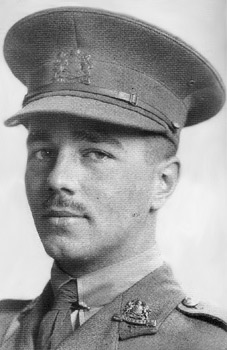
Wilfred Owen

Wilfred Owen born 18 March 1893 (d. 1918)

Born in Oswestry in Shropshire, the Owen family lived in a large house owned by his grandfather, but on his death in 1895, the family were forced to move to lodgings in Birkenhead. He was educated at the Birkenhead Institute and at Shrewsbury Technical College.

Shortly after leaving school in 1911, he passed the entrance exam for the University of London, but failed to achieve a scholarship so worked as an assistant to the Vicar of Dunsden and as a pupil-teacher at a school. He also worked as private tutor at the Berlitz School in Bordeaux, France.

In 1915, he enlisted in the army and, after training, was commissioned as a second lieutenant in the Manchester Regiment.

Owen started the war as a cheerful and optimistic man, but he soon changed forever. Initially, he held his troops in contempt for their loutish behaviour, and wrote to his mother calling his company 'expressionless lumps'. However, Owen's outlook on the war was to be changed dramatically after two traumatic experiences. Firstly, he was blown high into the air by a trench mortar, landing in the remains of a fellow officer. Soon after, he became trapped for days in an old German dugout. After these two events, Owen was diagnosed as suffering from shell shock and sent to Craiglockhart War Hospital in Edinburgh for treatment. While recuperating there he met a fellow poet with whom he would be forever associated - Siegfried Sassoon.

Although he had written poetry for years, his style was changed dramatically by the influence of Sassoon, who encouraged him to write from experience - this combined with his innovative use of rhyme, and his best work was a direct result - incl. Dulce et Decorum Est, Anthem for Doomed Youth & Strange Meeting. There is no evidence that their relationship was closer than friendship, but Owen's letters suggest that he was in love with Sassoon.

Wilfred Owen returned to active duty in France in the summer of 1918. He could have chosen to remain on home-duty, but seems to have taken a symbolic decision to return to the front in place of Sassoon, who had been invalided out of the war by his injuries, that he might continue to document the horrors of war.

Wilfred Owen was killed in battle while attempting to cross the Sambre-Oise Canal with his unit, on November 4th 1918. The war ended a week later. His mother received the telegram on Armistice Day. He was 25 years old. He was posthumously awarded the Military Cross.

Wilfred Owen saw a mere handful of his poems published in his lifetime. Following his death, his work was championed by Sassoon and later, others. The 1960s saw a renewed interest in the poets of the First World War, and Wilfred Owen has come to be regarded as perhaps the leading voice of that doomed generation.

He is generally now accepted as having being homosexual through indications in some of his poems, his circle of friends in London, his letters - although his brother is acknowledged to have destroyed or edited hundreds of these. His sister-in-law, Mrs Harold Owen donated all the manuscripts, documents, photographs and personal effects of Wilfred's that her late husband had owned, to Oxford University in 1975.

Dulce et Decorum Est

Bent double, like old beggars under sacks,
Knock-kneed, coughing like hags, we cursed through sludge,
Till on the haunting flares we turned our backs
And towards our distant rest began to trudge.
Men marched asleep. Many had lost their boots
But limped on, blood-shod. All went lame; all blind;
Drunk with fatigue; deaf even to the hoots
Of tired, outstripped Five-Nines that dropped behind.

Gas! GAS! Quick, boys!-- An ecstasy of fumbling,
Fitting the clumsy helmets just in time;
But someone still was yelling out and stumbling
And floundering like a man in fire or lime.
Dim, through the misty panes and thick green light
As under a green sea, I saw him drowning.

In all my dreams, before my helpless sight,
He plunges at me, guttering, choking, drowning.

If in some smothering dreams you too could pace
Behind the wagon that we flung him in,
And watch the white eyes writhing in his face,
His hanging face, like a devil's sick of sin;
If you could hear, at every jolt, the blood
Come gargling from the froth-corrupted lungs,
Obscene as cancer, bitter as the cud
Of vile, incurable sores on innocent tongues,--
My friend, you would not tell with such high zest
To children ardent for some desperate glory,
The old Lie: Dulce et decorum est
Pro patria mori.

Labels: , ,

Tuesday, March 01, 2011

Oliver Baldwin

Oliver Baldwin born 1 March 1899 (d. 1958)

Oliver Ridsdale Baldwin, 2nd Earl Baldwin of Bewdley, known as Viscount Corvedale from 1937 to 1947, was a British politician who had a quixotic career at political odds to his father, three-time Prime Minister Stanley Baldwin.

Baldwin was educated at Eton College, and grew up in the shadow of his father's political career. He joined the Irish Guards in 1916 and served in France through the remainder of World War I. After the war he travelled extensively and worked as a journalist and travel writer. He was in Armenia with the job of an infantry instructor; there the Bolsheviks imprisoned him for two months and later he was imprisoned by the Turks for a further grim five months. Despite his Conservative family, he gradually grew to adopt left-wing views and eventually announced that he was a Marxist and joined the Labour Party. He frequently addressed crowds from a socialist platform at Hyde Park Corner.

At the 1924 elections Baldwin contested the seat of Dudley for Labour. By this time his father was leader of the Conservative Party and Prime Minister, and his candidacy naturally attracted press comment. At the 1929 election he won Dudley, and served as a backbench member of Ramsay MacDonald's Labour government, facing his defeated father across the House.

He remained on personal good terms with his father despite their different politics, as each regarded their differences as being of principle and not personality. Baldwin refrained from personally attacking his father, and when he visited him, there was a tacit agreement that politics was not a suitable subject for discussion. Lucy Baldwin, who was also a strong Conservative, came from a background where questioning received opinion was regarded as a good thing, supported her son - although she did not like to attend the House of Commons to see her son and husband on opposite sides.

Like other young left-wing Labour MPs, Baldwin was critical of MacDonald's insistence on strict financial management and refusal to launch large Keynesian public works programmes. Early in 1931 Baldwin resigned from the Labour Party and briefly associated with Oswald Mosley's New Party, but repudiated Mosley after one day and rejoined Labour. When MacDonald formed the National Government Baldwin remained with the opposition Labour Party and inevitably lost his seat in the 1931 general election. He returned to journalism.

Baldwin fought Paisley at the 1935 election. In 1937 Stanley Baldwin retired from politics and was created Earl Baldwin of Bewdley. As a result Oliver Baldwin acquired the courtesy title Viscount Corvedale, although he remained a commoner. In 1939 he rejoined the army, becoming a major in the Intelligence Corps and serving in Egypt, Palestine, Syria, Eritrea and Algeria.

Baldwin was homosexual, a fact well known within the family but not to the public (his mother was again supportive and both parents acknowledged his long term relationship with John Boyle).

At the 1945 general election, when Labour returned to power under Clement Attlee, Baldwin was elected for Paisley. In 1946 he was appointed Parliamentary Secretary to the Secretary for War, a post he held until 1947. But there was little chance that he would hold high office. His homosexuality was well-known, and Attlee held puritanical views on this issue: he kept Tom Driberg out of the government for the same reason.

When Stanley Baldwin died in 1947, Oliver succeeded him as Earl Baldwin of Bewdley. It was not possible at this time to renounce a peerage, and Baldwin had no choice but to leave the Commons and take his seat in the House of Lords. Later that year, presumably to give him a dignified exit from politics, he was appointed Governor of the Leeward Islands, a British colonial territory in the Caribbean. He created a minor scandal by taking John Boyle with him.

Partly for this reason, and partly because he made no secret of his continuing socialist views among the British planter elite in Antigua, Baldwin was recalled in 1950. He died in 1958 and was succeeded in the earldom by his brother.

A biography of Oliver Baldwin was published in 2003 Oliver Baldwin: A Life of Dissent by Christopher J Walker

Labels: , ,

Tuesday, February 08, 2011

Ralph Chubb

Ralph Chubb born 8 February 1892 (d. 1960)

Ralph Nicholas Chubb was an English poet, printer, and artist. Heavily influenced by Whitman, Blake, and the Romantics, his work was the creation of a highly intricate personal mythology, one that was anti-materialist and sexually revolutionary.

Ralph Chubb attended St Albans School and Cambridge before becoming an officer in the First World War. He served with distinction but developed neurasthenia, and he was invalided out in 1918. From 1919 to 1922 Chubb studied at the Slade School of Art in London. It was there that he met Leon Underwood and other influential artists. He went on to contribute several articles and poems for Underwood's magazine, The Island. Although his work was displayed at the Royal Academy of Art, his paintings did not sell. He moved with his family to the village of Curridge, near Newbury in Berkshire. He began to devote his artistic talents to the printed works which would remain his chief labour in life.

His books were created in several chief phases. His typeset books of the 1920s were modest, exhibiting Chubb's talent for woodcutting and his quaint, visually inspired poetry. Even at this early stage, Chubb's lifelong obsession with adolescent males was beginning to become apparent. He expands upon this theme more explicitly in An Appendix, a pederastic and spiritualist manifesto duplicated from a cursive manuscript. An Appendix was the first of his printed works to be printed in his own hand; he soon followed this with the first of his opulent lithographic books, The Sun Spirit. Throughout the 1930s, Chubb's books became more elaborate and visually intriguing. Water Cherubs crystallises Chubb's aesthetic of the youthful male form, and The Secret Country unfolds like an illuminated manuscript, recounting stories of Chubb's family and his journeys among the Romani of the New Forest in Hampshire.

Chubb's printing press was interrupted by the war, but in 1948 he entered into the third period of his career with two massive volumes: The Child Of Dawn and Flames of Sunrise. Each page of these two volumes is crowded with obscure digressions on Chubb's mythology and drawings of symbolic significance. Briefly summarised, Chubb's vision was a prophecy of the redemption of 'Albion', or England, by the boy-god Ra-el-phaos, of whom Ralph claimed himself to be the prophet and herald.

Other themes run through all of Chubb's work. He was forever haunted by the memory of a young chorister at St Albans who disappeared from Chubb's life just as he had summoned up the courage to speak to him. Similarly, a brief sexual relationship with another boy when Ralph was 19 seemed to serve as a template for future visions of paradise. Chubb's books become progressively more self-involved and paranoid. Seeking to articulate his pederastic desires, he created a personal mythology which explained everything in terms only he could understand. Nonetheless, Chubb's work is of fascinating psychological significance; each of the various angels, knights, seers, and boy-gods in his dream world represents an aspect of his introspective and persecuted self.

Failing in health and facing continuing legal and financial difficulties, Ralph Chubb abandoned his controversial works in the mid-50s, and began to collect and reprint his early poems and childhood memories. Treasure Trove and The Golden City (published posthumously) are devoid of the usual profusion of naked, sensual youths, but instead offer a glimpse into his youthful imagination, and some of his most charming poetry. In the final years of his life he donated his remaining volumes to the national libraries of Britain. He died peacefully at Fair Oak Cottage in Hampshire and was buried next to his parents at the Kingsclere Woodland Church.

None of the editions of Chubb's books exceed more than 200 copies, and some of his lithographed masterworks exist in only 30 or 40 copies, of which a mere 6 or 7 are meticulously hand-coloured by Chubb.

Labels: , , ,

Saturday, September 25, 2010

C K Scott Moncrieff

C K Scott Moncrieff born 25 September 1889 (d. 1930)

Charles Kenneth Scott Moncrieff MC was a Scottish writer, most famous for his English translation of most of Proust's À la recherche du temps perdu, which he published under the Shakespearean title Remembrance of Things Past. Scott Moncrieff's Proust translation (volumes one through six of the seven) has earned him a place as one of the greatest translators of all time.

He attended Winchester College and while still a schoolboy, became associated with the Wildean circles of Robert Ross and Christopher Millard, with whom he began a sexual relationship which was to last into his twenties.

In 1907, he published a short story, 'Evensong and Morwe Song', in the pageant issue of New Field, the literary magazine that he edited, while at Winchester College. The story deals explicitly with sex between boys at public schools. The magazine was hastily suppressed, although not before copies of the offending edition had been mailed to parents. The story was republished in 1923 in an edition of fifty copies for private circulation only. It was never published again in the author's lifetime. Although it is commonly claimed that Scott Moncrieff was expelled for this act of rebellion, this fact is disputable: Scott Moncrieff's letters, published posthumously, mention his returning there before the war as an 'old boy', which would have been unlikely had he left in disgrace.

After Winchester, Scott Moncrieff attended Edinburgh University, where he undertook a degree in English Literature, a novel and somewhat flamboyant choice for the son of an eminent magistrate. Thereafter, he began an MA in Anglo-Saxon under the supervision of the respected man of letters, George Saintsbury. He graduated in 1914 with first class honours, winning a prestigious prize for his translation of Beowulf.

During his time at Edinburgh, Scott Moncrieff made the acquaintance of Philip Bainbrigge, a schoolmaster at Shrewsbury and the author of miscellaneous homoerotic odes to Uranian Love. He was also a close friend of Vyvyan Holland, younger son of Oscar Wilde.

He fought in the World War I, serving on the Western Front from 1914 until 1917, when he was seriously wounded in the right leg after being thrown into the air by a shell explosion from behind. He walked with a limp for the rest of his days.

While convalescing in London in 1918, Scott Moncrieff worked in the War Office in Whitehall. He supplemented his income by writing reviews for the New Witness, a literary magazine edited by the great man of letters G K Chesterton. During this time he befriended the young poet Robert Graves. He also succeeded, inadvertently, in earning the life-long enmity of Siegfried Sassoon whose The Old Huntsman he had given a mixed review.

It was at the wedding of Robert Graves in January 1918 that Scott Moncrieff met another poet, Wilfred Owen, with whom he maintained a difficult relationship for several months. Biographers of Owen disagree over whether or not this relationship was sexual. Coded sonnets by Scott Moncrieff, addressed to a 'Mr. W. O.,' suggest that his love for Owen was unrequited. However, rumours of an affair were enough for Graves to cut off correspondence with both men.

On the day of Graves' wedding Scott Moncrieff testified as a character witness at the trial of his erstwhile lover, Millard, at great personal risk to himself.

The last months of the war dealt a cruel blow. His closest friend, Bainbrigge, was killed in September 1918, and another ex-lover, the poet Ian Mackenzie, died of pneumonia the following month. Owen was killed in action on 4 November 1918, Scott Moncrieff arriving at the Front too late to be reunited with his beloved.

After Owen's death, Scott Moncrieff's failure to secure a 'safe' posting for Owen was viewed with suspicion by his friends, including Osbert Sitwell and Sassoon. Sitwell reportedly told one biographer that Scott Moncrieff had 'as good as murdered' Owen. Scott Moncrieff was subsequently cut out from the attempt by Edith Sitwell and Sassoon to publish Owen's poetry, despite being in possession of some original drafts. During the 1920s, Scott Moncrieff maintained a rancorous rivalry with Sitwell, who depicted him unflattering as 'Mr. X' in All At Sea.

In 1919, Scott Moncrieff published a translation of The Song of Roland, dedicating it to his three fallen friends. The poem addressed to Owen, the last in his series of sonnets, expresses a hope that their 'two ghosts' will 'together lie' in the next life.

During this time, he also developed an interest in spiritualism after an experience at Hambleton, the country home of Lady Astley Cooper, to whom he dedicated the first volume of his translation of Proust.

After the war, Scott Moncrieff worked as private secretary to the press Baron, Alfred Harmsworth or Lord Northcliffe, owner of The Times, until Northcliffe's death in 1922. Soon after, his health compelled him to move to Tuscany, Italy, where he divided his time between Florence and Pisa, and later, Rome.

He subsequently supported himself with literary work, notably translations from medieval and modern French.

Scott Moncrieff died of cancer at Calvary Hospital in Rome in 1930 and was buried in that city. He has no grave since his remains were interred in a communal ossuary.

Although his translations of Proust's masterpiece have been revised and updated in subsequent years there is debate in literary circles as to whether these have actually improved on Scott Moncrieff's originals.

Labels: , , ,

Wednesday, September 08, 2010

Siegfried Sassoon

Siegfried Sassoon born 8 September 1886 (d. 1967)

Siegfried Sassoon, CBE, MC was an English poet and author. He became known as a writer of satirical anti-war verse during World War I, but later won acclaim for his prose work.

Sassoon was born in a house named Weirleigh (which still stands) in the village of Matfield, Kent, to a Jewish father and a Protestant English mother. His father, Alfred, one of the wealthy Indian Baghdadi Jewish Sassoon merchant family, was disinherited for marrying outside the faith. His mother, Theresa, belonged to the Thornycroft family, sculptors responsible for many of the best-known statues in London. There was no German ancestry in Sassoon's family; he owed his unusual first name to his mother's predilection for the operas of Wagner.

Sassoon was educated at The New Beacon Preparatory School, Kent, Marlborough College in Wiltshire, and at Clare College, Cambridge, (of which he was made an honorary fellow in 1953) where he studied both law and history from 1905 to 1907. However, he dropped out of university without a degree, and spent the next few years hunting, playing cricket, and privately publishing a few volumes of not very highly acclaimed poetry. His income was just enough to prevent his having to seek work, but not enough to live extravagantly.

Sassoon, motivated by patriotism, joined the military just as the threat of WWI was realised, and was in service with the Sussex Yeomanry on the day the United Kingdom declared war (4 August 1914). He broke his arm badly in a riding accident and was put out of action before even leaving England; spending the spring of 1915 convalescing. At around this time, his younger brother Hamo was killed at Gallipoli; this hit Siegfried very hard. In May of that year, he joined the Royal Welch Fusiliers as a commissioned officer, and in November, he was sent to First Battalion in France. He was thus brought into contact with Robert Graves, and they became close friends. United by their poetic vocation, they often read and discussed one another's work. Though this did not have much perceptible influence on Graves's poetry, his views on what may be called 'gritty realism' profoundly affected Sassoon's concept of what constituted poetry. He soon became horrified by the realities of war, and the tone of his writing changed completely: where his early poems exhibit a Romantic dilettantish sweetness, his war poetry moves to an increasingly discordant music, intended to convey the ugly truths of the trenches to an audience hitherto lulled by patriotic propaganda. Details such as rotting corpses, mangled limbs, filth, cowardice and suicide are all trademarks of his work at this time, and this philosophy of 'no truth unfitting' had a significant effect on the movement towards Modernist poetry.

Sassoon's periods of duty on the Western Front were marked by recklessly brave actions, including the single-handed capture of a German trench in the Hindenburg Line. He often went out on night-raids and bombing patrols, and demonstrated ruthless efficiency as a company commander. Deepening depression at the horror and misery the soldiers were forced to endure produced in Sassoon a paradoxically manic courage, and he was nicknamed 'Mad Jack' by his men for his near-suicidal exploits. Despite having been decorated for bravery, he decided, in 1917, to make a stand against the conduct of the war.

Having thrown his Military Cross into the river Mersey at the end of a spell of convalescent leave, Sassoon declined to return to duty. Instead, encouraged by pacifist friends such as Bertrand Russell and Lady Ottoline Morrell, he sent a letter to his commanding officer titled A Soldier’s Declaration, which was forwarded to the press and read out in Parliament by a sympathetic MP.

Rather than court-martial Sassoon, the military authorities decided that he was unfit for service, and sent him to Craiglockhart War Hospital near Edinburgh, where he was officially treated for neurasthenia ('shell shock').

The novel, Regeneration, by Pat Barker, is a fictionalised account of this period in Sassoon's life, and was made into a film starring Jonathan Pryce as W H R Rivers, the psychiatrist responsible for Sassoon's 'recovery'. Rivers became a kind of surrogate father to the troubled young man, and his sudden death in 1922 was a major blow to Sassoon.

At Craiglockhart, Sassoon met Wilfred Owen, another poet who was eventually to exceed him in fame. It was thanks to Sassoon that Owen persevered in his ambition to write better poetry. A manuscript copy of Owen's Anthem for Doomed Youth, containing Sassoon's handwritten amendments, survives as testimony to the extent of his influence. To all intents and purposes, Sassoon became to Owen 'Keats and Christ and Elijah'; surviving documents demonstrate clearly the depth of Owen's love and admiration for him. Both men returned to active service in France, but Owen was killed in 1918.

Sassoon, having spent some time out of danger in Palestine, eventually returned to the Front, was almost immediately wounded again - by friendly fire, but this time in the head - and spent the remainder of the war in Britain. After the war, Sassoon was instrumental in bringing Owen's work to the attention of a wider audience. Their friendship is the subject of Stephen MacDonald's play, Not About Heroes.

The war had brought Sassoon into contact with men from less advantaged backgrounds, and he had developed Socialist sympathies. Having lived for a period at Oxford, where he spent more time visiting literary friends than studying, he dabbled briefly in the politics of the Labour movement, and in 1919 took up a post as literary editor of the socialist Daily Herald.
Sassoon later embarked on a lecture tour of the USA, as well as travelling in Europe and throughout Britain.

Meanwhile, he was beginning to practise his homosexuality more openly, embarking on an affair with the artist, Gabriel Atkin, who had been introduced by mutual friends. During his US tour, he met a young actor who treated him callously.

While in America, he had experimented with a novel. In 1928, he branched out into prose, with Memoirs of a Fox-Hunting Man, the anonymously-published first volume of a fictionalised autobiography, which was almost immediately accepted as a classic, bringing its author new fame as a humorous writer. Sassoon followed it with Memoirs of an Infantry Officer (1930) and Sherston's Progress (1936). In later years, he revisited his youth and early manhood with three volumes of genuine autobiography, which were also widely acclaimed. These were The Old Century, The Weald of Youth and Siegfried's Journey.

Sassoon, having matured greatly as a result of his military service, continued to seek emotional fulfilment, which he at first attempted to find in a succession of love affairs with men, including the actor Ivor Novello; Novello's former lover, the actor Glen Byam Shaw; German aristocrat Prince Philipp of Hesse; the writer Beverley Nichols; and Stephen Tennant. Only the last of these made a permanent impression, though Glen Byam Shaw remained his close friend throughout his life.

In December 1933, to many people's surprise, Sassoon married Hester Gatty, who was many years his junior; this led to the birth of a child, something which he had long craved. This child, their only child, George (1936-2006) became a noted scientist, linguist and author, and was adored by Siegfried, who wrote several poems addressed to him. However, the marriage broke down after WW2, Sassoon apparently unable to find a compromise between the solitude he enjoyed and the companionship he craved.

Separated from his wife in 1945, Sassoon lived in seclusion at Heytesbury in Wiltshire, although he maintained contact with a circle which included E M Forster and J R Ackerley. Towards the end of his long life, he was converted to Roman Catholicism, and was admitted to the faith at Downside Abbey, close to his home. He also paid regular visits to the nuns at Stanbrook Abbey, and the abbey press printed commemorative editions of some of his poems.

He died 7 days before his 81st birthday, and is buried at St Andrew's Church, Mells, Somerset, close to Ronald Knox, a Roman Catholic priest and writer whom he admired.

He remains an enigmatic figure in gay history: in his younger years homosexual but later, he lived comfortably as a conservative, religious, aristocratic heterosexual.

Siegfried Sassoon's only child, George Sassoon, died of cancer in 2006. George had three children, two of whom were killed in a car crash in 1996.

Labels: , , ,

Wednesday, September 01, 2010

Roger Casement

Roger Casement born 1 September 1864 (d. 1916)

Sir Roger David Casement was an Irish patriot, poet, revolutionary and nationalist by inclination. He was a British diplomat by profession and is famous for his activities against abuses of the colonial system in Africa and Peru, but more well known for his dealings with Germany prior to Ireland's Easter Rising in 1916.

Casement resigned from colonial service in 1912. The following year, he joined the Irish Volunteers. When WWI broke out in 1914, he attempted to secure German aid for Irish independence, sailing for Germany via America. He viewed himself as a self-appointed ambassador of the Irish nation. While the journey was his idea, he managed to persuade the exiled Irish nationalists in the Clan na Gael to finance the expedition. Many members of the Clan na Gael never trusted him completely, as he was not a member of the Irish Republican Brotherhood, and held views considered by many to be too moderate.

Casement drafted a 'treaty' with Germany, which stated that country's support for an independent Ireland. Most of his time in Germany, however, was spent in an attempt to recruit an 'Irish Brigade' consisting of Irish prisoners-of-war in the prison camp of Limburg an der Lahn, who would be trained to fight against England. The effort proved unsuccessful, as all Irishmen fighting in the British army did so voluntarily, and was abandoned after much time and money was wasted. The Germans, who were sceptical of Casement but nonetheless aware of the military advantage they could gain from an uprising in Ireland, offered the Irish 20,000 guns, 10 machine guns and accompanying ammunition, a fraction of the amount of weaponry Casement had hoped for.

Casement did not learn about the Easter Rising until after the plan was fully developed. The IRB purposely kept him in the dark, and even tried to replace him. Casement may never have learned that it was not the Volunteers who were planning the rising, but IRB members such as Patrick Pearse and Tom Clarke who were pulling the strings behind the scenes.

The German weapons never reached Ireland. The ship in which they were travelling, a German cargo vessel, the Libau, was intercepted, even though it had been thoroughly disguised as a Norwegian vessel, the Aud Norge. All the crew were German sailors, but their clothes and effects, even the charts and books on the bridge, were all Norwegian. The British, however, had intercepted German communications and knew the true identity and exact destination of the Aud. After it was intercepted, the ship's captain scuttled the ship.

Casement left Germany in a submarine, the U-19, shortly after the Aud sailed. Believing that the Germans were toying with him from the start, and purposely providing inadequate aid that would doom a rising to failure, he decided he had to reach Ireland before the shipment of arms, and convince his friend Eoin MacNeill (who he believed was still in control) to cancel the rising.

In the early hours of 21 April 1916, two days before the rising was scheduled to begin, Casement was put ashore at Banna Strand in County Kerry. Too weak to travel (he was ill), he was discovered and subsequently arrested on charges of treason, sabotage and espionage against the Crown.

Following a highly publicised trial, he was stripped of his knighthood. To the authorities' embarrassment it had been found difficult to find a law to prosecute Casement under since his activities against the crown had been carried out in Germany and the Treason Act seemed to imply that activities carried out away from British soil were not within its purview. However closer reading of the medieval document allowed for a more flexible interpretation leading to the accusation that Casement was 'hanged by a comma' as the court followed the letter of the unpunctuated document rather than its obvious sense. After an unsuccessful appeal against the death sentence, he was hanged at Pentonville Prison in London on 3 August 1916, at the age of 51.

Prior to his execution, pages of a diary which the Crown claimed belonged to Casement were circulated to those urging the commuting of his death sentence. These pages, supplied to King George V, the Archbishop of Canterbury, and others in Britain, Ireland and the United States, suggested that Casement had engaged in homosexual activity, which was a crime in most countries at the time. The effect of what became known as the 'Black Diary' killed off much support for Casement's case.

Most Irish people believed that the diaries were forgeries, much as Charles Stewart Parnell had been the target of the Pigott forgeries implicating him in the Phoenix Park Murders. However a recent study comparing his 'White Diaries' (ordinary diaries of the time) with the 'Black Diaries', which allegedly date from the same time-span, judged, on the basis of detailed handwriting analysis, that the Black Diaries were genuine and had been written by Casement. This study remains controversial.

It has also been claimed that the Black Diaries describe an extremely active homosexual sex life which is unlikely to be genuine, but it has been argued that this does not refute the authenticity of the diaries, as they may have been sexual fantasies. Whilst there are some minor inconsistencies between the Diaries and external records of Casement's life, overall they do appear overwhelmingly congruent with his known movements.

Source: Wikipedia

Labels: , , ,

Friday, August 06, 2010

Goldsworthy Lowes Dickinson

Goldsworthy Lowes Dickinson born 6 August 1862 (d. 1932)

Goldworthy Lowes Dickinson was an English historian and political activist. He led most of his life at Cambridge, where he did a dissertation on neo-platonism before becoming a fellow. He was closely tied with the Bloomsbury Group.

A noted pacifist, Dickinson protested Britain's involvement in World War I. His essay on the Covenant from the Treaty of Versailles (The Future of the Covenant, London: League of Nations Union, 1920) helped shape public opinion towards the League of Nations.

Born in London, his parents were artists and early Christian socialists. Educated at Charterhouse School and King's College, Cambridge, he graduated in 1884, as an outstanding scholar. That same year, he was also inducted into the Cambridge Conversazione Society, the Apostles or fratres, a club that once included Alfred Lord Tennyson and Arthur Hallam and that became the progenitor of the Bloomsbury group.

Dickinson studied medicine but never practiced. Instead, he wrote mostly indifferent poetry and pursued humanitarian projects, such as working on a cooperative farm and, like his friend Edward Carpenter, supporting the university extension programme through lecturing. He also met with many members of the socialist Fabian Society and immersed himself in classical and modern civilisation, avidly reading Plato, Shelley, and Goethe.

In 1887, he was named fellow of his old college (based on a thesis on the neo-Platonist Plotinus), which provided a more stable professional environment. In 1892, however, his fellowship was not renewed. He then became a librarian, but was appointed college lecturer in political science in 1896. In 1920, he was given a pension fellowship, tenable for life. He worked also as a lecturer at the London School of Economics and Political Science.

In 1900, Dickinson made a visit to Greece, followed by lecture tours in the United States, and finally trips to India, China, and Japan, where he soon realised the ills of Western imperialism and colonialism. He experienced a mystical heightening of consciousness and began to form a new concept of civilisation, shaped by Occidental humanism, Oriental philosophy, mystical religion, and classical wisdom.

When World War I broke out, Dickinson was deeply shocked. He founded the pacifist Bryce Group, became president of the Union of Democratic Control, joined Bertrand Russell in his stance against the war, advocated the establishment of the League of Nations (a phrase he possibly coined), and was instrumental in its conception. He hoped that his work on behalf of the League would help end future warfare.

He wrote an enormous number of books, most of which are now out of print and remain primarily of interest to specialists of the League of Nations and students of the influence of Platonism and Cambridge idealism. But the sheer number shows Dickinson's contribution to the society of his day and the unusually broad range of his interests and learning. The tomes range widely across cultures, histories, civilisations, denominations, philosophies, music, and more.

His most significant work from a gay perspective was the immensely popular The Greek Way of Life (1896), in which he delicately broaches homoeroticism and expounds his scholarship on Plato and his idealisation of male friendship.

After a prostate operation in 1932, Dickinson appeared to be recovering, but died on August 3. Memorial services were held in King's College Chapel, and in London.

E M Forster, by then a good friend who had been influenced by Dickinson's books, became his literary executor. Dickinson's sisters then asked Forster to write the dead man's biography, which was published as Goldsworthy Lowes Dickinson in 1934. Forster has been criticised for refraining from publishing details of Dickinson's sexual proclivities - but that may have said as much about Forster as Dickinson.

Labels: , , , , ,

Tuesday, August 03, 2010

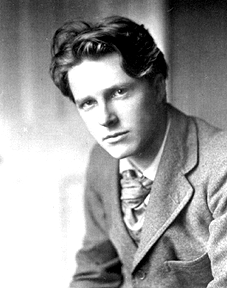
Rupert Brooke

Rupert Brooke born 3 August 1887 (d. 1915)

Rupert Brooke was born on August 3, 1887, and died at the age of twenty-seven while on his way to fight at Gallipoli. Because his death followed shortly after the publication of five sonnets extolling the virtues of patriotic sacrifice, Brooke's tragic early death (and, no doubt, his good looks) became inextricably linked in the public mind with his sonnets glorifying war, and a national hero was born.

Academic and literary executors have long tried to play down Rupert Brooke's attraction to men - often underplaying its importance and dismissing that side of his sexuality as schoolboy crushes, however there is considerable evidence in Brooke's writing of his lasting attraction to men - beginning with two schoolboy crushes with Charles Lascelles and Michael Sadleir. Brooke's love for these two boys was deeply felt (particularly in the case of Lascelles), but it was not until the age of twenty-two that he engaged in sex with another man, Denham Russell Smith, the younger brother of a friend. In July 1912, a few days following Smith's death from an infection, Brooke described his seduction of Smith in surprising detail in a letter to James Strachey.

Throughout his life, Brooke had close friends who were homosexual, and usually in love with him. As a schoolboy at Rugby, he was befriended by the aesthetic poet John Lucas-Lucas. At Cambridge, his best friend was James Strachey, who worshiped him. Even after suffering a nervous breakdown and denouncing Bloomsbury in 1912, Brooke only replaced one set of homosexual friends with another. His best friend at the end of his life was Edward Marsh, who was as much in love with him as Strachey had been.

Brooke makes abundant references to same-sex affection in his letters to James Strachey, which were kept out of print by Brooke's executors until 1998 for that very reason. Brooke was apparently bisexual, however, rather than homosexual, for his torturous relationships with women have been well documented. Unable to label himself bisexual, Brooke always felt emotionally and sexually displaced.

The poetry for which Brooke is most famous tends to involve impersonal matters, but his earliest poems, which seem more autobiographical in nature, were almost certainly written for the primary love of his youth (and, some critics have claimed, the real love of his life), Charles Lascelles.

Brooke's friends complained that the heroic myth of Brooke's patriotic self-sacrifice was deliberately exaggerated to encourage more young men to enlist. Generations of schoolchildren were taught the opening lines of his most famous poem The Soldier "If I should die, think only this of me:/ That there's some corner of a foreign field/That is for ever England." The patriotism of his poems contrasts strongly with the anti-war poetry of the often even younger poets who served in Europe.

Brooke's death was caused not by the bullet or bomb, but from septic pneumonia caused by an infected mosquito bite . Due to the hurry to get to Gallipoli, he was buried and remains on the Greek island of Skyros - perfectly encapsulating the sentiment of his famous poem.

Labels: ,

Thursday, July 22, 2010

James Whale

James Whale born 22 July 1889 (d. 1957)

James Whale was born in Dudley, the sixth of seven children. Thought not to be strong enough to follow his father and brothers into the local heavy industries, he trained as a cobbler. Having discovered some talent for illustration, he used his additional income to pay for evening classes at the Dudley School of Arts and Crafts.

In 1915, during World War I, he enlisted in the army and was commissioned a Second Lieutenant. He was taken prisoner of war in 1917, and while imprisoned, discovered a talent for staging theatrical productions. After the war, he returned to Birmingham and embarked on a professional stage career. In 1928, he was given the opportunity to direct two fringe performances of R. C. Sherriff's then unknown First World War play Journey`s End, staring the then also largely unknown Laurence Olivier. The production was such a huge success that it transferred to the West End where it played for 600 performances. Whale was invited to direct the Broadway transfer of the play and subsequently, the Hollywood film version in 1930.

His second film was the first version of Waterloo Bridge - later remade with Olivier and Vivien Leigh. But Whale is best known for his extraordinary and pioneering work in the horror genre - for his third film was Frankenstein (1931).

He subsequently directed The Old Dark House (1932), The Invisible Man (1933) and Bride of Frankenstein (1935) - all extraordinary and groundbreaking films; apparently influenced by German silent cinema, Whale was one of the first directors ever to move the camera through the shot, creating a new fluidity of movement.

His other notable films include the 1936 version of Showboat and The Man In The Iron Mask (1939) - many of his other films were unsuccessful and have faded into obscurity. He walked away from directing in the early 1940s.

A novel about James Whale The Father of Frankenstein by gay writer Christopher Bram formed the basis for the film Gods and Monsters (1998) in which Ian McKellen played Whale.

In 1929, Whale and David Lewis, a young story editor and later a producer, began a relationship that lasted more than two decades. Although their sexual relationship was an open secret, they lived rather cautiously discreet lives among the English colony in Hollywood. The sexual component of their relationship ended in the early 1950s, but they remained friends until Whale's death. Whale is sometimes described as a closet homosexual, but for the time, he lived quite openly as a gay man in Hollywood.

In later life, he suffered a series of strokes which left him with memory problems and suffering from depression and loneliness - he seemed unable to put his war experiences behind him. He committed suicide by drowning in his swimming pool in 1957 - he was 67. For years, his death was shrouded in mystery as his suicide note, which read: 'The future is just old age and illness and pain ... I must have peace and this is the only way ...' was withheld until by Lewis, until his own death many years later.

Labels: , , ,

Thursday, June 24, 2010

Horatio Herbert (Lord) Kitchener

Horatio Herbert (Lord) Kitchener born 24 June 1850 (d. 1916)

He never married and appreciated porcelain, fine fabrics and interior decor, but it is disputed whether Horatio Kitchener was gay or was just more interested in empire than the opposite sex.

The hero of Sudan and the Boer war, whose portrait encouraged millions to enlist for the first world war, has been declared gay by several historians. Little was known about his sexual preferences, although a contemporary journalist remarked that Kitchener 'has the failing acquired by most of the Egyptian officers, a taste for buggery'. Source: The Guardian

Great moustache, great poster. His death in 1916 - the ship he was travelling on HMS Hampshire struck a mine near Scapa Flow on a diplomatic mission to Russia - was a momentous event to World War I Britain.

Naturally, conspiracy theories abound. His body was never recovered.

Labels: , , ,

Thursday, December 18, 2008

Saki (Hector Munro)

Saki (Hector Munro) born 18 December 1870 (d. 1916)

Saki was the pen name of British author Hector Hugh Munro, whose witty and sometimes macabre stories satirised Edwardian society and culture. Saki's world contrasts the effete conventions and hypocrisies of Edwardian England with the ruthless but straightforward life-and-death struggles of nature. Nature generally wins in the end.

Saki is considered a master of the short story. His stories are always short and the good ones are exquisitely memorable, with delicately drawn characters and finely judged narratives.

H. H. Munro was born in Burma (now known as Myanmar), the son of Charles Augustus Munro, an inspector-general for the Burmese police when that country was still part of the British Empire. His mother died in 1872, killed, essentially, by a runaway cow. It charged at her, the shock of which caused her to miscarry, losing her life and that of the baby. It was an incident that may have influenced the sometimes deadly animals of his later stories. He was brought up in England with his brother and sister by his grandmother and aunts in a straitlaced household whose comic side he appreciated only later in life. He used the severity of these domestic arrangements in many stories.

Munro was educated at school in Exmouth and the Bedford Grammar School. In 1893 he followed in his father's footsteps by joining the Burma police. Three years later, failing health forced his resignation and return to England, where he started his career as a journalist.

In 1900 Munro's first book appeared, The Rise of the Russian Empire, a historical study modelled upon Edward Gibbon's famous The Decline and Fall of the Roman Empire. It was followed in 1902 by Not-So-Stories, a collection of short stories and a clear reference to Rudyard Kipling's Just-So Stories.

From 1902 to 1908 Munro worked as a foreign correspondent for The Morning Post in the Balkans, Russia, and Paris, then settled in London. Many of the stories from this period feature the elegant and effete Reginald and Clovis, young men-about-town who take heartless and cruel delight in the discomfort or downfall of their conventional and pretentious elders.  On the eve of the Great War, he published a 'what-if" novel, When William Came, imagining the eponymous German emperor conquering Britain.

At the start of World War I, although officially over age, Munro joined the Army as an ordinary soldier, refusing a commission. He returned to the battlefield more than once when officially still too sick or injured to fight. He was killed in France, near Beaumont-Hamel, in 1916. Munro was sheltering in a shell crater when he was killed by a German sniper. His last words, according to several sources, were, 'Put that damned cigarette out!' After his death, his sister Ethel destroyed most of his papers and wrote her own account of their childhood.

He never married. A J Langguth in his biography produces strong evidence to support the hypothesis that Munro was homosexual. Munro was guarded except in one or two of his stories and most of his readers would probably have been shocked had they known that his pen name refers to a cupbearer or beautiful boy and carries esoteric homoerotic connotations.

In the social climate of Edwardian Britain, in the years after the downfall of Oscar Wilde, Munro would have had every reason, social and psychological, to keep silent about 'the love that dares not speak its name'.

Labels: , , ,

Thursday, November 27, 2008

Edmund John

Edmund John born 27 November 1883 (d. 1917)

Edmund John was a British poet of the Uranian school whose verses were modelled on the Symbolist poetry of Swinburne and other earlier poets. Much of his work was condemned by critics for being overly decadent and unfashionable.

He fought in the First World War, but was invalided out in 1916. He died at Taormina, in Sicily, a year later.

Labels: , ,

Tuesday, November 11, 2008

In Flanders fields the poppies blow
Between the crosses, row on row,
That mark our place; and in the sky
The larks, still bravely singing, fly
Scarce heard amid the guns below.

We are the Dead. Short days ago
We lived, felt dawn, saw sunset glow,
Loved, and were loved, and now we lie
In Flanders Fields.

Take up our quarrel with the foe:
To you from failing hands we throw
The torch; be yours to hold it high.
If ye break faith with us who die
We shall not sleep, though poppies grow
In Flanders Fields.

In Flanders Fields by John McCrae

The Royal British Legion

Labels: , ,