Friday, June 03, 2011

Allen Ginsberg

Allen Ginsberg born 3 June 1926 (d. 1997)

Irwin Allen Ginsberg was an American Beat poet. Ginsberg is best known for Howl (1956), a long poem about the self-destruction of his friends of the Beat Generation and what he saw as the destructive forces of materialism and conformity in United States at the time.

Ginsberg was born into a Jewish family in Newark, New Jersey. His father Louis Ginsberg was a poet and a high school teacher. Ginsberg's mother, Naomi Levy Ginsberg (who was affected by epileptic seizures and mental illnesses such as paranoia) was an active member of the Communist Party USA and often took Ginsberg and his brother Eugene to party meetings. Ginsberg later said that his mother 'Made up bedtime stories that all went something like: "The good king rode forth from his castle, saw the suffering workers and healed them."'

As a teenager, Ginsberg began to write letters to The New York Times about political issues such as World War II and workers' rights. While in high school, Ginsberg began reading Walt Whitman; he said he was inspired by his teacher's passion in reading.

In Ginsberg's freshman year at Columbia he met fellow undergraduate Lucien Carr, who introduced him to a number of future Beat writers including Jack Kerouac, William S. Burroughs, and John Clellon Holmes. They bonded because they saw in one another excitement about the potential of the youth of America, a potential which existed outside the strict conformist confines of post-WWII McCarthy-era America. Ginsberg and Carr talked excitedly about a 'New Vision' (a phrase adapted from Arthur Rimbaud) for literature and America. Carr also introduced Ginsberg to Neal Cassady, for whom Ginsberg had a long infatuation. Kerouac later described the meeting between Ginsberg and Cassady in the first chapter of his 1957 novel On the Road. Kerouac saw them then as the dark (Ginsberg) and light (Cassady) side of their 'New Vision'. Kerouac's perception had to do partly with Ginsberg's association with Communism (though Ginsberg himself was never a Communist); Kerouac called Ginsberg 'Carlo Marx' in On the Road. This was a source of strain in their relationship since Kerouac grew increasingly distrustful of Communism.

Also in New York, Ginsberg met Gregory Corso in a bar and introduced him to the rest of his inner circle.

In 1954 in San Francisco, Ginsberg met Peter Orlovsky, a young man of 21 with whom he fell in love and who remained his life-long lover, and with whom he eventually shared his interest in Tibetan Buddhism.

Also in San Francisco Ginsberg met members of the San Francisco Renaissance and other poets who would later be associated with the Beat Generation in a broader sense.

He met Michael McClure at a W. H. Auden reading where they struck up a conversation about William Blake. McClure was planning a poetry reading at the Six Gallery where Robert Duncan's play Faust Foutu had previously been performed. But McClure handed the duties off to Ginsberg. Ginsberg advertised the event as 'Six Poets at the Six Gallery'. One of the most important events in Beat mythos, known simply as 'The Six Gallery reading' took place on October 7, 1955. The event, in essence, brought together the East and West Coast factions of the Beat Generation. Of more personal significance to Ginsberg: that night was the first public reading of Howl, a poem that brought world-wide fame to Ginsberg and many of the poets associated with him.

Ginsberg's principal work, Howl, is well-known to many for its opening line: 'I saw the best minds of my generation destroyed by madness.' Howl was considered scandalous at the time of its publication due to the rawness of its language, which is frequently explicit. Shortly after its 1956 publication by San Francisco's City Lights Bookstore, it was banned for obscenity. The ban became a cause célèbre among defenders of the First Amendment, and was later lifted after a judge declared the poem to possess redeeming social importance.

Though 'Beat' is most accurately applied to Ginsberg and his closest friends (Corso, Orlovsky, Kerouac, Burroughs, etc.), the term 'Beat Generation' has become associated with many of the other poets Ginsberg met and became friends with in the late 1950s and early 1960s. A key feature of this term seems to be a friendship with Ginsberg. (Friendship with Kerouac or Burroughs might also apply, but both writers later strove to disassociate themselves from the name 'Beat Generation') Part of the dissatisfaction with the term 'Beat Generation' came from the mistaken identification of Ginsberg as the leader. Ginsberg never claimed to be the leader. He did, however, claim many of the writers with whom he had become friends in this period shared many of the same intentions and themes.

Later in his life, Ginsberg formed a bridge between the beat movement of the 1950s and the hippies of the 1960s, befriending, among others, Timothy Leary, Ken Kesey, Rod McKuen, and Bob Dylan.

Ginsberg's willingness to talk about taboo subjects is what made him a controversial figure in the conservative 1950s and a significant figure in the 1960s. But Ginsberg continued to broach controversial subjects throughout the 1970s, '80s, and '90s.

One contribution that is often considered his most significant and most controversial was his openness about homosexuality, including his love of youths. Ginsberg was an early proponents of freedom for men who loved other men, having already in 1943 discovered within himself 'mountains of homosexuality'. He expressed this desire openly and graphically in his poetry. He also struck a note for gay marriage by listing Peter Orlovsky, his lifelong companion, as his spouse in his Who’s Who entry. Later homosexual writers saw his frank talk about homosexuality as an opening to speak more openly and honestly about something often before only hinted at or spoken of in metaphor.

Also, in writing about sexuality in graphic detail and in his frequent use of language seen as indecent he challenged — and ultimately changed — obscenity laws. He was a staunch supporter of others whose expression challenged obscenity laws (William S. Burroughs and Lenny Bruce, for example).

He continuously attempted to force the world into a dialogue about controversial subjects because he thought that no change could be made in a polite silence.

Allen Ginsberg died on April 5, 1997, surrounded by family and friends in his East Village loft in New York City. He succumbed to liver cancer via complications of hepatitis. He was 70 years old.

Labels: , , , , ,

Thursday, June 02, 2011

John Lehmann

John Lehmann born 2 June 1907 (d. 1987)

John Frederick Lehmann (born Bourne End, Buckinghamshire) was an English poet and man of letters, and one of the foremost literary editors of the twentieth century, founding the periodicals New Writing and The London Magazine.

The son of journalist Rudolph Lehmann, and brother of actress Beatrix Lehmann and novelist Rosamond Lehmann, he was educated at Eton and read English at Trinity College, Cambridge, his time at both of which he considered 'lost years'.

In 1928 he had a slim volume of his poems privately printed , but the next volume of verse was published by Leonard and Virginia Woolf's Hogarth Press. The Woolfs offered him an 'apprenticeship' - as dogsbody and secretary - an experience he later caustically documented in Thrown To The Woolfs. In August 1932, he turned his back on the Hogarth Press and departed for Vienna. Part of the legendary Auden generation, he spent the early 1930s in a politically precarious but sexually liberated central Europe, engrossed in leftist politics, artistic pursuits and gay hedonism.

He returned to England to found the popular periodical in book format, New Writing (1936-1941) which proved of great influence on literature of the period, and an outlet for writers such as Christopher Isherwood and W H Auden.

After re-establishing relations with the Woolfs, he returned as managing director of Hogarth Press between 1938 and in 1946 he created his own firm John Lehmann Ltd with his sister Rosamond, publishing new works by authors such as Sartre and Stendhal, and discovering talents like Thom Gunn and Laurie Lee. The venture was not a commercial success however.

In 1954 he founded The London Magazine, remaining as editor until 1961, following which he was a frequent lecturer in the US in the late 1960s and early 1970s, and completed his three volume autobiography, Whispering Gallery (1955), I Am My Brother (1960), The Ample Proposition (1966).

In The Purely Pagan Sense (1976) is an autobiographical record of his homosexual love life in England and pre-war Germany, discreetly written in the form of a novel. He also wrote the biographies Edith Sitwell (1952), Virginia Woolf and Her World (1975), Thrown To The Woolfs (1978) and Rupert Brooke (1980).

In the long run, Lehmann is not so much remembered as a poet as for his influential editorship, his memoirs of inter-war literary life and his volumes of autobiography.

He died in London on 7 April 1987.

Labels: , , , ,

Tuesday, May 31, 2011

Walt Whitman

Walt Whitman born 31 May 1819 (d. 1892)

Walter Whitman was an American poet, essayist, journalist, and humanist. Whitman is among the most influential poets in the American canon, often called the father of free verse. His work was very controversial in its time, particularly his poetry collection Leaves of Grass, which was described as obscene for its overt sexuality.

Born on Long Island, Whitman worked as a journalist, a teacher, a government clerk, and a volunteer nurse during the American Civil War in addition to publishing his poetry. Early in his career, he also produced a temperance novel, Franklin Evans (1842). Whitman's major work, Leaves of Grass, was first published in 1855 with his own money. The work was an attempt at reaching out to the common person with an American epic. He continued expanding and revising it until his death in 1892. After a stroke towards the end of his life, he moved to Camden, New Jersey where his health further declined. He died at age 72 and his funeral became a public event.

Whitman's sexuality is sometimes disputed, although often assumed to be bisexual based on his poetry. The concept of heterosexual and homosexual personalities was invented in 1868, and it was not widely promoted until Whitman was an old man. Whitman's poetry depicts love and sexuality in a more earthy, individualistic way common in American culture before the 'medicalisation' of sexuality in the late 1800s. Though Leaves of Grass was often labelled pornographic or obscene, only one critic remarked on its author's presumed sexual activity: in a November 1855 review, Rufus Wilmot Griswold suggested Whitman was guilty of 'that horrible sin not to be mentioned among Christians'. Whitman had intense friendships with many men throughout his life.

Some biographers have claimed that he may not have actually engaged in sexual relationships with men, while others cite letters, journal entries and other sources which they claim as proof of the sexual nature of some of his relationships.

Biographer David S. Reynolds described a man named Peter Doyle as being the most likely candidate for the love of Whitman's life. Doyle was a bus conductor whom he met around 1866. They were inseparable for several years. Interviewed in 1895, Doyle said: 'We were familiar at once — I put my hand on his knee — we understood. He did not get out at the end of the trip — in fact went all the way back with me.'

A more direct second-hand account comes from Oscar Wilde. Wilde met Whitman in America in 1882, and wrote to the homosexual rights activist George Cecil Ives that there was 'no doubt' about the great American poet's sexual orientation — 'I have the kiss of Walt Whitman still on my lips,' he boasted. The only explicit description of Whitman's sexual activities is second hand. In 1924 Edward Carpenter, then an old man, described an erotic encounter he had had in his youth with Whitman to Gavin Arthur, who recorded it in detail in his journal. Late in his life, when Whitman was asked outright if his series of Calamus poems were homosexual, he chose not to respond.

There is also some evidence that Whitman may have had sexual relationships with women. He had a romantic friendship with a New York actress named Ellen Grey in the spring of 1862, but it is not known whether or not it was also sexual. He still had a photo of her decades later when he moved to Camden and referred to her as 'an old sweetheart of mine'. In a letter dated August 21, 1890 he claimed, 'I have had six children - two are dead'. This claim has never been corroborated. Toward the end of his life, he often told stories of previous girlfriends and sweethearts and denied an allegation from the New York Herald that he had 'never had a love affair'.

In any case, Whitman is one of the first truly working-class poets and an iconic figure in gay literature.

Labels: ,

Monday, May 30, 2011

Countee Cullen

Countee Cullen born 30 May 1903 (d. 1946)

Countee Cullen was an American Romantic poet. Cullen was one of the leading African American poets of his time, associated with the generation of black poets of the Harlem Renaissance.

Cullen was born with the name Countee LeRoy Porter and was abandoned by his parents at birth. He was raised by his grandmother, Mrs Porter, but because he was very secretive about his life, it is unclear where he was actually born. Scholars state he was either born in Louisville, Kentucky, or Baltimore. Later in his life, Cullen said he was born in New York City. It is known that he attended Townsend Harris High School for one year and then transferred to DeWitt Clinton High School in New York and received special honours in Latin studies in 1922.

In 1918 his grandmother died. Cullen was subsequently adopted by Reverend Frederick Ashbury Cullen, minister at Salem Methodist Episcopal Church in Harlem, and thus Cullen was raised a Methodist. Throughout his unstable childhood his birth mother never attempted to contact Cullen, and would not attempt to do so until sometime in the 1920s, after he'd become famous.

Cullen won many poetry contests from a very young age and often had his winning work reprinted. He attended DeWitt Clinton High School, mainly consisting of all white, male students. He became Vice President of his class during his senior year, was also involved in the school magazine as an editor, and was affiliated with the Arista Honor Society.

After completing his secondary education, Cullen attended New York University. While an undergraduate, he published works in various literary magazines, including Harper's, Century Magazine, and Poetry. Also, his writing exceptional faculties were acknowledged with prizes from The Crisis, edited by W. E. B. Du Bois, and Opportunity of the National Urban League. He graduated in 1925. Soon afterwards, he produced his first volume entitled Color and pursued graduate studies at Harvard University.

In April 1928, Cullen married Nina Yolande Du Bois, daughter of the famous W. E. B. Du Bois. Two months after the wedding, Cullen left for Europe with his father and Harold Jackman; his wife followed after a month. He was awarded a Guggenheim Fellowship in 1928.

Nina Yolande Du Bois divorced Cullen two years later, saying that he told her that he was sexually attracted to men.

In 1940, he married Ida Mae Roberson and they enjoyed a seemingly happy marriage.

On January 9, 1946, Cullen unexpectedly died of uremic poisoning and complications from high blood pressure. After his death, for a few years, Cullen was honoured as the most celebrated African American writer. A collection of some of his best work was also arranged in On These I Stand.

The West 136th Street branch of the New York Public Library in Harlem is named after Countee Cullen

Labels: , , ,

Wednesday, May 18, 2011

Robin Blaser

Robin Blaser born 18 May 1925 (d. 2009)

Robin Francis Blaser was a noted author and poet in both the United States and Canada.

Born in Denver, Colorado, Blaser grew up in Idaho, and came to Berkeley, California in 1944. There he met Jack Spicer and Robert Duncan, becoming a key figure in the so-called San Francisco Renaissance of the 1950s and early 1960s. He moved to Canada in 1966, joining the faculty of Simon Fraser University; in his later years he held the position of Professor Emeritus and lived in British Columbia with his partner of 30+ years, David Farwell.

In June of 1995, for Blaser's 70th birthday, a conference was held in Vancouver, Canada to pay tribute to his contribution to Canadian poetry. The conference was attended by poets from Canada, the US and around the world.

Robin Blaser was also well known as the editor of The Collected Books of Jack Spicer, which includes Blaser's essay 'The Practice of Outside'. The 1993 publication The Holy Forest represents his collected poems to that date. In 2006, Blaser received a special Lifetime Recognition Award given by the trustees of the Griffin Trust for Excellence in Poetry, which also awards the annual Griffin Poetry Prize.

Blaser died of a brain tumour on May 7, 2009, in Vancouver, at age 83.

Labels: , , , ,

Thursday, May 12, 2011

Edward Lear

Edward Lear born 12 May 1812 (d. 1888)

Although a talented illustrator and painter, Edward Lear is best known for his nonsense verse. His poetry demonstrates a defining love of eccentricity, verbal invention and poetic delight in the sound of words. His best known poem is The Owl & The Pussycat.

He enjoyed poor health most of his life, suffering from epilepsy, asthma, bronchitis, and in later life, partial blindness. Although there a few clues in some of his work, the clearest indications of his attraction to other men are in his letters and diaries of the 1850s-70s. However, his lack of any relationships beyond mere longing and the nature of his verse and ironically sad life have encouraged some critics to see him as a shy heterosexual or completely unsexual.

Labels: , , , , ,

Friday, April 29, 2011

Rod McKuen

Rod McKuen born 29 April 1933

Rod McKuen is a bestselling American poet, composer and singer, instrumental in the revitalisation of popular poetry in the late 1960s and early 1970s.

Born in Oakland, California, he ran away from home at an early age to avoid an alcoholic stepfather and after a series of drifter jobs throught the West and a spell with the army in Korea, began to find an audience with his poetry in the 1950s, eventually appearing with Beat poets such as Jack Kerouac and Allen Ginsberg.

After moving to New York in 1959, he found great success in the 1960s with his poetry and songs. He spent much time in France working with and translating the work of his friend Jacques Brel.

In the late 1960s, McKuen managed to capture in verse the feelings of the student generation in opposition to the Vietnam war and his readings were attended like rock concerts.

He has written many hundreds of songs, including two albums for Frank Sinatra, and collaborated with many including Henry Mancini and John Williams. He has sold millions of albums and written orchestral and film music - his scores for The Prime of Miss Jean Brodie (1969) and A Boy Named Charlie Brown (1970) were Oscar nominated.

A major spell of clinical depression in the 1980s made him withdraw from the limelight. He has long since returned to activity but in a more low-key way and now making full use of the Internet.

Always a performer with a social conscience, he has gone from fighting the Vietnam war and apartheid and on to work for AIDS awareness.

Rod McKuen has a partner of 45 years standing.

"It doesn't matter who you love, or how you love, but that you love." - Rod McKuen

Labels: , , ,

Monday, April 25, 2011

James Fenton

James Fenton born 25 April 1949

James Fenton has been, at various times, a journalist, poet, literary critic, and professor.

Fenton grew up in Lincolnshire and Staffordshire. He was educated at Repton School, where he grew fond of the work of W H Auden, who proved to be the greatest influence of Fenton's own output. After graduating from Repton, Fenton attendended Magdalen College, Oxford to study English. He was already experimenting with and winning prizes for his poetry. He earned a BA from Magdalen in 1970.

His first collection, Terminal Moraine (1972) was well received and won a Gregory Award. He used the money to travel to the Far East where he witnessed the aftermath of America's withdrawal from Vietnam and the collapse of the Lon Nol regime in Cambodia which presaged the rise of Pol Pot. In 1976 Fenton returned to London and became political correspondent for the New Statesman. The Memory of War (1982), drawing on his experience in the Far East, secured his reputation as one of the finest poets of his generation and marked the climax of a new generation of English poets. He won the Geoffrey Faber Memorial Prize in 1984 for Children in Exile: Poems 1968-1984 and in 1994 Fenton became Professor of Poetry at Oxford, a position he held until 1999. He is currently a regular contributor to the The New York Review of Books and The Guardian.

Fenton's unsettling use of traditional form to confront contemporary events, combined with images of comedy and violence is evident in poems such as Out of the East and The Ballad of the Shrieking Man. Nonsense verse has always formed a part of Fenton's output and in these poems he employs its metrical and linguistic energy to explore the nightmarish scenarios of war; the jaunty rhythms of Kipling turned into the hysteria of apocalypse. Alongside these are more personal poems of love and regret such as In Paris with You which teeters beautifully between irony and romance.

Fenton worked on the New Statesman with Martin Amis, Christopher Hitchens and Ian McEwan during the 1970s. He remains friends with them all.

Fenton's Selected Poems was published in February 2006 by Penguin and in October 2006 by Farrar, Straus and Giroux. He also recently edited The New Faber Book of Love Poems.

On 23 April 2007 it was announced from Buckingham Palace that he had been awarded The Queen's Gold Medal for Poetry for 2007. In May 2007 he was placed on the list of the 100 most influential gay and lesbian people in Britain by The Independent.

His partner is Darryl Pinckney, a writer.

James Fenton - Official Website

Labels: , , , ,

Thursday, April 21, 2011

James Kirkup

James Kirkup born 21 April 1918 (d. 2009)

James Kirkup was a prolific English poet, Japanese scholar, translator, and travel writer. He was brought up in South Shields, and educated at Durham University. He wrote over 30 books, including an autobiography and plays.

During World War II he was a conscientious objector, and worked on the land in the Yorkshire Dales. He taught at The Downs School in Colwall, Malvern, where W H Auden had earlier been a master. Kirkup wrote his first book of poetry, The Drowned Sailor at the Downs, which was published in 1947. From 1950 to 1952 he was the first Gregory Poetry Fellow at Leeds University, making him the first resident university poet in the United Kingdom.

In 1952 he moved south to Gloucestershire and became visiting poet at Bath Academy of Art for the next three years. Moving on from Bath, he taught in a London grammar school before leaving England in 1956 to live and work in Europe, the Americas and the Far East. In Japan, he found acceptance and appreciation of his work, and he settled there for 30 years, lecturing in English Literature at several universities.

His poem The Love That Dares To Speak Its Name, which describes a sexual fantasy of a homosexual soldier for the dead Christ, was banned in 1979 under the UK's rarely invoked blasphemy laws after it was published by Gay News in 1976.

The blasphemous libel charge named Gay News Ltd and the publisher, Denis Lemon and was brought by self-appointed media watchdog, Mary Whitehouse, founder and first president of the National Viewers' and Listeners' Association. Following the trial Lemon received a nine-month suspended jail sentence.

This still genuinely shocking poem is accessible via the Internet but is still technically banned in the UK. In 1996, the NVLA attempted to prosecute Lesbian and Gay Christian Association when it posted a hyperlink to the poem on its website. In 1997, the charges against the Lesbian and Gay Christian Association were formally dropped.

Amongst his honours, Kirkup held the Atlantic Award for Literature from the Rockefeller Foundation in 1950; he was elected the Fellow of the Royal Society of Literature in 1962; he won the Japan PEN Club Prize for Poetry in 1965; and was awarded the Scott Moncrieff Prize for Translation in 1992.

In 1997 he was presented with the Japan Festival Foundation Award and invited by the Emperor and Empress to the Imperial New Year Poetry Reading at the Palace in Tokyo.

In the early 1990s Kirkup settled in Andorra. He continued his prolific work and correspondence, notably becoming a frequent contributor to the obituary section of the British newspaper The Independent until 2008.

Kirkup died in Andorra on 10 May 2009.

Labels: , ,

Sunday, April 17, 2011

C P Cavafy

C P Cavafy born 17 April 1863 (d. 1933)

Constantine P Cavafy was a major Greek poet who worked as a journalist and civil servant.

He has been called a sceptic and a neo-pagan. In his poetry he examines critically some aspects of Christianity, patriotism, and homosexuality, though he was not always comfortable with his role as a nonconformist. He published 154 poems; dozens more remained incomplete or in sketch form. His most important poetry was written after his fortieth birthday.

Cavafy was born in Alexandria, Egypt, to Greek parents, and was baptised into the Greek Orthodox Church. His father was a prosperous importer-exporter who had lived in England in earlier years and acquired British nationality. After his father died in 1870, Cavafy and his family settled, for a while, in Liverpool. Cavafy moved back to Alexandria in 1877, after the family faced financial problems in the crash of 1876.

Disturbances in Alexandria in 1882 caused the family again temporarily to move, this time to Constantinople. In 1885, Cavafy returned to Alexandria, where he lived for the rest of his life. He worked first as a journalist, then for the British-run Egyptian Ministry of Public Works for thirty years. (Egypt was a British protectorate until 1926.)

From 1891 to 1904 he published his poetry in broadsheet form, only for his close friends, receiving whatever acclaim mainly within the Greek community in Alexandria. He was introduced to mainland-Greek literary circles through a favourable review by Xenopoulos in 1903, but got little recognition, his style being very different from then-mainstream Greek poetry. Years later, a new generation of almost nihilist Greek poets would find inspiration in Cavafy's work.

Cavafy has been instrumental in the revival and recognition of Greek poetry both at home and abroad. His poems are, typically, concise but intimate evocations of real or literary figures and milieux that have played a role in Greek culture. Uncertainty about the future, sensual pleasures, the moral character and psychology of individuals, homosexuality, and a fatalistic existential nostalgia are some of the defining themes.

Besides his subjects, unconventional for the time, his poems also exhibit a skilled and versatile craftsmanship, which is almost completely lost in translation. Cavafy was a perfectionist, obsessively refining every single line of his poetry. His mature style was a free iambic form, free in the sense that verses rarely rhyme and are usually from 10 to 17 syllables. In his poems, the presence of rhyme usually implies irony.

Cavafy drew his themes from personal experience, along with an enormous knowledge of history, especially of the Hellenistic era. Many of his poems are either pseudo-historical, or seemingly historical, or accurately, but quirkily, historical.

One of Cavafy's most important works is his 1904 poem Waiting for the Barbarians. The work signifies that cultivation of fear of an invisible external enemy usually serves internal purposes and has recently been employed to draw parallels to the war on terror. Read this poem here

As well as his historical poems Cavafy wrote a large number of erotic and sensual poems filled with lyricism and emotion; inspired by recollection and remembrance. He also wrote many philosophical poems that mused on human states of being.

He died of cancer of the larynx on April 29, 1933, his 70th birthday.

Since his death, Cavafy's reputation has grown. One of his greatest supporters was the author E M Forster, who did much to promote awareness of Cavafy's work in the English-speaking world. He is now considered one of the finest modern Greek poets and his poetry is taught at schools in mainland Greece and throughout the world in Universities.

Labels: ,

Thursday, March 31, 2011

Edward FitzGerald

Edward FitzGgerald born 31 March 1809 (d. 1883)

Edward Marlborough FitzGerald was an English writer, best known as the poet of the first and most famous English translation of Rubáiyát of Omar Khayyám.

Edward FitzGerald was born near Woodbridge, Suffolk. He was one of eight children and his parents owned a number of estates in England and Ireland. He was educated at the King Edward VI Grammar School and Trinity College, Cambridge.

He spent most of his life in Suffolk where he lived the life of a country gentleman rarely travelling, except to London. He lived for sixteen years on his family estate at Boulge and spent the remainder of his life in Woodbridge.

In 1850 he married the daughter of the poet Bernard Barton whose biography he had penned previously. The marriage appears to have been an 'unhappy' one and they separated after only a few months. After learning Spanish privately he produced blank-verse translations of six poems by Calderon (1853). His developing fascination with Persian poetry led him to translate a series of works. Salaman and Absal, an allegory by Kami was published anonymously in 1856 followed in 1859 by his most celebrated work, translations from the Rubaiyat.

His warm personality and sophisticated wit earned him the friendship of many great writers including William Thackery, Alfred Tennyson and Thomas Carlyle. Tennyson was to dedicate his poem Tiresias to Fitzgerald. He left a legacy of delightful letters, bursting with anecdotes concerning his literary acquaintances, which were edited and published after his death.

FitzGerald's homosexuality has been well-known since at least 1970, when H Montgomery Hyde published The Love That Dared Not Speak Its Name. An entire book documenting FitzGerald's passionate affair with a fisherman named Joseph Fletcher was published in 1908 (James Blyth, Edward FitzGerald and Posh). He was previously enamored, at 23, of a teenage youth named Kenworthy Browne, whose tragic early death while riding left Fitzgerald heartbroken. FitzGerald became a dedicated sailor, and his later years were passed among various fishermen and friends along the coast. It has to be admitted however that there remains some doubt as to whether FitzGerald's intense love for his various male friends ever found physical expression.

Labels: , ,

Wednesday, March 30, 2011

Paul Verlaine

Paul Verlaine born 30 March 1844 (d. 1896)

One of the greatest and most popular French poets, bisexual Paul Verlaine was born in Metz, but educated in Paris where he started writing poetry early. He published his first volume in 1867 aged 23 and was soon recognised as a poet of promise and orginality.

His private life and his work are inextricably linked, beginning with his love for Mathilde Maute, who became his wife. He eventually lost interest in her after he paired up with a young poet who hero-worshipped him and became his drinking buddy and lover - Arthur Rimbaud.

Together they travelled widely throughout Europe but Verlaine brought their volatile affair to an abrupt halt in 1873 when he shot Rimbaud in a drunken jealous rage. Rimbaud survived but Verlaine was eventually arrested, subjected to a brutal internal examination to identify the nature of their relationship and sentenced to two years imprisonment at Mons. There, he underwent a religious conversion and his ensuing work took on a mystical spiritual bent.

On his release, Verlaine travelled to England where he continued to write and teach. On returning to France in 1877 to teach English, he became infatuated with a pupil named Lucien Letinois, but was devastated when the boy died of typhoid.

Verlaine's final years saw a decline into poverty and alcoholism - although his enthusiam for younger men remained with him. He continued to be recognised as a ground-breaking poet and did much to preserve the poetic reputation of his former lover, Rimbaud, who died aged 37 in 1891.

His best known poem is probably Chanson d`automne, largely thanks to its use as a code message for the Allies during WW2. His poetry has also proved popular with composers - Gabriel Faure set several to music. A heavy drinker and plagued with poor health in later years, he remained a prolific writer passionately dedicated to sensuality and poetry.

Labels: , ,

Sunday, March 27, 2011

Frank O'Hara

Frank O'Hara born 27 March 1926 (d. 1966)

Francis Russell O'Hara was an American poet who, along with John Ashbery and James Schuyler was a key member of what was known as the New York School of poetry.

Frank O'Hara was born at Maryland General Hospital, Baltimore and grew up in Grafton, Massachusetts. He attended St John's High School in Worcester. He studied piano at the New England Conservatory in Boston from 1941 to 1944. O'Hara served in the South Pacific and Japan as a sonarman on the destroyer USS Nicholas during World War II.

With the funding made available to veterans he attended Harvard University. Although he majored in music and did some composing, his attendance was irregular and his interests disparate. He regularly attended classes in philosophy and theology, while writing impulsively in his spare time. O'Hara was heavily influenced by visual art, and by contemporary music, which was his first love (he remained a fine piano player all his life and would often shock new partners by suddenly playing swathes of Rachmaninoff when visiting them).

While at Harvard, O'Hara met John Ashbery and began publishing poems in the Harvard Advocate. Despite his love for music, O'Hara changed his major and graduated from Harvard in 1950 with a degree in English.

He then attended graduate school at the University of Michigan in Ann Arbor. While at Michigan, he won a Hopwood Award and received his MA in English literature 1951. That autumn O'Hara moved into an apartment in New York City with Joe LeSueur, who would be his roommate and sometimes his lover for the next 11 years. Known throughout his life for his extreme sociability, passion, and warmth, O'Hara had hundreds of friends and lovers throughout his life, many from the New York art and poetry worlds. Soon after arriving in New York, he was employed at the front desk of the Museum of Modern Art and began to write seriously.

O'Hara was active in the art world, working as a reviewer for Art News, and in 1960 was made Assistant Curator of Painting and Sculpture Exhibitions for the Museum of Modern Art. He was also friends with artists like Willem de Kooning, Norman Bluhm, Larry Rivers and Joan Mitchell.

O'Hara died in an accident on Fire Island in which he was struck and seriously injured by a man speeding in a beach buggy during the early morning hours of July 24, 1966. He died the next day of a ruptured liver at the age of 40 and was buried in the Green River Cemetery on Long Island.

Labels: , , ,

Saturday, March 26, 2011

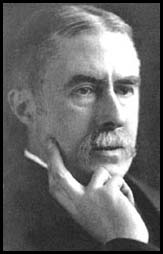
A E Housman

A E Housman born 26 March 1859 (d. 1936)

To mainstream readers of poetry, A E Housman was the much admired of author of two best-selling collections, A Shropshire Lad (1896) and Last Poems (1922), whose texts were taken as universal statements. But for all its universality, Housman's poetry is deeply rooted in homosexual experience and consciousness, and even reflects gay history.

Those 'in the know' were always aware of this, for despite being forced to write in code Housman was reasonably bold, and it would appear from some of his poems and from the work of his brother Laurence, his literary executor and also gay, that Housman wrote the bulk of his work for a secret and oppressed homosexual readership. Housman is unusual in that he not only wrote a large amount of private work of a more open nature, but it was not destroyed. In fact, Laurence assembled two further volumes from his brother's surviving manuscripts - More Poems (1936) and Additional Poems (1937). Laurence also wrote an essay circa 1940 about his brother's life and work in which he spoke openly about his homosexuality. This work, along with diaries and other surviving documents were left in the care of the British Museum in 1942 on the understanding that they would not be made public for twenty-five years. 1967 was an appropriate year to blow open the truth about one of the best loved English poets of his generation.

The inspiration for Housman's poetry comes from two sources - the unrequited love (and lifelong friendship) he had for a fellow student named Moses Jackson; he also had a brief affair and long friendship with Moses' brother, Adalbert. The second driving force behind his work was his anger at the treatment of homosexuals, particularly the public hostility generated by the Wilde trial, and the ensuing need for secrecy that followed for decades. Housman wrote as openly as he could.

So if you read all those poems in A Shropshire Lad that talk of 'lads', 'fellows' and 'comrades' , don't be under any illusions what he was really talking about...

The street sounds to the soldiers' tread,
And out we troop to see:
A single redcoat turns his head,
He turns and looks at me.

My man, from sky to sky's so far,
We never crossed before;
Such leagues apart the world's ends are,
We're like to meet no more;

What thoughts at heart have you and I
We cannot stop to tell;
But dead or living, drunk or dry,
Soldier, I wish you well.

from A Shropshire Lad

Labels: ,

Friday, March 18, 2011

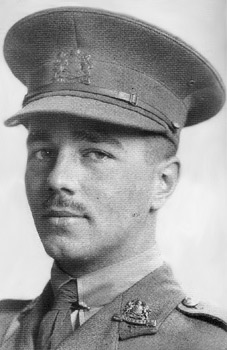
Wilfred Owen

Wilfred Owen born 18 March 1893 (d. 1918)

Born in Oswestry in Shropshire, the Owen family lived in a large house owned by his grandfather, but on his death in 1895, the family were forced to move to lodgings in Birkenhead. He was educated at the Birkenhead Institute and at Shrewsbury Technical College.

Shortly after leaving school in 1911, he passed the entrance exam for the University of London, but failed to achieve a scholarship so worked as an assistant to the Vicar of Dunsden and as a pupil-teacher at a school. He also worked as private tutor at the Berlitz School in Bordeaux, France.

In 1915, he enlisted in the army and, after training, was commissioned as a second lieutenant in the Manchester Regiment.

Owen started the war as a cheerful and optimistic man, but he soon changed forever. Initially, he held his troops in contempt for their loutish behaviour, and wrote to his mother calling his company 'expressionless lumps'. However, Owen's outlook on the war was to be changed dramatically after two traumatic experiences. Firstly, he was blown high into the air by a trench mortar, landing in the remains of a fellow officer. Soon after, he became trapped for days in an old German dugout. After these two events, Owen was diagnosed as suffering from shell shock and sent to Craiglockhart War Hospital in Edinburgh for treatment. While recuperating there he met a fellow poet with whom he would be forever associated - Siegfried Sassoon.

Although he had written poetry for years, his style was changed dramatically by the influence of Sassoon, who encouraged him to write from experience - this combined with his innovative use of rhyme, and his best work was a direct result - incl. Dulce et Decorum Est, Anthem for Doomed Youth & Strange Meeting. There is no evidence that their relationship was closer than friendship, but Owen's letters suggest that he was in love with Sassoon.

Wilfred Owen returned to active duty in France in the summer of 1918. He could have chosen to remain on home-duty, but seems to have taken a symbolic decision to return to the front in place of Sassoon, who had been invalided out of the war by his injuries, that he might continue to document the horrors of war.

Wilfred Owen was killed in battle while attempting to cross the Sambre-Oise Canal with his unit, on November 4th 1918. The war ended a week later. His mother received the telegram on Armistice Day. He was 25 years old. He was posthumously awarded the Military Cross.

Wilfred Owen saw a mere handful of his poems published in his lifetime. Following his death, his work was championed by Sassoon and later, others. The 1960s saw a renewed interest in the poets of the First World War, and Wilfred Owen has come to be regarded as perhaps the leading voice of that doomed generation.

He is generally now accepted as having being homosexual through indications in some of his poems, his circle of friends in London, his letters - although his brother is acknowledged to have destroyed or edited hundreds of these. His sister-in-law, Mrs Harold Owen donated all the manuscripts, documents, photographs and personal effects of Wilfred's that her late husband had owned, to Oxford University in 1975.

Dulce et Decorum Est

Bent double, like old beggars under sacks,
Knock-kneed, coughing like hags, we cursed through sludge,
Till on the haunting flares we turned our backs
And towards our distant rest began to trudge.
Men marched asleep. Many had lost their boots
But limped on, blood-shod. All went lame; all blind;
Drunk with fatigue; deaf even to the hoots
Of tired, outstripped Five-Nines that dropped behind.

Gas! GAS! Quick, boys!-- An ecstasy of fumbling,
Fitting the clumsy helmets just in time;
But someone still was yelling out and stumbling
And floundering like a man in fire or lime.
Dim, through the misty panes and thick green light
As under a green sea, I saw him drowning.

In all my dreams, before my helpless sight,
He plunges at me, guttering, choking, drowning.

If in some smothering dreams you too could pace
Behind the wagon that we flung him in,
And watch the white eyes writhing in his face,
His hanging face, like a devil's sick of sin;
If you could hear, at every jolt, the blood
Come gargling from the froth-corrupted lungs,
Obscene as cancer, bitter as the cud
Of vile, incurable sores on innocent tongues,--
My friend, you would not tell with such high zest
To children ardent for some desperate glory,
The old Lie: Dulce et decorum est
Pro patria mori.

Labels: , ,

Tuesday, March 15, 2011

Lionel Johnson

Lionel Johnson born 15 March 1867 (d. 1902)

Born in Broadstairs, Kent, Lionel Johnson was a leading literary critic of his time, writing the first critical study of Thomas Hardy (1894).

He has earned a particular place in history for introducing his lover to a writer friend - his lover was Lord Alfred Douglas, the friend was Oscar Wilde...

So disgruntled was he with this betrayal that he turned to Catholicism and wrote a sonnet called The Destroyer of a Soul (1892) - 'I hate you with a necessary hate...'

The following year he wrote what is regarded as his finest work The Dark Angel (1893) - an anguished work inspired by his homosexuality.

He lived a rather solitary life in London, struggling with alcoholism and his repressed homosexuality.

Having lived long enough to see his rival in love get more than his comeuppance, he cracked his head open falling off a barstool in 1902. He was just 35 years old.

Labels: , , , , ,

Monday, March 14, 2011

Count Eric Stenbock

Eric Stenbock born 14 March 1860 (d. 1895)

'Scholar, connoisseur, drunkard, poet, pervert, most charming of men' - W. B. Yeats.

Count Eric Stanislaus (or Stanislaus Eric) Stenbock was a Baltic German poet and writer of macabre fantastic fiction.

Stenbock was the Count of Bogesund and the heir to an estate in Estonia. He was the son of Lucy Sophia Frerichs, a Manchester cotton heiress, and Count Erich Stenbock, of a distinguished Baltic German noble family with Swedish roots.

Stenbock's father died suddenly while he was one year old; his properties were held in trust for him by his grandfather. Eric's paternal grandfather died while Eric was quite young, also, in 1866, leaving him another trust fund.

Stenbock attended Balliol College in Oxford but never completed his studies. While at Oxford, Eric was deeply influenced by the homosexual Pre-Raphaelite artist and illustrator Simeon Solomon. He is also said to have had a relationship with the composer and conductor Norman O'Neill and with other 'young men'.

In Oxford, Stenbock also converted to Roman Catholicism taking for himself the name Stanislaus. Some years later Eric also admitted to having tried a different religion every week in Oxford. At the end of his life, he seemed to have developed a composite religion containing elements of Catholicism, Buddhism and idolatry.
In 1885, Count Magnus died, upon which Stenbock, as the oldest living male relative, acceded to the status of Count and to the possession of the family's estates in Estonia. Eric travelled to and lived in Kolga, Estonia for a year and a half; he returned to England in the summer of 1887, during which time he sank deeper into alcoholism and drug addiction.

He returned to London and entered into London literary circles with the likes of W. B. Yeats, Aubrey Beardsley, Robert Ross, Charles Shannon, Charles Ricketts, Lionel Johnson and Oscar Wilde - who he rivalled for his sense of exotic decadence.

Stenbock lived in England most of his life, and wrote his works in the English language. He published a number of (now largely forgotten) books of verse (generally morbid, opium-drenched) during his lifetime, including Love, Sleep, and Dreams (1881), and Rue, Myrtle, and Cypress (1883). In 1894, Stenbock published The Shadow of Death, his last volume of verse, and Studies of Death, a collection of short (gothic gay-ish vampyr) stories that were good enough to be the subject of favourable comment by H P Lovecraft.

Stenbock died, either of cirrhosis of the liver, or from a blow to the head from a fall in Brighton. Rumour has it that on April 26th 1895, he died after a drunken incident involving taking a swing at someone with a poker and toppling into the grate. It was the first day of Oscar Wilde's trial. London's society's attention was thus focused elsewhere. His death certificate lists 'sepatic cirrhosis' as the cause of death.

In a macabre final twist, although his body is buried in Brighton, his heart was removed and sent to Estonia, where it was preserved in a glass urn in the family church.

A Secret Kept: A Brief Life of Count Stenbock

Labels: , , , , , ,

Sunday, March 13, 2011

Brian Howard

Brian Howard born 13 March 1905 (d. 1958)

Brian Christian de Claiborne Howard was an English poet, whose work belied a spectacularly precocious start in life; in the end he became more of a journalist, writing for the New Statesman.

He was born to American parents in Hascombe, Surrey, and brought up in London; his father Francis Gassaway Howard was an associate of James Whistler. He was educated at Eton College, where he was one of the Eton Arts Society group including Harold Acton, Oliver Messel, Anthony Powell and Henry Yorke.

He entered Christ Church, Oxford in 1923, not without difficulty. He was prominent in the group later known as the Oxford Wits. He was one of the Hypocrites group that included Harold Acton, Lord David Cecil, L P Hartley and Evelyn Waugh. He allegedly provided the model for Anthony Blanche, the social butterfly in Evelyn Waugh's Brideshead Revisited,

At this time he had already been published as a poet, in A R Orage's The New Age, and the final Sitwell Wheels anthology. He used the pseudonyms Jasper Proude and Charles Orange. His verse also was in Oxford Poetry 1924.

Subsequently he led a very active social life, tried to come to terms with his homosexuality, and published only one substantial poetry collection God Save the King (1930). He was active as a poet during the Spanish Civil War, but did not ultimately invest in his work with seriousness.

During the 1930s he drifted around Europe. He had affairs with various young men before settling on Toni, a young blond German bisexual who he had met in Munich. In September 1935 he and Toni were staying at the same pension as Christopher Isherwood and Klaus Mann, son of Thomas Mann, in Amsterdam. At the start of the war Toni was interned in France but eventually managed to escape to the States, where he married an American, putting distance and an end to their twelve-year relationship.

In 1931, in Germany, Howard had become influenced by novelist Thomas Mann's loathing for Hitler and he filed anti-Hitler articles to the British press. His anti-Nazi stance was further informed by his Jewishness. Later, in 1939, Howard assisted the release of a number of anti-Nazi Germans imprisoned in France.

Brian Howard was often drunk throughout his adult life and alcohol began to become a problem, along with drugs, during his 30s.

In 1940, Howard was recruited into MI5 as an undercover 'outside contact' to report on pro-Nazi personalities. His political acumen must have been respected by MI5 because, in the early years of the war, Howard's dark apprehensions from the 1930s were reflected in a series of sophisticated anti-Nazi propaganda scripts that he wrote for BBC radio. These scripts were some of the earliest to broadcast the facts of the genocidal 'eugenics programme' of the Third Reich. Following his dismissal from MI5 in 1942 he served in a low-key role in the RAF.

During this time, he renewed his acquaintance with the spy Guy Burgess, a fellow Old Etonian and also a BBC correspondent. Burgess, one of the Soviet Union's 'Cambridge Five' spy ring, had studied at Trinity College, Cambridge, and he and Oxonian Howard knew each other in 1937 in Germany.

In the autumn of 1943 Brian Howard started a relationship with Sam, a nineteen-year-old Irishman, and in command of an Air-Sea Rescue Launch. In June 1944 Brian Howard began being checked over for health problems at RAF Halton, and in December 1944 he was given an honourable discharge from the RAF for being 'below Air Force physical standard, although fit for selected employment in civil life'. Sam was invalided out of the Navy because of foot trouble and he got a job at the BBC.

Brian Howard wondered what he was going to do next and spent his time writing book reviews for the New Statesman. After the war he continued to drift with Sam. They lived in France for a while but in 1950 Howard was unexpectedly expelled as an 'undesirable' and they fled to Italy and then travelled around Austria and Germany.

Brian Howard's health failed during the 1950s and he relied on sedatives. He had tuberculosis that he said he had contracted in Spain, and his alcoholism was taking its toll. He and Sam continued to wander around Europe looking for a home. They spent some time in Tangier in the spring of 1954 where Brian Howard was curing his addiction to alcohol but becoming dependent on drugs.

In June 1954 he received a letter from Paris saying that he would be allowed to return to France, although more complications arose and doubts continued about whether either Brian Howard or Sam could have a visa. Both were still keen to settle in France and Howard's mother used an inheritance to buy a house near Nice. Brian Howard and Sam moved into the house at the beginning of January 1958 but disaster struck within two weeks of their arrival. In the morning of 11 January 1958 Sam went to have a bath but workmen had removed an exhaust pipe from the bathroom and Sam died accidentally of asphyxiation from fumes from a gas heater. He was 32. Four days later Brian Howard killed himself by taking an overdose of sedatives. He was 52. After a double funeral they were buried together at the Caucade de Nice cemetery.

Labels: , , , , , ,

Monday, March 07, 2011

Robert de Montesquiou

Robert de Montesquiou born 7 March 1855 (d. 1921)

Marie Joseph Robert Anatole, Comte de Montesquiou-Fezensac was a French Symbolist poet, art collector and dandy. With many homosexual friends, he is reputed to have been the inspiration both for des Esseintes in J K Huysmans' À rebours and, most famously, for Baron de Charlus in Proust's À la recherche du temps perdu. He wrote the verses found in the optional choral parts of Gabriel Fauré's Pavane.

His portrait Arrangement in Black and Gold: Comte Robert de Montesquiou-Fezensac was painted by Whistler in 1891-1892. Antonio de La Gandara produced several portraits of the Comte.

His background was truly aristocratic by birth and he placed a great value on his own intellectual and literary accomplishments. Despite producing a large amount of symbolist poetry, two novels, volumes of memoirs and much literary criticism, he is best remembered for how he lived rather than for what he wrote.

He befriended and supported many artists - who immortalised him in portraiture - poets, writers and musicians, placing himself at the centre of the Parisisan social, artistic and literary worlds. He was also a keen collector of Art Nouveau and was a dandy and aesthete, extravagant in dress, behaviour and lavish living, surrounding himself with bright and attractive young men.

Montesquiou died on the French Riviera in 1921

Portraits of Robert de Montesquiou: James Whistler [top left]; Giovanni Boldini [above right]; Jacques-Emile Blanche [left]

Labels: , ,

Wednesday, March 02, 2011

John Gray

John Gray born 2 March 1866 (d. 1934)

John Gray was an English poet whose works include Silverpoints, The Long Road and Park: A Fantastic Story.

Born in the working-class district of Bethnal Green, London, he is known today mostly as an aesthetic poet of the 1890s and as a friend of Ernest Dowson, Aubrey Beardsley and Oscar Wilde. He was also a talented translator, bringing works by the French Symbolists Mallarmé, Verlaine, Laforgue and Rimbaud into English, often for the first time. Purported to be the inspiration behind the title character in Wilde's The Picture of Dorian Gray, Gray distanced himself from this. His relationship with Wilde was initially intense, but had cooled for over two years by the time of Wilde's imprisonment.

Like many of the artists of that period, Gray was a convert to Roman Catholicism in the late-90s. He left his position at the Foreign Office and studied for the priesthood at the Scots College, Rome and later became a priest at Saint Patrick's and a rector at Saint Peter's in Edinburgh.

His most important supporter, and life partner, was the wealthy poet and early defender and theorist of homosexuality, Marc-André Raffalovich. He continued to write poetry of a high calibre for the rest of his life; later works were mainly devotional and often dealt with various Christian saints. His collected poems, with extensive notes, were printed in a 1988 edition edited by English professor and nineties expert Ian Fletcher.

He died in 1934 at St Raphael's nursing home in Edinburgh after a short illness.

Labels: , , , ,