Tuesday, May 03, 2011

Lindsay Kemp

Lindsay Kemp born 3 May 1938

Lindsay Kemp is a British dancer, actor, teacher, mime artist and choreographer.

Born in South Shields, Kemp was raised in Yorkshire and attended Bradford Art College before studying dance with Hilde Holger and mime with Marcel Marceau.

Kemp formed his own dance company in the early sixties and first attracted attention with an appearance at the Edinburgh Festival in 1968. Despite thirty years of worldwide touring with his company and the occasional film and television appearances, Kemp is ironically best known by devotees of Kate Bush and David Bowie, both former students and, briefly, members of Kemp's company (Bowie as a performer, Bush as a wardrobe assistant). Indeed, it is rumoured - a rumour begun by Kemp himself - that he had a brief but volatile affair with Bowie in the late sixties, culminating in a failed suicide attempt more notable for its melodrama than sincerity of purpose.
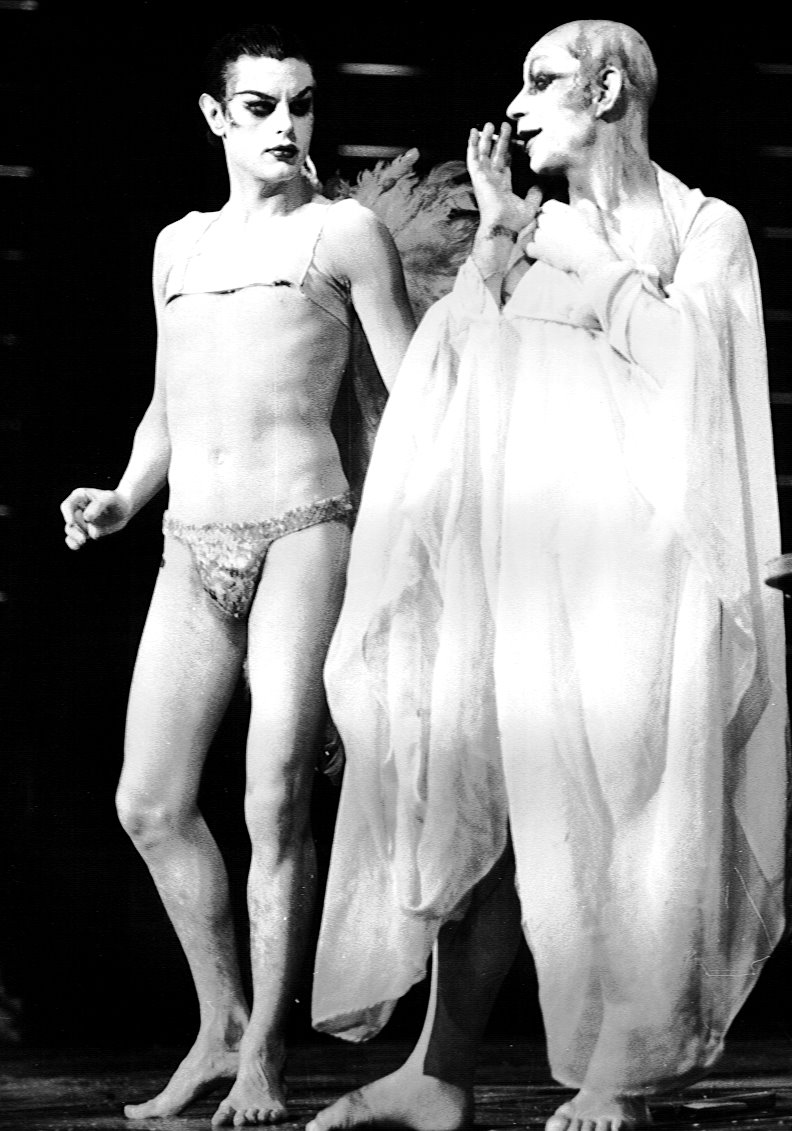
Kemp’s style of performance, a unique and seductive blend of Butoh, Mime, Burlesque, Drag and Music Hall, has at different times been described as fascinating, colourful and self-indulgent, but rarely fails to attract critical acclaim and a loyal fanbase.

He staged and performed in David Bowie's Ziggy Stardust concerts at London's Rainbow Theatre in August 1972, and, with Jack Birkett (more on him below), appears in the promotional video for Bowie's single John, I'm Only Dancing.

Kemp’s film roles include a dancer and cabaret performer in Derek Jarman’s Sebastiane (1976) and Jubilee (1977) respectively, a pantomime dame in Todd Haynes’ Velvet Goldmine (1998) and the wonderfully camp pub landlord Alder MacGregor in Anthony Shaffer's The Wicker Man (1973).

During the early 70s, Kemp was a popular and inspirational teacher of dance/mime with a regular two and a half hour session at the Dance Centre in Floral Street, Covent Garden. This was in the days before the Dance Centre became an up-market private club, and anyone could and did drop in. Classes were sometimes taken by Lindsay's unsighted friend Jack Birkett (aka 'The Incredible Orlando') whose flamboyance and mastery was such that uninitiated newcomers could go through a whole session without realising that they were being taught (and corrected) by a blind teacher. It was said that Lindsay had 'saved' Birkett from despair by re-training him after he lost his sight.

Lindsay Kemp now lives near Rome, Italy.

Labels: , , , , , ,

Tuesday, April 26, 2011

Ludwig Wittgenstein

Ludwig Wittgenstein born 26 April 1889 (d. 1951)

Ludwig Josef Johann Wittgenstein was an Austrian philosopher who worked primarily in the foundations of logic, the philosophy of mathematics, the philosophy of mind, and the philosophy of language. His influence has been wide-ranging and he is generally regarded as one of the twentieth century's most important philosophers.

Before his death at the age of 62, the only book-length work Wittgenstein had published was the Tractatus Logico-Philosophicus. Philosophical Investigations, which Wittgenstein worked on in his later years, was published shortly after he died. Both of these works are regarded as highly influential in analytic philosophy.

Ludwig Wittgenstein was born the youngest of eight children, into one of the most prominent and wealthy families in the Austro-Hungarian empire. His father's parents were born into Jewish families but later converted to Protestantism, and after they moved from Saxony to Vienna in the 1850s, assimilated into the Viennese Protestant professional classes.

Ludwig grew up in a household that provided an exceptionally intense environment for artistic and intellectual achievement. His parents were both very musical and all their children were artistically and intellectually educated. Karl Wittgenstein was a leading patron of the arts, and the Wittgenstein house hosted many figures of high culture — above all, musicians. The family was often visited by musicians such as Johannes Brahms and Gustav Mahler. Ludwig's older brother Paul Wittgenstein went on to become a world-famous concert pianist, even after losing his right arm in World War I. Ludwig himself had absolute pitch, and his devotion to music remained vitally important to him throughout his life: he made frequent use of musical examples and metaphors in his philosophical writings, and was said to be unusually adept at whistling lengthy and detailed musical passages.

His family also had a history of intense self-criticism, to the point of depression and suicidal tendencies. Three of his brothers committed suicide.

Until 1903, Ludwig was educated at home; after that, he began three years of schooling at the Realschule in Linz, a school emphasising technical topics. Adolf Hitler was a student there at the same time, when both boys were 14 or 15 years old. Wittgenstein was only a few days Hitler's junior but, instructed by private tutors, was two grades ahead of him. It is a matter of controversy whether Hitler and Wittgenstein knew each other personally.

In 1906, Wittgenstein began studying mechanical engineering in Berlin, and in 1908 he went to the Victoria University of Manchester to study for his doctorate in engineering, which led to an interest in pure mathematics and the philosophy of mathematics, and in 1912 he moved to Cambridge to become a pupil of Bertrand Russell.

His work from 1914-18 led to the writing of the Tractatus Logico-Philosophicus, which was published in Germany in 1921 and in London in 1922. Wittgenstein served in the Austrian army in World War I and was captured in Italy, and on his release after the war he gave away a considerable fortune he had inherited.

From 1920-26 he went to work as an elementary schoolmaster in Austria, then returned to Cambridge in 1929. During the next few years he came to a new position in philosophy, which was first stated in the Blue and Brown Books, a set of lecture notes from 1933-35 and published posthumously in 1958, and later in his Philosophical Investigations (published 1953). He became Professor of Philosophy at Cambridge in 1939.

In 1947 he resigned to devote himself to research, but his health soon deteriorated and he died of prostate cancer in 1951.

Although Wittgenstein was involved in a relationship with Marguerite Respinger (a young Swiss woman he had met as a friend of the family), his plans to marry her were broken off in 1931 and he never married. Most of his romantic attachments were to young men. There is considerable debate over how active Wittgenstein's homosexual life was, inspired by W. W. Bartley's claim to have found evidence of not only active homosexuality but in particular several casual liaisons with young men in the Wiener Prater park during his time in Vienna. Bartley published his claims in a biography of Wittgenstein in 1973. Wittgenstein's estate and other biographers disputed Bartley's claims and asked him to produce the sources that he claims. What has become clear, at least, is that Wittgenstein had several long-term homoerotic attachments, including an infatuation with his friend David Pinsent - who was killed in a military flying accident in 1918 - and long-term relationships during his years in Cambridge with Francis Skinner and Ben Richards.

Labels: , , , , ,

Monday, April 25, 2011

James Fenton

James Fenton born 25 April 1949

James Fenton has been, at various times, a journalist, poet, literary critic, and professor.

Fenton grew up in Lincolnshire and Staffordshire. He was educated at Repton School, where he grew fond of the work of W H Auden, who proved to be the greatest influence of Fenton's own output. After graduating from Repton, Fenton attendended Magdalen College, Oxford to study English. He was already experimenting with and winning prizes for his poetry. He earned a BA from Magdalen in 1970.

His first collection, Terminal Moraine (1972) was well received and won a Gregory Award. He used the money to travel to the Far East where he witnessed the aftermath of America's withdrawal from Vietnam and the collapse of the Lon Nol regime in Cambodia which presaged the rise of Pol Pot. In 1976 Fenton returned to London and became political correspondent for the New Statesman. The Memory of War (1982), drawing on his experience in the Far East, secured his reputation as one of the finest poets of his generation and marked the climax of a new generation of English poets. He won the Geoffrey Faber Memorial Prize in 1984 for Children in Exile: Poems 1968-1984 and in 1994 Fenton became Professor of Poetry at Oxford, a position he held until 1999. He is currently a regular contributor to the The New York Review of Books and The Guardian.

Fenton's unsettling use of traditional form to confront contemporary events, combined with images of comedy and violence is evident in poems such as Out of the East and The Ballad of the Shrieking Man. Nonsense verse has always formed a part of Fenton's output and in these poems he employs its metrical and linguistic energy to explore the nightmarish scenarios of war; the jaunty rhythms of Kipling turned into the hysteria of apocalypse. Alongside these are more personal poems of love and regret such as In Paris with You which teeters beautifully between irony and romance.

Fenton worked on the New Statesman with Martin Amis, Christopher Hitchens and Ian McEwan during the 1970s. He remains friends with them all.

Fenton's Selected Poems was published in February 2006 by Penguin and in October 2006 by Farrar, Straus and Giroux. He also recently edited The New Faber Book of Love Poems.

On 23 April 2007 it was announced from Buckingham Palace that he had been awarded The Queen's Gold Medal for Poetry for 2007. In May 2007 he was placed on the list of the 100 most influential gay and lesbian people in Britain by The Independent.

His partner is Darryl Pinckney, a writer.

James Fenton - Official Website

Labels: , , , ,

Tuesday, April 12, 2011

William M. Hoffman

William M. Hoffman born 12 April 1939.

William M. Hoffman is an American playwright, editor and teacher.

New York City native Hoffman's earliest works either were mounted in small, experimental off-off-Broadway theatres or remained unproduced. It was not until 1985 that he achieved critical acclaim and public recognition when As Is, one of the first plays to focus on the AIDS epidemic, opened in New York City at the Lyceum Theatre, where it ran for 285 performances. Hoffman won a Drama Desk Award for Outstanding New Play and a Tony Award nomination for Best Play. The following year, he adapted the work for a television production directed by Michael Lindsay-Hogg.

In 1991, Hoffman was commissioned to write the libretto for the Metropolitan Opera's The Ghosts of Versailles in celebration of the company's centennial. A 1993 televised production earned him an Emmy Award nomination for Outstanding Individual Achievement in Classical Music/Dance Programming.

As an editor at Hill and Wang, Hoffman promoted the careers of Lanford Wilson, Tom Eyen, and Joe Orton, among others, by including their plays in either his New American Plays series or his anthology, Gay Plays: A First Collection.

Hoffman currently is an Associate Professor of Theatre at Lehman College at The City University of New York.

Labels: , , , ,

Sunday, April 10, 2011

Montague Summers

Montague Summers born 10 April 1880 (d. 1948)

Augustus Montague Summers was an eccentric English author and clergyman. He is known primarily for his 1928 English translation of the medieval witch hunter's manual, the Malleus Maleficarum, as well as for several studies on witches, vampires, and werewolves, in all of which he professed to believe.

Montague Summers was the youngest of the seven children of an affluent banker and justice of the peace in Clifton, Bristol. Summers was educated at Clifton College before studying theology at Trinity College, Oxford with the intention of becoming a curate in the Church of England. He continued his religious training at Lichfield Theological College and became a deacon in 1908, but he apparently never proceeded to higher orders, probably because of accusations of sexual impropriety with young boys. Summers was for a while part of the circle of the so-called Uranian poets, who celebrated ancient Greco-Roman pederasty. His first book, Antinous and Other Poems appeared in 1907 and was dedicated to this subject matter.

Summers worked for several years as an English and Latin teacher at various schools before adopting writing as his full-time employment. He was interested in the theatre of the seventeenth century, particularly that of the English Restoration, and edited the plays of John Dryden and William Congreve among others. He was one of the founder members of The Phoenix, a society that performed those neglected works, and was elected a fellow of the Royal Society of Literature in 1916.

Summers also joined the growing ranks of English men of letters interested in medievalism, Catholicism, and the occult. In 1909 he converted to Catholicism and shortly thereafter he began passing himself off as a Catholic priest and styling himself the 'Reverend Alphonsus Joseph-Mary Augustus Montague Summers', even though he was never a member of any Catholic order or diocese. His biographer Father Brocard Sewell asserts that he was ordained a deacon in the Church of England in 1908, and thus was properly addressed as 'Reverend' in any case.

Summers wrote hagiography (on Saint Catherine of Siena) and lives of writers such as Jane Austen before turning to the occult, for which he is best remembered. In 1928 he published the first English translation of Heinrich Kramer's and James Sprenger's Malleus Maleficarum (The Hammer of Witches), a fifteenth century Latin text on the hunting of witches. This work followed his History of Witchcraft and Demonology (1927) and The Geography of Witchcraft (1928). He then turned to vampires, producing The Vampire: His Kith and Kin (1928) and The Vampire in Europe (1929), and later to werewolves with The Werewolf (1933). Summers's work on the occult is notorious for his unusual and old-fashioned writing style, his display of erudition, and his purported belief in the reality of the subjects he treats. Of more lasting value were his seminal works on Gothic literature: The Gothic Quest: a History of the Gothic Novel (1938), A Gothic Bibliography (1940) and his collection of Gothic Horror stories in The Supernatural Omnibus (1931) and Victorian Ghost Stories (1936). Summers also edited an incomplete edition of two of the seven obscure Gothic novels, known as the Northanger Horrid Novels, mentioned by Jane Austen in her Gothic parody Northanger Abbey. Summers was instrumental in rediscovering these lost books, which some had supposed were an invention of Jane Austen herself.

Summers cultivated his reputation for eccentricity. The Times wrote he was 'in every way a "character" and in some sort a throwback to the Middle Ages.' His biographer, Brocard Sewell, paints the following portrait of Summers: 'During the year 1927, the striking and somber figure of the Reverend Montague Sommers in black soutane and cloak, with buckled shoes - a la Louis Quatorze - and shovel hat could often have been seen entering or leaving the reading room of the British Museum, carrying a large black portfolio bearing on its side a white label, showing in blood-red capitals, the legend "VAMPIRES".'

While his friend Aleister Crowley adopted the persona of a modern-day witch, Summers played the part of the learned Catholic witch-hunter.

Summers was a member of the Order of Chaeronea, a secret society for homosexuals founded in 1897 by George Ives.

He died at his home in Richmond, Surrey. An autobiography The Galanty Show was published posthumously in 1980, though much is left unrevealed about his somewhat mysterious life.

Labels: , , , ,

Monday, January 17, 2011

Oscar Browning

Oscar Browning born 17 January 1837 (d. 1923)

Oscar Browning was an English writer, historian and educational reformer, born in London, the son of a merchant, William Shipton Browning. He was educated at Eton College, from Eton he went up to King's College, Cambridge, where he became fellow and tutor, graduating fourth in the classical tripos of 1860, and where he was inducted into the exclusive Cambridge Apostles, a debating society for the Cambridge elite.

In 1868 he became the lover of artist Simeon Solomon. He was for fifteen years a master at Eton College, until he was dismissed in the Autumn of 1875 following a dispute over his 'overly amorous' (but purportedly chaste) relationship with a pupil, George Curzon. He had taken Curzon on a trip through Europe with Curzon's father's permission, despite having been warned away from the boy by the Headmaster at Eton, F W Hornby. His parents' church, St. Andrew's, in Clewer, describes the reasons for his dismissal as 'his injudicious talk, his favourites, and his anarchic spirit'.

After Eton he took up a life Fellowship at King's College, Cambridge, where he achieved a reputation as a wit. He was universally known as 'O.B.' He travelled to India at Curzon's invitation after the latter had become viceroy. He resumed residence in 1876 at Cambridge, where he became university lecturer in history. He soon became a prominent figure in college and university life, encouraging especially the study of political science and modern political history, the extension of university teaching and the movement for the training of teachers.

He was principal of Cambridge University Day Training College for Teachers between 1891 and 1909, treasurer of the Cambridge Union Society between 1881 and 1902, founding treasurer of the Cambridge University Liberal Club between 1885 and 1908, and president of the Cambridge Footlights between 1890 and 1895.

He stood for Parliament three times as a Liberal.

He left Cambridge in 1908 and retired to Bexhill-on-Sea. In 1914 he was visiting Italy when World War I broke out. He decided to stay there and spent his later years in Rome where he died in 1923 at the age of eighty-six.

A large part of his papers disappeared. These include 'all Browning's letters to his mother, diaries that covered the whole of his career from his arrival at Eton in 1851, much of his correspondence as an Eton master, and no doubt also a number of his subject files'. This disappearance has been attributed to Hugo Wortham, Browning's nephew and sole executor and legatee, who took the materials to produce a biography of his uncle, Victorian Eton and Cambridge: being the life and times of Oscar Browning.

Illustration: an 1888 cartoon of Oscar Browning from a Vanity Fair series of Teachers and Headmasters.

Labels: , , , ,

Saturday, April 17, 2010

Thornton Wilder

Thornton Wilder born 17 April 1897 (d.1975)

Born Thornton Niven Wilder in Madison, Wisconsin, the son of a US diplomat, he spent part of his childhood in China.

He served in the US Coast Guard during WW1, before earning his BA at Yale in 1920. Six years later, his first novel The Cabala (1926) was published. That same year he earned his MA in French from Princeton. In 1927, The Bridge of San Luis Rey, which pioneered the diaster novel, linking individual stories via flashback with a calamity, brought him commercial success and his first Pulitzer Prize in 1928. From 1930 to 1937 he taught at the University of Chicago. He won two further Pulitzer Prizes for his plays Our Town (1938), his best loved work, and The Skin of Our Teeth (1943).

WW2 saw him return to military service gaining the rank of Lt Colonel in the Army Air Force and receive several awards. He went on to be a visiting professor at the University of Hawaii and to teach poetry at Harvard. Though he considered himself a teacher first and a writer second, he continued to write all his life, receiving numerous honours for his writing. He died in his sleep in at his home in Connecticut in December 1975.

Wilder had a wide circle of friends and enjoyed mingling with other famous people, including Ernest Hemingway, Russel Wright, Willa Cather, Montgomery Clift and Gertrude Stein.

Extremely reticent about his homosexuality, he shared a brief difficult relationship with writer and friend, Samuel Steward, but details of the private life of this shy and reserved man are few.

Labels: , , , ,