Sunday, May 15, 2011

Javier de Frutos

Javier de Frutos born 15 May 1963

Javier de Frutos is a multi award-winning director and choreographer who has directed a dynamic range of theatre productions as well as movement for TV and film. In 2007 he received an Olivier Award for his choreography in Cabaret

Javier De Frutos was born in Venezuela in 1963 where he began his dance training in 1980, continuing at the London School of Contemporary Dance and at the Merce Cunningham School, New York.

From 1988 to 1992 he was a member of Laura Dean Dancers and Musicians in New York. In 1992, he was appointed Choreographer in Residence at Movement Research in New York City. On his return to the UK in 1994 he established the Javier De Frutos Dance Company which toured to great acclaim around the world.

In 1999 his achievements were recognised in a South Bank Show. The programme was nominated for the Royal Television Society Award.

In 2000 the digital channel Artsworld made a documentary about the making of The Celebrated Soubrette for Rambert Dance Company as well as a companion broadcast of its performance at Sadler’s Wells Theatre, London. His ballet Milagros features in the documentary celebrating the 50th anniversary of the Royal New Zealand Ballet. The same year Javier was among the first to be made a Fellow of The Arts Council of England, conducting two years exhaustive research on the work of playwright Tennessee Williams.
 
In 2006 he represented Britain at the Venice Biennale with a trilogy of his work and developed and staged a new musical called Cattle Call in collaboration with Richard Thomas (creator of Jerry Springer the Opera) and the 2008 Tony Award winning designer Katrina Lyndsay.

Javier’s film and TV credits include The Long Road to Mazatlan in collaboration with Isaac Julien which was nominated for the Turner prize in 2001. Javier is also credited with the movement direction for Mika’s music video We Are Golden and more recently the pilot for the new HBO drama Game of Thrones directed by Thomas McCarthy.

Javier’s work is in the repertoire of many ballet and contemporary dance companies, including Rotterdam Dance Group, Ballet Shindowski, Nuremberg Ballet, Rambert Dance Company, The Royal New Zealand Ballet, Candoco, The Royal Ballet and Gothenburg Ballet.

His range extends beyond ballet and contemporary dance. A passionate focus of Javier’s work is musicals. He choreographed Carousel for the Chichester Festival Theatre, the National Theatre’s production of Wole Soyinka’s Death and the King’s Horseman (for which he was also movement director) and the acclaimed West End and touring productions of Kander and Ebb’s Cabaret for which he won the prestigious Olivier Award for Best Theatre Choreographer in February 2007. This follows Olivier Awards nominations in 2004 for best achievement in Dance (Elsa Canasta) and in 2005 for best new dance production (Milagros).

Other awards include the 1995 Paul Hamlyn Award, 1996 Bagnolet Prix d’ Auteur (E Muio Disperato…), 1997 South Bank Show Award (Grass and All Visitors Are Welcome, Some by Coming Some by Going), 2004 Time Out Live Award (Sour Milk) and the 2005 Critics Circle National Dance Award for Best Choreography (Elsa Canasta and Milagros) plus a nomination for the same award again in 2008. Javier has also received nominations for the Theatregoers’ Choice Award (Cabaret), Manchester Evening News Theatre Awards and the International Theatre Institute Award.

Javier directed and choreographed the Pet Shop Boys ballet The Most Incredible Thing, which premiered in London in spring 2011 to mostly favourable reviews.

Labels: , , , ,

Tuesday, May 03, 2011

Lindsay Kemp

Lindsay Kemp born 3 May 1938

Lindsay Kemp is a British dancer, actor, teacher, mime artist and choreographer.

Born in South Shields, Kemp was raised in Yorkshire and attended Bradford Art College before studying dance with Hilde Holger and mime with Marcel Marceau.

Kemp formed his own dance company in the early sixties and first attracted attention with an appearance at the Edinburgh Festival in 1968. Despite thirty years of worldwide touring with his company and the occasional film and television appearances, Kemp is ironically best known by devotees of Kate Bush and David Bowie, both former students and, briefly, members of Kemp's company (Bowie as a performer, Bush as a wardrobe assistant). Indeed, it is rumoured - a rumour begun by Kemp himself - that he had a brief but volatile affair with Bowie in the late sixties, culminating in a failed suicide attempt more notable for its melodrama than sincerity of purpose.

Kemp’s style of performance, a unique and seductive blend of Butoh, Mime, Burlesque, Drag and Music Hall, has at different times been described as fascinating, colourful and self-indulgent, but rarely fails to attract critical acclaim and a loyal fanbase.

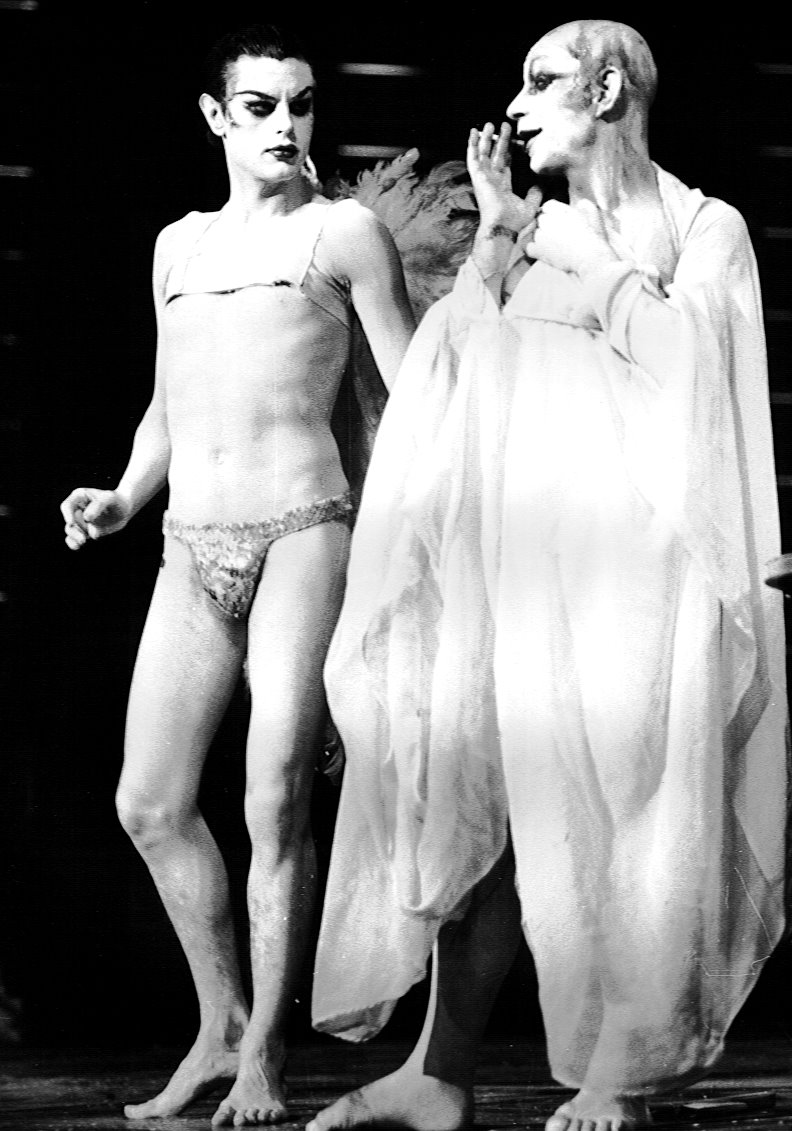
He staged and performed in David Bowie's Ziggy Stardust concerts at London's Rainbow Theatre in August 1972, and, with Jack Birkett (more on him below), appears in the promotional video for Bowie's single John, I'm Only Dancing.

Kemp’s film roles include a dancer and cabaret performer in Derek Jarman’s Sebastiane (1976) and Jubilee (1977) respectively, a pantomime dame in Todd Haynes’ Velvet Goldmine (1998) and the wonderfully camp pub landlord Alder MacGregor in Anthony Shaffer's The Wicker Man (1973).

During the early 70s, Kemp was a popular and inspirational teacher of dance/mime with a regular two and a half hour session at the Dance Centre in Floral Street, Covent Garden. This was in the days before the Dance Centre became an up-market private club, and anyone could and did drop in. Classes were sometimes taken by Lindsay's unsighted friend Jack Birkett (aka 'The Incredible Orlando') whose flamboyance and mastery was such that uninitiated newcomers could go through a whole session without realising that they were being taught (and corrected) by a blind teacher. It was said that Lindsay had 'saved' Birkett from despair by re-training him after he lost his sight.

Lindsay Kemp now lives near Rome, Italy.

Labels: , , , , , ,

Wednesday, April 27, 2011

Jack Cole

Jack Cole born 27 April 1911 (d. 1974)

Jack Cole was an American dancer, choreographer, and theatre director known as the father of theatrical jazz dance.

Born in New Brunswick, New Jersey, Cole virtually invented the idiom of American Show Dancing known as 'Theatre Dance'. He developed an entirely personal mode of jazz-ethnic-ballet that prevails as the dominant look of and technique for dancing in today's musicals, films, nightclub revues, television commercials and music videos.

Early on he decided to pursue dance with the Denishawn Dance Company led by Ruth St Denis and Ted Shawn. Cole also performed with Doris Humphrey and Charles Weidman, but eventually left the modern dance world for commercial dance career in nightclubs, performing with Alice Dudley, Anna Austin and Florence Lessing.

Cole is credited with choreographing and/or directing the stage musicals Alive and Kicking, Magdalena, Carnival in Flanders, Zenda, Foxy, Kismet, A Funny Thing Happened on the Way to the Forum, Kean, Donnybrook!, Jamaica, and Man of La Mancha. His film work includes Moon Over Miami, Cover Girl, Tonight and Every Night, Gilda, The Merry Widow, Gentlemen Prefer Blondes, There's No Business Like Show Business, Kismet (1955 film), Les Girls, and many others. He was most famous in Hollywood for his work with Rita Hayworth and Marilyn Monroe.

Cole's unmistakable style endures in the work of Gwen Verdon, Bob Fosse, Jerome Robbins, Gower Champion, Peter Gennaro, Michael Bennett, Tommy Tune, and countless other dancers and choreographers.

He was reportedly a demanding and relentless taskmaster in his pursuit of dance excellence.

Labels: , , , ,

Saturday, April 16, 2011

Merce Cunningham

Merce Cunningham born 16 April in 1919 (d. 2009)

Merce Cunningham was a ground-breaking 20th century American dancer and choreographer.

Merce Cunningham born in Centralia, Washington, received his first formal dance and theatre training at the Cornish School - Cornish College of the Arts - in Seattle, where he met his life-partner John Cage, who was a piano accompanist for dance classes.

From 1939 to 1945, he was a soloist in the company of Martha Graham. He presented his first New York solo concert with John Cage in April 1944. Merce Cunningham Dance Company was formed in 1953. Since then Cunningham choreographed around 200 works for his company. His work has been presented in many of the world's leading dance theatres including the New York City Ballet, the Ballet of the Paris Opéra, American Ballet Theatre, Boston Ballet, Zurich Ballet, London's Rambert Dance Company, and many others.

Along with their close friends, painters Robert Rauschenberg and Jasper Johns, Cunningham and Cage and other like-minded young gay artists defined an alternative creative art scene in 1950s New York that was an essential part of the development of what was to be known as post-modernism.

Cunningham's contribution to modern dance has several key elements. Cunningham applied the same use of chance to his choreography that Cage utilises in his music, so choices about sequences of movement would be determined randomly, making new relationships between movement, music and other applied arts and creating exciting new forms of narrative.

Cunningham also applied conventions of classical ballet to everyday activities, finding the structured yet fluid dance in running and walking for example. He also re-envisioned the use of dance space on stage, bringing the full dance area into play, wherever the dancer faces being 'front'. Rather than express sexuality through mixed or same-sex couples, combinations of dancers occur with the same use of 'chance', making gender and thus sexuality fluid and almost irrelevant.

Cunningham always embraced new technology in his work, with Cage, pioneering multimedia in dance and creating some of the first dance work to integrate music, movement, visual art and verse in equal balance. Since the 1990s Cunningham worked with a complex computer program called Life Forms, which provided a new way of creating choreography, and integrated the creation of images for projection during performance. He continued to experiment with music, choreographing to the music of Radiohead and Sigur Ros.

The inspirational personal and professional relationship between Merce Cunningham and John Cage lasted for 54 years, until Cage's death in 1992.

Merce Cunningham was one of the most significant and influential American choreographers of the 20th century, helping define modern dance and redefine elements of classical dance.

Although he spent his last few years using a wheelchair, he continued his work until he died peacfully at home on 26 July 2009, aged 90.

Labels: , ,

Friday, April 08, 2011

Michael Bennett

Michael Bennett born 8 April in 1943 (d. 1987)

Michael Bennett was a Tony Award-winning American musical theatre director, writer, choreographer, and dancer.

Born Michael Bennett DiFiglia to a Roman Catholic father and a Jewish mother in Buffalo, New York, he studied dance and choreography in his teens and staged a number of shows in his local high school before dropping out to accept the role of Baby John in the US and European tours of West Side Story.

Bennett's career as a Broadway dancer began in the 1961 Betty Comden-Adolph Green-Jule Styne musical Subways Are For Sleeping, after which he appeared in Meredith Willson's Here's Love and the short-lived Bajour. In the mid-1960s he was a featured dancer on the NBC pop music series Hullabaloo, where he met fellow dancer Donna McKechnie.

Bennett made his choreographic debut with A Joyful Noise (1966), which lasted only twelve performances, and in 1967 followed it with another failure, Henry, Sweet Henry (based on a Peter Sellers film). Success finally arrived in 1968 in the form of Promises, Promises, an adaptation of the film The Apartment, with a hip contemporary score by Burt Bacharach and Hal David. For the next few years, he earned praise for his work on Twigs with Sada Thompson, Coco with Katharine Hepburn, two Stephen Sondheim productions - Company and Follies (which he co-directed with Hal Prince) - and the Cy Coleman-Dorothy Fields' hit Seesaw, for which he was also the director and librettist.

The process of taking over the troubled Seesaw on the road, just six months before it was scheduled to open, convinced Bennett the usual way of developing musicals - rehearsals, out-of-town tryouts, previews, and opening - was no longer efficient and devised a better plan. He decided to do a show about the lives of 'gypsies' - chorus boys and girls - but rather than commission a script or write one of his own he let the story-line evolve through a series of group therapy-style workshops in which fellow dancers shared their feelings and frustrations about their careers. Hundreds of hours of audio tapes eventually led to the creation of his biggest and most personally-felt triumph, A Chorus Line, which opened in July 1975 at Joseph Papp's Public Theater in lower Manhattan. The reviews were ecstatic and the demand for tickets so huge it transferred uptown to the Shubert Theater, where it remained a sell-out hit for fifteen years. It won nine Tony Awards, the New York Drama Critics' Circle Award, and the Pulitzer Prize for Drama.

As its creator, choreographer, and director, Bennett devoted the next several years of his life to the show, auditioning, rehearsing, and directing productions throughout the world. Realising it was very much a theatrical piece intended to be played on a proscenium stage, he declined an offer to direct the screen version, although he agreed to join the project as a creative consultant, a position he left early on due to differences with the studio (Bennett believed the movie should be about the audition process for the filming of the stage play, rather than a movie version of the play itself). Director Richard Attenborough declined to use Bennett's original choreography, instead opting to hire Jeffrey Hornaday, and the end result was a disappointing critical and commercial failure.

Although A Chorus Line was very much an ensemble piece, the original cast's standout star was Bennett's old friend McKechnie. The two married in 1976, but separated three months later and eventually divorced, but remained close friends. The bisexual Bennett's relationships with men, including an early one with fellow dancer Larry Fuller, were more discreet, less-publicised, and tended to be lengthy.

A Chorus Line was a tough act to follow. Bennett's next musical was the unsuccessful Ballroom, but he found himself at the top again in 1981 with Dreamgirls, with a book and lyrics by Tom Eyen and music by Henry Krieger.

In the early 1980s, Bennett worked on various projects, but none of them reached the stage. His addictions to alcohol and drugs, notably cocaine and quaaludes, severely affected his ability to work and impacted on many of his professional and personal relationships. In 1985, he abandoned the nearly-completed musical Scandal, which he had been developing for nearly five years through a series of workshop productions, and signed to direct the West End production of Chess, but he had to withdraw in January 1986 due to his increasingly failing health, leaving Trevor Nunn to complete the production using Bennett's already commissioned sets. He moved to Tucson, Arizona, where he remained until his death from AIDS-related lymphoma at the age of forty-four. He left a sizable portion of his estate to funding research to fight the epidemic.

Labels: , , , , , , ,

Monday, April 04, 2011

Antony Tudor

Antony Tudor born 4 April 1908 (d. 1987)

Antony Tudor was a highly influential English ballet choreographer, dancer and teacher.

Born William Cook, the Cockney-born Tudor, who discovered dance accidentally, began dancing professionally with Marie Rambert in 1928, becoming general assistant for her Ballet Club the next year. A precocious choreographer, at age twenty-three he created for her dancers Cross Garter'd, then Lysistrata, The Planets and other works at the little Mercury Theatre, and his two most famous and revolutionary, Jardin Aux Lilas (Lilac Garden) and Dark Elegies, before the age of thirty, himself dancing main roles.

In 1938, he founded the London Ballet with Rambert members, including his future lifelong partner, Hugh Laing, Andreé Howard and Agnes de Mille, but, with the onset of World War II, in 1940 was invited with them to New York, joining Richard Pleasant's and Lucia Chase's reorganised Ballet Theater. Chase's company was later to become the American Ballet Theatre, with which Tudor was closely associated for the rest of his life. He was resident choreographer with Ballet Theater for ten years, restaging some of his earlier works but also setting the new works, his great Pillar of Fire, Romeo and Juliet, Dim Lustre and Undertow, on that company by the end of the war.

Retiring from dancing in 1950, he headed the faculty of the Metropolitan Opera Ballet School, taught at the Juilliard School recurrently from 1950 onwards, and was artistic director for the Royal Swedish Ballet from 1963 to 1964. He choreographed three works for the New York City Ballet. Tudor continued his teaching career as Professor of Ballet Technique at the Department of Dance, University of California from 1973 (work curtailed by a serious heart condition), while rejoining American Ballet Theater in 1974 as associate artistic director, creating The Leaves Are Fading and Tiller In the Fields, his last major work, in 1978. With Laing he continued seasonal residence in Laguna Beach, California.

Antony Tudor is generally accepted to be one of the great originals of modern dance forms. Along with George Balanchine, he is seen as a principal transformer of ballet into a modern art, but of a genius that uses, rather than proceeds from, ballet forms. His work is usually considered as modern 'psychological' expression, but characterised by austerity, elegance and nobility. Mikhail Baryshnikov stated: 'We do Tudor's ballets because we must. Tudor's work is our conscience.'

A disciplined Zen Buddhist, Antony Tudor died on Easter Sunday in his residence at the First Zen Institute of America.

Labels: , ,

Saturday, April 02, 2011

Serge Lifar

Serge Lifar born 2 April 1905 (d. 1986)

Born in Kiev, Sergei Mikhailovich Serdkin was the last of Sergei Diaghilev's dancer-lovers. He used his looks, charisma and talent, fuelled by his fierce ambition to become one of the greatest dancers and choreographers of the 20th century.

He enrolled in the Kiev Opera Ballet at age 15, and in 1923, Diaghilev asked Bronislava Nikinska, his ballet teacher, to provide her five best students for the Ballet Russes. Nijinska, who was not keen on Lifar, did not select him but one of the five dropped out and Lifar lept at his chance.

Some say that Diaghilev was instantly drawn to the handsome 18 year-old dancer, others suggest that Lifar made sure Diaghilev noticed him, but his charm, persistance, whatever, paid off and he joined the list of Diaghilev star dancers/lovers in the footsteps of Nijinsky, Leonide Massine & Anton Dolin. This meant he was cast in leading roles and encouraged to choreograph, as Diaghilev had done before.

Given an inch of acclaim, Lifar kept taking so much that even the world-devouring Diaghilev became exasperated at his extreme ambition and self-promotion. By that point, however, Lifar was indispensable as a star and the only choice for plum roles such as Apollo in Balanchine's history-making Apollon musagète (1928) and the title role in Balanchine's The Prodigal Son (1929).

Lifar's own first ballet, Renard (1929, to a score by Igor Stravinsky), though energetic and athletic, proved to be no masterpiece. His later work, however, demonstrated that he had learned much from Diaghilev, Balanchine, and Stravinsky.

He was at Diaghilev's bedside when he died in 1929, but the maestro's death left the Ballet Russes in chaos. However, Lifar was invited to star in a production at the Paris Opera Ballet, to be choreographed by George Balanchine, but his illness saw Lifar taking his place and he successfully went on to become ballet master and director of the Paris Opera Ballet until 1957 - although he was accused of collaborating with the German High Command during the Occupation of Paris and banished between 1944 and 1947.

In Paris, he maintained the Diaghilev tradition, reviving not only Ballet Russes classics, but the fortunes of French ballet itself, developing the profile of male dancers and employing great choreographers - Balanchine, Massine and Frederick Ashton.

He remained a major figure in international ballet for the rest of his life and was, with Boris Kochno, Diaghilev's last love, the last of the line from the great Diaghilev. He died in Switzerland in 1986.

Labels: , , , ,

Tuesday, March 22, 2011

Christopher Wheeldon

Christopher Wheeldon born 22 March 1973

Christopher Wheeldon is an international choreographer of contemporary ballet.

Born in Somerset, England, to an engineer and a physical therapist, Wheeldon began training to be a ballet dancer at the age of 8. He attended the Royal Ballet School between the ages of 11 and 18. In 1991, Wheeldon joined the Royal Ballet, London; and in that same year, he won the Gold Medal at the Prix de Lausanne competition. In 1993, at the age of 19, Wheeldon moved to New York City to join the New York City Ballet. Wheeldon was named Soloist in 1998.

Wheeldon began choreographing for the New York City Ballet in 1997, while continuing his career as a dancer. He retired as a dancer in 2000 in order to focus on his choreography.

In 2001, Wheeldon became the New York City Ballet resident choreographer and first resident artist. He was productive in this position, choreographing a number of much lauded works for the troupe. He quickly developed a reputation as a talented choreographer, and several other eminent ballet companies, such as the San Francisco Ballet, the Bolshoi Ballet, and the Royal Ballet, London have commissioned dances from him. As of May, 2003, Wheeldon had composed at least 23 works.

In November, 2006, Wheeldon announced the formation of his own dance company, Morphoses, a transatlantic company with a US base at City Centre, New York and in the UK at Sadler's Wells Theatre, London. In its first season, the company performed in Vail, London and New York. Wheeldon completed his tenure as Resident Choreographer of New York City Ballet in February 2008.

In February, 2010, resigned from Morphoses, which will continue to produce ballets without his name. Wheeldon's most recent creation is a new full-length ballet for the Royal Ballet based on Alice in Wonderland, which premiered in London at the Royal Opera House in March 2011 to generally postive reviews.

Morphoses/The Wheeldon Company Official Website

Labels: , ,

Saturday, March 12, 2011

Vaslav Nijinsky

Vaslav Nijinsky born 12 March 1890 (d. 1950)

Probably the greatest male ballet dancer of all time, Nijinsky's two greatest achievements, assisted by his impresario lover Sergei Diaghilev, were to bring the role of the male dancer to the fore, and to revitalise a world of classical ballet which had entered a period of decline.

Born in Kiev, Ukraine to Polish dancer parents, he was admitted to the St Petersburg Imperial School of Ballet aged 10, where he received an excellent general education as well as a thorough grounding in classical ballet. He was a brillant student and on graduation joined the Imperial Ballet as a soloist in 1907.

He had two love affairs with two Russian noblemen, Prince Pavel Dmitrievitch Lvov and Count Tishkievitch but then he met Sergei Diaghilev and joined the Ballet Russes - history was in the making. He went with the company to Paris in 1909 and became an international star.

Diaghilev used all his considerable skill and flair to create ballets which showcased his star and lover's incredible sensuality, athleticism and charisma, such as Petrushka, Daphnis & Chloe and Le Spectre de la Rose . He also gave Nijinsky the freedom and encouragement to choreograph to his own extraordinary vision. He created four ballets in all - L'Apres-midi d'un faune (1912) , Le Sacre du Printemps (Rite of Spring) (1913), Jeux (1913) and Till Eulenspiegel (1916) - each so technically innovative that Nijinsky could be credited with creating modern dance. His ballets were equally groundbreaking for their explorations of sexuality and sensuality.

In 1913 he married a young Hungarian woman, Romola Pulszky, who had travelled throughout Europe in pursuit of her dieu de la danse, whilst on tour in Buenos Aires. Devastated by his betrayal, Diaghilev dismissed his star from the company leaving Nijinsky stranded with wife and child and no career - furthermore, it was the First World War and Nijinsky was a Russian citizen in Hungary, and technically a prisoner of war.

Diaghilev attempted a reconciliation with Nijinsky, inviting him to rejoin the Ballet Russes on more than one occasion, but relations between the two former lovers and Nijinsky's wife frustrated every attempt to recreate his former success.

In the later years of the First World War signs of Nijinsky's mental illness became increasingly obvious to his wife and colleagues. In 1919 he suffered a mental breakdown. Increasingly unhappy with his marriage, his ruined career, and a world in turmoil, Romola committed him to a mental institution where he was diagnosed with schizophrenia and subjected to years of drugs and experimental shock treatment. He became a broken man and spent the rest of his life drifting between institutions, even having to be rescued from one asylum when the Nazis began to inter the mentally ill. He died in London in 1950.

Some people are just too beautiful and extraordinary for life.


Labels: , , , ,

Monday, February 28, 2011

Tommy Tune

Tommy Tune born 28 February 1939

Tommy Tune is an award-winning American actor, dancer, singer, director, producer, and choreographer.

Born Thomas James Tune in Wichita Falls, Texas, he attended Lamar High School in Houston. In 1965, he made his Broadway debut as a performer in the musical Baker Street. His first Broadway directing and choreography credits were for the original production of The Best Little Whorehouse in Texas in 1978.

Off-Broadway, Tune has directed The Club and Cloud Nine.

Tune's film credits include Hello, Dolly! and The Boy Friend.

Tune is the only individual to win Tony Awards in the same categories (Best Choreography and Best Direction of a Musical) in consecutive years (1990 and 1991), and the first to win in four different categories.

In 1997, Tune published Footnotes, a memoir. Despite the disjointed nature of the autobiography, Tune offers an insightful look into his then thirty-year career. It is here that he writes intimately about what drives him as a performer, choreographer and director. His obsession and desire to find everlasting love is prominent in the memoir, offering many personal stories about being openly gay and being hurt by other lovers. Ultimately though, it is his passion for theatre, dance, and people that carry him through a fruitful career full of many successful projects.

Two years later, he made his Las Vegas debut as the star of EFX at the MGM Grand Hotel.

In 2003, Tune was presented with the US's highest honour for artistic achievement, the National Medal of Arts.

The Tommy Tune Awards are awarded for outstanding work in high school theatre in Houston.

At 6'6½", Tune is unusually tall for a dancer. When not performing, he runs an art gallery in Tribeca that features his own work.

Labels: , , , , ,

Saturday, February 26, 2011

Christopher Gillis

Christopher Gillis born 26 February 1951 (d. 1993)

Christopher Gillis was an important gay male dancer and choreographer and member of the Paul Taylor Dance Company.

Born in Montreal, Quebec, the son of the late Gene Gillis, a US Olympic skier, and Rhona Wurtele, a Canadian Olympic skier who competed in the 1948 Winter Olympics along with her twin sister Rhoda. His sister, Margie Gillis, is also a dancer and choreographer; they were dance partners from childhood and collaborated on numerous shows. His brother, Jere Gillis, played professional hockey from 1977 to 1987.

Christopher Gillis joined the Paul Taylor Dance Company in 1976 in New York City. He lived and worked in New York for the next seventeen years. His major roles with Taylor included the detective in Le Sacre du Printemps (The Rehearsal), as well as leads in Profiles, Arden Court, and Speaking Tongues. He also danced with the O'Donnell and José Limón companies while making frequent appearances with his sister Margie Gillis, for whom he also choreographed. He began making and showing his own dances in the early 1980s, contributing to the repertories of the Paul Taylor Dance Company, Mikhail Baryshnikov's White Oak Dance Project, the Repertory Dance Theater, and the Fairfax Ballet.

Having been one of the Paul Taylor Dance Company's leading dancers and showing every sign of becoming a great choreographer - he choreographed more than twenty works - he was designated Taylor's heir-apparent. Unfortunately, this was not to be as he died from AIDS complications at the age of 42 in 1993.

The Taylor Foundation in New York City, which provides finding to support the Paul Taylor Dance Company's work, will house the Christopher Gillis / Alumni Dancers Lounge from 2010, in memory of the beloved dancer who performed with the Taylor Company for so many years.

Labels: , , ,

Tuesday, February 15, 2011

Bill T Jones

Bill T Jones born 15 February 1952

Bill T Jones is an American artistic director, choreographer and dancer based in New York City.

He is the recipient of the 2007 Tony Award, the 2005 Wexner Prize, the 2005 Samuel H. Scripps American Dance Festival Award for Lifetime Achievement and the 2003 Dorothy and Lillian Gish Prize, as well as a 1994 MacArthur Fellowship. Jones began his dance training at the State University of New York at Binghamton (SUNY), studying classical ballet and modern dance.

Jones choreographed and performed worldwide as a soloist and duet company with his late partner, Arnie Zane before forming the Bill T Jones/Arnie Zane Dance Company in 1982.

Creating more than 100 works for his own company, Jones has also choreographed for Alvin Ailey American Dance Theater, AXIS Dance Company, Boston Ballet, Lyon Opera Ballet, Berlin Opera Ballet and Diversions Dance Company, and many others.

In 1995, Pantheon Books published Jones’ memoirs, Last Night on Earth. In 1989, Station Hill Press published an in-depth look at the work of Bill T Jones and Arnie Zane, Body Against Body: The Dance and Other Collaborations of Bill T Jones and Arnie Zane. Hyperion Books published Dance, a children’s book written by Bill T Jones and photographer Susan Kuklin, in 1998.

Jones is the co-creator, director and choreographer of the musical Fela!, which ran Off-Broadway in 2008 and opened on Broadway in previews in October 2009. Jones won the Lucille Lortel Award as Outstanding Choreographer for his work as well as the Tony Award for Best Choreography. He has been nominated for an Olivier for Best Choreography now Fela! has opened in London's West End.

billtjones.org Official Website

Images: centre - Bill T Jones by Arnie Zane; bottom - Bill T. Jones and Arnie Zane in Rotary Action (1982)

Labels: , , ,

Thursday, February 03, 2011

Glen Tetley

Glen Tetley born 3 February 1926 (d. 2007)

Glen Tetley was an American ballet and modern dancer as well as a choreographer who mixed ballet and modern dance to create a new way of looking at dance, and is best known for his piece Pierrot Lunaire.

Glenford Andrew Tetley, Jr. was born in Cleveland, Ohio. While in medical school, Tetley found a passion for dance. After graduating from Franklin and Marshall College in 1946, Tetley moved to New York City to study dance.  Having served in the armed forces like most young men of his generation, thanks to the G.I. Bill, Tetley's dance training was government-funded.

He began his career as a dancer, dancing in Hanya Holm's Broadway production of Kiss Me Kate in 1948 and Juno in 1959, as well as with the New York City Opera Ballet, John Butler's American Dance Theatre, and the Joffrey Ballet where he was an original member. Later he danced with American Ballet Theatre and Jerome Robbins's Ballets: USA. Tetley's choreographic style rises from his experiences with modern dance teachers like Hanya Holm and Martha Graham as well as his time with ballet teachers such as Antony Tudor and Margaret Craske. Because of this mix in dance education, Tetley's choreography is a distinct blend between ballet and modern dance. Tetley wanted to achieve a mix of 'modern dance's visceral earthiness with the ethereal lyricism of classical ballet'. His ability to achieve this seamlessly is what made Tetley stand out among other choreographers.

Tetley choreographed over 50 ballets for some of the world's most famous dance companies. Tetley made his choreographic premier in 1962 with Pierrot Lunaire which he choreographed for his newly formed chamber company. Tetley based this piece on music of the same name by composer Arnold Schoenberg. Though this piece was one of his first choreographic ventures, it is heralded by many as one of his best and most iconic. It is also here where audiences first saw his iconic mix of classical and modern dance. Other works choreographed by Tetley include: Contredances, Gemini, Odalisque, Ricercare, Le Sacre du Printemps, Sargasso, Sphinx, and Voluntaries.

Tetley moved to Europe and became the Artistic Director for the Netherlands Dance Theatre in 1969 and the Stuttgart Ballet where he also danced from 1974-1976, before returning to North America to work with the National Ballet of Canada. While in Europe and Canada, Tetley choreographed many new pieces such as Alice in 1986 for the National Ballet of Canada. At the time of his departure, many in the American dance community would either train in ballet or modern dance, but never both. Some believe that because of this was the reson behind Tetley's move to Europe, where the atmosphere was more artistically free.

On January 26, 2007, Tetley died in Florida, aged 80, following a battle with skin cancer.

Labels: , ,

Sunday, January 23, 2011

Lester Horton

Lester Horton born 23 January 1906 (d. 1953)

Lester Horton was an American dancer, choreographer, and teacher.

Horton formed his first dance company, the Lester Horton Dancers, in 1932. That company evolved into what was briefly known as the Lester Horton California Ballets (1934) and then the Horton Dance Group (1934). The Horton Dance Group, billed in its film appearances as the Lester Horton Dancers, lasted until early 1944. Later, Horton attempted to develop a company on the East Coast for dancer Sonia Shaw, but Shaw's husband stopped underwriting the venture and the company collapsed before it could give any public performances. After a brief hiatus, Horton formed the Dance Theater of Los Angeles with his longtime leading dancer, Bella Lewitzky; their partnership ended when Lewitzky left in 1950. Horton's final company continued until 1960 under the direction of Frank Eng.

In order to finance his school and various dance companies, Horton choreographed a number of early Hollywood musicals, beginning with Moonlight in Havana (1942). Most of the films, like the Maria Montez vehicle White Savage (1943), were B-movie musicals. Horton's dancers also frequently worked at clubs, including the Folies Bergère in New York and Earl Carroll's Theatre-Restaurant in Los Angeles. Horton's best-known works, which he called 'choreodramas', are Salome (which occupied Horton for nearly two decades) and The Beloved.

Dance Theater made only one appearance in New York, during the last year of Horton's life. The troupe was scheduled to perform at the reputation-making theatre of the Young Men's and young Women's Hebrew Association on East Ninety-Second street in New York City. Upon arriving the troupe discovered the venue did not provide publicity and so the performance was largely unknown and not well attended. Only about 300 people showed for the Saturday night performance and only about 200 tickets were sold for the Sunday matinee. This netted the company a total of 100 dollars. All but one of the reviews was good.  There was not enough money to return home to New York and Horton had doubts about the company's financial ability to attend the Jacob's Pillow dance festival  later that summer. Horton's agent wired Horton the money to get the troupe home. At the time, Horton was drinking heavily and was emotionally and physically ill. Upon returning to Los Angeles he moved into a house on Mulholland Drive where he was attended to by his parents and friends.

Determined to perform at the Jacob's Pillow, the group travelled the Berkshires by car. The show was a success, though Horton could not afford to accompany the troupe to the festival. Riding on their success at the festival, the troupe was asked to open for Johnny Desmond in the autumn; they were so popular that they were invited back for another two-week engagement. Horton died of a heart attack at his home on November 2, 1953.

Since Horton's death, his dance technique and choreography have become widely known and practiced. Horton's legacy has survived through the Lester Horton Dance Theater Foundation, Inc., which is dedicated to preserving and promoting Horton's contributions as a dancer, choreographer, and educator. Also, various dance companies such as the Joyce Trisler Danscompany focus on Horton's technique. Horton developed his own approach to dance that incorporated diverse elements including indigenous peoples of the Americas/Native American dances and modern Jazz dance. Horton's dance technique, which is now commonly known as Horton Technique, emphasises a whole body, anatomical approach to dance that includes flexibility, strength, coordination and body and spacial awareness to enable unrestricted, dramatic freedom of expression.

Alvin Ailey, the most significant African American dancer and choreographer of the twentieth century and one of the key figures in American dance was a pupil of Horton's, and Ailey's company practise the Horton  Technique to this day.

Horton was involved with William Bowne from 1932 to 1949 when Bowne left Horton to marry a former member of Horton's dance company. Not long after, Horton became involved with film and theatre writer Frank Eng. Eng was with Horton until his death in 1953.  It is belived that Horton briefly dated Martha Graham, alough it is not a proven fact.

Labels: , ,

Friday, January 14, 2011

Gerald Arpino

Gerald Arpino born 14 January 1923 (d. 2008)

Gerald Arpino was an American dancer and choreographer. He was the artistic director and co-founder of The Joffrey Ballet.

Born in Staten Island, New York, Gerald Arpino studied ballet with Mary Ann Wells, while stationed with the Coast Guard in Seattle, Washington.

Arpino first met Robert Joffrey at Wells's school. It was love at first sight. Although the passion between them faded after a few years, they maintained a close domestic arrangement until Joffrey's death in 1988. Arpino studied modern dance with May O'Donnell in whose company he appeared in the 1950s.

In 1956, Arpino was a founding member of the Robert Joffrey Ballet. He served as co-director of the American Ballet Center, the school of the Robert Joffrey Ballet, was resident choreographer for the company, and, in 1965, became co-director of the Joffrey Ballet.

After the death of Robert Joffrey in 1988, Arpino became the Artistic Director of the Joffrey Ballet and in 1995 moved the company to Chicago. In July 2007, he was named 'Artistic Director Emeritus' as a search for a successor began. Although the ballet he founded carried his partner's name, Arpino was equally significant in founding and artistically driving one of the great American ballet companies.

Arpino suffered an illness for seven months and eventually died on October 29, 2008.

Labels: , ,

Thursday, January 13, 2011

Matthew Bourne

Matthew Bourne born 13 January 1960

Matthew Bourne OBE is a choreographer.

Matthew was born in Walthamstow, London. At the age of five or six he staged his first production. In 1982 he enrolled at the Laban Centre for Movement and Dance, where he was awarded a BA in Dance Theatre. For the next year (1985-1986) he danced with the Laban Centre's Transitions Dance Company. As a founder member of Lea Anderson's Featherstonehaughs he created many roles within the company. In addition to founding and choreographing for his own companies he has collaborated in theatre productions, working with actors including Sir Nigel Hawthorne, Dawn French and Jonathan Pryce (Oliver! in 1994). His final performance as a dancer was in January 1999 on Broadway. Since then he has been a director/choreographer.

Adventures in Motion Pictures, a dance company, was founded in 1987 by Matthew Bourne after he graduated from the Laban Centre in south London. Bourne's first professional stage production was Overlap Lovers. An Intrigue in Three Parts in 1987. Apart from a gap in 1993 he has choreographed musicals and ballets every year. His work was featured in the film Billy Elliot in 2000, showing the older Billy (played by Adam Cooper) starring in Bourne's production of Swan Lake. As a result, the Swan Lake sequence has probably been seen by more people than anything else he has done.

His first major brush with controversy was Swan Lake in 1995, where the story was entirely re-written and the role of the swans taken by men. The music by Tchaikovsky remained intact. This has been revived several time since then. It is not a gay ballet as such, but there is a homoerotic undercurrent. Some critics have reviewed the show harshly, saying the traditional plot has become absurd and that many scenes seem to lack motivation. Others have praised it lavishly. The ballet has been substantially revised for a new touring production in 2009/10. Similar criticism (and praise) greeted Nutcracker! in 2002.

Bourne has stated that his inspiration for most of his recent works are films and that Swan Lake was inspired in part by Alfred Hitchcock's The Birds.

The Car Man (a version of Carmen with a homoerotic The Postman Always Rings Twice twist) was produced in 2000 and toured regularly since then.

Bourne directed and choregraphed a version of The Nutcracker for the Christmas season at London's Sadler's Wells theatre in 2002 and it subsequently toured the US. Bourne's take on the Nutcracker was unique because, in an homage to The Wizard of Oz, Bourne set the opening and ending in black and white and the world of the Nutcracker in colour. Bourne also kept it in Victorian times but set it in a Victorian orphanage resembling something out of Charles Dickens. He also made the characters quite a bit more grotesque, and introduced a more openly sexual element that not everyone has welcomed.

Bourne's latest dance company is called New Adventures.

Bourne directed and choreographed Play Without Words in 2002 and 2003. It was a work inspired by the film The Servant. In 2004 he was awarded an OBE and in February 2005 won an Olivier Award for his choreography in the stage production of Mary Poppins. He revamped his 1994 production of Highland Fling for a UK and Asian tour in 2005.

A book by the theatre critic Alastair Macaulay Matthew Bourne and His Adventures in Motion Pictures was published in 2000.

Bourne's next project, after a successful ballet version of the Tim Burton film Edward Scissorhands (2005-9), which toured the world extensively, was reported to be Prokofiev's Romeo and Juliet with an all-male cast and a much stronger gay element, provisionally entitled Romeo, Romeo. In fact the next New Adventures production was Dorian Gray, a version of the Oscar Wilde novel, which premiered at the Edinburgh Festival in September 2008 before transferring to Sadler's Wells and touring the UK. This was followed by a sell-out UK and international tour of a revamped Swan Lake - a show that retains its power - and in 2010 by a completely revised production of Bourne's Cinderella.

Labels: , , ,

Wednesday, January 05, 2011

Alvin Ailey

Alvin Ailey born 5 January 1931 (d. 1989)

Alvin Ailey, Jr. was an African American modern dancer and choreographer who founded the Alvin Ailey American Dance Theater on 92nd Street in New York City.

Born into poverty in Rogers, Texas, Alvin Ailey moved to Los Angeles at the age of twelve and was introduced to dance by performances of the Katherine Dunham Dance Company and the Ballet Russe de Monte Carlo. His formal training in dance began with an introduction to Lester Horton's classes by his friend, Carmen de Lavallade. It was with Horton, the founder of the first racially integrated dance company in the US, that Ailey embarked on his professional dance career. After Horton's death in 1953, Ailey became the director of the Lester Horton Dance Theater and began to choreograph his own works.

In 1954, he and his friend Carmen de Lavallade were invited to New York to dance in the Broadway show, House of Flowers by Truman Capote. In New York, Ailey studied with many outstanding dance artists, including Martha Graham, Doris Humphrey and Charles Weidman and took acting classes with Stella Adler. The versatile Ailey won a number of acting roles, continued to choreograph and performed as a dancer.

In 1958, Ailey founded his own company, the Alvin Ailey American Dance Theater. Ailey had a vision of creating a company dedicated to the preservation and enrichment of the American modern dance heritage and the uniqueness of black cultural expression. In 1960, he choreographed Revelations, the classic masterpiece of American modern dance based on the religious heritage of his youth.

When Ailey began creating dance, he drew upon his 'blood memories' of Texas, the blues, spirituals, and gospel as inspiration. He concentrated on ballets that used blues, folk songs, and gospel to celebrate the southern Black Experience in America.

Although he created 79 ballets over his lifetime, Alvin Ailey maintained that his company was not exclusively a repository for his own work. Today, the company continues Ailey's mission by presenting important works of the past and commissioning new ones to add to the repertoire. In all, more than 200 works by over 70 choreographers have been performed by the Company.

Alvin Ailey died from AIDS in 1989 at the age of 58.

Alvin Ailey American Dance Theater

Labels: , , , ,

Saturday, January 01, 2011

Maurice Béjart

Maurice Béjart born 1 January 1927 (d. 2007)

Maurice Béjart was one of the most influential choreographers of the twentieth and early twenty-first centuries who attracted huge audiences to ballet.

Maurice Béjart was born in Marseilles, the eldest of three children of the distinguished philosopher Gaston Berger and his wife, Germaine.

Because of his slight physique as a child a doctor recommended that the 11-year-old boy should take some form of exercise or sport. With two great interests in life, reading and the theatre, young Maurice thought dancing might be a good idea. And so it proved.

As soon as he could, he moved to Paris to study with such celebrated teachers as Leo Staats, Lubov Egorova, Nora Kiss and Madame Rousanne. Later, on the recommendation of Margot Fonteyn, he moved to London to study with Vera Volkova.

Having adopted the stage name Maurice Béjart – a homage to Molière's wife the actress Armande Béjart – he toured with several small companies. In 1949 he joined Mona Inglesby's International Ballet and danced a number of important roles, including the virtuoso Bluebird pas de deux in that company's Sleeping Beauty. The following year he joined the company of the Swedish choreographer Birgit Cullberg, where he had his first experience of modern dance. He also worked with the Royal Swedish Ballet for a time, which led to his first film choreography and his first Stravinsky ballet, The Firebird (1952).

Although he had been choreographing since an early age it was not until 1953, after a break caused by ill-health and obligatory military service, that Béjart formed his own small company in association with the actor and writer Jean Laurent, based at the Théâtre de l'Etoile in Paris. The most important work of this period was Symphonie pour un homme seul, danced to the musique concrète of Pierre Henry. Béjart's musical tastes were eclectic, and he could just as happily make dances to scores by Albinoni or Gerry Mulligan, or mix electronic sound with Tchaikovsky, as he did later in Nijinsky, Clown of God (1971).

His breakthrough came in 1959 when he created his version of Rite of Spring for a season of dance at the Théâtre Royal de la Monnaie in Brussels. The cast was made up of dancers from his own small company, Western Theatre Ballet and Les Ballets Janine Charrat, plus the troupe from the Monnaie. The mix of theatricality and eroticism proved an instant hit and Béjart was invited to become resident choreographer at the Monnaie with a greatly enlarged company which he renamed Ballet of the Twentieth Century.

It was here that forged his reputation, making small works like Webern Opus Five and his homage to Marius Petipa, Ni fleurs ni couronnes (a deconstructed version of the Rose Adagio) as well as monumental works for the vast Forest National arena in Brussels. The company toured widely in Europe.

Béjart attracted some exceptional dancers, notable among them Paolo Bortoluzzi, Shonach Mirk, Maina Gielgud and the Argentinian Jorge Donn who for more than two decades was a central focus of Béjart's life, both professionally and personally. Dancers loved working with him. Many remained with him throughout their careers, despite the modest salaries paid even to principal dancers.

Other famous dancers were happy to work with Béjart for short periods or in specially created works. For Rudolf Nureyev he made a duet, Songs of a Wayfarer, to the Mahler song cycle, which Nureyev danced for many years. Balanchine's muse, Suzanne Farrell, was a member of the company for a period and when she left to rejoin New York City Ballet, Balanchine is said to have remarked that 'she left him as a girl and came back a woman'. Certainly her remarkable technique had not declined during her years in Brussels, since Béjart insisted on a very high standard of teaching for his dancers.

Despite the adulation surrounding him, Béjart remained entirely level-headed, living quite simply. He had a keen and often earthy sense of humour. He made no secret of his homosexuality, and he generally lived alone, even when in long-term relationships. Nor was he backward in expressing his admiration for other choreographers.

In 1987, following a dispute with Gérard Mortier, the new director of the Monnaie, Béjart moved his base from Brussels to Lausanne in Switzerland. In Lausanne he had good working conditions, complete artistic freedom and the possibility of re-establishing the dance and theatre school he had set up in Brussels. (A similar school, Mudra Afrique, operated in Dakar between 1977 and 1985).

He continued working, creating and touring widely. In all, Béjart made more than 200 ballets, besides directing operas, plays and films. Most of his work was for his own company, but he made several ballets for the Paris Opéra (he was offered the directorship there on more than one occasion but always declined). For the Deutsche Oper Berlin, he made an ambitious full-evening work, Ring around "The Ring", which encapsulated all four of the Wagner operas.

Béjart wrote prolifically, including several volumes of autobiography and a novel, Mathilde (1963), plus copious programme notes for his ballets.

Béjart received numerous awards and prizes during his life.

At his best, Béjart produced some of the most exciting dance theatre of our time. Among his astonishingly large output of about 220 creations, the three most likely to survive in the repertoire are his devastatingly simple but gripping Bolero and his highly original treatments of Stravinsky's Rite of Spring and The Firebird. In both of these latter, characteristically, he gave more importance than usual to male dancing. His Firebird was the leader of a partisan troop, shot and killed in battle but returning in spirit to inspire continued resistance. For Rite, he abandoned the original idea of a single female sacrificial victim in favour of showing a man and a woman chosen to save their tribe through ritual copulation and death.

Advancing years, and sorrow at the death of some close friends, did not interrupt his activity and originality. He continued making new ballets right up to his death in late-November 2007, in spite of illness (exhaustion plus heart and kidney problems) that required his frequent admission to hospital. His final ballet, Around the World in 80 Minutes, was premiered in Lausanne in December 2007.

Obituary in The Times
Obituary in The Independent

Labels: , , , ,

Friday, September 17, 2010

Sir Frederick Ashton

Sir Frederick Ashton born 17 September 1904 (d. 1988)

Sir Frederick William Mallandaine Ashton began his career as a dancer but is largely remembered as a choreographer.

Ashton was born at Guayaquil in Ecuador, in the artistic neighbourhood called Las Peñas, the original founding site of the city.

When he was 13 he witnessed a life-changing event when he attended a performance by the legendary Anna Pavlova in the Municipal Theatre in Lima, Peru. He was so impressed that from that day on he knew he would become a dancer.

In 1919 he went to England to attend Dover College and then to study under the famous Leonide Massine and established a working relationship with the ballet troupe belonging to Marie Rambert and Ninette de Valois. Rambert discovered Frederick's aptitude for choreography and allowed him to choreograph his first ballet, The Tragedy of Fashion [left] in 1926, starting a tremendously successful career as a choreographer.

He began his career with the Ballet Rambert which was originally called The Ballet Club. He rose to fame with The Royal Ballet, becoming its resident choreographer in the 1930s. His version of La Fille mal gardée was particularly successful. He worked with Margot Fonteyn among others. His broad travesti performances as one of the comic Ugly Stepsisters in Sergei Prokofiev's Cinderella were annual events for many years. [Ashton pictured in rehearsal with fellow 'sister' Robert Helpmann]

The choreographer's emotional life focused on the unattainable and the unsuitable, and it often wreaked havoc in his ballet company, as when, in the case of the heterosexual Michael Somes (Fonteyn's principal partner), the beloved enjoyed and exploited favoritism to the point that other dancers signed a petition of protest.

Ashton, like so many other famous gay men of his epoch, including Cecil Beaton and Noël Coward, was necessarily discreet, but he was not closeted. The British high society in which he moved enjoyed the scintillating company

Ashton was a member of the circle of gay men who surrounded Queen Elizabeth, the late Queen Mother, whom he taught to tango. When she heard that Ashton, a formidable mimic, did imitations of her, she allegedly retaliated by imitating his own queenly manners.

Ashton was a great friend of the Paget family and was a frequent visit to the family seat at Plas Newydd; it was here that one of the Paget daughters, Lady Rose fell hopelessly in love with him; he rebuffed her advances and at one point returned her letters - after having corrected her spelling! Despite this, they remained friends.

In 1962, he was knighted for his services to ballet. He died in 1988 at his home, Chandos Lodge, in Eye, Suffolk, England.

Labels: , ,

Sunday, August 15, 2010

John Cranko

John Cranko born 15 August 1927 (d. 1973)

John Cranko was a choreographer with the Sadler's Wells Ballet (which later became the Royal Ballet) and the Stuttgart Ballet.

Born in Rustenburg in the former province of Transvaal, South Africa, as a child, he would put on puppet shows as a creative outlet. Cranko received his early ballet training in Cape Town under leading South African ballet teacher and director, Dulcie Howes, of the University of Cape Town Ballet School.

John Cranko choreographed the comic ballet Pineapple Poll, based on Gilbert and Sullivan's operettas, in collaboration with Sir Charles Mackerras, for a British Festival, following the expiration of the copyright on Arthur Sullivan's music in 1950.

Estranged from his mother his parent's acrimonious divorce, Cranko's father, Herbert, a balletomane, spent a great deal of time with him in London.

John Cranko wrote and developed a musical revue Cranks, which opened in London in December 1955, moved to a West End theatre the following March, and ran for over 220 performances. With music by John Addison, its cast of four featured singers Anthony Newley, Annie Ross, Hugh Bryant and dancer Gilbert Vernon then transferred to New York. Cranko followed the format of Cranks with a new revue New Cranks opening at the Lyric Theatre Hammersmith in 1960 with music by David Lee and a stellar cast including Gillian Lynne, Carole Shelley and Bernard Cribbins, but it failed to have the same impact.

John Cranko took the moribund tradition of the full-length narrative ballet and, with dazzling productions of Eugene Onegin and Romeo and Juliet, gave it new life. And he brought, to a world of dying swans and sighing swains, a puckish humour that found expression in comic ballets like Pineapple Poll and Jeu de cartes.

But his energy and humour were not without a darker side. A biography by John Percival paints a portrait of a man capable of great friendship but unable to sustain the stable romantic relationship he felt essential to his well-being. The whirl of one-night stands and brief homosexual affairs seems not to have been enough, and his unhappiness was manifested in bouts of drinking and depression.

Cranko choked to death after suffering an allergic reaction to a sleeping pill he took during a transatlantic flight. His mother, Grace, who was divorced from Herbert and lived in what was then Rhodesia, heard about his death from a radio broadcast.

Labels: , ,