Saturday, May 28, 2011

Mark Feehily

Mark Feehily born 28 May 1980

Mark Feehily is one of the two lead singers - along with Shane Filan - of Irish boyband Westlife who have enjoyed a record-breaking succession of number 1 singles and hit albums.

In August 2005, Mark announced in an interview with The Sun that he was gay:
'I want people to know the truth. I am gay and I'm very proud of who I am.
'I'm not asking for sympathy, or to be a role model for someone else.
'I simply felt it was the right time to tell the truth.'

Westlife have sucessfully avoided several boyband curses - they lost a popular member, made a disastrous Rat Pack album and have survived the self-outing of a gay member.

Mark is in a relationship with Kevin McDaid, a former member of defunct boyband V.

Westlife continue to be successful and show no signs of splitting.

Labels: , ,

Sunday, May 22, 2011

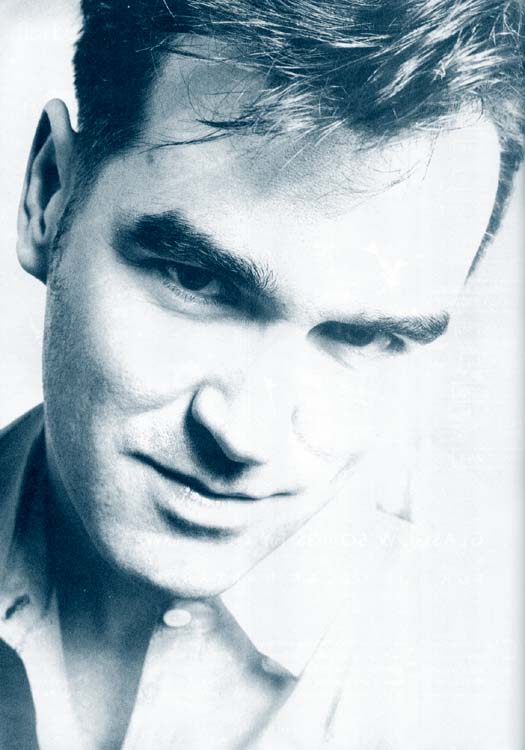
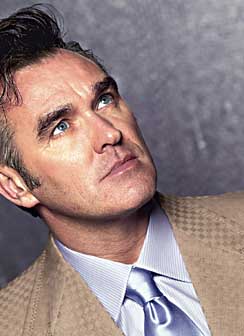
Morrissey

Morrissey born 22 May 1959

"I don't recognise such terms as heterosexual, homosexual, bisexual, and I think it's important that there's someone in pop music who's like that. These words do great damage, they confuse people and they make people feel unhappy, so I want to do away with them."

"Artists aren't really people. And I'm actually 40 per cent papier mache."

"I lost myself to music at a very early age, and I remained there."

Labels: , , , ,

Sunday, May 08, 2011

Ian Watkins aka H

Ian Watkins born 8 May 1976

Ian Watkins (born in Llwynypia, Rhondda, Wales), better known as H from Steps, is a Welsh Pop singer, one of the five members of the now defunct pop group Steps. He has said that 'H' stands for 'hyperactive', describing his character - it later emerged that it may have meant something else entirely. Before joining Steps, he worked as a redcoat for Butlins holiday parks.

As a result of his hyperactive, camp persona and seemingly limited contribution to the success of Steps, he was voted number 8 in a 2003 poll of the 100 Worst Britons.

After Steps split in 2001, he formed a duo with fellow ex-Steps member Claire Richards and became H & Claire. They released a few singles and then went their separate ways. He then decided to take a musical theatre course at the Royal Academy of Music. He was filmed through the course and it was broadcast as a reality TV series, H-side Story, which followed him as he tried to make a new career in acting. At the end of the course H passed his exam and graduated from the academy. After graduating from the academy H travelled to New York to continue refining his acting skills. Following his extra tuition in New York, H has successfully obtained a job on the West End, and toured the country starring in the production of Joseph and the Amazing Technicolour Dreamcoat in Autumn 2006.

In June 2006, Watkins appeared in a special week of episodes of the BBC Radio Drama Silver Street on the BBC Asian Network. He played the character of former solider Dave in episodes set in the Welsh countryside.


On 3 January 2007, Ian Watkins came out as gay in an interview with The Sun newspaper. He also revealed that he had been involved in a ten-year relationship with Steps' manager, Tim Byrne, though this had ended several months earlier. Prior to this, Ian had hidden the fact he was gay from fans, although rumours were widespread. His interview was published the same day he entered the Celebrity Big Brother house...

Watkins has continued to find regular pantomime work.

There is talk of a one-off Steps reunion.

Labels: , , , , ,

Darren Hayes

Darren Hayes born 8 May 1972

Darren Hayes is an Australian singer-songwriter.

Hayes was born in Brisbane, Australia, the youngest of three children. He started performing for his mother at home from an early age. At Mabel Park High School, Hayes appeared in school musicals and school concerts before graduating in 1989.

Hayes declined an opportunity to attend a performance academy in favour of studying at the University of Queensland. He ended up deferring a degree to pursue a musical career. Hayes also met make-up artist Colby Taylor while studying at university, and the pair eventually married. They split up around 1998 and divorced in 1999.

Hayes debuted in 1996 as the frontman and singer of the pop duo Savage Garden, whose 1997 album Savage Garden propelled them to stardom. It spawned the international hit singles I Want You, To the Moon and Back, and Truly Madly Deeply. The duo followed the success of their debut album with album Affirmation (1999), which also produced several hits such as I Knew I Loved You and The Animal Song. Savage Garden sold more than 23 million albums worldwide before parting ways in 2001.

Hayes released his first solo album Spin in 2002. The album was supposed to continue the success of Savage Garden and make Hayes an even bigger star, but it failed to meet the expectations of Hayes' record company at the time, although it did sell a couple of million copies worldwide. Hayes' second solo album The Tension and the Spark marked a big change of direction for the singer-songwriter, showing him experimenting with electronica and dark, depressing lyrics. This ultimately became the reason why Hayes' record company let him go in 2006. Hayes then started his own independent record label Powdered Sugar, from which he would release his third solo album This Delicate Thing We've Made (2007). Including his work with Savage Garden, Hayes has sold more than 25 million albums worldwide

Hayes has been based in London for the past few years.

Darren Hayes entered into a civil partnership with his boyfriend of three years, Richard Cullen, on June 19, 2006 in London. In keeping with his usual practice of not talking about his sexual orientation, he did not announce the civil partnership until July 17, when the information appeared on his official website. While visiting Australia in August 2007, Darren was enraged when Richard was not recognised as his partner and was forced to enter the country under a tourist visa.

He has since become an unofficial spokesman on the subject of gay marriage, still resisted by the leading Australian political parties. He also makes regular appearances on Pride stages around the world.

Darren Hayes

Labels: , , ,

Wednesday, May 04, 2011

Lance Bass

Lance Bass born 4 May 1979

James Lance Bass is an American pop singer, actor, film and television producer, and author.

Bass grew up in Mississippi and rose to fame as the bass singer for the American pop boy band N Sync. N Sync's success led Bass to experiment with film and television, primarily as an actor and a producer. Bass' acting career is most noted for his starring role in the 2001 film On The Line, which his company, Bacon & Eggs, also produced. Bass later formed a second production company, Lance Bass Productions, as well as a now-defunct music management company, Free Lance Entertainment.

After completion of 'N Sync's Pop Odyssey Tour, Bass moved to Star City, Russia in much publicised pursuit of a seat on a Soyuz space capsule. Bass was certified by both NASA and the Russian Space Program after several months of cosmonaut training, and planned to join the TMA-1 mission to the International Space Station in October of that year. However, after his financial sponsors backed out, Bass was denied a seat on the mission.

In July 2006, Bass revealed that he was gay in a cover story for People magazine. He was awarded the Human Rights Campaign Visibility Award in October 2006, and released an autobiography, Out of Sync, in October 2007, which debuted on The New York Times Best Seller list.

Bass was a contestant on Season 7 of Dancing with the Stars, and was paired with swing dance champ Lacey Schwimmer. He ended up with the third position in the show.

Labels: , , ,

Tuesday, May 03, 2011

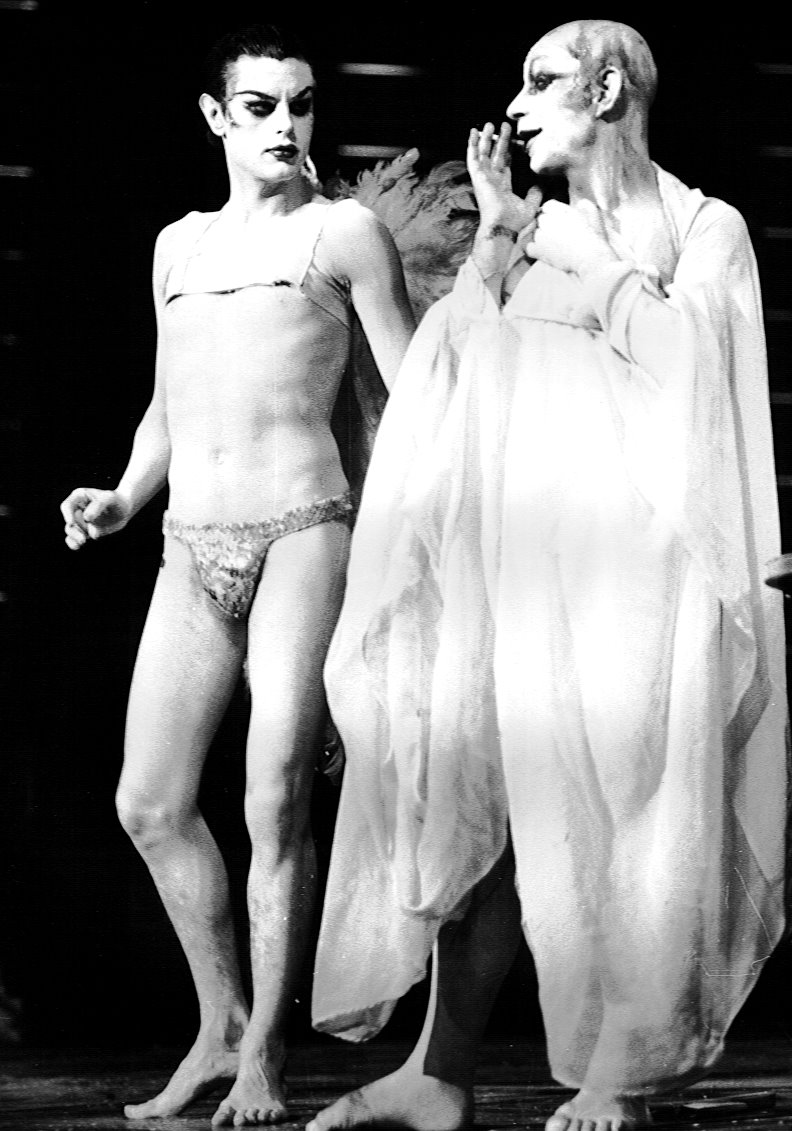
Lindsay Kemp

Lindsay Kemp born 3 May 1938

Lindsay Kemp is a British dancer, actor, teacher, mime artist and choreographer.

Born in South Shields, Kemp was raised in Yorkshire and attended Bradford Art College before studying dance with Hilde Holger and mime with Marcel Marceau.

Kemp formed his own dance company in the early sixties and first attracted attention with an appearance at the Edinburgh Festival in 1968. Despite thirty years of worldwide touring with his company and the occasional film and television appearances, Kemp is ironically best known by devotees of Kate Bush and David Bowie, both former students and, briefly, members of Kemp's company (Bowie as a performer, Bush as a wardrobe assistant). Indeed, it is rumoured - a rumour begun by Kemp himself - that he had a brief but volatile affair with Bowie in the late sixties, culminating in a failed suicide attempt more notable for its melodrama than sincerity of purpose.

Kemp’s style of performance, a unique and seductive blend of Butoh, Mime, Burlesque, Drag and Music Hall, has at different times been described as fascinating, colourful and self-indulgent, but rarely fails to attract critical acclaim and a loyal fanbase.

He staged and performed in David Bowie's Ziggy Stardust concerts at London's Rainbow Theatre in August 1972, and, with Jack Birkett (more on him below), appears in the promotional video for Bowie's single John, I'm Only Dancing.

Kemp’s film roles include a dancer and cabaret performer in Derek Jarman’s Sebastiane (1976) and Jubilee (1977) respectively, a pantomime dame in Todd Haynes’ Velvet Goldmine (1998) and the wonderfully camp pub landlord Alder MacGregor in Anthony Shaffer's The Wicker Man (1973).

During the early 70s, Kemp was a popular and inspirational teacher of dance/mime with a regular two and a half hour session at the Dance Centre in Floral Street, Covent Garden. This was in the days before the Dance Centre became an up-market private club, and anyone could and did drop in. Classes were sometimes taken by Lindsay's unsighted friend Jack Birkett (aka 'The Incredible Orlando') whose flamboyance and mastery was such that uninitiated newcomers could go through a whole session without realising that they were being taught (and corrected) by a blind teacher. It was said that Lindsay had 'saved' Birkett from despair by re-training him after he lost his sight.

Lindsay Kemp now lives near Rome, Italy.

Labels: , , , , , ,

Monday, April 25, 2011

Andy Bell

Andy Bell born 25 April 1964

Andy Bell was born in Peterborough, England and moved to London at the age of nineteen. He was working in a meat factory and playing in a band 'going nowhere' when he responded to an ad placed by Vince Clarke, a former member of Depeche Mode and Yazoo, seeking a musician to form a new band. Bell, the forty-first singer auditioned, was Clarke's choice, and Erasure were formed in 1985.

Erasure initially struggled to achieve the same level of sucess as Clarke's earlier bands but soon went on to achieve a string of hit singles, albums and highly theatrical sell-out tours. Staying true to their original formula, Erasure have been in and out of fashion at various times but their appeal has endured, although they are no longer in the mainstream, having more of a cult following.

Andy Bell has been significant in pop music for being one of the first artists to be openly gay throughout his career, allowing his sexuality to colour his writing and performance. He proved his courage a second time in 2004, when he announced that he has been battling HIV since 1998.

In 2005 he released his debut solo album Electric Blue. A second solo album Non-Stop was released in 2010.

Andy Bell - Official Website

Labels: , , ,

Saturday, April 23, 2011

Jón Þór Birgisson

Jón 'Jónsi' Þór Birgisson born 23 April 1975

Jón 'Jónsi' Þór Birgisson plays guitar and sings lead vocals for the Icelandic band Sigur Rós.

Sigur Rós are an Icelandic post-rock band with melodic, classical, experimental, and minimalist elements. The band is known for its ethereal sound and lead singer Jónsi’s falsetto voice.

Obscure and highly artistic, the band have nonetheless developed a huge international following without either compromising their integrity or achieving mainstream commercial success. They could best be described as the Icelandic Radiohead.

In January 2010, the band announced that they will be on hiatus until further notice in order to pursue solo careers and to spend time with their families. Jónsi and Alex Somers released an instrumental album Riceboy Sleeps in 2009. His first 'proper' solo album Go was released in April 2010.


Brigisson's trademark is playing an electric guitar with a cello bow and using distortion and reverberation to get an ethereal and ambient sound. His vocal style includes the frequent use of falsetto. His first language is naturally Icelandic but he also speaks English, although the band avoid this compromise. Most songs are sung in Icelandic but Birgisson has developed a made-up language called 'Hopelandic' - a kind of gibberish vocal that functions as another instrument as opposed to a conventional lyric-based vocal.

He is gay and is blind in his right eye. The two facts are unrelated.

His boyfriend Alex Somers does much of the graphic design for Sigur Rós and Amiina.

Sigur Rós

Labels: , ,

Wednesday, April 20, 2011

Luther Vandross

Luther Vandross born 20 April 1951 (d. 2005)

Luther Ronzoni Vandross, Jr was probably the greatest male R&B singer of his generation. During his career, Vandross sold 25 million albums and won eight Grammys including Best Male R&B Vocal Performance four times. He won four Grammy awards in 2004 including the Grammy for Song of the Year for the track Dance With My Father.

Initially content to remain in the background as a backing singer and producer - he toured with David Bowie in 1974 and sang backing vocals on the Young Americans (1975) album - Vandross was encouraged to take centre stage by Roberta Flack, who thought he had a unique talent.

His breakthrough to major chart success came as lead singer with Change, and he went on to have a string of million selling hit solo albums, and successful collaborations with other artists, throughout the 80s and 90s.

During Vandross' entire career he was 'dogged' by questions regarding his sexuality. He never married, his name was never romantically linked in the media with women. Although Vandross never explicitly denied being gay, he never publicly acknowledged it either. He generally fielded questions by saying that his 'busy lifestyle' made marriage difficult and indicated that, in any case, 'it was not what he wanted.' Many gay publications have stated that Vandross' gayness was an 'open secret' in the music business, but even now it is rarely spoken of.

Vandross had diabetes, a disease that ran in his family, as well as hypertension. His weight fluctuated wildly throughout his career. His father, Luther Sr, died of complications from diabetes when Luther Jr. was eight years old. Luther Jr.'s two sisters and a brother also predeceased him. In 2003 Vandross suffered a stroke at his home in Manhattan. Although he appeared briefly on video at the 2004 Grammys to accept his Song of the Year award, he was otherwise never seen in public again. On the videotape on which Vandross appeared he sent an emotional message that said: 'Whenever I say goodbye it's never for long because I believe in the power of love.'

Vandross died in hospital on 1 July 2005 . He was just 54 years old and reportedly had never fully recovered from the 2003 stroke. It was reported that he died peacefully, surrounded by his family and friends.

Labels: , , ,

Tuesday, April 05, 2011

Joe Meek

Joe Meek born 5 April 1929 (d. 1967)

Joe Meek (born Robert George Meek in Newent, Gloucestershire) was a pioneering English record producer and songwriter acknowledged as one of the world's first and most imaginative independent producers. His most famous work was The Tornados' hit Telstar (1962), which became the first record by a British group to hit #1 in the US Hot 100. It also spent five weeks atop the UK singles chart, with Meek receiving an Ivor Novello Award for this production as the Best-Selling single of 1962.

Meek's innovative sonic concept album I Hear A New World (1960) is regarded as a watershed in modern music, although it was shelved for decades.

A stint in the Royal Air Force as a radar operator, spurred a life-long interest in electronics and outer space. From 1953 he worked for the Midlands Electricity Board. He used the resources of his company to develop his interest in electronics and music production, including acquiring a disc-cutter and producing his first record.

He left the electricity board to work as a sound engineer at Radio Luxembourg. He made his breakthrough with his work on Ivy Benson's Music for Lonely Lovers. His technical ingenuity was first shown on the Humphrey Lyttelton jazz single Bad Penny Blues (1956).

Despite not being able to play a musical instrument or write notation, Meek displayed a remarkable facility for producing successful commercial recordings. To compose, he was dependent on musicians, who would transcribe his (or: recordings of his) singing. He worked on 245 singles, of which 45 were major hits (top fifty or better).

He pioneered studio tools such as artificial multi-tracking on one- and two-track machines, close miking, direct input of bass guitars, the compressor, and effects like echo and reverb, as well as sampling. Unlike other producers, his search was for the 'right' sound rather than for a catchy musical tune, and throughout his brief career he single-mindedly followed his quest to create a unique 'sonic signature' for every record he produced.

At a time when studio engineers were still wearing white coats and assiduously trying to maintain clarity and fidelity, Meek was producing everything on the three floors of his 'home' studio and was never afraid to distort or manipulate the sound if it created the effect he was seeking. For John Leyton's hit song Johnny Remember Me he placed the violins on the stairs, the drummer almost in the bathroom, and the brass section on a different floor entirely.

Meek was one of the first producers to grasp and fully exploit the possibilities of the modern recording studio. His innovative techniques - physically separating instruments, treating instruments and voices with echo and reverb, processing the sound through his fabled home-made electronic devices, the combining of separately-recorded performances and segments into a painstakingly constructed composite recording - comprised a major breakthrough in sound production. Up to that time, the standard technique for pop, jazz and classical recordings alike was to record all the performers in one studio, playing together in real time, a legacy of the days before magnetic tape, when performances were literally cut live, directly onto disc.

Meek was obsessed with the occult and the idea of 'the other side'. He would set up tape machines in graveyards in a vain attempt to record voices from beyond the grave. In particular, he had an obsession with Buddy Holly and other dead rock and roll musicians.

His efforts were often hindered by his paranoia (Meek was convinced that Decca Records would put hidden microphones behind his wallpaper in order to steal his ideas), drug use and attacks of rage or depression. His then-illegal homosexuality put him under further pressure; he had been charged with 'importuning for immoral purposes' in 1963 and was consequently subjected to blackmail.

In January of 1967, police in Tattingstone, Suffolk, discovered a suitcase containing the mutilated body of Bernard Oliver, an alleged rent boy who had previously associated with Meek. According to some accounts, Joe became concerned that he would be involved in the investigation when the London police stated that they would be interviewing all known homosexuals in the city.

On February 3, 1967, the eighth anniversary of Buddy Holly's death, Meek killed his landlady Violet Shenton and then himself with a single-barrelled shotgun that he had confiscated from his protegé, former Tornados bassist and solo star Heinz Burt at his Holloway Road home/studio (Meek had flown into a rage and taken it from him when he informed Meek that he used it while on tour to shoot animals). Meek had kept it under his bed, along with the shells. As the gun had been registered to Burt, he was questioned intensively by police, before being eliminated from their enquiries.

A blue plaque has since been placed at the location of the studio to commemorate Meek's life and work.

Although he turned down opportunities to work with David Bowie, The Beatles and Rod Stewart, Meek did work with a host of other artists including Gene Vincent, Billy Fury, Petula Clark, Shirley Bassey, Tommy Steele and many more.

Labels: , , , ,

Saturday, March 19, 2011

Ricky Wilson

Ricky Wilson born 19 March 1953 (d. 1985)

Ricky Helton Wilson was the original guitarist in the rock band The B-52s, which he helped to form in 1976.

Born in Athens, Georgia, he was the brother of fellow B-52s member Cindy Wilson.

Among guitar aficionados, Wilson's most salient feature must surely be his highly original approach to playing the instrument. Because at first The B-52s did not have a bass, he invented his own tunings, grouping the strings into a bass course (usually tuned to 5ths for strumming) and a treble course (often tuned in unison), removing the middle two strings entirely, though sometimes he played with 5 strings as well.

His style is said to have been heavily influenced by American surf group The Ventures, possibly Pink Floyd's Lucifer Sam and other Batman-style sixties music. A Wilson-modifield blue Mosrite guitar is visible on the back cover of the B-52s' self-titled first album [pictured left, Ricky Wilson is in the red jacket].

Wilson died on October 12, 1985, aged 32, from health complications related to AIDS. In an interview, fellow band member Kate Pierson stated that Wilson had kept his illness secret from his fellow band members because he 'did not want anyone to worry about him or fuss about him'.

Following his death, fellow B-52s' member Keith Strickland (originally the drummer for The B-52s) learned how to play the guitar in a similar fashion to Wilson.

The B-52s effectively disappeared for a couple of years following their loss, unable at first to envisage continuing without their friend (and in Cindy Wilson's case, brother) but they eventually regrouped and returned to achieve mainstream worldwide commercial success and The B52s remain musically active.

Labels: , ,

Thursday, March 17, 2011

Stephen Gately

Stephen Gately born 17 March 1976 (d. 2009)

Stephen Gately first found fame as second lead vocalist with Irish vocal group Boyzone, who in the late 1990s were the most successful boyband in the UK, bridging the gap between Take That & Westlife.

Enjoying a string of number 1 singles and albums and successful tours, they were at the height of their fame when, in 1999, Stephen discovered that a national newspaper was planning to out him. He made the decision to tell his own story first and went public in The Sun newspaper - a brave choice in the, even now, surprisingly closeted world of pop music. Already out to friends, family and the other members of Boyzone, the fans attitude to their idol remained unchanged.

Boyzone took a career hiatus in 2000. Lead singer Ronan Keating went on to a highly successful solo career; Stephen Gately had a short and relatively successful career as a solo artist, but being solo after Boyzone left him depressed and missing his bandmates. He eventually moved more succesfully into musical theatre, his roles including Joseph in Joseph & the Amazing Technicolour Dreamcoat and the child-catcher in Chitty Chitty Bang Bang in London's West End.

Stephen made his pantomime debut in Bromley in December 2005 starring as Dandini in Cinderella. In April 2006 Gately took on the role of the Scarecrow in The Wizard of Oz at the Marlowe Theatre, Canterbury.

He also took part in Channel Five's All Star Talent Show in October 2006, performing the slice and dice magic trick which he only had a week to learn, coming second to Toby Anstis. He also took part in the second series of ITV's Dancing on Ice with his dancing partner Kristina Lenko. They went out in eighth place on 10 February 2007.

In 2007 after months of stories and rumours it was finally confirmed that Boyzone were to reform with the original lineup, making their debut reappearance for the BBC's Children In Need in November 2007. Inspired by the renewed success of Take That, the band successfully reformed, touring and releasing new material.

At the time of his tabloid coming out Stephen Gately revealed that in 1998 he had started a relationship with Eloy de Jong, who had been in the Dutch boy band Caught in the Act. Stephen and Eloy split up in 2001, however.

After remaining single for a while, Stephen then started dating internet businessman Andrew Cowles, who had been introduced to him by Elton John and David Furnish.

Having only been dating each other for a matter of months, Stephen and Andrew held a commitment ceremony in a wedding chapel whilst on holiday in Las Vegas in 2003.

On 19 March 2006 Stephen entered into a civil partnership with Andrew in a ceremony in London.

In 2008 the reformed Boyzone released a cover version of Tom Baxter's song Better, the video for which broke new ground by showing Gately with another man rather than the female models his straight bandmates apeared with, becoming probably the first mainstream pop video by a boyband to reflect the true sexuality of its members.

In October 2009 Stephen Gately was in Mallorca with husband Andrew, where they owned a holiday apartment. After going out for drinks on Saturday, 10 October the pair returned to their apartment with a man they had met in a club. Eventually Gately was left to sleep in the living room and was discovered in the early hours of the morning by their guest not moving and seated strangely; he immediately alerted Andrew Cowles that something was wrong. Stephen Gately was dead. His completely unexpected death at the age of 33 - and as his career with Boyzone was flourishing once again - came as a huge shock as the news quickly emerged.

A post mortem examination in Spain established that Gately died of natural causes. An official said he suffered a pulmonary oedema, which is an accumulation of fluid on the lungs, adding that once the witness statements and tests were confirmed then the 'case will be closed'. It has since emerged that the three men had smoked cannabis together but drugs and alcohol were ruled out as playing any part in Gately's death; he appears to have simply suffered a heart attack, which, it emerges, may have been a congenital family trait, although Gately was seemingly unaware that he had any kind of heart condition. Gately's body was repatriated to Ireland later that week, accompanied by Ronan Keating, Keith Duffy, Shane Lynch and Mikey Graham.

The final forensic report, published in December 2009 confirmed that Gately was killed by an undiagnosed heart condition. He suffered from atheromatosis, which is a thickening of the arteries. A preliminary pathology report said the star died from an acute pulmonary oedema, a build-up of fluid on the lungs caused by the atheromatosis. The report made it clear he had not been killed by alcohol or drugs.

Stephen Gately's funeral was held in Dublin on Saturday, 17 October 2009. The star-studded event was attended by his fellow Boyzone members - who not only acted as pall bearers but had remained with Gately's body the night before the funeral at his mother's request that he not be left alone; by manager Louis Walsh; members of Westlife; David Furnish; partner Andrew Cowles, and many other showbiz figures from the UK and Ireland. After the funeral Gately's body was taken for cremation at a private family ceremony.

The days following Stephen Gately's death witnessed much media speculation about the seemingly clean-living Gately's 'secret life' and the apparent mystery surrounding the events of that night. It seems that the truth is that although Gately's fairly normal gay lifestyle may have looked strange to some observers, his death was a simple case of heart failure and any anticipated scandal had no basis.

His last message on the social networking site Twitter, posted on 6 October, said: "still busy - lots going on. Focussing on finishing my book next so may be quiet here."

Labels: , ,

Wednesday, March 02, 2011

Lou Reed

Lou Reed born 2 March 1942 (d. 2013)

Lou Reed was an influential American rock singer-songwriter and guitarist. He first came to prominence as the guitarist and principal singer-songwriter of The Velvet Underground (1965-1973).

An enduring but complicated figure whose shadow stretches back five decades to the very beginnings of the American rock underground, Lou Allen Reed was born on Long Island to a middle-class, suburban family - a family with whom he soon found himself at odds, as they were unable to accept his unconventional attitudes and sexually ambiguous behaviour. During his teen years, they went so far as to have him confined in a mental hospital, where he was forced to endure electro-shock treatments and drug therapy as a means to ward off any nascent homosexual tendencies; somehow Reed managed to emerge from this ordeal with his attitudes intact, and, despite his parents' disapproval, continued to pursue his musical interests.

Highly influenced by R&B and early rock music, Reed performed with a number of different bands during his high school years, making his first recording as a member of the doo-wop ensemble The Shades. After high school he moved on to Syracuse University, where his interests broadened to include free jazz and other more experimental forms of music. It was at this time that Reed decided to pursue a career as a writer.

After completing his studies at Syracuse, Reed moved to New York City and took a job as a songwriter at Pickwick Records. His hit-making duties proved less than rewarding, and he soon joined forces with fellow disillusioned employee John Cale to try and create some music that was more worthwhile. Initially assuming the name The Warlocks, the two spent short periods working with various other musicians as The Primitives and The Falling Spikes before finally enlisting guitarist Sterling Morrison and drummer Angus MacLise and becoming The Velvet Underground in 1965. Later in the year MacLise quit and was replaced by Maureen Tucker, at which time the band began performing in local clubs and cafés; not long afterwards they came to the attention of art prankster Andy Warhol, who, intrigued by their unconventional approach, offered to assume management duties for the band.

Warhol subsequently integrated the Velvets into his multimedia project The Exploding Plastic Inevitable, adding German vocalist Nico to the line-up and sending them out on a tour of the US and Canada in 1966. Later in the year, the band's debut was recorded within the space of one or two days; the album was eventually released by MGM in early 1967, sporting a Warhol-designed peelable banana as its cover. The strange mix of styles - and particularly the controversial subject matter dealt with in Reed's lyrics - resulted in an extremely mixed reception for the album, with sales being far from brisk. By the following year both Warhol and Nico were shed, and the band enlisted The Mothers of Invention's producer Tom Wilson to create their second album White Light/White Heat. Public and critical interest remained elsewhere. By this time, the relationship between Reed and Cale had entirely deteriorated, and Cale was fired from the band before sessions for a third album were organised.

After bringing in Doug Yule to replace Cale, Reed recorded two more albums with the Velvets in a markedly different stylistic vein: The Velvet Underground (1969) and Loaded (1970) - although a considerable amount of material not contained on these albums was also generated during this period (most of which would eventually surface in the mid-80s on the collections VU and Another View). The personal and professional dynamics of the group remained unstable, however, and in August of 1970 Reed made the decision to quit just prior to the release of Loaded. The next year was spent away from the music industry, living in his parents' house on Long Island and working for his father's accounting firm; in 1971 a contract with RCA finally initiated the launch of his solo career, and an eponymous album followed in 1972. Primarily featuring Velvets-era material, the release accordingly received the same lack of interest that had plagued his previous band.

In the hopes of avoiding the dismal response given to his first solo effort, Reed enlisted the help of long-standing Velvets fans David Bowie and Mick Ronson to create his second offering, Transformer (1972). Given a thorough glam makeover by the pair, the album featured one of his most commercially successful songs (Walk On The Wild Side) and at last provided a bit of forward momentum to his floundering career. Regardless of his new-found popularity, the subject matter of Reed's songs remained as uncompromising as ever - a fact that was abundantly evident on the follow-up release Berlin (1973), a concept album that explored the disintegrating lives of two drug addicts. This oscillation between commercial success and commercial suicide continued throughout the rest of his 70s output: the live collection Rock N Roll Animal (1974) reviving the enthusiasm generated by Transformer, followed by the blatantly mainstream Sally Can't Dance (1974) and the extreme, formless feedback assault of Metal Machine Music (1975). Upbeat pop was then shamelessly indulged on Rock And Roll Heart (1976), only to be discarded in favour of the the raw punk of Street Hassle (1978).

With the arrival of the 1980s, Lou Reed at last managed to gain control of his self-destructive personal habits, with the result that his recorded output became far less erratic. The strong critical momentum generated in the first half of the decade by The Blue Mask (1982), Legendary Hearts (1983) and New Sensations (1984) served to cement his standing as a major American songwriter once and for all, and this status was further reinforced by later releases such as New York (1989) and Magic And Loss (1992).

The 80s even witnessed a temporary reconciliation between Reed and his former bandmate John Cale, brought about by the death of Andy Warhol in 1987. The pair initially renewed their partnership in order to commemorate their former producer with the 1990 collection Songs For Drella, but by 1993 a full-scale reunion of the Velvet Underground had been organised. Not surprisingly, the reunion only managed to survive a brief European tour before the relationship between Reed and Cale once again hit the skids, and the death of Sterling Morrison in 1995 brought an end to the possibility of any future band revivals.

In distinct contrast to his years with the Velvet Underground, in the 90s and 00s Reed found himself an established and widely-respected member of the music industry. What would prove to be an enduring relationship with performance artist Laurie Anderson was started in the early 90s, with some musical cross-pollination resulting. During this same period, a relationship of a different nature was also established with theatre director Robert Wilson, initiated with the collaborative production Time Rocker (1996) and resuming for the Edgar Allan Poe-derived POE-Try in 2001. The Raven, a recorded version of the latter project featuring readings by Anderson, David Bowie, Steve Buscemi, Willem Dafoe, Amanda Plummer and several others was eventually released in 2003, and closely followed by the live document Animal Serenade in 2004.

In 2007 Reed rather unexpectedly began performing and touring a mixed media performance of his 1973 Berlin album. Reed continued to record and tour new work and revisit his previous work alone and in collaboration, now a highly respected, influential and established music veteran.

In April 2013, Reed underwent a liver transplant. Afterwards, he claimed on his website to be 'bigger and stronger' than ever. On October 27, 2013, Reed died at the age of 71.

Labels: , , , , ,

Sunday, February 27, 2011

Peter Christopherson

Peter Christopherson born 27 February 1955 (d. 2010)

Peter Martin Christopherson, aka Sleazy is a musician, video director and designer, and former member of the influential British design agency Hipgnosis.

He was one of the original members of the infamous Industrial Records band, Throbbing Gristle. Along with Chris Carter, Christopherson claims to have custom made a keyboard-triggered sampler before the first sampler (Fairlight) was available in UK. He's also participated in two other famous industrial bands, Psychic TV and Coil.

Peter Christopherson was a founding member of Throbbing Gristle and created the genre industrial music along with the group. Throbbing Gristle disbanded in 1981. Throbbing Gristle members Chris Carter and Cosey Fanni Tutti formed their own group while Peter Christopherson and TG's other member Genesis P-Orridge formed Psychic TV along with other musicians.

John Balance met Christopherson as a Throbbing Gristle fan and the two became a couple. Christopherson worked on the first two Psychic TV albums, Force The Hand Of Chance and Dreams Less Sweet, joined by Balance on the second one. The two played several times live with Psychic TV then decided to collaborate on their own personal project, forming Coil, who lasted 23 years until Balance's death.

Despite Christopherson's long and extensive history as a musical artist, he has only released a single track under the name Peter Christopherson. The song, In My Head A Crystal Sphere Of Heavy Fluid, appeared on the compilation Foxtrot, a benefit album for former partner John Balance's alcohol addiction.

In 2005, Christopherson relocated from England to Krung Thep, Thailand and undertook the project The Threshold HouseBoy's Choir. Since Christopherson's relocation he has released the final Coil CDs: The Ape Of Naples, The Remote Viewer, Black Antlers, and reissued Musick To Play In The Dark Vol. 1 and Musick To Play In The Dark Vol. 2, which were formerly being manufactured in England.

2005 also marked the reuniting of Throbbing Gristle for a few concerts. Throbbing Gristle announced a new album Part Two. The group announced several additional concerts in 2007 to promote the album.

In 2007 Christopherson released the debut album of his solo effort The Threshold HouseBoys Choir. The album, Form Grows Rampant, is broken down into five 'parts' or songs, and includes a DVD of the album set to video of Thai rituals in Krung Thep.

He was a guest and jury head of the 2007 Melbourne Underground Film Festival.

In 2008 Christopherson and Ivan Pavlov (aka COH) started a new project called Soisong. The band officially premiered in Tokyo on 9 March 2008 and later toured Europe with several shows, having self-released their debut EP. In April of the same year Christopherson and Pavlov, alongside David Tibet, Othon Mataragas and Ernesto Tomasini, performed a live soundtrack for Derek Jarman's The Angelic Conversation in Turin, Italy.

Christopherson died in his sleep on November 24, 2010.

Labels: , , ,

Wednesday, February 09, 2011

Holly Johnson

Holly Johnson born 9 February 1960

Holly Johnson is an artist, writer and musician - born William Johnson in Liverpool.

Actively involved in the Liverpool punk rock/new wave scene, Johnson played bass with Big In Japan and released several solo singles on the Eric's label, before finding fame as the lead singer and lyricist of Frankie Goes to Hollywood, who enjoyed considerable controversy and commercial success during their brief heyday in the early 1980s. The band were pioneering for having two openly gay members - Holly and second vocalist Paul Rutherford - and a sound and image that borrowed heavily from underground gay culture and dance music, which they in turn fed into with their controversial number 1 hit Relax. However the band's image and music was controlled as much by their producer Trevor Horn and label ZTT's Paul Morley as by the band, despite their initial authenticity and ability to play. After a few perfect singles, ambition and experimentation quickly descended into self-indulgence and excess.

Holly left the group in 1987 after growing increasingly unhappy with their musical direction, but was immediately the subject of an injunction from the group's record company, ZTT Records, which cited his prior recording agreement and effectively barred him from releasing solo material with new label MCA Records.

Johnson famously embarked on a protracted legal battle with ZTT, the case finally being settled in Johnson's favour in 1989, the judge ruling that ZTT's original contract had constituted an unreasonable restraint of trade. The result represented a landmark legal outcome within the music business. Johnson's relationship with ZTT owners Trevor Horn and Jill Sinclair apparently broke down irretrievably due to the court case.

Johnson finally released his first solo album, Blast, which reached number one in the UK and spawned three hit singles. However, relations with MCA cooled over dissatisfaction with promotional budgets for his second solo album, Dreams That Money Can't Buy, released in 1991 after Johnson had left the label.

In November of that year, Johnson discovered he was HIV positive. This triggered a temporary withdrawal from the music business and public life in general. His condition was made public in April 1993. In 1994 his critically acclaimed autobiography, A Bone In My Flute, was published.

Since the mid 1990s, Johnson has worked primarily as a successful painter. His works have been exhibited at the Tate Liverpool, and The Royal Academy. He has contributed to Modern Painters magazine and other art magazines. He has continued to make music via his own Pleasuredome label, such as 1999's Soulstream, an album that includes a re-recording of The Power Of Love, Johnson's de facto signature song.

Labels: , , ,

Tuesday, February 08, 2011

Jim Verraros

Jim Verraros born 8 February 1983

James Conrad Verraros is an American singer/entertainer and native of Crystal Lake, Illinois who is most notable for being one of the top 10 finalists in the first season of American Idol, eventually won by Kelly Clarkson.

The first openly gay contestant ever to be on American Idol, Verraros quickly became a celebrity in the American gay press because of a controversy that erupted when Fox Broadcasting Company made him remove gay-friendly comments from his network-sponsored American Idol website in the summer of 2002.

Verarros released a solo album Rollercoaster in 2005, which spawned a couple of US dance hits. A second album was released late-2007.

As an actor, Verarros is a star of the 2004 gay-themed comedy Eating Out and its 2006 sequel, Eating Out 2: Sloppy Seconds.

jimverraros.com Offical Website

Labels: , , ,

Saturday, January 29, 2011

Adam Lambert

Adam Lambert born 29 January 1982

Adam Mitchel Lambert is an American singer, songwriter, and actor from San Diego, California. In May 2009, he finished as the runner-up on the eighth season of American Idol.

Adam Lambert has been a stage actor since he was about ten years old. He was cast as Linus in San Diego's Lyceum Theater's production of You're a Good Man, Charlie Brown. He also played the part of Joshua in The Ten Commandments: The Musical at the Kodak Theatre alongside Val Kilmer, and was one of the only actors in the play that garnered a positive review. He was also the understudy for the part of Fiyero in the touring and Los Angeles casts of the musical Wicked. Since 2004, he has regularly performed at the Zodiac Show, which was co-created by Carmit Bachar of the Pussycat Dolls. He also performed at the Upright Cabaret.

Lambert auditioned for the eighth season of American Idol in San Francisco, California. In the semi-finals, Lambert was voted into the Top 13.

On May 20, 2009, Lambert was announced as the runner-up for the eighth season of American Idol. There was a school of thought that the 'flamboyant' Lambert, already widely rumoured to be gay, lost out to the much blander and more mainstream Kris Allen - a devout Christian - by the Christian Right mobilising their voting forces to prevent a homosexual winning America's most popular show. It is likely that Adam Lambert, like several other notable non-winners of the show will prove to be the winner in the end.

Photos of Lambert kissing a man surfaced while he was competing on American Idol. Lambert confirmed that the photos were of him, stating he had nothing to hide and has always been open about his life, whilst stopping one step short of stating the fact that he was gay. Mainstream media speculation centered on Lambert's sexuality; presuming he was gay, he would be the first gay American Idol (although far from the first gay American Idol finalist). Much of the media focus regarded the readiness of American Idol voters for an openly gay winner. Asked by Rolling Stone whether the speculation surrounding his sexual orientation impacted the final vote, Lambert laughed and said 'probably'. Lambert confirmed that he was gay in a cover story interview with Rolling Stone, stating that 'I don't think it should be a surprise for anyone to hear I'm gay... I'm proud of my sexuality. I embrace it. It's just another part of me.'

Lambert released his debut album, For Your Entertainment, on November 23, 2009, via RCA Records/19 Recordings. The album debuted at number 3 on the Billboard 200 on the week of December 12, 2009, selling 198,000 copies in the United States. Ironically (or not), the number 1 album that week was the debut release by Britain's Got Talent runner-up, Scottish spinster and singing phenomenon, Susan Boyle. Like most American Idol 'winners', Lambert's post-show success has yet to translate internationally.

Labels: , , ,

Monday, January 24, 2011

Klaus Nomi

Klaus Nomi born 24 January 1944 (d. 1983)

Klaus Nomi was a German countertenor noted for remarkable vocal performances and an unusual, elfin stage persona. Nomi is remembered for bizarrely theatrical live performances, heavy make-up, unusual costumes, and a highly stylised signature hairdo which flaunted a receding hairline. His songs were equally unusual, ranging from synthesiser-laden interpretations of classic opera to covers of 1960s pop standards like Chubby Checker's The Twist and Lou Christie's Lightning Strikes.

Nomi was born Klaus Sperber in Immenstadt, Germany. His birthday is commonly observed as January 24, 1944, though the director of The Nomi Song stated at the New York City premiere of the documentary that Sperber's exact birthday is unknown.

Nomi moved from Germany to New York City in the mid-1970s. He began his involvement with the art scene based in the East Village. According to Andrew Horn's documentary film, Nomi took singing lessons and supported himself working as a pastry chef. Nomi moved in gay circles and in the performance underground.

After a chance meeting in a nightclub, David Bowie hired Nomi and drag-diva Joey Arias as back-up singers and consultants on costume design for a performance on Saturday Night Live which aired on December 14, 1979.

Nomi also collaborated with producer Man Parrish.

The 1981 rock documentary film, Urgh! A Music War features Nomi's live performance of Total Eclipse.

Many consider Nomi an important part of the 1980s East Village scene, which was a hotbed of development for punk rock, music, the visual arts, and the avant-garde. Although Nomi's work was not met with national commercial success at the time, he garnered a cult following, mainly in New York and in France.

In 2004 Andrew Horn made a feature documentary about Nomi's life, work and influence called The Nomi Song.

Nomi died on August 6, 1983 in New York City, one of the first celebrities to die of an illness complicated by AIDS.


The Nomi Song website

The middle video is Klaus Nomi's remarkable interpretation of Henry Purcell's The Cold Song from the opera King Arthur.

Labels: , , , ,

Friday, January 21, 2011

Mel Cheren

Mel Cheren born 21 January 1933 (d. 2007)

Mel Cheren was an entrepreneur, record company founder and nightclub boss, often acknowledged as the Godfather of Disco.

Mel Cheren played a crucial role in the evolution of dance music. In the mid-Seventies, while working at Scepter Records, he introduced the 12-inch single and the instrumental B-side, which enabled DJs to mix and loop tracks and build the excitement on the dancefloor. He was also one of the prime movers behind the Paradise Garage, the New York nightclub famed for employing the DJ Larry Levan.

In 1976, Cheren co-founded the equally influential West End Records. The label sparked off the house music movement in Detroit and also scored several hits in the UK, most notably with Hot Shot by Karen Young (1978), Don't Make Me Wait by the Peech Boys and Do It to the Music by Raw Silk (both 1982), and Another Man by Barbara Mason in 1984.

Born in Everett, Massachusetts in 1933, Cheren started as an office clerk at ABC-Paramount Records in New York in 1960, progressed to sales rep and eventually became head of production. In 1970, he joined Scepter and was an early mover in the New York disco scene with acts like B.T. Express.

After Scepter folded in 1976, Cheren and his colleague Ed Kushins launched West End Records with Sesso Mato, a disco version of the soundtrack from an Italian comedy. The following year, Cheren provided the financial backing for his partner Michael Brody to open the Paradise Garage in Greenwich Village.

Since it was a private rather than a licensed club and didn't sell alcohol, the Paradise Garage could stay open all night and became the streetwise alternative to Studio 54. It also boasted the biggest dance-floor and the best sound system in New York, and hosted appearances by Grace Jones, Madonna, New Order, Phyllis Hyman, Colonel Abrams and Gwen Guthrie during its lifetime. In a notoriously faddish city and industry, the Paradise Garage managed to stay open until 1987.

West End became a very collectable label, in particular tracks like (Everybody) Get Dancin' by the Bombers from 1979 and the much-sampled Heartbeat by Taana Gardner from 1981. After a lengthy hiatus between 1985 and 1998, Cheren bought Kushins out and West End Records was reactivated. In 2001, the DJs Kenny 'Dope' Gonzalez and Little Louie Vega compiled a non-stop mastermix double-CD to celebrate the label's 25th anniversary. 'We were on the cutting edge without realising it,' Cheren said, looking back. 'I've always heard we had a special sound, but 'til today I still don't know what that was . . . If I liked a song, we would put it out.'

In addition to his role in music history, Cheren became a dedicated AIDS awareness activist. Seeing the impact of the epidemic at first hand, Cheren became actively involved with the Gay Men's Health Crisis (GMHC) in 1982. During that year, he donated his building in Chelsea rent-free to GMHC for use as their headquarters, until they moved into larger quarters in 1984.

Cheren's philanthropic efforts remained an integral part of his life and in 1987 he formed 24 Hours For Life, a not-for-profit organisation of media and music professionals which produced fundraising events for AIDS relief and education.

In 2000, Cheren published an autobiography entitled My Life and the Paradise Garage: Keep On Dancin', calling it 'the story of my gay generation, the world we built, and the world we lost'. One of the themes of the book was the devastation caused to the New York disco scene by the AIDS epidemic, to which Mel Cheren himself finally fell victim on 7 December 2007 at the age of 74.

Labels: , , , , ,

Thursday, January 20, 2011

Will Young

Will Young born 20 January 1979

William Robert Young is an English singer and actor. He catapulted to fame in 2002 after winning the inaugural UK Pop Idol contest. He has continued to work in music, and also as an actor.

Young was born in Reading/Wokingham, Berkshire, with a non-identical twin, Rupert. He was educated at Horris Hill preparatory school and Wellington College.

He then attended the University of Exeter where he read Politics. In September 2001, he became a student at The Arts Educational Schools in Chiswick, London, starting a three-year course in musical theatre with a scholarship.

In February 2002 Young came to national prominence by winning the ITV television programme contest Pop Idol.

Contrary to popular belief, Will did not come from behind to win the contest. After having beaten the widely-accepted frontrunner Gareth Gates in the final show, it emerged that he had in fact gained the most votes in six out of the nine weeks of the live show.

Young's first single was a double A-side featuring Westlife's song Evergreen and Anything Is Possible, a new song written for the winner of the show by Cathy Dennis. In March 2002 this became the fastest-selling debut in UK chart history, selling 403,027 copies on its day of release (1,108,659 copies in its first week). It went on to sell over 1.7 million copies, and in the official list of the all-time best-selling singles in the UK issued later that year it was 11th. On 31 December 2009, Radio 1 confirmed that Anything Is Possible/Evergreen was the biggest selling single of the 2000s decade in the United Kingdom.

Young subsequently revealed that he was gay, in order to pre-empt a tabloid newspaper that was preparing to run a story 'outing' him. He also stated that he had never hidden, and was comfortable with, his sexuality.

He went on to win the Brits' Best Breakthrough Act award, and a plethora of other awards.

Taken from his second album, Friday's Child was first the hugely successful Ivor Novello award-winning single Leave Right Now. This second album is often deemed to be Young's most successful, selling over 1.6 million copies (5x platinum) and containing several tracks co-written by him, the album received a great many accolades and much critical acclaim.

His second Brit, in February 2005, was awarded for the single Your Game. Following sell-out theatre and arena tours in 2004, he toured again at outside festival venues in summer 2005. On July 6, 2005, he performed at Edinburgh 50,000 - The Final Push, the final concert of Live 8, where he performed a duet with James Brown singing Papa's Got A Brand New Bag.

Later in the year, Young met comedian David Walliams and the pair became good friends, with Young appearing at the Little Britain live stage show in Manchester, and later recording a podcast with Walliams, in which they chatted about various aspects of Young's career.

His third album, Keep On, was released in November 2005 together with the first single from the same, Switch It On. He released a second single in the form of All Time Love and a third single Who Am I.

In May 2006, Young was voted the UK's favourite artist 'ever' in a poll conducted by commercial radio, beating the likes of Robbie Williams, Paul McCartney and the Spice Girls.

Also in 2006, he sang Who Am I, Leave Right Now and Love the One You're With at the Prince's Trust 30th Birthday. In the autumm of 2006 he undertook a sell-out stadium tour of the UK, Ireland and South Africa, and also appeared at G-A-Y in London. During November Will performed in South Africa for Nelson Mandela's Unite of the Stars charity concerts.

Will added acting to his repertoire when he accepted a role in the BBC film Mrs Henderson Presents, starring Judi Dench and Bob Hoskins. The film was released in the UK in November 2005 to excellent reviews — not least for Young's performance as both actor and singer in the film.

Young made his serious stage acting debut proper in the Royal Exchange Theatre's production of The Vortex by Noel Coward from January to March 2007 and Young played the leading role of Nicky Lancaster, to a reasonable critical response.

In July 2007, he appeared at the Concert for Diana at the new Wembley Stadium. He sang Switch It On but the concert was running late and his performance of his hit song Leave Right Now had to be cut. He has also recently narrated an audio version of the Roald Dahl novel, Danny, the Champion of the World.

On Sunday 23 September 2007, Young performed at Ronnie Scott's Jazz Club with the Vanguard Jazz Band to an audience of about 300 people who received him with rapturous applause, where he performed a set of mostly jazz standards.

Young took part in the Little Noise Sessions, a series of intimate, acoustic gigs for the learning disability charity, Mencap in November 2007 with special guests at Islington's Union Chapel, which is acclaimed for its ambience and acoustics. It was an intimate gig as the venue only holds 600.

In 2008 Will Young released his fourth album Let It Go, and toured the UK, culminating with an appearance at Elton John's Live New Year show at the O2 Arena in London, where they duetted on Daniel. He appeared on the popular BBC current affairs panel discussion Question Time in early 2009, having already spoken at the Oxford Union.

In late 2009 Will Young released a greatest hits album. Whether this represents a major shift of direction in his career is still unclear, although he appears to be increasingly diversifying into acting.

Will Young actively promotes various charities and issues, including Oxfam, Women's Aid, Mencap and the Prince's Trust.

Official website

Labels: , , ,