Saturday, May 14, 2011

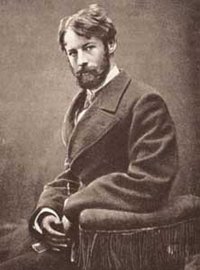
Magnus Hirschfeld

Magnus Hirschfeld born 14 May 1868 (d. 1935)

Magnus Hirschfeld was a prominent German-Jewish physician, sexologist, and gay rights pioneer.

Hirschfeld developed the theory of a third, 'intermediate sex' between men and women. He was interested in the study of a wide variety of sexual and erotic urges, at a time when the early notions of sexual identity was still being formed. His scientific work extended that of Karl Heinrich Ulrichs and influenced Havelock Ellis and Edward Carpenter.

As a young man he had lived in Paris and worked as a journalist. His subsequent career successfully found a balance between medicine and writing. After several years as a general practitioner in Magdeburg, in 1896 he issued the anonymous pamphlet Sappho and Socrates, on homosexual love.

In 1897, Hirschfeld founded the Scientific Humanitarian Committee with Adolf Brand, Benedict Friedlaender and other leaders of Der Eigene, a homosexual campaign and publication. The group aimed to undertake research to defend the rights of homosexuals and to repeal Paragraph 175, the section of the German penal code that since 1871 had criminalised homosexuality. They argued that the law encouraged blackmail, and the motto of the Committee, 'Justice through science', reflected Hirschfeld's belief that a better scientific understanding of homosexuality would eliminate hostility toward homosexuals. He was a tireless campaigner and became a well-known public figure.

Within the group, some of the women, as well as Friedlaender, scorned Hirschfeld's analogy that homosexuals are like cripples. They argued that society might tolerate or pity cripples, but never treat them as equals. They also disagreed with Hirschfeld's (and Ulrichs's) view that male homosexuals were by nature womanish — Brand, Friedlaender and others would later leave the Scientific-Humanitarian Committee and form their another group, Gemeinschaft der Eigenen, which argued that male-male love is a simple aspect of virile manliness rather than a special condition.

However, the Scientific-Humanitarian Committee, under Hirschfeld's leadership, managed to gather over 5,000 signatures from prominent Germans for a petition to overturn Paragraph 175. Signatories included Albert Einstein, Hermann Hesse, Thomas Mann, Rainer Maria Rilke and Leo Tolstoy, but no one admitted publicly to being homosexual themselves.

The bill was brought before the Reichstag in 1898, but was only supported by a minority from the Social Democratic Party of Germany, prompting a frustrated Hirschfeld to consider the controversial strategy of 'outing' — that is, forcing some of the prominent law-makers who had remained silent out of the closet. The bill continued to come before parliament, and eventually began to make progress in the 1920s before the takeover of the Nazi party obliterated any hopes for reform.

In 1921 Hirschfeld organised the First Congress for Sexual Reform, which led to the formation of the World League for Sexual Reform. Congresses were held in Copenhagen (1928), London (1929), Vienna (1930), and Brno (1932).

Hirschfeld was both quoted and caricatured in the press as a vociferous expert on sexual manners, receiving the epithet 'the Einstein of Sex'. He saw himself as a campaigner and a scientist, investigating and cataloging many varieties of sexuality, not just homosexuality. He coined the word 'transvestism', for example.

Hirschfeld co-wrote and acted in the 1919 film Anders als die Andern (Different From the Others), where actor Conrad Veidt played possibly the first homosexual character ever written for cinema. The film had a specific gay-rights law reform agenda — Veidt's character is blackmailed by a lover, eventually coming out rather than continuing to make the blackmail payments, but his career is destroyed and he is driven to suicide.

In 1919, under the more liberal atmosphere of the newly founded Weimar Republic, Hirschfeld was given a former royal palace for his new Institut für Sexualwissenschaft (Institute for Sexual Research) in Berlin. His Institute housed his immense library on sex and provided educational services and medical consultations. People from around Europe visited the Institute to gain a clearer understanding of their sexuality. Christopher Isherwood writes about his and Auden's visit to the Institute in his book Christopher and His Kind. They were visiting Francis Turville-Petre, a friend of Isherwood's who was staying there. The Institute also housed the Museum of Sex, an educational resource for the public which is reported to have been visited by school classes.

Hirschfeld's work continues to be controversial. Critics have claimed that some of his financial support came from closeted but prominent German homosexuals whom he blackmailed. Though he was immensely popular in some circles, in others he was reviled. Gatherings at which he spoke came under attack from anti-gay groups: in one such instance in 1921, his skull was fractured and he was left lying in the street.

Others complain that his belief that homosexuality was, at root, hormonal opened the door for others who were seeking a 'cure' for homosexuality.

When the Nazis took power, one of their first actions, on May 6, 1933, was to destroy the Institut and burn the library. The press-library pictures & archival newsreel film of Nazi book-burnings seen today are often pictures of Hirschfeld's library ablaze. Fortuitously, at that time Hirschfeld was away from Germany on a world speaking tour.

He never returned to Germany, dying in exile in Nice of a heart attack on his 67th birthday in 1935. He is buried there.

Labels: , , , , , ,

Wednesday, April 27, 2011

Friedrich-Paul von Groszheim

Friedrich-Paul von Groszheim born 27 April 1906 (*)

Friedrich-Paul von Groszheim, born in Lübeck, Germany was an ordinary German man who was imprisoned by the Nazis for the (then) crime of homosexuality.

Von Groszheim was one of 230 men arrested in Lübeck on suspicion of being gay by the SS in January 1937 under paragraph 175, which outlawed homosexuality. He was imprisoned for ten months, during which he had to wear a badge emblazoned with a capital A, for Arschficker (arse-fucker):

They beat us to a pulp. I couldn't lie down...my whole back (was) bloody. You were beaten until you finally named names.


Von Groszheim was held in a cell with no heating, very little food, and no toilet facilities. He was rearrested in 1938 and tortured. Von Groszheim was eventually offered the 'alternative' of castration or Sachsenhausen concentration camp. He 'chose' castration. Terrible as it may seem, it was a decision that probably saved his life. He was then released.

Because of the castration, von Groszheim was rejected as physically unfit for military service in 1940. In 1943 he was arrested a third time, this time as a supporter of the former Kaiser Wilhelm II, and imprisoned as a political prisoner at Neuengamme concentration camp.

After the war, he settled in Hamburg.

Von Groszheim was never acknowledged as a victim of the Nazi regime, and due to on-going persecution of homosexuals in Germany, it took nearly half a century before he broke his silence. Eventually he explained why he began to speak out: 'I'm living proof that Hitler didn't win. I'm aware of that every day. If I don't tell my story, who will know the truth?.' He only told his story in 1992, on We Were Marked with a Big "A", a film in German with English subtitles.

*I can find nothing to indicate when Friedrich-Paul von Groszheim died, but as he would now be over 100 years-old I can only assume that he is no longer with us - but his memory is important.

Labels: , , ,

Thursday, February 17, 2011

Friedrich Alfred Krupp

Friedrich Alfred Krupp born 17 February 1854 (d. 1902)

Friedrich Alfred Krupp was a member of the German metal-based industrial dynasty. After his father Alfred's death in 1887 Friedrich Alfred assumed control of the family business. His father had been a hard man, known as 'Herr Krupp' since his early teens. His son was 'Fritz' all his life, and was strikingly dissimilar to his father in terms of personality. He was a philanthropist, a rare commodity amongst the Ruhr industrial leaders; though part of his philanthropy went towards supporting the study of eugenics.

He did, however, possess an industrial genius, though of a different sort from his father. Fritz was a master of the subtle sell, and cultivated a close rapport with the Kaiser, Wilhelm II. Under Fritz's management, the firm's business blossomed further and further afield, spreading across the globe. It was under him as well that many new products that would do much to change history were authorised. Hiram Maxim peddled his machine gun, and Rudolf Diesel brought his new engine to Krupp to construct. Fritz was, therefore, the first to bring Europe diesel engines. The programme that eventually resulted in the German U-Boat fleet was also begun during his tenure.

During his lifetime, Fritz married and had two daughters. He also enjoyed living on the island of Capri, where he built a villa and did biological research. In 1902 he, and also the painter Christian Wilhelm Allers, were caught up in a pederastic scandal involving youths Fritz had 'procured' in Capri and transported to the Bristol Hotel in Berlin (after even the corrupt Capri authorities had had enough of his pederacy). A tumultuous few weeks ensued, which ended in the Fritz's death, ostensibly of a stroke, though suicide is a more probable answer.

Labels: ,

Saturday, February 12, 2011

Prince Philip of Eulenburg

Prince Philip of Eulenburg born 12 February 1847 (d. 1921)

Philip Frederick Alexander, Prince of Eulenburg and Hertefeld, Count of Sandels, was a politician and diplomat of imperial Germany in late 1800s and early 1900s.

Count Philip of Eulenburg was born at Königsberg, Prussia in 1847. He became a close friend of Kaiser Wilhelm II, who was two years his junior, prior to Wilhem’s accession to the imperial throne. Eulenburg entered the diplomatic corps in 1877, becoming Prussia's ambassador to Bavaria and, subsequently, Germany's amabassador to Austria-Hungary.

Upon the accession of his friend Wilhelm to the thrones of Prussia and Germany, count Eulenburg assumed an unofficial position of immense influence, and among other things, was instrumental in the appointment of Bernhard von Bülow as head of the foreign office in 1897. Wilhelm II had long desired the appointment of 'his own Bismarck' - a powerful chancellor who would enact the Kaiser's will - and Eulenburg was the first to suggest Bülow for this role.

In 1900, count Philip was created Prince of Eulenburg and Hertefeld, and to continue his wife's otherwise soon-to-be-extinguishing comital name, also Count of Sandels.

Count Philip of Eulenburg married at Stockholm on 20 November 1875 Augusta Sandels, daughter of the last Count Sandels. Sources say that he continued his 'individual' lifestyle also after the marriage. They had eight children.

Although he was married, Eulenburg was connected in homosexual liaisons with members of the Kaiser’s inner circle, including count Kuno von Moltke, the military commander of Berlin. The public exposure of these liaisons in 1907 led to the Harden-Eulenburg Affair. In 1908, Eulenburg was placed on trial for perjury due to his denial of his homosexuality; the trial was repeatedly postponed due to Eulenburg’s claim of poor health.

With many of his closest advisors discredited by accusations of homosexuality, the Kaiser came to rely more on his military leaders. Prussian militarism culminated in Germany's involvement in the disastrous First World War in which over 3 million German men were killed and an additional 4 million wounded.

Eulenburg died in 1921.

Princess Sophie, Duchess in Bavaria, the current Hereditary Princess of Liechtenstein, is one of Philip Eulenburg's descendants, as are Sophie's children, of whom one son will succeed on the throne of Liechtenstein.

Eulenburg-Hertefeld, Philipp, Prince zu (1857-1921) - lgbtq encyclopedia

Labels: , , ,

Monday, January 24, 2011

Klaus Nomi

Klaus Nomi born 24 January 1944 (d. 1983)

Klaus Nomi was a German countertenor noted for remarkable vocal performances and an unusual, elfin stage persona. Nomi is remembered for bizarrely theatrical live performances, heavy make-up, unusual costumes, and a highly stylised signature hairdo which flaunted a receding hairline. His songs were equally unusual, ranging from synthesiser-laden interpretations of classic opera to covers of 1960s pop standards like Chubby Checker's The Twist and Lou Christie's Lightning Strikes.

Nomi was born Klaus Sperber in Immenstadt, Germany. His birthday is commonly observed as January 24, 1944, though the director of The Nomi Song stated at the New York City premiere of the documentary that Sperber's exact birthday is unknown.

Nomi moved from Germany to New York City in the mid-1970s. He began his involvement with the art scene based in the East Village. According to Andrew Horn's documentary film, Nomi took singing lessons and supported himself working as a pastry chef. Nomi moved in gay circles and in the performance underground.

After a chance meeting in a nightclub, David Bowie hired Nomi and drag-diva Joey Arias as back-up singers and consultants on costume design for a performance on Saturday Night Live which aired on December 14, 1979.

Nomi also collaborated with producer Man Parrish.

The 1981 rock documentary film, Urgh! A Music War features Nomi's live performance of Total Eclipse.

Many consider Nomi an important part of the 1980s East Village scene, which was a hotbed of development for punk rock, music, the visual arts, and the avant-garde. Although Nomi's work was not met with national commercial success at the time, he garnered a cult following, mainly in New York and in France.

In 2004 Andrew Horn made a feature documentary about Nomi's life, work and influence called The Nomi Song.

Nomi died on August 6, 1983 in New York City, one of the first celebrities to die of an illness complicated by AIDS.


The Nomi Song website

The middle video is Klaus Nomi's remarkable interpretation of Henry Purcell's The Cold Song from the opera King Arthur.

Labels: , , , ,

Thursday, September 16, 2010

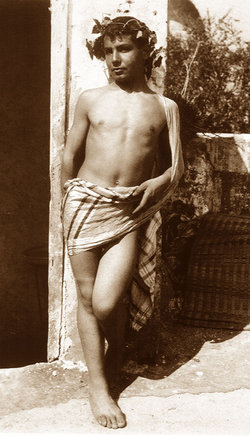
Wilhelm von Gloeden

Wilhelm von Gloeden born 16 September 1856 (d. 1931)

Baron Wilhelm von Gloeden was a German photographer who worked mainly in Italy. He is mostly known for his pastoral nude studies of Sicilian boys, which usually featured props such as wreaths or amphoras, suggesting a setting in the Greece or Italy of antiquity. From a modern standpoint, his work is commendable due to his controlled use of lighting as well as the often elegant poses of his models. Innovative use of photographic filters and special body make-up contribute to the artistic perfection of his works.

Von Gloeden was a minor German aristocrat from Mecklenburg who, suffering from what appears to have been tuberculosis, came to Taormina in Sicily in 1876. He was wealthy and provided a considerable economic boost in this comparatively poor region of Italy, which might explain why the homosexual aspects of his life and work were generally tolerated by the locals.

Von Gloeden, who in the 1880s had started photographing boys, but had also made portrait studies of local peasants and engaged in some landscape photography, turned his hobby into a profitable business in the 1890s when his family fell on hard times financially. Already a local celebrity in Taormina, his work (and his models) drew to Sicily such luminaries of the times as Oscar Wilde, the 'cannon king' Alfred Krupp, Richard Strauss, as well as the German Kaiser.

The bulk of von Gloeden's work stems from this time period up until the beginning of World War I. His idyllic 'illustrations of Homer and Theocritus', i.e. pictures of skimpily clad boys in classical poses, were also reproduced as postcards and enjoyed popularity as souvenirs for tourists.

Von Gloeden generally made different kinds of photographs: the ones that garnered the most widespread attention in Europe and overseas were usually relatively chaste, featured clothes such as togas and generally downplayed their homoerotic implications.

More explicit photos in which the boys were nude and which, because of eye contact or physical contact were more sexually suggestive were traded by the Baron 'under the counter' to close friends.

Still, considering the prudish and homophobic atmosphere of the time, it is remarkable that von Gloeden and large parts of his work were generally accepted and respected. The popularity of his work in Germany, England, and America can possibly be attributed to four major reasons:
- He was a consummate and talented photographer.
- The Classical and painterly themes in which his work wreathed itself served as a cultural 'badge of protection'.
- At that time male-male-love 'did not speak its name' and was thus totally unthinkable to many who saw his images.
- New printing technologies enabled the mass reproduction and sale of his work in postcard form.

In total the Baron took over 3,000 images, which after his death were left to one of his models, Pancrazio Bucini, also known as Il Moro for his North African looks. In 1936, over 2,500 of the pictures were destroyed by Mussolini's police under the allegation that they constituted pornography. Most of the surviving images therefore come from private collections.

Labels: , ,

Thursday, September 02, 2010

Frank Ripploh

Frank Ripploh born 2 September 1949 (d. 2002)

Frank Ripploh was a German actor, film director, and author. He is best remembered for his semi-autobiographical 1981 movie Taxi zum Klo.

The film, produced on a shoestring budget of 100,000 DM, explored the day-to-day life of a Berlin schoolteacher who also led a very active gay sex life. Extremely explicit, especially for its day, Taxi zum Klo was considered groundbreaking for the subject matter it portrayed, and achieved something of a cult status among gay audiences of the time.

Ripploh also participated in the creation of a small number of other art house films during the 1980s, and had a role in the 1982 movie Querelle.

He died of cancer in 2002.

Labels: , , , , ,

Saturday, August 28, 2010

Karl Heinrich Ulrichs

Karl Heinrich Ulrichs born 28 August 1825 (d. 1895)

Karl Heinrich Ulrichs - the first modern theorist of homosexuality - is seen today as a pioneer of modern lesbian, gay, bisexual and transgender movements.

Ulrichs was born in Aurich (Kingdom of Hannover), Germany in 1825. His father, an architect in the civil service of Hannover, died when Ulrichs was ten years old. Ulrichs and his mother then lived with her father, a Lutheran superintendent.

His first homosexual experience was in 1839 at the age of fourteen, in the course of a brief affair with his riding instructor. After studying law in Göttingen and Berlin, Ulrichs joined the civil service of Hannover in 1848. In 1854, however, his homosexual activity came to the attention of his superiors. He resigned in order to avoid being disciplined, for although homosexual acts were not then illegal in Hannover, as a civil servant he could be dismissed.

Ulrichs then earned his living as a reporter for the important Allgemeine Zeitung (Augsburg) and as secretary to one of the representatives to the German Confederation in Frankfurt. He also received a small inheritance from his mother on her death in 1856.

Using the pseudonym Numa Numantius he published in 1864-1865 five booklets under the collective title Forschungen über das Rathsel der mannmännlichen Liebe (Researches on the Riddle of Male-Male Love). They set forth a biological theory of homosexuality, the so-called third sex theory, which he summed up in the Latin phrase anima muliebris virili corpore inclusa (a female psyche confined in a male body).

Ulrichs coined the term Urning for the male subject of this condition; he variously called the female counterpart Urningin, Uranierin, Urnin, and Urnigin. (The term "homosexual," coined by Karl Maria Kertbeny, first appeared in 1869.)

Using his real name in his next booklet, Ulrichs described his appearance at a Congress of German Jurists in Munich, where on August 29, 1867, he urged repealing the anti-homosexual laws. He was shouted down and not allowed to finish, but this was the first time that a self-acknowledged Urning/homosexual spoke out publicly for his cause. Thus Ulrichs was not only the first theorist of homosexuality, but also the first homosexual to 'come out' publicly.

Ulrichs's series of twelve booklets continued until 1879. His goal was to free people like himself from the legal, religious, and social condemnation of homosexual acts as unnatural, and for this he invented a new terminology that would refer to the nature of the individual and not to the acts performed.

Ulrichs's impact on sexology was more significant for directing medical researchers' attention to the subject of homosexuality than for changing their view of it. Richard von Krafft-Ebing, for example, whose book Psychopathia sexualis (1886) established the medical view of homosexuality, was first interested in the subject by Ulrichs's writings.

Twice imprisoned for his public protests against the invasion and annexation of Hannover by Prussia in 1866, Ulrichs fought not only for the equal rights of homosexuals, but also for the rights of ethnic and religious minorities, as well as for the rights of women, including unwed mothers and their children.

But his one-man campaign against the legal oppression of homosexuals was unsuccessful. Indeed, the harsh Prussian anti-homosexual law was extended to the unified Germany in 1872.

Ulrichs left Germany in 1880 for voluntary exile in Italy, where he devoted the last years of his life to promoting Latin as an international language through the publication of a little Latin journal (Alaudae) written entirely by himself. He died on July 14, 1895 in Aquila, Italy.

Ulrichs's original biological theory of homosexuality has since been abandoned, but for more than a century some form of biological determinism has prevailed, both in the popular mind and in scientific circles; it has been adopted by both homosexual liberationists and their enemies.

Ulrichs will be best remembered for his courageous stand for the equal rights of all and, as Magnus Hirschfeld wrote, 'as one of the first and noblest of those who have striven with courage and strength in this field to help truth and charity gain their rightful place'.

Labels: , ,

Wednesday, August 18, 2010

Guglielmo Plüschow

Guglielmo Plüschow born 18 August 1852 (d. 1930)

Guglielmo Plüschow, born Wilhelm Plüschow was a German photographer who moved to Italy and became known for his nude photos of local youths, predominantly males (but also young and rather androgynous looking girls).

Plüschow was the cousin of Wilhelm von Gloeden, who, despite taking up nude photography later than Plüschow, soon overshadowed him. Plüschow was several times at odds with the law and charged with corruption of minors. Today, his photography is recognised for its artistic merits, even though it is generally considered somewhat inferior to von Gloeden's on account of his less graceful handling of lighting and the sometimes strangely stilted poses of his models. His photographs are more erotic and less 'artistic' than von Gloeden's.

Not much is known about Plüschow's early life, except that he was born in Wismar as the eldest of seven brothers and sisters. His father Friedrich Carl Eduard Plüschow was an illegitimate child of Friedrich Ludwig von Mecklenburg-Schwerin and the family home was Schloss Plüschow.

In the early 1870s, he moved to Rome and changed his first name from 'Wilhelm' to its Italian equivalent 'Guglielmo'. Initially making a living as a wine merchant, he soon turned to male and female nude photography. Later he also worked in Naples, among others doing contract work like taking pictures of Nino Cesarini, the young lover of Baron Jacques d'Adelswärd-Fersen at the latter's house Villa Lysis on Capri.

In 1902, Plüschow was charged with 'common procuration' and 'seduction of minors' and had to spend eight months in jail. Another scandal followed in 1907: Plüschow was arrested for his portrayal of a nude minor twelve-year old boy, after which he 'converted' to photographing landscapes. He never stopped producing the erotic images, but learned to be discreet. In 1910 Plüschow left Italy for good and returned to Berlin.

Labels: ,

Sunday, August 15, 2010

Wolfgang Tillmans

Wolfgang Tillmans born 15 August 1968

Wolfgang Tillmans is a photographer. He has worked for fashion and style magazines as well as showing his work in art galleries.

Born in Remscheid in Germany, Tillmans lived and worked in Hamburg at the end of the 1980s before moving to England. He took a course on photography at Bournemouth and Poole College of Art from 1990 to 1992, and then moved to London. He has subsequently been based in New York, Berlin, and London again.

Even before he moved to England, Tillmans was working for British fashion and style magazines. His work for them was apparently more spontaneous than most magazine photography, often seeming to catch fleeting moments. He typically photographed young people, sometimes clubbers or part of the gay scene, sometimes homeless. His work has often been compared to Nan Goldin who from around the 1980s documented Manhattan's Lower East Side in New York City in a similar snapshot aesthetic way.

His initial work led to some degree of fame in the business, and within a couple of years he was photographing people like Moby and Blur's vocalist Damon Albarn in a similar spontaneous style.

Tillmans' photographs are often exhibited clustered together in groups, thus drawing connections between apparently disparate images. In one installation, for example, an image of Concorde sat alongside a picture of some fruit and a photo portrait.

Tillmans has become one of the most prominent and influential photographers to emerge during the 1990s. He profiles the lifestyles of his immediate circle of friends, working collaboratively with his subjects so that they lose their inhibitions in front of the camera. Tillmans produces raw, confessional images yet stays within the traditional genres of portraiture, landscape and still-life. His ability to produce powerful and sometimes shocking images has brought him success in art galleries and mainstream media alike.

As well as his work being shown in a range of places, both fashion magazines and galleries, Tillmans' work also show a wide range of subject matter. Apart from innocent, and what may be seen by many as rather banal, pictures of fruit or a pair of jeans over a bannister, he has photographed nudes and masturbating men. The kind of prints he exhibits also vary - inkjet prints are shown alongside expensive glossy shots and images taken from magazines.

Tillmans' representations of gay men are an important aspect of his art. While his representations of gay men are more abstracted than the sexualised images of Robert Mapplethorpe, Tillmans presents each of his subjects, including gay men, directly, avoiding the subtle homoeroticism of such fashion photographers as Bruce Weber or Herb Ritts, for example.

Tillmans won the Turner Prize in 2000. He has released a book, Burg. His work has been featured in Arto Lindsay's recording The Subtle Body (1995). The same year his photographs were published in a Taschen book Wolfgang Tillmans (with a preface of Simon Watney).

Labels: ,

Saturday, August 14, 2010

Horst P Horst

Horst P Horst born 14 August 1908 (d. 1999)

Horst P Horst, born Horst Paul Albert Bohrmann, and most often known as just Horst was a photographer best known for his photographs of women and fashion taken while working for Vogue.

Horst was born in Weißenfels-an-der-Saale, Germany. His father was a successful merchant. In his teens, he met dancer Eva Weidemann at the home of his aunt's, and this aroused his interest in avant-garde art. In the late 1920s, Horst studied at Hamburg Kunstgewerbeschule, leaving there to go to Paris to study under the architect Le Corbusier.

While in Paris, he befriended many people in the art community and attended many galleries. In 1930 he met Vogue photographer Baron George Hoyningen-Huene, a half-Baltic, half-American nobleman, and became his lover. He travelled to England with him that winter. While there, they visited photographer Cecil Beaton, who was working for the British edition of Vogue. In 1931, Horst began his association with Vogue, publishing his first photograph in the French edition of Vogue in November of that year.

His first exhibition was hung in La Plume d'Or in Paris in 1932. It was reviewed by Janet Flanner in The New Yorker, and this review, which appeared after his exhibit was over, made Horst instantly famous. Horst made a portrait of Bette Davis the same year, the first in a series of celebrities he would photograph during his life.

Horst rented an apartment in New York in 1937, and while residing there met Coco Chanel, whom Horst called 'the queen of the whole thing'. He would photograph her fashions for three decades.

He met Valentine Lawford, British diplomat in 1938 and they would live together as a couple until Horst's death. They adopted and raised a son, Richard J Horst, together.

In 1940, Horst applied for United States citizenship. In 1942 he passed an Army physical, and joined the Army on July 2, 1943. On October 21 he received his United States citizenship as Horst P Horst. He became an Army photographer, with much of his work printed in the forces' magazine Belvoir Castle. In 1945 he photographed United States President Harry S Truman, with whom he became friends, and he photographed every First Lady in the post-war period at the invitation of the White House.

In 1947, Horst moved into his house in Oyster Bay, New York. He designed the white stucco-clad building himself, the design inspired by the houses that he had seen in Tunisia during his relationship with Hoyningen-Huene.

Horst is best known for his photographs of women and fashion, but is also recognised for his photographs of interior architecture, still lifes, especially ones including plants, and environmental portraits. One of the great iconic photos of the twentieth century is 'The Mainbocher Corset' with its erotically charged mystery, captured by Horst in Vogue’s Paris studio in 1939. His work frequently reflects his interest in Surrealism and his regard of the ancient Greek ideal of physical beauty.

His method of work typically entailed careful preparation for the shoot, with the lighting and studio props (of which he used many) arranged in advance. His published work uses lighting to pick out the subject; he frequently used four spotlights, often one of them pointing down from the ceiling. Only rarely do his photos include shadows falling on the background of the set. Horst rarely, if ever, used filters. While most of his work is in black & white, much of his colour photography includes largely monochromatic settings to set off a colourful fashion. He photographed a number of interiors designed by Robert Denning and Vincent Fourcade of Denning & Fourcade and often visited their homes on Manhattan and Long Island. After making the photograph, Horst generally left it up to others to develop, print, crop, and edit his work.

In the 1960s, encouraged by Vogue editor Diana Vreeland, Horst began a series of photos illustrating the lifestyle of international high society. The articles were written by his partner, Valentine Lawford. From this point until nearly the time of his death, Horst spent most of his time travelling and photographing. In the mid-1970s, he began working for House & Garden magazine as well as for Vogue.

He died at his home in Palm Beach Gardens, Florida, at 93 years of age.

Horst P Horst - official website

Labels: , ,

Friday, August 06, 2010

Christian Wilhelm Allers

Christian Wilhelm Allers born 6 August 1857 (d. 1915)

Christian Wilhelm Allers was a German painter and printmaker.

C W Allers, the son of a merchant, was born 1857 in Hamburg. He first worked as a lithographer, and in 1877 he moved to Karlsruhe where he continued to work as a lithographer.

In 1880/1881 he served in the German navy in Kiel where the German painter Anton Alexander von Werner supported him. In Kiel he got to know the poet Klaus Groth, who became a friend of his.

Allers became well-known when he published his collection of prints Club Eintracht in 1888. Several other books and maps (collections of prints) followed, e.g. about Bismarck, so at the beginning of the 1890s he was able to build a villa on Capri. He lived there for many years, also spending some time in Hamburg, Karlsruhe and travelling around the world.

His drawings are rich in detail and are of realistic style, so they often seem clinical. Although the drawings look realistic, Allers sometimes added persons to scenes who were never at that location. In this respect, he was not a realist. Technically, Allers often used pencil and drew scenes of everyday life, travelogue and portraits.

In autumn 1902, there was a scandal. Friedrich Alfred Krupp, a member of the famous industrial dynasty and another well-known German living in Capri, was accused by some italian newspapers of homosexuality and pederasty. It is uncertain how much truth there was in the accusations or if it was part of an extortion attempt by a journalist.

Some weeks later, Allers was accused, by court. (Krupp died some weeks later, possibly a suicide.) Allers managed to escape before the trial began, which led to a sentence of 4½ years imprisonment, pronounced in absentia. According to Tito Fiorani, 'Allers had distinctly homosexual tendencies, and liked to surround himself with boys, whom he often used as models.' [pictured: Junge]

Allers left Capri and began travelling around the world for more than 10 years, staying some time in New Zealand, Samoa, and Australia. During this time, he often used the pseudonym W. Andresen, and earned money by making portraits of wealthy people.

He died in 1915 in Karlsruhe some months after returning to Germany. [pictured: Ganymede]

Labels: ,

Thursday, July 22, 2010

Richard Plant

Richard Plant born 22 July 1910 (d. 1998)

Richard Plant was a German-American writer. He is said to have written, in addition to the works published under his own name, several detective novels or Kriminalromane, on which he collaborated with Dieter Cunz and Oskar Seidlin, and which were published under the collective pen-name of Stefan Brockhoff.

Richard Plant was born Richard Plaut in Frankfurt am Main to the family of the town councillor Theodor Plaut. Upon the accession of the Nazis to power in Germany in 1933 and the zealous enforcement of the provisions of Paragraph 175 of the criminal code against homosexuality, he was obliged to leave Germany for Switzerland in concert with his partner, Oskar Seidlin. Here he obtained a doctorate from the University of Basle (Universität Basel) in 1935 with a dissertation on Arthur Schnitzler.

His first non-academic book seems to have been a children’s tale, Die Kiste mit dem großen S., published in 1936. This was followed in 1938 by his Taschenbuch des Films. In the same year, Richard Plaut arrived in the United States, where he eventually adopted the name Richard Plant. Here another children’s book, S.O.S. Geneva, co-authored with Oskar Seidlin, was published in October 1939. His next book had to await the end of the Second World War, when The Dragon in the Forest appeared in 1948.

From 1947 to 1973 Plant taught at the City University of New York, and discontinuously also at the New School for Social Research.

He is the author of The Pink Triangle: The Nazi War against Homosexuals (1986; German translation, 1991).

Richard Plant died in New York City on March 3, 1998.

Labels: , ,

Thursday, July 15, 2010

Carl Bruns and Heinrich Roth

Carl Bruns and Heinrich Roth died 1945

Carl Bruns and Heinrich Roth were two ordinary gay German men who became victims of Nazi Germany.

The gay pogrom in Germany started just over 70 years ago, in the summer of 1937. The Gestapo launched a systematic crack-down in the mid-1930s, actively entrapping gay men. The Nazis created a vicious protection racket that allowed gay bar owners to remain in business, on condition that they handed over names of customers on a regular basis.

Landlords were bribed to inform on tenants. If someone at work didn't like a bachelor co-worker, all he had to do was to go to the Gestapo and suggest a sexual advance had been made, and the next day the co-worker would be gone. It mattered little whether there was any truth to the allegations.

In the city of Hamburg, Gestapo men in leather trench coats entered the city's most famous department store, the Alsterhaus, during business hours and rounded up about 40 gay employees, who were hauled off in vans waiting out on the street.

The Alsterhaus department store raid was just the beginning. Raids occurred with growing frequency in the late 1930s.

What followed were weeks and months of 'protective custody' and transfers to mental asylums for 'curative treatment' and eventual sentencing to imprisonment in concentration camps. Many were 'offered' castration, with a vague promise of leniency, as an alternative to imprisonment.


This photo shows homosexual prisoners in Buchenwald concentration camp, recognisable by the pink triangles on their striped prison uniforms.

After German unification, hundreds of thousands of case histories were released and historians have spent the least few years sifting through them. Their findings are still just being published, and have shocked even those historians who knew that atrocities had occurred, but were surprised by the extent of them.

With Prussian thoroughness, the Nazis documented every detail of the lives of those they rounded up. Those documents provide chilling insights into a hitherto unknown story.

One such story was that of Carl Bruns and Heinrich Roth, a gay couple who ran an upmarket men's clothing shop in central Hamburg, right across the street from Gestapo headquarters.

Bruns and Roth were arrested in 1940 and, after months of pre-trial detention, they were sent to concentration camps near Hamburg. By some miracle, both men survived until spring 1945, when the camps were being liberated by Allied forces.

But it was then that the final tragedy struck.

Auschwitz was liberated by the Red Army in early 1945, and the pictures of skeletal camp inmates shocked the world. In response, Heinrich Himmler issued an order to all camp commandants that they were to ensure that no camp inmates should ever fall into the hands of Allied forces. He didn't specify what they should do, leaving it in the hands of camp commandants.

Some commandants at Dachau and other camps began gassing all surviving inmates so that none would be left alive. Others began evacuating their inmates.

Thus Bruns and Roth were forced to leave their camp near Hamburg on a forced march to the Baltic Sea, 100 kilometers (62 miles) away, where the converted cruise liner Cap Arcona was at anchor.

The Allies were advancing on all fronts. Everyone knew that the war was over. All the inmates had heard the news. British forces had dropped leaflets saying they would be in Hamburg within hours.

And yet these men were sent on a death march to the sea. Stragglers were machine-gunned to death. Others collapsed and died of exhaustion. Bruns died along the way. Roth made it to the Baltic Sea docks where the Cap Arcona was waiting and he was herded aboard along with thousands of other inmates. Two other ships were also used in this way, the Thielbek and the Athen.

The British RAF was conducting intensive air raids to pave the way for ground forces, which were only a few miles away. RAF fighter-bombers had been told that Nazi officials were seeking to flee Germany aboard a big ship disguised as a refugee vessel.

On 3 May 1945, four days after Hitler's suicide but four days before the unconditional surrender of Germany, the RAF planes came in and bombed and strafed the Cap Arcona, setting it ablaze and sending it to the bottom. Those inmates who managed to dive into the water were either killed by the bombs and strafing from the planes or else were machine-gunned by Gestapo men as they tried to climb ashore.

A handful found shelter in reeds along the shore and were found shivering in the water by British soldiers a few hours later. Roth was not among them.

There were 4,500 prisoners on board the Cap Arcona, 2,800 prisoners on board the Thielbek, and 1,998 prisoners on board the Athen. 350 were rescued from the Cap Arcona, 50 were rescued from the Thielbek and all the 1,998 prisoners from the Athen survived. A total of 7,500 people were killed in the air-raid. The British who were seen as potential rescuers by the concentration camp prisoners turned out to be their unwitting excecutioners. Although there is evidence to suggest that the SS planned to sink the Cap Arcona, and the other two other ships, to 'destroy the evidence' and remove potential witnesses to their atrocities.

According to documents at the Dutch Institute of War Documentation (NIOD), the government of Sweden had warned the British government that prisoners were aboard the ships. The British government is keeping its documents relating to the attack on the three ships closed until 2045

Labels: , , ,

Sunday, June 13, 2010

Siegfried Fischbacher

Siegfried Fischbacher born 13 June 1939

Siegfried Fischbacher is the blond half of the popular illusionist act Siegfried & Roy.

Sigfried & Roy are two German-American entertainers working in Las Vegas. Their long running show of magic and illusion was famous for including white tigers.

Siegfried Fischbacher and Roy Horn were born in Germany around the time of the Second World War. They emigrated to the United States where they are now naturalised citizens.

Siegfried is a traditional magician (illusionist), whilst Roy grew up among exotic animals and is known for his rapport with them.

They met in 1959 when they both found work on a German ocean liner. Siegfried was a cabin steward and Roy a waiter. Siegfried began performing magic for some of the passengers, eventually being allowed to have his own show, with Roy as his assistant. Unknown to the crew, Roy had smuggled a cheetah named Chico aboard the vessel. Roy had come to know Chico from his frequent visits to the Bremen zoo.

After developing their show they were engaged in Las Vegas. In 1972 they received an award for the best show of the year. In 1990 they were hired by Steve Wynn, the manager of The Mirage, for an annual guarantee of $57.5 million. In 2001, they signed a lifetime contract with the hotel. The duo has appeared in around 5,750 shows together, mostly at The Mirage. Their long-running illusion and magic act closed October 3, 2003 after Roy was seriously injured by one of the act's tigers during a performance.

According to the 2000 Becky Celebrity 100 List, Siegfried & Roy were then the 9th-highest-paid celebrities in the US, coming in just behind motion picture producer and director Steven Spielberg. For many years, they 'shared living quarters'.

For their contribution to live theatre performance, Siegfried & Roy have a star on the Hollywood Walk of Fame at 7060 Hollywood Boulevard.

Their extravagant and spectacular act embodies camp in the truest sense and marks Siegfried & Roy as the Liberaces of illusion.

Siegfried & Roy returned for a one-off farewell performance in February 2009.

Labels: , ,

Sunday, December 28, 2008

F. W. Murnau

Friedrich Wilhelm Murnau born 28 December 1888 (d. 1931)

Friedrich Wilhelm Murnau was one of the most influential directors of the silent film era.

He was one of a number of German film directors to take part in the expressionist movement that took root in German cinema during the 1920s, and he directed a number of movies that were influential and remain widely seen among film scholars today. Some of Murnau's output from the silent era has been lost, although many of his films still survive; film scholars widely acknowledge them as masterpieces.

He was born as Friedrich Wilhelm Plumpe in Bielefeld, Germany. He attended the University of Heidelberg and studied art history. He took the name 'Murnau' from a town in Germany. He was a combat pilot during World War I and directed his first film Der Knabe in Blau ('The Child in Blue') in 1919.

Murnau's most famous film is Nosferatu, a 1922 adaptation of Bram Stoker's Dracula that caused Stoker's estate to sue for copyright infringement. Murnau lost the lawsuit and all prints of the film were ordered destroyed, but bootleg prints were stored and preserved over time, so that Nosferatu is widely available in the present era. Werner Herzog remade the film in 1979.
Nosferatu, subtextually, depicted demoralised Germany post-World War I.

Nearly as important as Nosferatu in Murnau's filmography was The Last Laugh (Der Letzte Mann, German, The Last Man) (1925), written by Carl Mayer and starring Emil Jannings. Often voted second greatest film of all time by international critics' polls, the film introduced the subjective point of view camera, where the camera 'sees' from the eyes of a character and uses visual style to convey a character's psychological state. It also anticipated the cinéma vérité movement in its subject matter.

Murnau's last German film was the big budget Faust (1926) with Gösta Ekman as the title character, Emil Jannings as Mephisto and Camilla Horn as Gretchen. Murnau's film draws on older traditions of the legendary tale of Faust as well as on Goethe's classic version. This carefully composed and innovative feature contains many memorable images and startling special effects, with careful attention paid to contrasts of light and dark. Particularly striking is the sequence in which the giant, horned and black winged figure of Mephisto (Jannings) hovers over a town sowing the seeds of plague. The acting by Ekman (who miraculously transforms, in the course of the film, from a bearded old man to a handsome youth) and the sinister, scowling, demonic Jannings is first rate and the virtually unknown actress Camilla Horn gives a memorable performance as the tragic figure of Gretchen.

Murnau emigrated to Hollywood in 1926, where he joined the Fox Studio and made Sunrise (1927), a movie often cited by film scholars as one of the greatest films of all time. Filmed in the Fox Movietone sound-on-film system (music and sound effects only), Sunrise was not a financial success but received several Oscars at the very first Academy Awards ceremony in 1928. In winning the Academy Award for Unique and Artistic Production it shared what is now the Best Picture award with the movie Wings.

Murnau's next two pictures, Four Devils (1928) and City Girl (1930), were modified to adapt to the new era of sound film and were not well received. No copy of Four Devils now exists. Their poor receptions disillusioned Murnau, and he quit Fox to journey for a while in the South Pacific.

Together with documentary pioneer Robert Flaherty, Murnau travelled abroad to Bora Bora to realise the film Tabu in 1931. But Flaherty left after artistic disputes with Murnau who had to finish the movie on his own. Because of images of bare-breasted 'native' Polynesian women the movie was censored in the United States. The film was originally shot as half-talkie, half-silent, before being fully restored as a silent film - Murnau's preferred medium.

Murnau did not live to see the premiere of his last film; he died in a car crash in Santa Barbara, California on March 11, 1931. The car was driven by Murnau's fourteen-year old Filipino valet Garcia Stevenson. Murnau was entombed on Southwest Cemetery (Südwest-Kirchhof Stahnsdorf) in Stahnsdorf near Berlin. Only 11 people showed up for the funeral. Among them were Robert Flaherty, Emil Jannings, Greta Garbo and Fritz Lang who delivered the funeral speech. Garbo also commissioned a deathmask of Murnau which she kept on her desk during her years in Hollywood.

In Berlin, Murnau moved in artistic circles where homosexuality was accepted as a matter of course. In Hollywood, however, Murnau's homosexuality was the cause of much gossip, including the infamous rumour that his death was precipitated by his fellating his chauffeur while the latter was driving. All evidence has shown this rumour to be false, yet it persists.

A fictionalised account of the making of the film Nosferatu was Shadow of the Vampire by director E. Elias Merhige. Murnau is portrayed by John Malkovich. In the film, Murnau is so dedicated to making the film genuine that he actually hires a real vampire to play Orlok.

Labels: , , , ,

Monday, December 22, 2008

Gustaf Gründgens

Gustaf Gründgens born 22 December 1899 (d. 1963)

Gustaf Gründgens was one of Germany's most famous actors of the 20th century, leading theatres in Berlin, Düsseldorf, and Hamburg. His single most famous role was that of Mephistopheles in Goethe's Faust, which is still considered by many to have been the best interpretation of the role ever given.

Born in Düsseldorf, Gründgens was also involved in one of the most famous literary cases in 20th century Germany, as the subject of a novel entitled Mephisto by Klaus Mann, son of Thomas. The novel, a thinly veiled account of Gründgens' life, portrayed its main character as having shady connections with the Nazi regime. A lawsuit ensued, as well as a controversy about libel and the freedom of fiction. Their relation was a complicated one, since Gründgens was at one point married to Erika Mann, Klaus' sister, and the three had together worked in the theatre. Both had sexual relationships with men - Mann was gay, Gründgens bisexual - but this topic was avoided in the novel.

Gründgens adopted son was Peter Gorski, who directed Faust in 1960 and later sued the publisher of Mephisto on his father's behalf.

From 1936 till 1946, Gründgens was married to the famous German actress Marianne Hoppe.

On October 7, 1963, he died in Manila of an internal hemorrhage.

Labels: , , ,

Friday, December 12, 2008

Karl Gorath

Karl Gorath born 12 December 1912

Karl Gorath was born in the small town of Bad Zwishenahn in northern Germany. When he was 2, his family moved to the port of Bremerhaven. His father was a sailor and his mother became a nurse in a local hospital. After his father died, Karl continued to live with his mother. Karl was 20 when he began training as a deacon at his parish church.

Gorath was training for a nursing career when, at twenty-six, he was denounced as a homosexual.

1933-39: I was 26 when my jealous lover denounced me and I was arrested at my house under paragraph 175 of the criminal code, which defined homosexuality as an 'unnatural' act. Though this law had been on the books for years, the Nazis had broadened its scope and used it as grounds to make mass arrests of homosexuals. I was imprisoned at Neuengamme concentration camp near Hamburg where the '175ers' had to wear a pink triangle.


1940-44: Because I'd had some training as a nurse, I was transferred to work at the prisoner hospital at the Wittenberg subcamp. One day, a guard ordered me to decrease the bread ration for the patients who were Polish war prisoners, but I refused, telling him that it was inhuman to treat the Poles in this way. As punishment, I was sent to Auschwitz, and this time, rather than being marked as a '175er', I wore the red triangle of a political prisoner. At Auschwitz I had a lover who was Polish; his name was Zbigniew.


Gorath was one of the lucky ones. Being reclassified as a political prisoner spared him much of the brutality that was often inflicted on inmates marked with the pink triangle.

Karl Gorath was liberated in Auschwitz in 1945. However, when his past conviction under paragraph 175 became known, he was ostracised and found great difficulty getting a job. Gorath had survived the holocaust but remained a marked man.

Gorath is one of six gay men who are the subject of a documentary on gays in Nazi concentration camps. The film, by producers Jeffrey Friedman and Rob Epstein and narrated by Rupert Everett, is called Paragraph 175.

Between 1933 and 1945, 100,000 men were arrested under Paragraph 175. Some were imprisoned, others were sent to concentration camps. Only about 4,000 survived.

In 2000 when the film was released, fewer than ten of these men were known to be living. Five come forward in the documentary to tell their stories for the first time, considered to be among the last untold stories of the Third Reich.

Those Who Are Left

Labels: , ,

Sunday, November 30, 2008

Robert Odeman

Robert Odeman born 30 November 1904 (d. 1985)

Robert T Odeman, born Martin Hoyer in Hamburg, Germany was a German classical pianist, actor, writer, and composer. He was a Holocaust survivor.

Odeman [pictured right] met his first love, architecture student Martin Ulrich Eppendorf [pictured left], who went by the name Muli, at the age of 17. The two shared a close relationship for ten years until Muli's death.

After training to become a carpenter, Odeman studied classical piano, successfully performing throughout Europe for several years as a pianist. He played accompaniments for silent films in many cinemas in Hamburg. After suffering a hand injury, Odeman was forced to give up piano playing, and turned to theatre.

A year after Muli’s death, in 1933, Odeman became musical director of the New Theater in Hamburg. In 1935, Odeman opened a cabaret in Hamburg, which was shut down a year later by the Nazis, who claimed it was politically subversive.

Odeman's boyfriend, a bookseller, was pressured by the Gestapo to denounce him in 1937 and he was arrested under paragraph 175, which outlawed homosexual acts between men. Odeman was sentenced to 27 months in prison, which he spent first in Plötzensee and then in various Berlin prisons. After his release in 1940, Odeman was subject to a 'Berufsverbot' forbidding him from carrying on certain professions, and he was not permitted to appear in public. He also remained under police surveillance.

Odenbach purported to carry on a relationship with the singer Olga Rinnebach, but in 1942 he was again arrested under paragraph 175 and sent to Sachsenhausen concentration camp where he was assigned an office job. During a forced march from the camp towards the Baltic Sea in April 1945, he escaped with other homosexual concentration camp prisoners.

After the war, Odeman focused on cultural activities, completing training as an actor and appearing in various theatres and productions. He also wrote many satirical poems, which were released in book form, and were later set to music and released on musical and spoken records, some with Odeman himself performing.

In 1959, Odeman met the 25-year-old Günter Nöring, with whom he lived until his death. Since the two were unable to marry, Odeman adopted his younger partner. After the adoption, Nöring used the name Günter Odeman-Nöring.

Odeman died in the Berlin-Grunewald district of Berlin in 1985, at the age of 81.

Labels: , , , , , ,

Friday, November 28, 2008

Ernst Röhm

Ernst Röhm born 28 November 1887 (d. 1934)

Ernst Julius Röhm was a German military officer, and the commander and co-founder of the Nazi Sturmabteilung, or storm troopers — the SA, also known as 'Brownshirts'.

Ernst Röhm was one of the most prominent of a number of early Nazi party members who was a homosexual, and his homosexuality was ultimately the pretext used for his removal during the purge of the SA. The real reason was the threat he eventually posed to Hitler's authority. Having been outed in 1925, Röhm made little attempt to hide his sexuality. Despite Hitler's pretense of shock upon discovering his deputy's sexual orientation, he had in fact long known - probably since 1919 - that Röhm was homosexual.

During Röhm's tenure at the head of the SA, it has been suggested that a number of homosexual men (notably Karl Ernst, a former bouncer at a gay nightclub, and Edmund Heines) were appointed to and promoted within the SA as a result of high-level liaisons with powerful SA figures. Röhm's Brownshirt militia - mostly undisciplined soldiers and roughnecks from the city-slums - contained many gay men, and there was debauchery in the ranks. This was despite the openly anti-gay policies of the Nazis, exemplified by their strengthening of Paragraph 175 (criminalising homosexual acts) of the German Criminal Code of 1871.

Röhm was executed without trial during the purge of the SA — the so-called 'Night of the Long Knives' in June 1934.

In the wake of Röhm's execution, Hitler ordered the registration of homosexuals and the Gestapo was charged with the responsibility of creating dossiers on homosexuals and other 'asocials' in the Third Reich. The beginning of the Nazi terror against homosexuals was marked by the murder of Ernst Röhm.

Ernst Röhm
The Gay Holocaust - Nazi Persecution: The Röhm Affair

On a personal note, I gave considerable thought as to whether I wanted to feature a leading Nazi in Gay For Today - this site has always been intended to mark and celebrate the contributions of gay men to (usually) the worlds of the arts, media, sport, politics and entertainment and so on - but a Nazi? And Hitler's deputy to boot. However, the story of Ernst Röhm's openness about his sexuality, his leading role in the early days of the Nazis - he very much believed in the 'socialist' part of National Socialism - and the way Hitler tolerated this powerful homosexual as long as he was useful to him and then ruthlessly snuffed him out and purged the SA and then Germany of homosexuals is interesting and significant.

In the end, yes, Ernst Röhm was a gay man and a Nazi but he ultimately became a victim of the Nazis and his death, as it says above, marked the real beginning of the still tragically under-told story of the Nazi terror against homosexuals - an intensely dark period in the long, dark history of gay persecution and oppression.

Labels: , , ,