Sunday, May 08, 2011

Tom of Finland

Tom of Finland born 8 May 1920 (d. 1991)

Tom of Finland (born Touko Laaksonen in Kaarina, Finland) was a fetish artist notable for his stylised homoerotic art and his influence on late twentieth century gay culture.

Over the course of four decades he produced some 3,500 illustrations, mostly featuring men with exaggerated primary and secondary sex traits: heavily muscled torsos, limbs, buttocks and improbably large penises. Tight or partially removed clothing showed off these traits, with penises often visible as distinct bulges in tight trousers or prominently displayed for the viewer. His drawings frequently feature two or more men either immediately preceding or during explicit sexual activity.

Touko Laaksonen made his first erotic drawings in his youth, but none of them are known to exist; Laaksonen said that he had at first kept his drawings hidden, but then destroyed them 'at least by the time I went to serve the army'. His drawings were based on images of masculine Finnish labourers he had seen from an early age. Finland, however, soon became embroiled in the Winter War with the USSR, and then formally involved in World War 2, and Laaksonen was conscripted into the Finnish Army. He served as an anti-aircraft officer, holding the rank of a second lieutenant. He later attributed his fetishistic interest in uniformed men to encounters with men in army uniform at this time. After the war, Laaksonen returned to civilian life and worked in the advertising industry as a commercial graphic artist, continuing to create erotic drawings for his own pleasure on the side.

In 1956, Laaksonen submitted some of his homoerotic drawings to the influential American magazine Physique Pictorial for publication under the pseudonym Tom. The editor of the magazine changed the name to Tom of Finland.

Laaksonen's work soon came to the attention of the gay community at large, and by 1973, he was both publishing erotic comic books and infiltrating the mainstream art world. He was best known for works that focused on homomasculine archetypes such as lumberjacks, motorcycle policemen, sailors, businessmen, bikers, and leathermen. His most prominent comic series are the Kake comics, which included these archetypal characters in abundance.

Exhibitions of Laaksonen's work began in the 1970s and in 1973 he gave up his full-time job at the Helsinki office of international advertising firm McCann-Erickson.

In 1979, Laaksonen founded the Tom of Finland Company to collect and distribute his work. This company exists to the present day, and has expanded into a non-profit foundation dedicated to collecting, preserving, and exhibiting homoerotic artwork.

Before his death, Laaksonen was the subject of the Finnish documentary Daddy and the Muscle Academy - The Art, Life, and Times of Tom of Finland which includes interviews with the artist. The European art publisher Taschen has published various collections of his work including three 'Retrospective' Anthologies and the complete Kake comics

Many of his drawings are based on photographs, but none are exact reproductions of them. The photographic inspiration is used, on the one hand, to create lifelike, almost moving images, with convincing and active postures and gestures whilst, on the other hand, Laaksonen exaggerates physical features and presents his ideal of masculine beauty and sexual allure, combining realism with fantasy.

Arguably Laaksonen's work revived and commercialised an underground leather counter-culture which emerged after World War 2 and reached its height in the late 1970s and early 1980s before the emergence of AIDS in the gay community.


The apparel, styling, and demeanour adopted by large numbers of gay men during that period appear to be derived directly from his work. Although the prevalence of this 'look' has declined since the mid-1980s - except in the leather and S&M scene - Laaksonen's work continues to be used extensively in gay publications, bars, clubs, and online communities who associate with its erotic subject matter. The combination of cap, leather jacket, and moustache became known in the pop culture of Western world as a visual stereotype of gay men.


Tom of Finland Foundation

Labels: , , , ,

Thursday, September 16, 2010

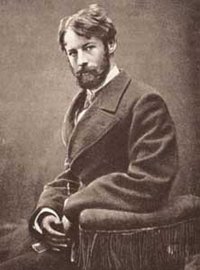
Wilhelm von Gloeden

Wilhelm von Gloeden born 16 September 1856 (d. 1931)

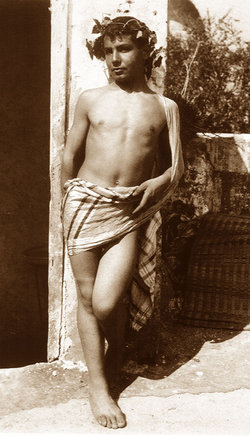
Baron Wilhelm von Gloeden was a German photographer who worked mainly in Italy. He is mostly known for his pastoral nude studies of Sicilian boys, which usually featured props such as wreaths or amphoras, suggesting a setting in the Greece or Italy of antiquity. From a modern standpoint, his work is commendable due to his controlled use of lighting as well as the often elegant poses of his models. Innovative use of photographic filters and special body make-up contribute to the artistic perfection of his works.

Von Gloeden was a minor German aristocrat from Mecklenburg who, suffering from what appears to have been tuberculosis, came to Taormina in Sicily in 1876. He was wealthy and provided a considerable economic boost in this comparatively poor region of Italy, which might explain why the homosexual aspects of his life and work were generally tolerated by the locals.

Von Gloeden, who in the 1880s had started photographing boys, but had also made portrait studies of local peasants and engaged in some landscape photography, turned his hobby into a profitable business in the 1890s when his family fell on hard times financially. Already a local celebrity in Taormina, his work (and his models) drew to Sicily such luminaries of the times as Oscar Wilde, the 'cannon king' Alfred Krupp, Richard Strauss, as well as the German Kaiser.

The bulk of von Gloeden's work stems from this time period up until the beginning of World War I. His idyllic 'illustrations of Homer and Theocritus', i.e. pictures of skimpily clad boys in classical poses, were also reproduced as postcards and enjoyed popularity as souvenirs for tourists.

Von Gloeden generally made different kinds of photographs: the ones that garnered the most widespread attention in Europe and overseas were usually relatively chaste, featured clothes such as togas and generally downplayed their homoerotic implications.

More explicit photos in which the boys were nude and which, because of eye contact or physical contact were more sexually suggestive were traded by the Baron 'under the counter' to close friends.

Still, considering the prudish and homophobic atmosphere of the time, it is remarkable that von Gloeden and large parts of his work were generally accepted and respected. The popularity of his work in Germany, England, and America can possibly be attributed to four major reasons:
- He was a consummate and talented photographer.
- The Classical and painterly themes in which his work wreathed itself served as a cultural 'badge of protection'.
- At that time male-male-love 'did not speak its name' and was thus totally unthinkable to many who saw his images.
- New printing technologies enabled the mass reproduction and sale of his work in postcard form.

In total the Baron took over 3,000 images, which after his death were left to one of his models, Pancrazio Bucini, also known as Il Moro for his North African looks. In 1936, over 2,500 of the pictures were destroyed by Mussolini's police under the allegation that they constituted pornography. Most of the surviving images therefore come from private collections.

Labels: , ,

Friday, July 23, 2010

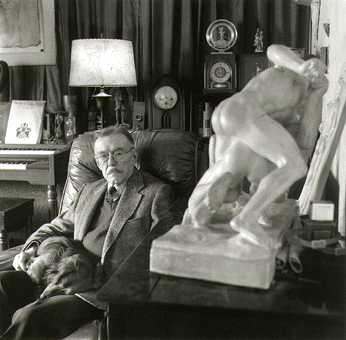
Samuel M Steward aka Phil Andros

Samuel M Steward born 23 July 1909 (d. 1993)

Samuel Morris Steward, also known by the pen name Phil Andros, was a novelist and tattoo artist based in Oakland, California. He was born in Woodsfield, Ohio and attended the Ohio State University. He began teaching English at OSU as a university fellow in 1932 during the final year of his PhD and was given his first post as a university professor in 1934 at Carroll College in Helena, Montana.

In 1936 he was dismissed from a position at the State College of Washington due to the portrayal of prostitution in his novel Angels on the Bough. He moved to Chicago, teaching at Loyola until 1946 and then at DePaul University. In 1954 he left teaching and, oddly, began tattooing in Chicago under the professional name Phil Sparrow.

Steward met famed sex researcher Alfred Kinsey around 1949 and became an unofficial collaborator, helping Kinsey find new contacts. In 1949, he participated in a BDSM scene for Kinsey to film, with a sadist that Kinsey flew in from New York. He said Kinsey was 'as approachable as a park bench' and described him as a liberating influence.

In the early 1950s he made pornographic drawings, many of them based on his own Polaroid photographs.

Steward maintained friendships with Gertrude Stein, Alice B Toklas, and Lord Alfred Douglas (the lover of Oscar Wilde). His 1981 memoir Chapters from an Autobiography detailed these relationships, as well as other experiences. He also edited the book Dear Sammy: Letters from Gertrude Stein and Alice B. Toklas, and wrote two 'Gertrude Stein-Alice B. Toklas Mysteries' featuring the famous couple as detectives. Steward was also introduced to Thornton Wilder by Gertrude Stein, who at the time regularly corresponded with the both of them. Wilder famously drafted the third act of Our Town during a brief affair with Steward in Zurich on their first meeting.

In the 1960s Steward began writing gay erotica under the name Phil Andros. His works dealt with rough trade and S&M sex. The name Phil Andros, which he used both as a pen name and the name of his protagonist, comes from the Greek words for love and man.

Steward uniquely regarded his skills as a man of letters, pornographer and tattoo artist with equal merit, symbolising some of the contradictions of gay male life as he made his contribution to defining the gay male identity in the twentieth century.

Steward died at age 84 of chronic pulmonary disease in Berkeley, California.

Labels: , , , ,

Wednesday, July 14, 2010

Jim French

Jim French born 14 July 1932

Jim French is an American photographer who under the name Rip Colt was founder of the Colt Studio line of male erotica.

French began drawing and photographing male erotica in the 1960s, and his first published book, Man, was in 1972. Other books include Another Man, Jim French Men, Opus Deorum, Masc., The Art of Jim French and The Art of the Male Nude.

French was formally trained at the Philadelphia Museum School of Art from 1950 to 1954 and went on active duty in the United States Army in 1955, having been in the reserves for two years prior to his enlisting. He was honourably discharged from the service in 1957. French settled in New York and pursued a successful career in fashion illustration. At the suggestion of an Army contact who had seen some of his early, mostly unpublished homoerotic drawings done under the name Arion, he and French formed a partnership to start a mail order company they named Luger. This brand was chosen because of the strong suggestions of masculinity associated with the German Luger pistol.

While the Arion drawings had been rather romantic and glamorised sketches of Fire Island life and similar scenes (certainly hinting at the paintings of two of his favourite artists, Petty and Varga), the drawings he began to produce for Luger made a considered transition to decidedly more masculine subjects like bikers, cowboys, wrestlers and other familiar macho figures. When his art was featured on the cover and inside several issues of Mars, sales increased dramatically.

Because of legal restraints of the time, the earliest works did not contain frontal nudity but were nonetheless highly erotic and humorously creative in their suggestiveness. He also began offering prints of photographs he had taken as references for his drawings, and these too sold well.

Eventually French’s partner bought out his share of Luger, freeing French and a new partner, Lou Thomas, to establish another business called COLT Studio (again, a reference to a firearm, although before long, this image association was scrapped in favor of a young stallion logo). Having worked for nearly a year to produce the first drawings and photographs to be offered by the new company, Colt was begun in late 1967. Once more the images were offered in sets of prints by mail and the company quickly became successful. But after fifteen years in New York, often travelling to California to take advantage of the weather and abundance of models, French decided to make a permanent move West.

Finally, in 1974 he bought out his partner’s share of the business leaving Lou Thomas to start, briefly, his own company (Target Studio) and French made his home in the Hollywood Hills. From the COLT Studio offices in the San Fernando Valley he continued to run what was the most successful physique photography company since Bob Mizer’s Athletic Model Guild. For thirty-six years COLT Studio offered the singularly iconic, erotic and highly influential photographs for which French has become known worldwide. In 2003 he sold COLT Studio and now produces fine art prints from his archives.

Jim French website

The Jim French photograph shown top was famously used for the cover of The Smiths' first single Hand In Glove.

Labels: , ,

Saturday, November 08, 2008

Chi Chi LaRue

Chi Chi LaRue born 8 November 1959

Chi Chi LaRue - born Larry David Paciotti in Hibbing, Minnesota, United States - is a director of gay and bisexual pornography. He has also directed under the names 'Lawrence David' and 'Taylor Hudson'.

LaRue moved to the Twin Cities area and began performing in drag as one-half of 'The Weather Gals', a 'hag drag' revue.

He moved to California with a friend and was hired by Catalina Video as an administrative assistant and publicist because of his knowledge of porn and the workings of the porn industry.

LaRue worked at Catalina during the initial revelation of the AIDS crisis in which many of the producers and directors in the gay porn industry were falling ill or dying. This created an opportunity for LaRue to persuade Catalina management to allow him to direct full-length videos.

LaRue has directed hundreds of gay porn films since 1988 and in 2003 he began to direct straight porn for Vivid Video to which he became a favourite among female stars. For some time, LaRue divided his attention between Vivid Video and his own Rascal Video for Channel 1 Releasing.

In 2006, LaRue announced he would no longer produce films for Vivid Video because they were featuring actors and actresses having sex without condoms. LaRue has been an outspoken critic of the growth of bareback [condom free] material in the gay adult video industry.

LaRue is an accomplished DJ, performing at many events throughout the year.

In 1992, LaRue appeared in Madonna's video for Deeper And Deeper.

In 2007, LaRue was chosen as one of Out Magazine's top 50 'most powerful gay men and women in America'.

Labels: , ,