Friday, April 15, 2011

George Platt Lynes

George Platt Lynes born 15 April 1907 (d. 1955)

George Platt Lynes was an American fashion and commercial photographer.

Born in East Orange, New Jersey his childhood was spent in New Jersey but he attended the Berkshire School in Massachusetts. He was sent to Paris in 1925 with the idea of better preparing him for college. His life was forever changed by the circle of friends that he would meet there. Gertrude Stein, Glenway Wescott and Monroe Wheeler - who became his lovers - and those that he met through them opened an entirely new world to the young artist.

He returned to the United States with the idea of a literary career and he even opened a bookstore in Englewood, New Jersey in 1927. He first became interested in photography not with the idea of a career, but to take photographs of his friends and displayed them in his bookstore.

Returning to France the next year in the company of Wescott and Wheeler, he travelled around Europe for the next several years, always with his camera at hand. He developed close friendships within a larger circle of artists including Jean Cocteau and Julien Levy the art dealer and critic. Levy would exhibit his photographs in his gallery in New York City in 1932 and Lynes would open his studio there that same year. He was soon receiving commissions from Harper's Bazaar, Town & Country and Vogue.

In 1935 he was asked to document the principal dancers and productions of Lincoln Kirstein's and George Balanchine's newly founded American Ballet company (now the New York City Ballet). This became a lifetime project.

While he continued to shoot fashion photographs, getting accounts with such major clients as Bergdorf Goodman and Saks Fifth Avenue during the 1930s and 1940s he was losing interest and had started a series of photographs which interpreted characters and stories from Greek mythology [Orpheus and Eros, 1936, left].

By the mid-1940s he grew disillusioned with New York; his relationship with Wescott and Wheeler had cooled and he left for Hollywood in 1946 where he took the post of Chief Photographer for the Vogue studios. He photographed Katharine Hepburn, Rosalind Russell, Gloria Swanson and Orson Welles, from the film industry as well as others in the arts among them Aldous Huxley, Igor Stravinsky and Thomas Mann. While a success artistically it was a financial failure.

His friends helped him to move back to New York City in 1948. Other photographers, such as Richard Avedon, Edgar de Evia and Irving Penn, had taken his place in the fashion world. This combined with his disinterest in commercial work, meant he was never able to regain the successes he once had.

Focus on homoerotic imagery started to take over his photographic life. He had begun in the 1930s taking nudes of his circle of friends and performers, including a young Yul Brynner, but these had been known only to intimates for years. He began working with Dr Alfred Kinsey and his Institute in Bloomington, Indiana. The Kinsey Institute for Research in Sex, Gender and Reproduction, as it is known today holds the largest collection of his male nudes. Twice he declared bankruptcy.

By May of 1955 he had been diagnosed terminally ill with lung cancer. He closed his studio. He destroyed much of his print and negative archives particularly his male nudes. After a final trip to Europe, Lynes returned to New York City where he died in December 1955. He was just 48.


Labels: , , ,

Monday, April 11, 2011

Glenway Wescott

Glenway Wescott born 11 April 1901 (d. 1987)

Born on a farm in Wisconsin, Glenway Wescott has become rather overlooked as a novelist. He produced a series of best-selling, highly regarded novels, notably The Grandmothers (1927), The Pilgrim Hawk (1940) and Apartment In Athens (1945), although he didn't complete a novel after the age of forty-five. He was equally well known as an arts impressario and for the company he kept.

Wescott is a linking figure at the heart of the American literary scene in the middle of the 20th century. As a young writer in 1920s Paris, he associated with Hemingway, Gertrude Stein and F. Scott Fitzgerald. On his return to the States he was a central figure in New York's artistic and gay communities - W. H. Auden, Christopher Isherwood, Somerset Maugham, E. M. Forster, Jean Cocteau, Ford Madox Ford, Thornton Wilder, and many others were among his acquaintance.

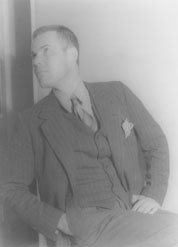
Although only some of his work hints at his sexuality, he wrote a private journal from 1937 until the 1950s, focusing on his private life and relationships with fellow gay artists including lifelong partner Monroe Wheeler, photographer George Platt Lynes and Paul Cadmus - this was published in 1990 as Continual Lessons. His relationship with Monroe Wheeler lasted from 1919 until Wescott's death. [Photograph of Glenway Wescott by George Platt Lynes]

In the late 1950s and early 1960s he was elected as president of the National Institute of Arts and Letters; he also assisted Dr Alfred Kinsey with his ground-breaking research into human sexuality and published a collection of critical essays on writer friends he admired, called Images of Truth (1962).

A recent biography by Jerry Rosco has brought about a fresh appraisal of Wescott's work and his central role in American literature, and his best works have begun to be republished.

Labels: , , ,

Thursday, February 03, 2011

Kenneth Anger

Kenneth Anger born 3 February 1927

Kenneth Anger is an American underground avant-garde film-maker and author.

Born in Santa Monica, California as Kenneth Wilbur Anglemyer, as a child he played the child prince in the 1935 version of A Midsummer Night's Dream and attended dancing school with Shirley Temple.

He gained fame and notoriety from the publication of the French version of Hollywood Babylon in Paris in 1958, a tell-all book of the scandals of Hollywood's rich and famous. (The US version wasn't published until 1974.)

He became fascinated with the supernatural and Aleister Crowley (as well as becoming an adherent of Crowley's religion of Thelema) sometime in his late teens and many of his films reflect occult themes. He began making films around age 11, but his early films were mostly destroyed. His first film to see distribution was Fireworks, filmed in Los Angeles in 1947, which gained the attention of Jean Cocteau, who then invited him to go to Paris. While most of his films are short subject (ranging from 3.5 minutes to 30 minutes) mood pieces, in 1955 he made a documentary film of the ruins of Crowley's Thelema abbey in Cefalù, Sicily, which has since been lost.

Anger was one of America's first openly gay filmmakers, and certainly the first whose work addressed homosexuality in an undisguised, self-implicating manner. He developed a close friendship with Dr Alfred Kinsey of the Institute for Sex Research. Anger would later recall that Kinsey was his first customer after Kinsey purchased a copy of Fireworks when they first met in 1947. Anger eventually helped Kinsey build his film archive. The Anger Collection includes correspondence between the two men, as well as letters to and from former Institute director John Bancroft. Anger would later speak openly of his participation in Kinsey's research, including being filmed masturbating.

During the late 1960s he associated with The Rolling Stones, Mick Jagger and convicted first degree murderer Bobby Beausoleil of the Charles Manson family, who starred in Anger's 1969 film Invocation of My Demon Brother.

Kenneth Anger had a widely publicised spat with Led Zeppelin guitarist Jimmy Page over the Lucifer Rising soundtrack. Anger claimed Page took three years to deliver the music, and the final product was only 25 minutes of droning and was useless. Anger also accused Page of 'having an affair with the White Lady' and being too strung out on drugs to complete the project. Page countered claiming he had fulfilled all his obligations, even going so far as to lend Anger his own film editing equipment to help him finish the project. Page's music was dumped eventually and replaced by music written by Beausoleil, completed in 1980 from prison.

For 20 years from the early eighties, Anger released no new material. In the new millennium he has since returned to filmmaking. He also performs as Technicolor Skull with Brian Butler.

In a scene in John Waters's 2000 movie Cecil B. Demented, the characters are introducing themselves and each one shows the name of an independent director tattooed on his/her arm. One of the characters has Kenneth Anger.

Anger makes an appearance in the 2008 feature documentary by Nik Sheehan about Brion Gysin and the Dreamachine entitled FLicKeR.

In 2009 his work was featured in a retrospective exhibition at the P.S. 1 Contemporary Art Center in New York

Anger has finished writing Hollywood Babylon III, but has not yet published it, fearing severe legal repercussions if he did so.


Labels: , , , ,

Sunday, January 09, 2011

Herbert Huncke

Herbert Huncke born 9 January 1915 (d. 1996)

Herbert Huncke was a rare blend of sub-culture icon, writer, homosexual pioneer (he participated in Alfred Kinsey's studies), drug addict, common criminal, friend and enemy to America's most important social movements of the 20th century. He lived a remarkable, and yet all-too-human life, spending decades incarcerated and decades more writing and contributing to the Beat Generation among other artistic endeavours.

Born in Greenfield, Massachusetts and reared in Chicago, Herbert Huncke was a street hustler, high school drop out and drug addict who lived the lifestyle described by Jack Black in his autobiography You Can't Win. The book — and Huncke's life — was centred around living as an outlaw hobo, jumping trains across the vast expanse of the United States, bonding through a shared destitution and camaraderie with other hoboes of all walks of life. Although Huncke later came to regret his loss of family ties; in his autobiography, Guilty of Everything, he states his lengthy jail sentences were a partial result of his lack of family support. Huncke left Chicago as a teenager after his parents divorced. Despite the fantasies the largely college-educated beat generation had about Huncke, he was from as much of a middle-class background as they were.

Huncke arrived in New York City in 1939 and headed immediately for 42nd Street. For the next ten years Huncke was a 42nd Street regular and became known as the 'Mayor of 42nd Street'.

At this point, Huncke's regular haunts were 42nd Street and Times Square, where he associated with people of all kinds including prostitutes (both male and female) and sailors. During World War II, Huncke shipped out to sea as a United States Merchant Marine to ports in South America, Africa and Europe. He landed on the beach of Normandy three days after the invasion.

Aboard ships, Huncke would kick his drug habit or keep it up with morphine supplied by the ship medic. When he returned to New York, he returned to 42nd Street, and it was after one of these trips where he met then-unknown writer William S. Burroughs, who was selling a sawed-off shotgun and a box of morphine syrettes. Huncke took an immediate dislike to Burroughs and thought he was 'heat', slang for undercover police or FBI. Assured that Burroughs was all right, Huncke bought the morphine and, at Burroughs' request, immediately gave him an injection.

Thus began a long career of drug use by Burroughs, and Huncke became a lead character in William Burrough's first pulp novel, written under the pseudonym Bill Lee, JUNKIE: Confessions of an Unredeemed Drug Addict. After Huncke first exposed Burroughs to both jive talk and morphine, these elements became central to Burroughs' writing. In the late 1940s Huncke was invited to Texas to grow marijuana on the Burroughs' farm.

Huncke was a bisexual hustler, drug user, thief and burglar. His autobiography, titled Guilty of Everything, was lived in the 1940s and 1960s but published in the 1990s.

During the late 1940s, Huncke was recruited to be a subject in Alfred Kinsey's research on the sexual habits of the American male. He was interviewed by Kinsey, and recruited fellow addicts and friends to participate. Huncke was a writer, unpublished, since his days in Chicago and gravitated toward literary types and musicians. In the music world, Huncke visited all the jazz clubs and associated with Billie Holiday, Charlie Parker and Dexter Gordon (with whom he was once busted on 42nd Street for breaking into a parked car). When he first met Allen Ginsberg, Jack Kerouac and William Burroughs, they were interested in writing and also unpublished. They were inspired by his stories of 42nd Street life, criminal life, street slang and Huncke's vast experience with drugs. Huncke told them stories of life on 42nd Street, his life on the road prior to New York City and, obligingly, turned them on to drugs.

Although it was his passion for thievery, heroin use and the outlaw lifestyle which fuelled his daily activities, ultimately, when he was caught, he never ratted out his friends. In the late 1940s, Allen Ginsberg, Jack Melody and 'Detroit Redhead' flipped a car in Queens, New York, while trying to run down a motorcycle cop. Although Huncke was not at the scene of the crime, he was picked-up in Manhattan because he lived with Ginsberg, and Huncke received the heavy prison sentence.

'Someone had to do the bit.' Huncke said years later.

Huncke himself was a natural storyteller, a unique character with a paradoxically honest take on life. Later, after the formation of the so-called Beat Generation, members of the Beats encouraged Huncke to publish his notebook writings, which he did with limited success in 1964. Huncke used the word 'Beat' to describe someone living roughly with no money and few prospects. Huncke was considered to have coined the phrase that eventually came to describe an entire generation. Jack Kerouac later insisted that 'Beat' was derived from beatification, to be supremely happy. However, it is thought that this definition was a defence of the beat way of life, which was frowned upon and offended many American sensibilities.

Huncke died in 1996. He had been living for several years in the basement of a building on East 7th Street near Avenue D in New York City, supported fiancially in old age by his many friends. Prior to this, his rent at the Chelsea Hotel came from financial support from Jerry Garcia of The Grateful Dead, whom Huncke never met.

Labels: , , , , ,

Friday, July 23, 2010

Samuel M Steward aka Phil Andros

Samuel M Steward born 23 July 1909 (d. 1993)

Samuel Morris Steward, also known by the pen name Phil Andros, was a novelist and tattoo artist based in Oakland, California. He was born in Woodsfield, Ohio and attended the Ohio State University. He began teaching English at OSU as a university fellow in 1932 during the final year of his PhD and was given his first post as a university professor in 1934 at Carroll College in Helena, Montana.

In 1936 he was dismissed from a position at the State College of Washington due to the portrayal of prostitution in his novel Angels on the Bough. He moved to Chicago, teaching at Loyola until 1946 and then at DePaul University. In 1954 he left teaching and, oddly, began tattooing in Chicago under the professional name Phil Sparrow.

Steward met famed sex researcher Alfred Kinsey around 1949 and became an unofficial collaborator, helping Kinsey find new contacts. In 1949, he participated in a BDSM scene for Kinsey to film, with a sadist that Kinsey flew in from New York. He said Kinsey was 'as approachable as a park bench' and described him as a liberating influence.

In the early 1950s he made pornographic drawings, many of them based on his own Polaroid photographs.

Steward maintained friendships with Gertrude Stein, Alice B Toklas, and Lord Alfred Douglas (the lover of Oscar Wilde). His 1981 memoir Chapters from an Autobiography detailed these relationships, as well as other experiences. He also edited the book Dear Sammy: Letters from Gertrude Stein and Alice B. Toklas, and wrote two 'Gertrude Stein-Alice B. Toklas Mysteries' featuring the famous couple as detectives. Steward was also introduced to Thornton Wilder by Gertrude Stein, who at the time regularly corresponded with the both of them. Wilder famously drafted the third act of Our Town during a brief affair with Steward in Zurich on their first meeting.

In the 1960s Steward began writing gay erotica under the name Phil Andros. His works dealt with rough trade and S&M sex. The name Phil Andros, which he used both as a pen name and the name of his protagonist, comes from the Greek words for love and man.

Steward uniquely regarded his skills as a man of letters, pornographer and tattoo artist with equal merit, symbolising some of the contradictions of gay male life as he made his contribution to defining the gay male identity in the twentieth century.

Steward died at age 84 of chronic pulmonary disease in Berkeley, California.

Labels: , , , ,

Saturday, October 04, 2008

C A Tripp

C A Tripp born 4 October 1919 (d. 2003)

C A Tripp, Ph.D. was a psychologist, writer, gay activist, and researcher for Dr Alfred C Kinsey.

Born Clarence Arthur Tripp in Denton, Texas, USA. Tripp studied at the Rochester Institute of Technology, and is a Naval Veteran.

He worked with Alfred Kinsey at the Kinsey Institute for Research in Sex, Gender and Reproduction in Bloomington, Indiana from 1948 to 1956.

Tripp earned a Ph.D. in Clinical psychology from New York University.

He wrote two books, the first an influential scholarly bestseller The Homosexual Matrix (1975) Among the many revelations in Tripp's book was that during World War II, the FBI operated a male bordello in New York City staffed with homosexual agents, who were charged with the task of extracting information from foreign sailors. His final book, The Intimate World of Abraham Lincoln (2005), controversially makes the case that Lincoln had several homosexual relationships throughout his life.

He died of cancer, aged 83.

Labels: , , ,