Sunday, April 10, 2011

Montague Summers

Montague Summers born 10 April 1880 (d. 1948)

Augustus Montague Summers was an eccentric English author and clergyman. He is known primarily for his 1928 English translation of the medieval witch hunter's manual, the Malleus Maleficarum, as well as for several studies on witches, vampires, and werewolves, in all of which he professed to believe.

Montague Summers was the youngest of the seven children of an affluent banker and justice of the peace in Clifton, Bristol. Summers was educated at Clifton College before studying theology at Trinity College, Oxford with the intention of becoming a curate in the Church of England. He continued his religious training at Lichfield Theological College and became a deacon in 1908, but he apparently never proceeded to higher orders, probably because of accusations of sexual impropriety with young boys. Summers was for a while part of the circle of the so-called Uranian poets, who celebrated ancient Greco-Roman pederasty. His first book, Antinous and Other Poems appeared in 1907 and was dedicated to this subject matter.

Summers worked for several years as an English and Latin teacher at various schools before adopting writing as his full-time employment. He was interested in the theatre of the seventeenth century, particularly that of the English Restoration, and edited the plays of John Dryden and William Congreve among others. He was one of the founder members of The Phoenix, a society that performed those neglected works, and was elected a fellow of the Royal Society of Literature in 1916.

Summers also joined the growing ranks of English men of letters interested in medievalism, Catholicism, and the occult. In 1909 he converted to Catholicism and shortly thereafter he began passing himself off as a Catholic priest and styling himself the 'Reverend Alphonsus Joseph-Mary Augustus Montague Summers', even though he was never a member of any Catholic order or diocese. His biographer Father Brocard Sewell asserts that he was ordained a deacon in the Church of England in 1908, and thus was properly addressed as 'Reverend' in any case.

Summers wrote hagiography (on Saint Catherine of Siena) and lives of writers such as Jane Austen before turning to the occult, for which he is best remembered. In 1928 he published the first English translation of Heinrich Kramer's and James Sprenger's Malleus Maleficarum (The Hammer of Witches), a fifteenth century Latin text on the hunting of witches. This work followed his History of Witchcraft and Demonology (1927) and The Geography of Witchcraft (1928). He then turned to vampires, producing The Vampire: His Kith and Kin (1928) and The Vampire in Europe (1929), and later to werewolves with The Werewolf (1933). Summers's work on the occult is notorious for his unusual and old-fashioned writing style, his display of erudition, and his purported belief in the reality of the subjects he treats. Of more lasting value were his seminal works on Gothic literature: The Gothic Quest: a History of the Gothic Novel (1938), A Gothic Bibliography (1940) and his collection of Gothic Horror stories in The Supernatural Omnibus (1931) and Victorian Ghost Stories (1936). Summers also edited an incomplete edition of two of the seven obscure Gothic novels, known as the Northanger Horrid Novels, mentioned by Jane Austen in her Gothic parody Northanger Abbey. Summers was instrumental in rediscovering these lost books, which some had supposed were an invention of Jane Austen herself.

Summers cultivated his reputation for eccentricity. The Times wrote he was 'in every way a "character" and in some sort a throwback to the Middle Ages.' His biographer, Brocard Sewell, paints the following portrait of Summers: 'During the year 1927, the striking and somber figure of the Reverend Montague Sommers in black soutane and cloak, with buckled shoes - a la Louis Quatorze - and shovel hat could often have been seen entering or leaving the reading room of the British Museum, carrying a large black portfolio bearing on its side a white label, showing in blood-red capitals, the legend "VAMPIRES".'

While his friend Aleister Crowley adopted the persona of a modern-day witch, Summers played the part of the learned Catholic witch-hunter.

Summers was a member of the Order of Chaeronea, a secret society for homosexuals founded in 1897 by George Ives.

He died at his home in Richmond, Surrey. An autobiography The Galanty Show was published posthumously in 1980, though much is left unrevealed about his somewhat mysterious life.

Labels: , , , ,

Wednesday, March 02, 2011

John Gray

John Gray born 2 March 1866 (d. 1934)

John Gray was an English poet whose works include Silverpoints, The Long Road and Park: A Fantastic Story.

Born in the working-class district of Bethnal Green, London, he is known today mostly as an aesthetic poet of the 1890s and as a friend of Ernest Dowson, Aubrey Beardsley and Oscar Wilde. He was also a talented translator, bringing works by the French Symbolists Mallarmé, Verlaine, Laforgue and Rimbaud into English, often for the first time. Purported to be the inspiration behind the title character in Wilde's The Picture of Dorian Gray, Gray distanced himself from this. His relationship with Wilde was initially intense, but had cooled for over two years by the time of Wilde's imprisonment.

Like many of the artists of that period, Gray was a convert to Roman Catholicism in the late-90s. He left his position at the Foreign Office and studied for the priesthood at the Scots College, Rome and later became a priest at Saint Patrick's and a rector at Saint Peter's in Edinburgh.

His most important supporter, and life partner, was the wealthy poet and early defender and theorist of homosexuality, Marc-André Raffalovich. He continued to write poetry of a high calibre for the rest of his life; later works were mainly devotional and often dealt with various Christian saints. His collected poems, with extensive notes, were printed in a 1988 edition edited by English professor and nineties expert Ian Fletcher.

He died in 1934 at St Raphael's nursing home in Edinburgh after a short illness.

Labels: , , , ,

Wednesday, July 28, 2010

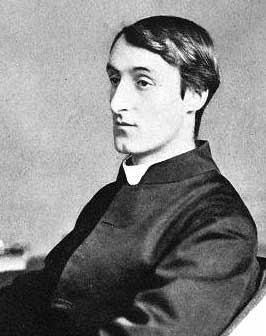
Gerard Manley Hopkins

Gerard Manley Hopkins born 28 July 1844 (d. 1889)

Essex-born Gerard Manley Hopkins was a Victorian poet and Jesuit priest.

Although a brilliant scholar, Hopkins failed his final theology exam which limited his career in the clergy, although ordained. Short (5ft 2in.), gloomy and odd, he was not an effective teacher either, although he was a professor of Greek literature at University College, Dublin; but he was a lifelong poet of considerable brilliance (if a gloomy kind of brilliance) and influence. He was particularly influential in creating a new form of rhythm by combining different traditions of poetry into something completely new, which effectively pre-dated the free verse of 20th century poetry.

Little known during his lifetime, he had an enthusiastic audience of motley fellow poets but it was his university friend and supporter Robert Bridges who brought Gerard Manley Hopkins work to prominence when he, by then Poet Laureate, published the first collected edition of his late friend's work.

Plagued by ill health for much of his life, Hopkins died of typhoid fever aged only 45, and is buried in Dublin.

Although it is unlikely that the sexually-repressed Catholic priest, Hopkins would have considered himself to be homosexual, his poetry reveals that he considered male beauty to be one of the most splendid witnesses of the divine; his diaries reveal something of a tortured obsession with actual male beauty.

Labels: , , ,

Monday, July 26, 2010

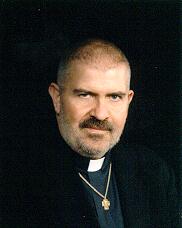
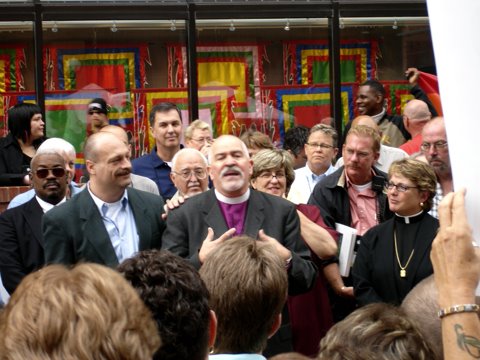
Reverend Troy Perry

Rev. Troy Perry born 26 July 1940

Involved in the church since he was a boy, as a young man, Troy Perry entered full-time ministry in a Pentecostal Church and married a pastor's daughter, with whom he had two sons. He was unable to ignore his homosexual feelings which ultimately brought an end to his marriage and his ministry. He thought that was where his involvement in the church had come to an end but ...

In 1968, before the Stonewall Riots and the Christopher Street Parades, the Reverend Troy Perry founded the Metropolitan Community Church of Los Angeles to serve the spiritual needs of gay and lesbian people. His action was revolutionary - and transformational - and not without difficulty.

Ever since , the Universal Fellowship of Metropolitan Community Churches has served as a safe haven for those rejected by other religious communities. Rev Perry retired as Moderator of the MCC in 2005, but has remained active as a writer, public speaker and activist and advocate.

Troy Perry married his longterm partner Phillip Ray De Blieck in Canada at the Metropolitan Community Church in Toronto. On their return to Los Angeles, they sued the State of California for recognition of their marriage and won. The State appealed and the ruling was overturned but the law has since changed in California to allow gay marriage.

In addition to his work as a gay religious leader and human rights activist, Rev. Perry has found time to write an autobiography, The Lord is My Shepherd and He Knows I'm Gay. Rev. Perry also completed a sequel to this book, titled Don't Be Afraid Anymore, published by St. Martin's Press and Profiles in Gay and Lesbian Courage also published by St. Martin's. He is a contributing editor for the book Is Gay Good? and the subject of another book, Our God Too. In 2003, he completed the text of his latest book, 10 Spiritual Truths For Gays and Lesbians* (*and everyone else!).

Labels: ,

Wednesday, June 16, 2010

Simon Bailey

Simon Bailey born 16 June 1955 (d. 1995)

The Reverend Simon Bailey was an Anglican priest.

Simon Bailey was born in Halifax, West Yorkshire, one of five children of the Reverend Walter Bailey. Walter was a Baptist minister who combined conservative evangelical theological convictions with social radicalism. He bought his first television in order to be able to watch the funeral of Sir Winston Churchill in 1965. He supported the Campaign for Nuclear Disarmament and actually died while distributing leaflets for the Labour Party.

The family moved first to Birkenhead and then to Stoke-on-Trent, following Walter as he was called to different churches. Eventually he became so idiosyncratic that he ran his own church from home.

Simon Bailey continued his education at Regent's Park College, the Baptist Permanent Private Hall of the University of Oxford, where he read English Language and Literature.

Despite having chosen to study at the Baptist Regent's Park, Simon Bailey was by now unhappy in the Baptist tradition. He received the sacrament of confirmation in the Church of England, embracing Anglicanism as more 'aesthetic and sensual'.

Simon Bailey was a sexually active gay man who contracted HIV. He learned that he had the virus just as he took up the position of Rector of Dinnington in South Yorkshire. When he became too unwell to conceal his condition from the people around him he informed the diocesan authorities and gradually introduced the news to his own parishioners. Though not the only Anglican priest at that time to be HIV-positive, and eventually to develop AIDS, he was the first to stay in parish ministry, continuing to celebrate the Eucharist until only a few weeks before his death. One of the most remarkable features of his time at Dinnington was the love and care that he received from his parishioners.

Simon Bailey became well known to a wider public as a result of a BBC Everyman programme, Simon's Cross, that was broadcast in January 1995. The making of the programme led to his sister writing the biography, Scarlet Ribbons: A Priest with AIDS, which also contains extracts from Simon's published and unpublished writing.

Labels: ,