Wednesday, May 25, 2011

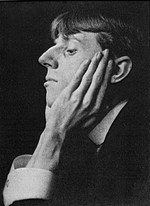
Robert 'Robbie' Ross

Robert 'Robbie' Ross born 25 May 1869 (d. 1918)

Robert Baldwin Ross was a journalist and art critic. He is best known, however, as the executor of Oscar Wilde's estate. He was also responsible for bringing together several great literary figures and acting as their mentor.

Ross was born in Tours, France but came to Britain at an early age. His father originally came from Northern Ireland and his mother from Canada. His father had been the attorney-general of Upper Canada and his grandfather was the Canadian Prime Minister Robert Baldwin.

While working as a journalist and critic, he is alleged to have been Oscar Wilde's first male lover, and remained loyal to Wilde through thick and thin, eventually becoming his literary executor. This was not an easy task. It meant tracking down and purchasing the rights to all of Wilde's texts, which had been sold off along with all of Wilde's possessions when he was declared bankrupt. It also meant fighting the rampant trade, following Wilde's arrest, in black market copies of his books and, in particular, books, usually erotic, that Wilde did not write but which were published illegally under his name. The rights to all of Oscar's works along with the money earned from their printing/performance while he was executor was given by Ross to Wilde's sons.

Ross was also responsible for commissioning Jacob Epstein to produce the tomb for Wilde. He even requested that Epstein design a small compartment into the tomb for Ross’s own ashes.

In 1908, some years after Wilde's death, Ross produced the definitive edition of his works. Following Wilde's disgrace and imprisonment, Ross went abroad for safety's sake, but returned to offer support, both financial and emotional, to Wilde during his last years. Ross himself did not escape scandal. A few years before Wilde's imprisonment, Ross was involved in a scandal over his sexual relationship with a boy of fourteen, the son of friends, and his best-friend, aged fifteen. Both boys confessed to their parents that Ross had made love to them, and the fourteen year old boy also admitted that Lord Alfred Douglas had also made love to him while he was a guest at Ross's house. After a good deal of panic and frantic meeting held with solicitors, Douglas and Ross convinced the parents not to go to the police.

As a young man, Ross moved to England to go to university. He was accepted at Cambridge but was the victim of bullying, probably due to his sexuality (of which he made no secret) and his, perhaps, outspoken journalism in the university paper. Ross caught pneumonia after a cruel dunking in a fountain by a number of students with, according to Ross, the full support of a don. After recovering he fought for an apology from his fellow students, which he received, but more fiercely, for the dismissal of the don who, he argued, had known about and supported the bullying. The university refused to punish the man and Ross dropped out of university.

Following this Ross tried his hand at a number of careers, as writer, art critic, and literary executor. He was able to rely on an allowance and inheritance from his wealthy family to support himself. His literary output is small, with only one book worth a mention; Masques and Phases is a collection of previously published works by Ross, short stories and reviews. Ross's main contribution to literature lies in his work as Wilde's executor, and as Wilde's friend in reading Wilde's texts, making suggestions, and, if Ross is to be believed, frequently suggesting changes and improvements. As an art critic, Ross was highly critical of the post-impressionist painters. He worked unpaid for many years for a small art gallery run by friends, for whom he travelled purchasing works. At one time he hoped to be selected for a royal position but was rejected probably due to his connection to Wilde.

Ross is also of interest in his decision to 'come out' to his family, whom he gathered to hear the announcement not long after he left university.

As a result of his faithfulness to Wilde even in death, Ross was vindictively pursued by Lord Alfred Douglas, who repeatedly attempted to drag him into court, and attempted to have him arrested as a homosexual.

During the First World War, he drew around him a coterie of young artists, mostly homosexuals, including Siegfried Sassoon and Wilfred Owen. He was also a close friend of Wilde's son Vyvyan Holland, and a friend of his other son Cyril until his death in the First World War. In early 1918, during the German Spring Offensive, Noel Pemberton Billing, a right-wing M.P., published an article entitled The Cult of the Clitoris, in which he accused members of Ross's circle of being at the centre of 47,000 homosexual traitors who were betraying the nation to the Germans. The incident brought much embarrassing attention to Ross and his associates.

Later in the same year, Ross was preparing to travel to Melbourne, Australia to open an exhibition at the National Gallery when he died suddenly, an event which caused great grief to his many friends. In 1950, on the 50th anniversary of Wilde's death, Ross's ashes were added to Wilde's tomb in the Le Père Lachaise Cemetery.

Labels: , , , ,

Tuesday, April 26, 2011

Charles Shannon

Charles Shannon born 26 April 1865 (d. 1937)

Charles Haslewood Shannon, English artist, was born at Sleaford in Lincolnshire, the son of the Rev Frederic Shannon.

He attended the Lambeth school of art, and was subsequently considerably influenced by his friend and partner Charles Ricketts and by the example of the great Venetians. In his early work he was addicted to a heavy low tone, which he abandoned subsequently for clearer and more transparent colour. He achieved great success with his portraits and his Giorgionesque figure compositions, which are marked by a classic sense of style, and with his etchings and lithographic designs.

The Dublin Municipal Gallery owns his circular composition The Bunch of Grapes and The Lady with the Green Fan (portrait of Mrs Hacon). His Study in Grey is at the Munich Gallery, a Portrait of Mr Staats Forbes at Bremen, and a Souvenir of Van Dyck at Melbourne. One of his most remarkable pictures is The Toilet of Venus in the collection of Lord Northcliffe. Several of his portrait works are on display in the National Portrait Gallery in London.

Shannon taught himself lithography, realising that lithography could be used for original artistic expression, not merely as a means of reproducing images. Shannon's skill was such that he was described as 'one of the most gracefully accomplished and scholarly lithographers of the day'. He is regarded in particular as the master of lithographic portraiture.

Complete sets of his lithographs and etchings have been acquired by the British Museum and the Berlin and Dresden print rooms. He was awarded a first-class gold medal at Munich in 1895 and a first-class silver medal in Paris in 1900.

Shannon and Ricketts founded The Dial, a magazine, which had five issues from 1889 to 1897, and the Vale Press, named after their house, The Vale, in Chelsea, London. The pair came to the attention of Oscar Wilde with the publication of their magazine. He visited them at their home and they become great friends. Ricketts and Shannon were among the few to remain faithful to Wilde when he was disgraced.

Throughout their careers Shannon and Ricketts were collectors of art and over time built up a valuable collection. Charles Shannon was particularly interested in Japanese art and they bought a number of Hokusai drawings. In their joint will they left their collection to public bodies such as the Fitzwilliam Museum in Cambridge and the British Museum.

Charles Shannon was elected as an Associate of the Royal Academy in 1911 and a full member in 1920.

In January 1929 Shannon was re-hanging some pictures on the staircase of his studio when he fell and hit his head on the marble floor. From then on he was a physical and mental invalid, and unable to recognise and communicate with Charles Ricketts. Charles Ricketts died of a heart attack two years later, and Charles Shannon lived for a further six years.

Shannon and Ricketts spent their entire adults lives together but were very discreet as a couple. It is generally accepted that Charles Ricketts was a homosexual but there are those who believe that Shannon was bisexual. One particular friendship with a woman caused an anxious Ricketts to record in his diary his fears that Shannon might marry.

Labels: , , , , ,

Tuesday, March 15, 2011

Lionel Johnson

Lionel Johnson born 15 March 1867 (d. 1902)

Born in Broadstairs, Kent, Lionel Johnson was a leading literary critic of his time, writing the first critical study of Thomas Hardy (1894).

He has earned a particular place in history for introducing his lover to a writer friend - his lover was Lord Alfred Douglas, the friend was Oscar Wilde...

So disgruntled was he with this betrayal that he turned to Catholicism and wrote a sonnet called The Destroyer of a Soul (1892) - 'I hate you with a necessary hate...'

The following year he wrote what is regarded as his finest work The Dark Angel (1893) - an anguished work inspired by his homosexuality.

He lived a rather solitary life in London, struggling with alcoholism and his repressed homosexuality.

Having lived long enough to see his rival in love get more than his comeuppance, he cracked his head open falling off a barstool in 1902. He was just 35 years old.

Labels: , , , , ,

Monday, March 14, 2011

Count Eric Stenbock

Eric Stenbock born 14 March 1860 (d. 1895)

'Scholar, connoisseur, drunkard, poet, pervert, most charming of men' - W. B. Yeats.

Count Eric Stanislaus (or Stanislaus Eric) Stenbock was a Baltic German poet and writer of macabre fantastic fiction.

Stenbock was the Count of Bogesund and the heir to an estate in Estonia. He was the son of Lucy Sophia Frerichs, a Manchester cotton heiress, and Count Erich Stenbock, of a distinguished Baltic German noble family with Swedish roots.

Stenbock's father died suddenly while he was one year old; his properties were held in trust for him by his grandfather. Eric's paternal grandfather died while Eric was quite young, also, in 1866, leaving him another trust fund.

Stenbock attended Balliol College in Oxford but never completed his studies. While at Oxford, Eric was deeply influenced by the homosexual Pre-Raphaelite artist and illustrator Simeon Solomon. He is also said to have had a relationship with the composer and conductor Norman O'Neill and with other 'young men'.

In Oxford, Stenbock also converted to Roman Catholicism taking for himself the name Stanislaus. Some years later Eric also admitted to having tried a different religion every week in Oxford. At the end of his life, he seemed to have developed a composite religion containing elements of Catholicism, Buddhism and idolatry.

In 1885, Count Magnus died, upon which Stenbock, as the oldest living male relative, acceded to the status of Count and to the possession of the family's estates in Estonia. Eric travelled to and lived in Kolga, Estonia for a year and a half; he returned to England in the summer of 1887, during which time he sank deeper into alcoholism and drug addiction.

He returned to London and entered into London literary circles with the likes of W. B. Yeats, Aubrey Beardsley, Robert Ross, Charles Shannon, Charles Ricketts, Lionel Johnson and Oscar Wilde - who he rivalled for his sense of exotic decadence.

Stenbock lived in England most of his life, and wrote his works in the English language. He published a number of (now largely forgotten) books of verse (generally morbid, opium-drenched) during his lifetime, including Love, Sleep, and Dreams (1881), and Rue, Myrtle, and Cypress (1883). In 1894, Stenbock published The Shadow of Death, his last volume of verse, and Studies of Death, a collection of short (gothic gay-ish vampyr) stories that were good enough to be the subject of favourable comment by H P Lovecraft.

Stenbock died, either of cirrhosis of the liver, or from a blow to the head from a fall in Brighton. Rumour has it that on April 26th 1895, he died after a drunken incident involving taking a swing at someone with a poker and toppling into the grate. It was the first day of Oscar Wilde's trial. London's society's attention was thus focused elsewhere. His death certificate lists 'sepatic cirrhosis' as the cause of death.

In a macabre final twist, although his body is buried in Brighton, his heart was removed and sent to Estonia, where it was preserved in a glass urn in the family church.

A Secret Kept: A Brief Life of Count Stenbock

Labels: , , , , , ,

Wednesday, March 02, 2011

John Gray

John Gray born 2 March 1866 (d. 1934)

John Gray was an English poet whose works include Silverpoints, The Long Road and Park: A Fantastic Story.

Born in the working-class district of Bethnal Green, London, he is known today mostly as an aesthetic poet of the 1890s and as a friend of Ernest Dowson, Aubrey Beardsley and Oscar Wilde. He was also a talented translator, bringing works by the French Symbolists Mallarmé, Verlaine, Laforgue and Rimbaud into English, often for the first time. Purported to be the inspiration behind the title character in Wilde's The Picture of Dorian Gray, Gray distanced himself from this. His relationship with Wilde was initially intense, but had cooled for over two years by the time of Wilde's imprisonment.

Like many of the artists of that period, Gray was a convert to Roman Catholicism in the late-90s. He left his position at the Foreign Office and studied for the priesthood at the Scots College, Rome and later became a priest at Saint Patrick's and a rector at Saint Peter's in Edinburgh.

His most important supporter, and life partner, was the wealthy poet and early defender and theorist of homosexuality, Marc-André Raffalovich. He continued to write poetry of a high calibre for the rest of his life; later works were mainly devotional and often dealt with various Christian saints. His collected poems, with extensive notes, were printed in a 1988 edition edited by English professor and nineties expert Ian Fletcher.

He died in 1934 at St Raphael's nursing home in Edinburgh after a short illness.

Labels: , , , ,

Saturday, September 11, 2010

Marc-André Raffalovich

Marc-André Raffalovich born 11 September 1864 (d. 1934)

Marc-André Raffalovich was a French poet and writer on homosexuality best known today for his patronage of the arts and for his life-long relationship with John Gray.

Raffalovich's was born in a rich Jewish family, which moved from Odessa to Paris in 1863. He went up to study in Oxford in 1882 before settling down in London and opening a salon in the 1890s. Oscar Wilde attended, calling the event a saloon rather than a salon. This is where Raffalovich met the love and companion of his life, John Gray.

In 1894, Raffalovich started to contribute on the subject of homosexuality (unisexualité, as he called it) to the Archives de l'Anthropologie Criminelle, a prestigious revue founded in Lyon by Alexandre Lacassagne, a pioneer criminologist and professor of Forensic Medicine. He soon became recognised as an expert in the field, engaging in correspondence with other researchers throughout Europe.

His magnus opus, Uranisme et unisexualité: étude sur différentes manifestations de l'instinct sexuel was published in 1896. In 1897, he started working on Annales de l'unisexualité, and les Chroniques de l'unisexualité with the aim of cataloguing everything published on the subject of homosexuality. These have proved useful to historians up to this day.

In 1896, under the influence of John Gray, Raffalovich converted to Catholicism and joined the terciary order of the Dominicans as brother Sebastian. At the same time Gray became a priest and was sent to Edinburgh. Raffalovich followed and settled down nearby, paying for the cost of Gray's new church.

There is a close link between Raffalovich's views on homosexuality and his Catholic beliefs. He had moved on from the contemporary vision of homosexuality as a 'third sex' to consider it simply as an expression of human sexuality. He made the distinction between the born and the chosen inverts. The former only is worth considering while the latter is mired in vice and perversion.

He drew however a difference with heterosexuality based on the idea of vice and virtue. While a heterosexual's destiny is to marry and start a family, a homosexual's duty is to overcome and transcend his desires with artistic pursuits and spiritual and even mystical friendships.

These views led him to clash with Magnus Hirschfeld and the members of the Scientific Humanitarian Committee, accusing them of being propagandists for moral dissolution and of wanting to destroy whole generations. He even supported Paragraph 175 as a way to prevent total moral chaos.

His attempt to reconcile his homosexuality and his Catholic beliefs pushed him further into his criticism of the early gay liberation movement and in 1910, he finally stopped commenting altogether on the subject which had had such a place in his life. He focused on his Edinburgh salon and his support of young artists.

He died in 1934, the same year as his life-long companion John Gray.

Labels: , , ,

Saturday, August 21, 2010

Aubrey Beardsley

Aubrey Beardsley born 21 August 1872 (d 1898)

Born in Brighton to a genteel but nearly destitute family, Aubrey Beardsley was a musical and artistic prodigy as a child who went on in his short life to become a highly original and influential illustrator, one of the greatest of the Symbolists.

He was educated at the Bristol Grammar School and later, with the encouragement of Pre-Raphaelite painter Sir Edward Burne-Jones, attended night classes at the Westminster School of Art. Although he absorbed a number of influences, including that of the Pre-Raphaelites, Beardsley was largely self-taught.

In 1892, the young artist received his first commission, an invitation to illustrate an edition of Thomas Malory's Morte D'arthur for the publisher J M Dent. The assignment entailed over 300 illustrations and chapter heads, which the artist executed in a mock-medieval, Pre-Raphaelite style.

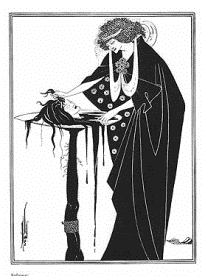
In 1893, as he was working on the Dent commission, he met Oscar Wilde, with whom he would be associated for the rest of his life, at least in the public's imagination. Beardsley was invited by Wilde's publisher to illustrate the English edition of Salome. When it was published in 1894, both the play and the witty, provocative - blatantly erotic - illustrations created a sensation.

That same year Beardsley became famous as the art editor of The Yellow Book, a new arts and letters periodical. Although Wilde never actually contributed to the magazine, it was widely assumed to be an organ for the aesthetic ideas that the playwright espoused. Beardsley's stunning black-and-white drawings, title-pages, and covers helped make the new quarterly a great success. But The Yellow Book also quickly became a site of the fin de siècle culture wars, a target of moralists concerned about the influence of the decadent movement on English society and art. One detractor described Beardsley's designs for the periodical as 'Diseased, weird, macabre, and sinister.'

In the context of the growing notoriety of Wilde and his circle, this may be seen as an attack on the newly visible homosexual subculture that emerged at the end of the nineteenth century. The culture wars culminated in Wilde's prosecution and conviction for gross indecency in 1895. One casualty of the reaction triggered by the Wilde trials of 1895 was Beardsley himself. He was summarily fired from his job as art editor of The Yellow Book. He had been too closely associated with Wilde for the publisher's comfort and his art too erotic and perverse for the new mood of conformity prompted by Wilde's conviction.

Beardsley however continued to find work as an illustrator and created many more beautiful illustrations. Unfortunately, Beardsley had been plagued by ill-health and bouts of tuberculosis since childhood and he died in the South of France, where he had gone in search of a better climate for his increasingly frail health. He was just 25.

Considering the brevity of his life, Beardsley's achievement is astonishing. A highly original creator, he transformed the art of illustration and profoundly influenced artists of his own and subsequent generations.

Labels: , , ,

Wednesday, August 04, 2010

Walter Pater

Walter Pater born 4 August 1839 (d. 1894)

Walter Horatio Pater was an English essayist and literary critic.

Among British prose writers of the Victorian era, Pater stands as the embodiment of stylistic elegance. A close student of German philosophy (particularly the work of Hegel) and well read in the French writers of the period, Pater's criticism and fiction were highly cerebral, yet embraced the purely sensuous dimensions of art and life. From the 1870s through the 1890s, he was regarded by the reading public as a major theorist and practitioner of Aestheticism and Decadence.

His stylistic elegance and his dangerous ideas about art's autonomy from morality, combined with rumours of homosexuality at Oxford, where he taught, made Pater's name virtually synonymous with gay sensibility during the late nineteenth century. He is believed to have been an influence on the work of Oscar Wilde.

In recent decades, Pater has been rediscovered by critics as one of the most important English sources of literary Modernism.

Labels: , , , ,

Monday, August 02, 2010

Lord Ronald Gower

Lord Ronald Gower born 2 August 1845 (d. 1916)

Lord Ronald Charles Sutherland-Leveson-Gower was a British aristocrat, Liberal politician, sculptor and writer.

The youngest son of the 2nd Duke of Sutherland and the former Lady Harriet Howard, daughter of the 6th Earl of Carlisle, he was educated at Eton and at Trinity College, Cambridge.

He was a Liberal Member of Parliament for Sutherland from 1867-1874. He was a Trustee of the National Portrait Gallery, and of the Birthplace and Shakespeare Memorial Building at Stratford-on-Avon.

A sculptor, he also published a number of works on the fine arts. His most important sculpture was the statue of Shakespeare and four of his principal characters, erected in Stratford-upon-Avon. He also created a sculpture depicting Marie Antoinette on her way to the scaffold and another of a member of the Old Guard at Waterloo.

He also wrote biographies of Marie Antoinette and Joan of Arc, and a history of the Tower of London.

He never married, and was well known among the homosexual community of the time. Oscar Wilde's story The Portrait of Mr W.H. has been interpreted as a comment on Gower's social circle, and Gower is generally identified as the model for Lord Henry Wotton in The Picture of Dorian Gray. In 1879 hints of his homosexual liaisons published in the journal Man of the World led Gower to sue the paper, but later in the year the Prince of Wales sent him a letter accusing him of being 'a member of an association for unnatural practices', to which Gower wrote an angry reply. John Addington Symonds, who stayed with him once, stated that Gower 'saturates ones spirit in Urningthum [homosexuality] of the rankest most diabolical kind'.

Gower's most notable lover was the journalist Frank Hird, a relationship that lasted to the end of his life. Gower adopted Hird as his son, leading Wilde to remark on one occasion, 'Frank may be seen, but not Hird.'

Labels: , , ,

Saturday, June 12, 2010

Henry Scott Tuke

Henry Scott Tuke born 12 June 1858 (d. 1929)

In the late 1880s, British artist Henry Scott Tuke became part of a circle of poets and writers who wrote about and discussed the beauty of male youth. Tuke's paintings typically celebrate male beauty, as well as the artist's lifelong love of the sea, swimming, and sailing.

After studying art at the Slade school of Art and in Paris [where he met American painter John Singer Sargent], Tuke met Oscar Wilde in the 1880s and developed connections with the Uranian poets and writers who celebrated the adolescent male.

He wrote a sonnet to youth that was published anonymously in the journal The Artist and also contributed an essay to The Studio, another journal that published Uranian verse and essays.

After returning from Paris moved to Newlyn in Cornwall and eventually Tuke settled in near Falmouth Bay in 1885. He converted his boat into a floating studio and living quarters where he could pose his models and entertain his friends in private. Although he was also an accomplished portraitist with a separate London career - he painted a well-known portrait of T.E. Lawrence (of Arabia) - most of his works depict young men who swim, dive, and lounge on a boat or on the beach.

Tuke's paintings of nude youths illustrate sensual, rather than sexual, feelings. They are not explicit either in the relationships they describe or in the details of the body.

In his day, he was a successful portrait artist but the subject matter of his other work limited his appeal to 'specialist' collectors, although girl-paintings were in the popular mainstream. Today, he would probably be considered 'suspect', but his beautiful work actually speaks more of beauty, innocence and freshness both of subject and in technique.

Tuke did well enough from his painting to be able to travel abroad, painting in France, Italy and the West Indies. In 1900 a banquet was held in his honour at the Royal Cornwall Polytechnic Society. He was elected to the Royal Academy of Arts in 1914.

He died after a long illness in 1929, in Falmouth. After his death Tuke's reputation faded, and he was largely forgotten until the 1970s, when he was rediscovered by a new generation of openly gay artists and art collectors. He has since become something of a cult figure in gay cultural circles, with lavish editions of his paintings published and his works fetching high prices at auctions.

Labels: , , , , ,

Friday, October 16, 2009

Oscar Wilde

Oscar Wilde born 16 October 1854 (d. 1900)

Oscar Fingal O'Flahertie Wills Wilde was an Irish playwright, novelist, poet, short story writer and Freemason. Known for his barbed and clever wit, he was one of the most successful playwrights of late Victorian London, and one of the greatest celebrities of his day. As the result of a famous trial, he suffered a dramatic downfall and was imprisoned after being convicted of 'gross indecency' for homosexual acts.

Though Wilde's sexual orientation has variously been considered bisexual, homosexual, and pederastic, Wilde himself felt he belonged to a culture of male love inspired by the Greek pederastic tradition. His most significant sexual relationships appear to have been (in chronological order) with (perhaps) Frank Miles, Constance Lloyd (Wilde's wife), Robert Baldwin Ross, and Lord Alfred Douglas. Wilde also had numerous sexual encounters with working-class male youths, who were often rent boys.

Biographers generally believe Wilde was introduced to homosexuality in 1885 (the year after his wedding) by the 17-year-old Robert Baldwin Ross. Neil McKenna's biography The Secret Life of Oscar Wilde (2003) theorises that Wilde was aware of his homosexuality much earlier, from the moment of his first kiss with another boy at the age of 16. According to McKenna, after arriving at Oxford in 1874, Wilde tentatively explored his sexuality, discovering that he could feel passionate romantic love for 'fair, slim' choirboys, but was more sexually drawn towards swarthy young rough trade.

By the late 1870s, Wilde was already preoccupied with the philosophy of same-sex love, and had befriended a group of Uranian poets and homosexual law reformers. Wilde also met Walt Whitman in America in 1881, writing to a friend that there was 'no doubt' about the great American poet's sexual orientation — 'I have the kiss of Walt Whitman still on my lips,' he boasted. He even lived with the society painter Frank Miles, who was a few years his senior and may have been his lover. However, writes McKenna, he was unhappy with the direction of his sexual and romantic desires, and, hoping that marriage would cure him, he married Constance Lloyd in 1884.

After meeting and falling in love with Lord Alfred Douglas, 'Bosie', in 1891, Wilde and his lover embraced an hedonistic life style, and for a few years they lived together more or less openly in a number of locations. Wilde and some within his upper-class social group also began to speak about homosexual law reform, and their commitment to 'The Cause' was formalised by the founding of a highly secretive organisation called the Order of Chaeronea, of which Wilde was a member.

Bosie's father, the Marquess of Queensberry, became increasingly enraged at his son's involvement with Wilde. He confronted the two publicly several times, and each time Wilde was able to mollify the Marquess. Eventually, the Marquess planned to interrupt the opening night of The Importance of Being Earnest with an insulting delivery of vegetables, but somebody tipped Wilde off and he was barred from entering the theatre.

On February 18, 1895, the Marquess left a calling card at one of Wilde's clubs, the Albemarle. On the back of the card he wrote 'For Oscar Wilde posing as a Somdomite' (a misspelling of 'Sodomite').

Although Wilde's friends advised him to ignore the insult, Lord Alfred later admitted that he egged Wilde on to charge Queensberry with criminal libel. Queensberry was arrested, and in April 1895, the Crown took over the prosecution of the libel case against him. The trial lasted three days. The prosecuting counsel, Edward Clarke, was unaware that Wilde had had liaisons and romantic relationships with other males. Clarke asked Wilde directly whether there was any substance to Queensberry's accusations and Wilde denied that there was. Edward Carson, the barrister who defended Queensberry, hired investigators who were able to locate a number of youths with whom Wilde had been involved, either socially or sexually, such as the 16-year-old Walter Grainger and other newsboys and valets. Most damaging of all, among them were a number of young men who had earned money through prostitution, including one of the main witnesses, Charles Parker.

Wilde put on a tremendous display of drama in the first day of the trial, parrying Carson's cross-examination on the morals of his published works with witticisms and sarcasm, often breaking the courtroom up with laughter. However, on the second day, Carson's cross-examination was much more damaging: Wilde later admitted to perjuring himself with some of his answers. On the third day, Clarke recommended that Wilde withdraw the prosecution, and the case was dismissed. The authorities were unwilling to let matters rest.

Based on the evidence acquired by Queensberry and Carson, Wilde was arrested on April 6, 1895, at the Cadogan Hotel, London, and charged with 'committing acts of gross indecency with other male persons' under Section 11 of the 1885 Criminal Law Amendment Act. Despite pleas by friends to flee the country, Wilde chose to stay and martyr himself for his cause.

Two trials followed. The first trial ended with the jury unable to reach a verdict. The next, and last, trial was presided over by Chief Justice Sir Alfred Wills. On May 25, 1895 Wilde was convicted of gross indecency and sentenced to two years' hard labour. He was imprisoned first in Pentonville and then in Wandsworth prison in London, and finally transferred in November to Reading Prison.

Prison was harsh on Wilde's health and after he was released on May 19, 1897 he spent his last three years penniless, in self-imposed exile from society and artistic circles. After his release, he wrote the famous poem The Ballad of Reading Gaol.

Wilde spent his last days in the Hôtel d'Alsace, now known as L'Hôtel, in Paris.

Oscar Wilde died of cerebral meningitis on November 30, 1900.

Wilde is an iconic figure in modern popular culture, both as a wit and as an archetype of gay identity. His trial, imprisonment and death have made him a gay martyr and come to symbolise the inhumane attitudes and treatment with which society has confronted gay people - although it could be argued that his foolish decision to sue the Marquess of Queensberry and his own resulting trial drove an entire generation of increasingly confident homosexual men underground and set the course of gay liberation back by untold decades - but that we shall never know.

Labels: , , , , , , ,

Wednesday, October 22, 2008

Lord Alfred Douglas

Lord Alfred Douglas born 22 October 1870 (d. 1945)

Lord Alfred Bruce Douglas was a poet, a translator and a prose writer, best known as the intimate friend and lover of the writer Oscar Wilde. Much of his early poetry was Uranian in theme, though he tended, later in life, to distance himself from both Wilde's influence and his own role as a Uranian poet.

Douglas, universally known as Bosie, was the third son of John Sholto Douglas, 9th Marquess of Queensberry. His oldest brother, Francis Douglas, Viscount Drumlanrig, was also reported to have been homosexual

After a boyhood during which his parents separated, Douglas went up from Winchester to Magdalen College, Oxford, in 1889. He met Oscar Wilde through a mutual friend, critic Lionel Johnson, in early summer, 1891, and they became lovers the following spring. Douglas' beauty was 'like a narcissus - white and gold', as Wilde told Robert Ross.

Most of Douglas' homoerotic poetry was written between 1893 and 1896 and appeared in undergraduate literary journals such as The Spirit Lamp, which he edited, and The Chameleon, or in small-circulation magazines like The Artist. Poems like 'Hymn to Physical Beauty' (with a nod to Shelley), the sonnet 'In an Aegean Port', and most famously 'Two Loves', one of whom concludes the poem by sighing 'I am the Love that dare not speak its name' are typical in their wistful tone.

Some of these poems appeared in a French edition of Douglas' verse in 1896, but most were not republished until the Sonnets and Lyrics of 1935, and then, at least in the sonnet mentioned, with the homosexual content revised out.

In 1895, Douglas' father accused Oscar Wilde of 'posing as a sodomite', whereupon Wilde (at Bosie's urging) sued him for libel. At the trial, Queensberry was found not guilty and a warrant was promptly issued for Wilde's arrest. His first trial resulted in a hung jury, but at the second Wilde was found guilty and sentenced to two years' hard labour.

Although Douglas and Wilde remained close until the latter's death in 1900, the scandal generated a sheaf of spiteful documents. In prison, Wilde wrote a long and bitter epistle later titled De Profundis, accusing Douglas of betraying their friendship. When the full text of De Profundis was made public in 1913, Douglas responded with Oscar Wilde and Myself, repudiating Wilde and his works.

Soon after Wilde's death, Douglas renounced his homosexuality; he married Olive Custance in 1902, and they had a son, Raymond. Douglas converted to Roman Catholicism in 1911, and he and his wife separated two years later. By his own account, Douglas remained celibate thereafter.

From 1907 to 1910, Douglas edited the journal The Academy, assisted by the 'obnoxious' T W H Crosland, who in fact, ghost-wrote most of Oscar Wilde and Myself. Douglas revived The Academy in 1920 and 1921 as Plain English, and the journal had a mild commercial success. Editorially, however, it was non-literary and virulently anti-Semitic, simply a forum for Douglas' considerable collection of bigotries.

Douglas' intemperate expression of his views led to his arrest and conviction for writing and publishing a pamphlet libelling Winston Churchill. He spent six months in Wormwood Scrubs prison. There he turned again to poetry, but his prison writing, a sonnet sequence, was called In Excelsis.

Douglas spent the remaining twenty-one years of his life quietly, living in Hove or Brighton on allowances provided by his mother and wife. He produced his Autobiography during this time, several versions of his collected poems, occasional verse, and in 1940, his most judicious account of his life's central experience, Oscar Wilde: A Summing Up.

He died on March 20, 1945, following a heart attack.

Labels: , , ,

Thursday, October 02, 2008

Charles Ricketts

Charles Ricketts born 2 October 1866 (d. 1931)

Charles De Sousy Ricketts was an English artist and designer, best known for his work as a book designer and typographer from 1896 to 1904 with the Vale Press, and his work in the theatre as a set designer.

He was born in Geneva to a French mother and an English father. He grew up mainly in France and Italy. He began his studies in art at the City and Guilds Technical Art School in Lambeth, in 1882, after both his parents had died.

There he met Charles Shannon, painter and lithographer, who would be his lifelong partner in both his artistic and personal life. Choosing to settle in England rather than abroad, they founded The Dial, a magazine, which had five issues from 1889 to 1897, and the Vale Press, named after their house, The Vale in Chelsea, London.

Ricketts was one of two illustrators of Oscar Wilde's work, the other being Aubrey Beardsley who worked on Salomé. He and Shannon were friends and supporters of Wilde.

It was in the work of the Vale Press that Ricketts would find his talents were best employed.

After 1902, he became a more serious painter and sculptor. He also wrote on art, was a collector, and became a member of the Royal Academy in 1928. He designed sets for plays by Wilde, Bernard Shaw and Cecil Lewis; and also the revived Savoy Operas of the 1920s.

In January 1929 Shannon fell while hanging a picture. He never completely recovered his health or senses and remained an invalid until his death in 1937. Charles Ricketts died of heart failure in 1931.

[Painting of Charles Ricketts and Charles Shannon by Jacques-Emile Blanche]

Labels: , , , ,

Wednesday, October 01, 2008

George Cecil Ives

George Cecil Ives born 1 October 1867 (d. 1950)

George (Cecil) Ives was a German-British poet, writer, penal reformer and early gay rights campaigner.

Ives was the illegitimate son of an English army officer and a Spanish baroness. He was raised by his paternal grandmother, Emma Ives. They lived between Bentworth in Hampshire and the South of France.

Ives was educated at home and at Magdalene College, Cambridge, where he started to amass 45 volumes of scrapbooks (between 1892 and 1949). These scrapbooks consist of clippings on topics such as murders, punishments, freaks, theories of crime and punishment, transvestism, psychology of gender, homosexuality, cricket scores, and letters he wrote to newspapers.

Ives met Oscar Wilde at the Authors' Club in London in 1892. Oscar Wilde was taken by his boyish looks and persuaded him to shave off his moustache, and once kissed him passionately in the Travellers' Club. Ives was already working for the end of the oppression of homosexuals, what he called the 'Cause'. He hoped that Wilde would join the 'Cause', but was disappointed. In 1893, Lord Alfred Douglas, with whom he had a brief affair, introduced Ives to several Oxford poets whom Ives also tried to recruit.

By 1897, Ives created and founded the Order of Chaeronea, a secret society for homosexuals which was named after the location of the battle where the Sacred Band of Thebes was finally annihilated in 338 BC. Members included Charles Kains Jackson, Samuel Ellworth Cottam, Montague Summers, and John Gambril Nicholson. It is thought that C R Ashbee and A E Housman were also members. In his voluminous writings, Ives refers to Walt Whitman as 'The Prophet' and used lines from Whitman's poetry in the ritual and ceremony of the Order.

The same year, Ives visited Edward Carpenter at Millthorpe. This marked the beginning of their friendship.

In 1914, Ives, together with Edward Carpenter, Magnus Hirschfeld, Laurence Housman and others, founded the British Society for the Study of Sex Psychology. He also kept in touch with other progressive psychologists such as Havelock Ellis and Professor Cesare Lombroso.

The topics addressed by the Society in lectures and publications included: the promotion of the scientific study of sex and a more rational attitude towards sexual conduct; problems and questions connected with sexual psychology (from medical, juridical, and sociological aspects), birth control, abortion, sterilisation, venereal diseases, and all aspects of prostitution. In 1931, the organisation became the British Sexological Society. Ives was the archivist for the Society whose papers are now held by the Harry Ransom Center at the University of Texas at Austin.

Ives also visited prisons across Europe and specialised in the study of the penal methods, particularly that of England. He lectured and published books on the topic.

When the Second World War ended he refused to believe it and carried a gas mask with him until his death. He was also afraid to sleep alone and would always contrive to have at least one bed fellow.

Throughout his life, Ives had many lovers whom he called his 'children'. He took care of them, gave them money and bought them houses. He often lived with more than one lover at a time and some stayed with him several years.

At his death in 1950, George Ives left a large archive covering his life and work between 1874 and 1949. The papers were bought in 1977 by the Harry Ransom Research Center.

Labels: , , ,