Monday, May 30, 2011

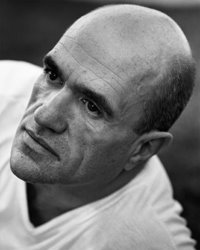
Colm Tóibín

Colm Tóibín born 30 May 1955

Acclaimed Irish novelist and journalist Colm Tóibín is the author of a number of non-fiction books and five novels. His writings are infused with keen political insights and shrewd analyses. While same-sex desire is not overtly addressed in his early work, his most recent novels are astutely observed, unsentimental explorations of gay men trying to fit into an unwelcoming, and often openly hostile, world.

Tóibín received his secondary education at St Peter's College, Wexford, where he was a boarder from 1970 to 1972. He then progressed to University College Dublin, graduating in 1975. Immediately after graduation, he left for Barcelona. His first novel, The South (1990), was partly inspired by his time in the Spanish city, as was, more directly, his non-fiction Homage to Barcelona (1990).

After returning to Ireland in 1978, he began studying for a Masters. He never handed in his thesis and left academia, at least partly, for a career in journalism. The early 1980s were an especially bright period in Irish journalism and the heyday of the monthly news magazine Magill. Tóibín became editor of that magazine in 1982, remaining in the position until 1985.

The Heather Blazing (1992), his second novel, was followed by the award-winning The Story of the Night (1996) and The Blackwater Lightship (1999). His fifth novel, The Master (2004), was a fictional account of portions in the life of author Henry James. In 2006 his first collection of short stories was published as Mothers and Sons. In January 2010, Tóibín was named the winner of the Costa Novel Award for his novel Brooklyn.

He is the author of other non-fiction books: Bad Blood: A Walk Along the Irish Border (1994), (reprinted from the 1987 original edition) and The Sign of the Cross: Travels in Catholic Europe (1994). He has written a play that was staged in Dublin in August 2004, Beauty in a Broken Place.

He has continued to work as a journalist, both in Ireland and abroad. He has also achieved a reputation as a literary critic: he has edited a book on Paul Durcan, The Kilfenora Teaboy (1997); The Penguin Book of Irish Fiction (1999); and has written The Modern Library: The 200 Best Novels in English since 1950 (1999), with Carmen Callil; a collection of essays, Love in A Dark Time: Gay lives from Wilde to Almodóvar (2002); and a study on Lady Gregory, Lady Gregory's Toothbrush (2002).

Tóibín's work explores several main lines: The depiction of Irish society, living abroad, the process of creativity and the preservation of a personal identity, focusing especially on homosexual identities — Tóibín is openly gay — but also on identity in front of loss.

Labels: , , , ,

Wednesday, May 25, 2011

Robert 'Robbie' Ross

Robert 'Robbie' Ross born 25 May 1869 (d. 1918)

Robert Baldwin Ross was a journalist and art critic. He is best known, however, as the executor of Oscar Wilde's estate. He was also responsible for bringing together several great literary figures and acting as their mentor.

Ross was born in Tours, France but came to Britain at an early age. His father originally came from Northern Ireland and his mother from Canada. His father had been the attorney-general of Upper Canada and his grandfather was the Canadian Prime Minister Robert Baldwin.

While working as a journalist and critic, he is alleged to have been Oscar Wilde's first male lover, and remained loyal to Wilde through thick and thin, eventually becoming his literary executor. This was not an easy task. It meant tracking down and purchasing the rights to all of Wilde's texts, which had been sold off along with all of Wilde's possessions when he was declared bankrupt. It also meant fighting the rampant trade, following Wilde's arrest, in black market copies of his books and, in particular, books, usually erotic, that Wilde did not write but which were published illegally under his name. The rights to all of Oscar's works along with the money earned from their printing/performance while he was executor was given by Ross to Wilde's sons.

Ross was also responsible for commissioning Jacob Epstein to produce the tomb for Wilde. He even requested that Epstein design a small compartment into the tomb for Ross’s own ashes.

In 1908, some years after Wilde's death, Ross produced the definitive edition of his works. Following Wilde's disgrace and imprisonment, Ross went abroad for safety's sake, but returned to offer support, both financial and emotional, to Wilde during his last years. Ross himself did not escape scandal. A few years before Wilde's imprisonment, Ross was involved in a scandal over his sexual relationship with a boy of fourteen, the son of friends, and his best-friend, aged fifteen. Both boys confessed to their parents that Ross had made love to them, and the fourteen year old boy also admitted that Lord Alfred Douglas had also made love to him while he was a guest at Ross's house. After a good deal of panic and frantic meeting held with solicitors, Douglas and Ross convinced the parents not to go to the police.

As a young man, Ross moved to England to go to university. He was accepted at Cambridge but was the victim of bullying, probably due to his sexuality (of which he made no secret) and his, perhaps, outspoken journalism in the university paper. Ross caught pneumonia after a cruel dunking in a fountain by a number of students with, according to Ross, the full support of a don. After recovering he fought for an apology from his fellow students, which he received, but more fiercely, for the dismissal of the don who, he argued, had known about and supported the bullying. The university refused to punish the man and Ross dropped out of university.

Following this Ross tried his hand at a number of careers, as writer, art critic, and literary executor. He was able to rely on an allowance and inheritance from his wealthy family to support himself. His literary output is small, with only one book worth a mention; Masques and Phases is a collection of previously published works by Ross, short stories and reviews. Ross's main contribution to literature lies in his work as Wilde's executor, and as Wilde's friend in reading Wilde's texts, making suggestions, and, if Ross is to be believed, frequently suggesting changes and improvements. As an art critic, Ross was highly critical of the post-impressionist painters. He worked unpaid for many years for a small art gallery run by friends, for whom he travelled purchasing works. At one time he hoped to be selected for a royal position but was rejected probably due to his connection to Wilde.

Ross is also of interest in his decision to 'come out' to his family, whom he gathered to hear the announcement not long after he left university.

As a result of his faithfulness to Wilde even in death, Ross was vindictively pursued by Lord Alfred Douglas, who repeatedly attempted to drag him into court, and attempted to have him arrested as a homosexual.

During the First World War, he drew around him a coterie of young artists, mostly homosexuals, including Siegfried Sassoon and Wilfred Owen. He was also a close friend of Wilde's son Vyvyan Holland, and a friend of his other son Cyril until his death in the First World War. In early 1918, during the German Spring Offensive, Noel Pemberton Billing, a right-wing M.P., published an article entitled The Cult of the Clitoris, in which he accused members of Ross's circle of being at the centre of 47,000 homosexual traitors who were betraying the nation to the Germans. The incident brought much embarrassing attention to Ross and his associates.

Later in the same year, Ross was preparing to travel to Melbourne, Australia to open an exhibition at the National Gallery when he died suddenly, an event which caused great grief to his many friends. In 1950, on the 50th anniversary of Wilde's death, Ross's ashes were added to Wilde's tomb in the Le Père Lachaise Cemetery.

Labels: , , , ,

Sunday, April 17, 2011

Lindsay Anderson

Lindsay Anderson born 17 April 1923 (d. 1994)

Lindsay Gordon Anderson was a Scottish film critic, and a film, theatre and documentary director. The son of a British Army officer, he was born in Bangalore, South India, and educated at Cheltenham College and Wadham College, Oxford.

Before going into film-making, Anderson was a prominent film critic writing for the influential Sequence magazine (1947-52), which he co-founded with Gavin Lambert and Karel Reisz; later writing for the British Film Institute's journal Sight and Sound and the left-wing political weekly the New Statesman. In one of his early and most well-known polemical pieces, Stand Up, Stand Up, he outlined his theories of what British cinema should become.

Anderson developed an acquaintance from 1950 with John Ford, which led to his writing what has come to be regarded as one of the standard books on that director, About John Ford (1983). As seen in his writings, another major influence was Humphrey Jennings, the great wartime documentary film maker.

Following a series of screenings which he organised at the National Film Theatre of independently-produced short films by himself, Karel Reisz and others, he developed a philosophy of cinema which found expression in what became known as the Free Cinema Movement in Britain by the late-1950s. This was the belief that the cinema must break away from its class-bound attitudes and that the working classes ought to be seen on Britain's screens.

Along with Karel Reisz, Tony Richardson, and others he secured funding from a variety of sources and they each made a series of socially challenging short documentaries on a variety of subjects.

These films, made in the tradition of British documentaries in the 1930s by such men as John Grierson, foreshadowed much of the social realism of British cinema which emerged in the 1960s with Anderson's own film This Sporting Life, Reisz's Saturday Night and Sunday Morning, and Richardson's The Loneliness of the Long Distance Runner.

One of Anderson's early short films, Thursday's Child, won an Oscar for Best Documentary Short in 1954. Anderson reconnected with his roots as a documentary maker in 1985 when he was invited by producer Martin Lewis to chronicle the first-ever visit to China by Western pop artists Wham! resulting in Anderson's film Foreign Skies: Wham! In China.

Anderson is best remembered internationally for his 'Mick Travis' trilogy of feature films, all of which star Malcolm McDowell as Travis: If...., O Lucky Man! and Britannia Hospital.

Anderson was also a significant British theatre director. He was long associated with London's Royal Court Theatre, where he was Co-Artistic Director 1969-70, and Associate Artistic Director 1971-75, directing premiere productions of plays by David Storey, among others.

Lindsay Anderson Memorial Foundation

Labels: , , , ,

Sunday, April 10, 2011

George Stambolian

George Stambolian born 10 April 1938 (d. 1991)

George Stambolian was a scholar of French, and advocate and critic of American literature and photography. A pioneer of queer literary studies, he also edited many very successful collections of homosexual fiction including the Men On Men series, and was a regular contributor to The Advocate, Christopher Street and the New York Native.

He died of an AIDS-related illness in December 1991, at his home in New York.

Labels: , , ,

Friday, April 01, 2011

F O Mathiessen

F O Mathiessen born 1 April 1902 (d. 1950)

Francis Otto Matthiessen was a historian and literary critic influential in the creation of the field of American studies.

He wrote and edited landmark works of scholarship on T S  Eliot, Ralph Waldo Emerson, Sarah Orne Jewett, Sinclair Lewis, Herman Melville, Henry David Thoreau, and Walt Whitman.

Matthiessen's best-known book, American Renaissance: Art and Expression in the Age of Emerson and Whitman (1941), discussed the flowering of literary culture in the middle of the American 19th century, with Emerson, Thoreau, Melville, Whitman and Nathaniel Hawthorne. Its focus was the period roughly from 1850 to 1855 in which all these writers but Emerson published what would, by Matthiessen's time, come to be thought of as their masterpieces: Melville's Moby-Dick, multiple editions of Whitman's Leaves of Grass, Hawthorne's The Scarlet Letter and The House of the Seven Gables, and Thoreau's Walden. The mid-19th century in American literature is commonly called the American Renaissance because of the influence of this work on later literary history and criticism.

Matthiessen, as a gay man in the 1930s and 1940s, chose to remain in the closet throughout his professional career, if not in his personal life – although traces of homoerotic concern are apparent in his writings. His longtime lover and life partner, the painter Russell Cheney, shared a cottage with him in Kittery, Maine for decades.

He was hospitalised once for a nervous breakdown in 1938-39. After Cheney's death, Matthiessen was increasingly distraught; he committed suicide by jumping from a window in 1950. Inquiries by the House Un-American Activities Committee (HUAC) into his politics may also have been a factor in his suicide.

Matthiessen's politics were left-wing, socialist, though not dogmatically Marxist, as he felt his Christianity was incompatible with Marxist atheism. Matthiessen, who was already financially secure, donated an inheritance he received in the late 1940s to his friend, Marxist economist Paul Sweezy; Sweezy used the money, totalling almost $15,000, to found a new journal, which became the Monthly Review.

Labels: , ,

Tuesday, March 15, 2011

Lionel Johnson

Lionel Johnson born 15 March 1867 (d. 1902)

Born in Broadstairs, Kent, Lionel Johnson was a leading literary critic of his time, writing the first critical study of Thomas Hardy (1894).

He has earned a particular place in history for introducing his lover to a writer friend - his lover was Lord Alfred Douglas, the friend was Oscar Wilde...

So disgruntled was he with this betrayal that he turned to Catholicism and wrote a sonnet called The Destroyer of a Soul (1892) - 'I hate you with a necessary hate...'

The following year he wrote what is regarded as his finest work The Dark Angel (1893) - an anguished work inspired by his homosexuality.

He lived a rather solitary life in London, struggling with alcoholism and his repressed homosexuality.

Having lived long enough to see his rival in love get more than his comeuppance, he cracked his head open falling off a barstool in 1902. He was just 35 years old.

Labels: , , , , ,

Sunday, March 06, 2011

Parker Tyler


Parker Tyler born 6 March 1904 (d. 1974)

Harrison Parker Tyler, better known as Parker Tyler was an American author, poet and film critic. Tyler lived with filmmaker Charles Boultenhouse (1926-1994) from 1945 until his death.

Born March 6, 1904, in New Orleans, the son of an insurance salesman, Tyler lived a childhood on the move, living in larger cities all over the eastern United States. He completed high school but refused to enter college, determined to continue his education as a poet on the streets of New York, where he arrived in 1924.

By the time he began corresponding with Charles Henri Ford a few years later, Tyler had already published scores of book reviews and hundreds of poems, many of which received their first public hearing in the basement clubs of Greenwich Village, where Tyler lived. Tyler was known in the neighbourhood as a dandy, going about in mascara and attired in cast-off clothing from the second-hand shops of the Lower East Side.

Tyler's letters apparently ignited in Ford a similar desire for the bohemian life, and in January 1930 he set out for New York. Tyler was waiting at the pier when Ford disembarked.

Ford had arrived in New York at a curious moment in time. With the stock market crash of 1929 only a few months in the past, the Depression was beginning to deepen. Nobody, it seemed, had any money or prospects, certainly not Ford or Tyler. Prohibition was still in full swing, though it was openly flouted by many, including New York's mayor Jimmy Walker.

Out of Prohibition came speakeasies, illegal quasi-private clubs, a number of which in the Village were sufficiently sheltered from scrutiny to become some of the first specifically gay and lesbian gathering places in North America. The more visible congregation of gay men in public places led to a vogue among New Yorkers for these 'strange brothers' - the so-called pansy craze.

He co-authored The Young and Evil (Obelisk Press, 1933) with Charles Henri Ford, an energetically experimental novel with obvious debts to fellow Villager Djuna Barnes, and also to Gertrude Stein. Tyler and Ford co-edited the Surrealist magazine View until it folded in 1947.

A writer for the journal Film Culture, Tyler is one of the few film critics to write extensively on experimental film and underground film. His Screening the Sexes (1972) is thought to be the first book-length study of homosexuality in film. Other books of film criticism by Tyler include The Hollywood Hallucination (1944), Magic and Myth of the Movies (1947), Classics of Foreign Film (1962), Sex Psyche Etcetera in the Film (1969), and The Shadow of an Airplane Climbs the Empire State Building (1973).

Pictured: Parker Tyler and Andy Warhol photographed by Gerard Malanga - worth clicking on for the larger image

Tyler's books became popular - and some old titles reissued after being out-of print for years - after he was mentioned several times in the novel Myra Breckinridge (1968) by Gore Vidal.

Parker Tyler died of prostate cancer in New York in 1974.

Labels: , , , , ,

Tuesday, March 01, 2011

Lytton Strachey

Lytton Strachey born 1 March 1880 (d. 1932)

Giles Lytton Strachey was a British writer and critic. He is best known for establishing a new form of biography in which psychological insight and sympathy are combined with irreverence and wit.

At Cambridge, he found his niche and made lasting friends, including those who would later form the nucleus of the Bloomsbury Group. It was in this milieu that Strachey wrote about and spoke openly of his homosexuality.

From 1904 to 1914 he contributed book and drama reviews to The Spectator magazine, published poetry, and wrote an important work of literary criticism, Landmarks in French Literature (1912). During World War 1, he was a conscientious objector, and spent much time with like-minded people such as Lady Ottoline Morrell and the 'Bloomsberries'.

His first great success, and his most famous achievement, was Eminent Victorians (1918), a collection of four short biographies of Victorian heroes. With a dry wit, he exposed the human failings of his subjects and what he saw as the hypocrisy at the centre of Victorian morality. This work was followed in the same style by Queen Victoria (1921).

Though Strachey spoke openly about his homosexuality with his Bloomsbury friends (he had a relationship with John Maynard Keynes, who also was part of the Bloomsbury group), it was not publicly revealed until (1967-8), in a biography by Michael Holroyd.

His unusual relationship with the painter Dora Carrington (she loved him, but Strachey was much more interested in her husband Ralph Partridge, as well as various other young men) was portrayed in the film Carrington (1995). Jonathan Pryce won Best Actor at the Cannes Film Festival for his performance as Strachey in this film.

He died of (then undiagnosed) stomach cancer at age 51 at his country house near Hungerford in Berkshire.

Painting of Giles Lytton Strachey by Vanessa Bell

Labels: , , ,

Friday, September 10, 2010

Cyril Connolly

Cyril Connolly born 10 September 1903 (d. 1974)

Cyril Vernon Connolly was an English man of letters.

He was born in Coventry in Warwickshire to a wealthy family of Anglo-Irish extraction. He was educated at St Cyprian's School and Eton College, at both of which he was an exact contemporary of George Orwell, who remained a life-long friend. Connolly later attended Balliol College, Oxford.

A regular contributor to the leftist New Statesman in the 1930s, Connolly went on to co-edit, with Stephen Spender and Peter Watson, the influential literary magazine Horizon from 1939 to 1950. He was at one time the literary editor for The Observer, and, after 1950, the chief book reviewer for the London Sunday Times. Connolly wrote only one novel, The Rock Pool (1935) a satirical work which was generally well received. Perhaps his best known work is the autobiography Enemies of Promise (1938), in which he attempted to explain why he failed to produce the literary masterpiece which he and others believed he should have been capable of writing. However, the work he wrote afterwards, The Unquiet Grave (under the pseudonym 'Palinurus') is also noteworthy.

Cyril Connolly was a man of letters, a species now almost extinct. He did his best work as a critic and wielded enormous influence. Connolly was an astute critic who informed the thinking and attitudes of a generation. He set exacting standards for himself and his failure to flourish as a writer was something he both acknowledged and was able to explain. As editor of Horizon (1939-1950), Connolly gave a platform to a wide range of distinguished and emerging writers. The magazine was an integral component of intellectual and literary life in England and contributed to the maintenance of a vital literary culture.

He died in 1974.

Since 1976, Connolly's papers and personal library of over 8,000 books have been housed at the University of Tulsa.

Source: Wikipedia

Labels: , ,

Monday, August 23, 2010

Newton Arvin

Newton Arvin born 23 August 1900 (d. 1963)

Frederick Newton Arvin was a literary critic, historian, and academic.

Frederick Newton Arvin studied English Literature at Harvard and was inspired by American literary critic Van Wyck Brooks. Leaving Harvard in 1922, Arvin taught at several high schools before finding tenure at Smith College in Northampton, Massachusetts.

A homosexual, Newton Arvin endured a brief and unhappy marriage and is said to have had an affair with Truman Capote during the 1940s.

Arvin often wrote about political issues, until he came to national attention with the publication in 1950 of Herman Melville, a critical biography of Herman Melville, the writer today most famous as the author of Moby-Dick. Herman Melville won the second annual National Book Award for non-fiction.

Other works by Arvin included a similar analysis of Nathaniel Hawthorne, the author of The Scarlet Letter. Another book on the same pattern, about poet and writer Henry Wadsworth Longfellow and entitled Longfellow, His Life and Work, was finished shortly before Arvin's death.

In 1960, officers of the Massachusetts State Police arrested Arvin on pornography-related charges after investigations by the office of the United States Postmaster General into soft-core homosexually-themed pictures sent to Arvin by mail. The resulting scandal destroyed his career and resulted in the firing of two colleagues, Edward Spofford and Joel Dorius, whom he gave up in exchange for leniency in sentencing.

In 2001, Barry Werth's book The Scarlet Professor: Newton Arvin: a literary life shattered by scandal, was published, detailing the affair.

In 2002, Smith acknowledged the wrongful termination of the three professors by creating a lecture series and a small scholarship, the $100,000 Dorius/Spofford Fund for the Study of Civil Liberties and Freedom of Expression, and the Newton Arvin Prize in American Studies, a $500 annual stipend.

Labels: , ,

Friday, August 06, 2010

Richard Buckle

Richard Buckle born 6 August 1912 (d. 2001)

Christopher Richard Sandforth Buckle, better known as Richard Buckle, was a lifelong devotee of ballet, and a well-known ballet critic.

Buckle came from an army family. His father, a major, was killed in 1918 when Buckle was just two. His childhood was dominated by women, including his mother who lived until well into her 90s. He was educated at Marlborough, where he discovered that he was an aesthete, and went up to Oxford to read modern languages, but failed to obtain a scholarship and left after the first year.

Subsequently, he was sent to Heatherley's Art School, although by then he had already alighted upon his metier. In 1933, on Liverpool Street station, he saw a copy of Romola Nijinsky's biography of her husband. That changed his life. Seventeen years on, Buckle was to be one of the pall-bearers at the great dancer's funeral.

He founded the magazine Ballet in 1939, and revived it after the war (during which he served with the Scots Guards, being mentioned in despatches in 1944 during the Italy campaign). Between 1948 and 1955 he was ballet critic for The Observer.

He organised a number of highly successful exhibitions, including most notably one in 1954 on the life and work of Diaghilev, first at the Edinburgh Festival and then at Forbes House in London. He also organised the quatercentenary Shakespeare exhibition at Stratford-upon-Avon in 1964-5. His long series of exhibitions during the decade 1954 to 1964 were hugely innovative. They orchestrated an army of talents, from Cecil Beaton to David Hockney, from Leonard Rosoman to Nicholas Georgiadis. Their eventual impact on the staid world of art exhibitions and indeed on permanent museum display was considerable, even if never really acknowledged. Buckle was the first person to raise exhibition making of this kind to the level of an art form in its own right.

In 1967 he began to work to create a museum of the performing arts, and he was instrumental in the purchase from the sale of the remaining Diaghilev scenery the Picasso backcloth to the ballet Le Train Bleu. In 1973 the project merged with the old British Theatre Museum under the aegis of the Victoria & Albert museum and became the Theatre Museum in Covent Garden.

Richard Buckle's contribution to dance criticism was significant during a period when modern ballet style was emerging. He praised the Russian style which used the whole body and contrasted it unfavourably with the British style. He could be brutal and his criticism of the July 1951 production of the ballet Tiresias by the choreographer Frederick Ashton and composer Constant Lambert was particularly resented. However, his writing became uneven as drink got the better of him.

His health deteriorated and he had mental breakdowns in 1971 and 1976, and he had a heart attack in 1979. In 1976 he left London and settled in Wiltshire where he continued to write, and he produced two more autobiographies.

His publications include the most comprehensive biographies of Nijinsky (1971) and Diaghilev (1979), and he edited several books, including the autobiography of Lydia Sokolova and the selected diaries of Cecil Beaton.

He was appointed a CBE in 1979.

Labels: , ,

Wednesday, August 04, 2010

Walter Pater

Walter Pater born 4 August 1839 (d. 1894)

Walter Horatio Pater was an English essayist and literary critic.

Among British prose writers of the Victorian era, Pater stands as the embodiment of stylistic elegance. A close student of German philosophy (particularly the work of Hegel) and well read in the French writers of the period, Pater's criticism and fiction were highly cerebral, yet embraced the purely sensuous dimensions of art and life. From the 1870s through the 1890s, he was regarded by the reading public as a major theorist and practitioner of Aestheticism and Decadence.

His stylistic elegance and his dangerous ideas about art's autonomy from morality, combined with rumours of homosexuality at Oxford, where he taught, made Pater's name virtually synonymous with gay sensibility during the late nineteenth century. He is believed to have been an influence on the work of Oscar Wilde.

In recent decades, Pater has been rediscovered by critics as one of the most important English sources of literary Modernism.

Labels: , , , ,

Tuesday, July 13, 2010

Dale Peck

Dale Peck born 13 July 1967

Born on Long Island, New York, author Dale Peck was raised in Kansas and attended university in New Jersey. He currently teaches creative writing at The New School in New York.

The influential New York Times critic Michiko Kakutani has described Peck as 'a fiercely gifted modernist' and 'one of the most eloquent voices of his generation'. His critically acclaimed first novel Martin and John (published as Fucking Martin in the UK) (1993) was an ambitious, complex series of stories about a young gay writer named John and his lover Martin who dies of AIDS. Two further novels The Law of Enclosures (1996) and Now It's Time We Say Goodbye (1999) ensued, followed by What We Lost (2005) a 'creative' biography of his father's childhood.

Peck is well known in the US as a vitriolic literary critic, famous for a review of a novel which began: 'Rick Moody is the worst writer of his generation.' Because of this and other equally eviscerating reviews, Peck become the self-described 'most hated man in literature'.

In 2004, he published Hatchet Jobs, a collection of his literary criticism. In a complete change of direction, his most recent books Drift House: The First Voyage (2005) and The Lost Cities: A Drift House Voyage (2007) have been imaginative books for children. His most recent novel was the gay teen coming of age novel Sprout (2009).

Dale Peck lives in Manhattan and is a regular columnist for Out.

Labels: , ,

Friday, June 25, 2010

Forrest Reid

Forrest Reid born 25 June 1876 (d. 1948)

Forrest Reid was a novelist, literary critic and translator. He was, along with Hugh Walpole and J M Barrie, a leading pre-war British novelist of boyhood. He is still acclaimed as the greatest of Ulster novelists.

Born in Belfast, Northern Ireland, Reid entered Christ's College Cambridge in 1905, and was influenced there by the novelist E M Forster. After graduation Forster continued to visit Reid, who was then settled back in Belfast, and the remained lifelong friends. In 1952 Forster travelled to Belfast to unveil a plaque commemorating Forrest Reid's life (at 13 Ormiston Crescent).

As well as his fiction, Reid also translated poems from the Greek Anthology (Greek Authors (Faber, 1943)). His study of the work of W B Yeats (W B Yeats: A Critical Study (1915)) has been acclaimed as one of the best critical studies of that poet. He also wrote the definitive work on the English woodcut artists of the 1860s; his collection of original illustrations from that time are housed in the Ashmolean Museum, Oxford.

He was a close friend of Walter de la Mare, whom he first met in 1913, and about whose fiction he published a perceptive book in 1929. Reid was also an influence on novelist Stephen Gilbert, and had good connections to the Bloomsbury Group of writers. Reid was a founding member of the Imperial Art League (later the Artists' League of Great Britain).

A 'Forrest Reid Collection' is held at the University of Exeter, England; consisting of first editions of all his works and books about Reid. Many of his original manuscripts are in the archives of the Belfast Central Library.

Labels: , , ,

Wednesday, November 12, 2008

Roland Barthes

Roland Barthes born 12 November 1915 (d. 1980)

Roland Barthes was a French literary critic, literary and social theorist, philosopher, and semiotician. Barthes's work extended over many fields and he influenced the development of schools of theory including structuralism, semiology, existentialism, Marxism and post-structuralism.

Roland Barthes was born in the town of Cherbourg in Normandy. He was the son of naval officer Louis Barthes, who was killed in a battle in the North Sea before Roland reached one year of age. His mother, Henriette Barthes, and his aunt and grandmother raised him in the French city of Bayonne where he received his first exposure to culture, learning piano from his musically gifted aunt. When he was nine his mother moved to Paris and it was there that he would grow to manhood (though his attachment to his provincial roots would remain strong throughout his life).

Barthes showed great promise as a student and spent the period from 1935 to 1939 at the Sorbonne, earning a licence in classical letters. Unfortunately, he was also plagued by ill health throughout this period, suffering from tuberculosis that often had to be treated in the isolation of sanatoria. His repeated physical breakdowns disrupted his academic career, affecting his studies and his ability to take certain qualifying examinations. However, it also kept him out of military service during World War II, and, while being kept out of the major French universities meant he had to travel a great deal for teaching positions, Barthes later professed an intentional avoidance of major degree-awarding universities throughout his career.

His life from 1939 through 1948 was largely spent obtaining a license in grammar and philology, publishing his first papers, taking part in a little pre-medical study and continuing to struggle with his health. In 1948 he returned to purely academic work, gaining numerous short-term positions at institutes in France, Romania and Egypt. During this time he contributed to the leftist Parisian paper Combat, out of which grew his first full length work Writing Degree Zero (1953). In 1952 Barthes was able to settle at the Centre National de la Recherche Scientifique when he studied lexicology and sociology. During his seven-year period there he began writing bimonthly installments to Les Lettres Nouvelles, a popular series of essays that dismantled myths of popular culture (gathered in the Mythologies collection published in 1957).

Barthes spent the early 60s exploring the fields of semiology and structuralism, chairing various faculty positions around France, and continuing to produce more full-length studies. Many of his works were discursive to traditional academic views of literary theory and specific, renowned figures of literature. His unorthodox thinking led to a conflict with another French thinker, Raymond Picard, who attacked the New Criticism (a label with which he inaccurately identified Barthes) for being obscure and disrespectful to the culture’s literary roots. Barthes' rebuttal in Criticism and Truth (1966) accused the old, bourgeois criticism of being unconcerned with the finer points of language and capable of selective ignorance towards challenging concepts of theories like Marxism.

By the late 1960s Barthes had established a reputation. He traveled to America and Japan, delivering a presentation at Johns Hopkins University, and producing his best known work, the 1967 essay 'The Death of the Author', which, in light of the growing influence of Jacques Derrida's deconstructionist theory, would prove to be a transitional piece investigating the logical ends of structuralist thought. Barthes continued to contribute with Philippe Sollers to the avant-garde literary magazine Tel Quel, which was very much concerned with the kinds of theory being developed in his work. In 1970 Barthes produced what many consider to be his most prodigious work, the dense critical reading of Balzac’s Sarrasine entitled S/Z. Throughout the 70s Barthes continued to develop his literary criticism, pursuing new ideals of textuality and novelistic neutrality through his works.

In 1977 he was elected to a rather lauded position as chair of Sémiologie Littéraire at the Collège de France. The same year as his mother died.

He had often written works of theory on photography, dating back as far as his individual works in Mythologies. His last great work was Camera Lucida. The text, which was a meditation on an old picture of his mother, was half theory of communication through the photographic medium and half act of grief to his mother’s memory. Roland Barthes died less than three years after his mother. On 25 February 1980, after leaving a lunch party held by François Mitterrand (who would be elected president of France the next year), Barthes was struck by a laundry truck while walking home through the streets of Paris. He succumbed to his injuries a month later and died on 25 March.

Labels: , , , ,

Sunday, October 26, 2008

Adam Mars-Jones

Adam Mars-Jones born 26 October 1954

Writer and critic Adam Mars-Jones was born in London. Educated at Westminster School and Trinity Hall, Cambridge, he studied and then taught Creative Writing at the University of Virginia.

He was film critic for The Independent between 1986 and 1997 and for The Times between 1998 and 2000. He is an occasional contributor to The Guardian and the Times Literary Supplement, and a regular reviewer for The Observer. He was selected by Granta as one of its 20 'Best of British Young Novelists' in both 1983 and 1993.

His fiction includes two collection of short stories: Lantern Lecture (1981), his first book, winner of a Somerset Maugham Award, and Monopolies of Loss (1992). The Darker Proof: Stories from a Crisis (1987) was co-written with Edmund White. Adam Mars-Jones' first novel, The Waters of Thirst, was published in 1993. Much of his fiction writing concerns people living with - and sometimes dying from - HIV and Aids.

Blind Bitter Happiness (1997), a collection of essays, includes 'Venus Envy', originally published as a pamphlet in the CounterBlasts series in 1990.

Pilcrow (2008) is his long-awaited second novel.

Adam Mars-Jones lives in London.

Labels: , ,

Monday, October 13, 2008

Richard Howard

Richard Howard born 13 October 1929

Richard Howard is a distinguished American poet, literary critic, essayist, teacher, and translator. He was born in Cleveland, Ohio and is a graduate of Columbia University. He lives in New York City.

Howard had a brief early career as a lexicographer. He soon turned his attention to poetry and poetic criticism, and won the Pulitzer Prize for poetry for his 1969 collection Untitled Subjects, which took for its subject dramatic imagined letters and monologues of 19th century historical figures. For much of his career, Howard has written poems using a quantitative verse technique.

He was awarded the PEN Translation Prize in 1976 for his translation of E M Cioran's A Short History of Decay.

Howard was a long-time poetry editor of The Paris Review and is currently poetry editor of The Western Humanities Review. A former Chancellor of the Academy of American Poets, he is Professor of Practice in the writing programme at Columbia's School of the Arts.

He has translated more than 150 books by French authors - including Charles Baudelaire, André Gide, Jean Cocteau, and Roland Barthes - and he has written incisive accounts of contemporary American poets, collected in Alone with America: Essays on the Art of Poetry in the United States Since 1950 (1969). But his own searching and witty poetry is his most significant contribution to the gay and lesbian literary heritage.

Howard's persistent themes are those of identity, existential loneliness, and the losses exacted by time. Homosexuality, which he defines as not a problem but a solution, is a significant and continuing thread that runs through all the books.

Labels: , , , ,

Sunday, October 05, 2008

John Addington Symonds

John Addington Symonds born 5 October 1840 (d. 1893)

John Addington Symonds was born in Bristol and was a writer and critic, like his father, also called John Addington Symonds.

Considered delicate as a child, he showed no particular promise as a scholar. In 1858 he proceeded to Balliol College, Oxford as a commoner but was elected to an exhibition in the following year.

In spring of that same year he had fallen in love with Wilie Dyer, a Bristol choirboy three years younger than himself. They engaged in a passionate but chaste love affair that lasted one year, being broken up by Symonds' father. Their friendship continued for several years afterwards.

In January 1851 Symonds received a letter from Alfred Pretor, a friend of his, in which Pretor told him he was having an affair with their headmaster, Charles John Vaughan. Symonds was shocked and disgusted, feelings complicated by his growing awareness of his own homosexuality. He didn't mention the incident for eight years until, in 1859, he blurted out the whole story to a confidant, a professor at Oxford. He encouraged Symonds to tell his father, which he did. Dr Symonds got Vaughan to resign. Pretor was disgusted with Symonds' part in the whole affair, and never spoke to him again.

At Oxford, Symonds began to reveal his academic ability. However the strain of study proved too great for him. Immediately after his election to a fellowship, his health broke down, and he left for Switzerland.

There he met Janet Catherine North. After a romantic betrothal in the mountains, he married her at Hastings in 1864. They settled in London. Symonds hoped to study law, but his health again broke down and forced him to travel. Returning to Clifton, he lectured and wrote academic works.

Meanwhile he was occupied with his major work, Renaissance in Italy, which appeared in seven volumes at intervals between 1875 and 1886. The Renaissance had been the subject of Symonds' prize essay at Oxford, and this had aroused a desire to produce a more complete picture of the reawakening of art and literature in Europe. His work, however, was again interrupted by illness, this time in a more serious form. In 1877 his life was in danger, and the recovery he made at Davos Platz led to a belief that this was the only place where he was likely to be able to enjoy life.

He practically made his home at Davos. There he wrote most of his books and completed his study of the Renaissance, the work for which he is mainly remembered. He was feverishly active throughout his life. The amount of work he achieved was remarkable, considering his poor health. He had a passion for Italy and for many years resided during the autumn in Venice. He died in Rome and was buried close to Shelley.

He left his papers and his autobiography in the hands of his friend Horatio Brown, who wrote an expurgated biography in 1895, which Edmund Gosse further stripped of homoerotic content before its publication. In 1926, upon coming into the possession of Symonds' papers, Gosse proceeded to burn everything except the memoirs.

While the taboos of Victorian England prevented Symonds from speaking openly obout homosexuality, his works published for a general audience contained strong implications and some of the first direct references to male-male sexual love in English literature. For example, in 'The Meeting of David and Jonathan', from 1878, Jonathan takes David 'In his arms of strength / [and] in that kiss / Soul into soul was knit and bliss to bliss'.

The same year, his translations of Michelangelo's sonnets to the painter's beloved Tommaso Cavalieri return the male pronouns which had been heterosexualised by previous editors. By the end of his life, Symonds' homosexuality had become an open secret in Victorian literary and cultural circles.

Simultaneously to these widely available works, Symonds was writing, privately publishing and distributing more candid writings about homosexuality. As well as a large number of poems written throughout the 1860s and 1870s, Symonds wrote one of the first essays in defence of homosexuality in the English language, A Problem in Greek Ethics, in 1873. A follow-up essay from 1891, A Problem in Modern Ethics, includes proposals for reforming anti-homosexual legislation.

These essays were widely read by an underground of homosexual writers and continued to be secretly published and distributed decades after his death. Some of his other personal writings and letters were finally published in the late twentieth century, and are of great interest to historians for the candid descriptions of an 'unspeakable' sexual culture which existed against the 'social law' of his time that 'regarded this love as abominable and unnatural'.

In particular, Symonds' memoirs, written over a four your period from 1889 to 1893, form the earliest known self-conscious homosexual autobiography.

Labels: , , ,