Tuesday, May 17, 2011

Howard Ashman

Howard Ashman born 17 May 1950 (d. 1991)

Howard Ashman was an American playwright and lyricist.

Howard Ashman first studied at Boston University and Goddard College and then went on to achieve his master's degree from Indiana University in 1974. He collaborated with Alan Menken on several films, notably animated features for Disney, Ashman writing the lyrics and Menken composing the scores.

Ashman, born Howard Elliott Ashman in Baltimore, Maryland was the artistic director of the WPA Theater in New York. He first worked with Alan Menken on a 1979 musical adapted from Kurt Vonnegut's God Bless You, Mr. Rosewater. They also collaborated on Little Shop of Horrors with Ashman as director, lyricist, and librettist.

Ashman was director, lyricist and bookwriter for the 1986 Broadway musical, Smile (music by Marvin Hamlisch). Along with Menken, Ashman was the co-recipient of two Grammy Awards, two Golden Globes and two Oscars. His second Academy Award in 1992 was awarded posthumously for Best Song and was accepted by his partner, Bill Lauch.

He succumbed to complications from AIDS at the age of 40 in New York, during the making of both Beauty and the Beast and Aladdin. The song Proud of Your Boy from Aladdin was cut from the movie after the mother was taken out of the story. Ashman and Menken had finished the songs for Beauty and the Beast, but Tim Rice was brought in to finish the Aladdin songs with Menken.

He was posthumously named a Disney Legend in 2001. Beauty and the Beast was dedicated to him, 'To our Friend Howard, who gave a mermaid her voice and a beast his soul, we will be forever grateful. Howard Ashman 1950-1991'

Labels: , , , , , , , ,

Friday, May 13, 2011

Alan Ball

Alan Ball born 13 May 1957

Alan Ball - born in Atlanta, Georgia - is an Academy Award-winning screenwriter, director, producer and occasional actor, who is best known for writing the screenplay for the Oscar-winning film American Beauty (1999), and for creating the HBO original drama series Six Feet Under. His most recent creation is the acclaimed TV vampire drama True Blood.

Alan Ball was an undergraduate student of the Florida State University School of Theatre. He did not receive a diploma; however he informed reporters, after winning an Emmy for directing at the 54th Emmy Awards, that he did start writing and producing his own work at FSU and has been doing so since.

Ball started out by writing for the TV show Cybill, starring Cybill Shepherd, and he stated that he based the horrific suburban wife character played by Annette Bening in American Beauty on Shepherd, who has a (possibly unfair) reputation for being extremely difficult to work with, from both male and female co-workers. Ball has also written scripts for several stage plays.

He is openly gay and his work frequently includes gay themes and characters.

In 2011 Ball was sued by his California neighbour Quentin Tarantino over the 'obnoxious pterodactyl-like screams' of his collection of Macaw parrots.

Labels: , , , ,

Sunday, April 17, 2011

Lindsay Anderson

Lindsay Anderson born 17 April 1923 (d. 1994)

Lindsay Gordon Anderson was a Scottish film critic, and a film, theatre and documentary director. The son of a British Army officer, he was born in Bangalore, South India, and educated at Cheltenham College and Wadham College, Oxford.

Before going into film-making, Anderson was a prominent film critic writing for the influential Sequence magazine (1947-52), which he co-founded with Gavin Lambert and Karel Reisz; later writing for the British Film Institute's journal Sight and Sound and the left-wing political weekly the New Statesman. In one of his early and most well-known polemical pieces, Stand Up, Stand Up, he outlined his theories of what British cinema should become.

Anderson developed an acquaintance from 1950 with John Ford, which led to his writing what has come to be regarded as one of the standard books on that director, About John Ford (1983). As seen in his writings, another major influence was Humphrey Jennings, the great wartime documentary film maker.

Following a series of screenings which he organised at the National Film Theatre of independently-produced short films by himself, Karel Reisz and others, he developed a philosophy of cinema which found expression in what became known as the Free Cinema Movement in Britain by the late-1950s. This was the belief that the cinema must break away from its class-bound attitudes and that the working classes ought to be seen on Britain's screens.

Along with Karel Reisz, Tony Richardson, and others he secured funding from a variety of sources and they each made a series of socially challenging short documentaries on a variety of subjects.

These films, made in the tradition of British documentaries in the 1930s by such men as John Grierson, foreshadowed much of the social realism of British cinema which emerged in the 1960s with Anderson's own film This Sporting Life, Reisz's Saturday Night and Sunday Morning, and Richardson's The Loneliness of the Long Distance Runner.

One of Anderson's early short films, Thursday's Child, won an Oscar for Best Documentary Short in 1954. Anderson reconnected with his roots as a documentary maker in 1985 when he was invited by producer Martin Lewis to chronicle the first-ever visit to China by Western pop artists Wham! resulting in Anderson's film Foreign Skies: Wham! In China.

Anderson is best remembered internationally for his 'Mick Travis' trilogy of feature films, all of which star Malcolm McDowell as Travis: If...., O Lucky Man! and Britannia Hospital.

Anderson was also a significant British theatre director. He was long associated with London's Royal Court Theatre, where he was Co-Artistic Director 1969-70, and Associate Artistic Director 1971-75, directing premiere productions of plays by David Storey, among others.

Lindsay Anderson Memorial Foundation

Labels: , , , ,

Thursday, April 14, 2011

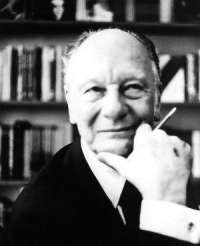
Sir John Gielgud

Sir John Gielgud born 14 April 1904 (d. 2000)

Undoubtedly one of the greatest British actors of the 20th century, John Gielgud was born in London into a family with a theatrical tradition, and was acting by his teens. He joined the Old Vic theatre company in 1921, made his silent film debut in 1923 and soon after, became Noel Coward`s understudy and successor in a number of plays.

His career flourished and he began to work his way through the major Shakespearean roles at the Old Vic, starting with Romeo, and before he was thirty, Richard II, The Tempest, Macbeth, Hamlet and King Lear.

Gielgud also successfully moved into directing, launching his own distinguished company in 1937. He continued to work his way through the Shakespearean and more modern classics - School For Scandal, Three Sisters, The Importance of Being Earnest.

He was knighted in 1953, alledgedly through the intervention of his two already-knighted colleagues, Sir Laurence Oliver and Sir Ralph Richardson. The honour may have been 'overlooked' due to his widely acknowledged - if discreet - homosexuality. Ironically, a few months later, he was arrested for 'importuning' outside a public lavatory in Chelsea during one the Police's then regular purges. The press launched into a vitriloic campaign against him, but his public were more forgiving, and the publicity and the moral debate may have contributed to the slow move towards decriminalisation. Nonetheless, he found the experience deeply humiliating and became extremely reticent about his private life thereafter.

With the new writers and actors of the late 1950s and 1960s came a new, more naturalistic style of acting, and Gielgud, now slightly unfashionable in style, moved increasingly towards the film career that would make him a much loved and respected international star in later life. The pinnacle of his movie career was his best supporting actor Academy Award for his memorable appearance as the butler in Arthur (1982).

As he entered old age, he began to find it difficult to memorise lengthy dialogue and retired from the stage in 1988, but he continued to appear in films, notably Shine (1996) and his final appearance, in Elizabeth (1998).

In 1999, he was devastated by the death of his partner of nearly forty years, Martin Hensler. A few months later, in May 2000, Sir John Gielgud passed away quietly at home. He was 96 years old.

Labels: , , , , , ,

Sunday, April 03, 2011

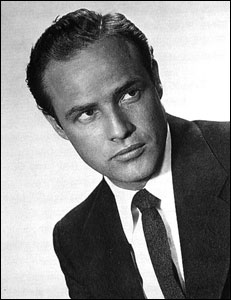
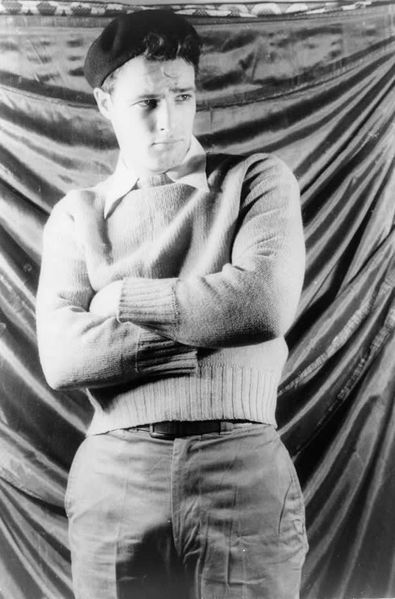
Marlon Brando

Marlon Brando born 3 April 1924 (d. 2004)

Oscar-winning Marlon Brando is unquestionably one of the greatest film actors of the 20th Century. At his peak, he was compelling, magnetic, charismatic and sexy.

Although he married three times and acknowledged no fewer than eleven children in his will, Brando was quoted in 1976 as saying. 'Like a large number of men, I, too, have had homosexual experiences, and I am not ashamed.'

He would appear to have had many such experiences and his name has been linked with many including Cary Grant, Rock Hudson, Stewart Granger, Montgomery Clift, John Gielgud and James Dean.

During the filming of Streetcar Named Desire (1951), in the garden of Vivien Leigh's mansion, David Niven discovered Brando and Laurence Olivier swimming in the pool. Olivier was kissing Brando. 'I turned my back to them and went back inside to join Vivien. I'm sure she knew what was going on, but she made no mention of it. Nor did I. One must be sophisticated about such matters in life.'

He also appears to have had a long-term relationship with an actor named Wally Cox. 'If Wally had been a woman, I would have married him and we would have lived happily ever after.' Wally Cox died in 1973, but Brando kept his ashes for 30 years and they were eventually scattered with his own. I think that tells you something...

Labels: , , ,

Friday, March 25, 2011

Elton John

Elton John born 25 March 1947

Sir Elton Hercules John, CBE (born Reginald Kenneth Dwight) is an English pop/rock singer, composer and pianist.

In a career spanning five decades, Elton John has sold more than 250 million records, making him one of the most successful musicians of all time. Elton was one of the dominant commercial forces in the rock world during the 1970s.

His success had a profound impact on popular music, and contributed to the continued popularity of the piano in rock and roll. Key musical elements in Elton's success included his melodic gifts matched with the contributions of his most significant lyricist partner Bernie Taupin, his rich tenor and gospel-chorded piano, aggressive string arrangements, and his flamboyant fashion sense and on-stage showmanship. He has also successfully diversified his talents into co-writing a number of Broadway and West End musical theatre productions including The Lion King, Aida and Billy Elliot, as well as the less successful Lestat.

He continues to be a major public figure, and has been heavily involved in the fight against AIDS since the late 1980s. He was inducted into the Rock and Roll Hall of Fame in 1994 and was knighted in 1998, and has remained an enduringly successful artist. Elton continues to be a champion for lesbian, gay, bisexual and transgender social movements.

Elton has had a complicated personal history in both his sexual orientation, as well as personal battles with drugs, depression, bulimia and spending.

In a 1976 Rolling Stone interview he announced that he was bisexual. He stated his belief that everyone is bisexual to a degree.

Elton married German recording engineer Renate Blauel on Valentine's Day, 1984, but they divorced four years later. He later renounced his bisexuality and came out as a homosexual instead.

He met his partner David Furnish, a former advertising executive and now film maker, in 1993. Furnish helped John overcome his drug addiction. On 21 December 2005, they entered into a civil partnership. A low-key ceremony with only their parents in attendance was held at the Guildhall, Windsor, followed by a lavish party at their Berkshire mansion.

Their son Zachary Jackson Levon Furnish-John was born 25 December 2010 in California via a surrogate. Ingrid Sischy (and her partner Sandy Brant) and Lady Gaga were named Zachary's godmothers respectively. Elton himself has many godchildren. These include Sean Ono Lennon, Elizabeth Hurley's son Damian Charles and David and Victoria Beckham's son Brooklyn.

Within the music industry, Elton is sometimes known as 'Sharon', a nickname originally given to him by good friend Rod Stewart. In return, Elton calls Rod 'Phyllis'.

In 2008, Billboard magazine ranked him as the most successful male solo artist on 'The Billboard Hot 100 Top All-Time Artists' (Third overall, behind only The Beatles and Madonna).

Labels: , , , , , ,

Tuesday, March 22, 2011

Stephen Sondheim

Stephen Sondheim born 22 March 1930

Stephen Sondheim is probably the greatest post-war writer of Broadway musicals.

Having been rescued from a lonely childhood and encouraged as a boy by his neighbourhood friend's father, Oscar Hammerstein II, and studied music at Williams College, his career took off when, aged 26, he was asked to write the lyrics for Leonard Bernstein's West Side Story. The following year he was writing lyrics for Jule Styne's songs for Gypsy. His first attempt as a composer & lyricist was A Funny Thing Happened On The Way To The Forum (1962) and a hit.

His work is hard to categorise. He is gay but has rarely created a gay character; his range of subjects is diverse; he has mastered many different musical styles, each new project is a new challenge; he is rarely formulaic. Lyrically he is as intelligent, witty and ironic as his music is audacious, in the style of his gay predecessors Noel Coward, Lorenz Hart or Cole Porter. His shows however, generally reject traditional notions of love and romance and neither do they reflect the gay culture which has emerged and become mainstream during his career, although ironically, his work has contributed much to that culture and become part of the gay musical tapestry - songs such as: Somewhere, Losing My Mind, Being Alive, Send In The Clowns...

His greatest shows include: Company (1970), Follies (1971), A Little Night Music (1973), Pacific Overtures (1976), Sweeney Todd (1979), Into The Woods (1987), Sunday In The Park With George (1984), Assassins (1991), Passion (1994) & Getting Away With Murder (1996).

He has won seven Tonys, an Academy Award, eight Grammys and a Pulitzer Prize, multiple Drama Desk and other theatre awards. His shows are regularly revived and many of his songs are now standards covered by a diverse range of artists. In 2008 he was awarded a special Tony Award for Lifetime Achievement in the Theatre.

2010 marks the 80th birthday of this Broadway and songwriting legend, and many events, benefits and tributes are planned to celebrate this landmark.

Sondheim.com

Labels: , , , , , , ,

Friday, January 14, 2011

Cecil Beaton

Cecil Beaton born 14 January 1904 (d. 1980)

Sir Cecil Walter Hardy Beaton was an English fashion and portrait photographer and a stage and costume designer for films and the theatre.

When Beaton was growing up his Nanny had a Kodak 3A Camera, a popular model which was renowned for being an ideal piece of equipment to learn on. Beaton's nanny began teaching him the basics of photography and developing film. He would often get his sisters and mother to sit for him. When he was sufficiently proficient, he would send the photos off to London society magazines, often writing under a pen name and ‘recommending’ the work of Beaton.

Schooled at Heath Mount School (where he was bullied by Evelyn Waugh) and St Cyprian's School, Eastbourne, he went on to Harrow and finally St John's College, Cambridge, which he left without a degree. At the end of his college career in 1925, he set up his own successful photography studio. One of his earliest clients and, later, best friends was Stephen Tennant; Beaton's photographs of Tennant and his circle are considered some of the best representations of the 'Bright Young Things' of the twenties and thirties.

He was already taking photographs for the British edition of Vogue in 1931 when George Hoyningen-Huene, who was a photographer for the French Vogue travelled to England with his new friend Horst. Horst himself would begin to work for French Vogue in November of that year. The exchange and cross pollination of ideas between this collegial circle of artists across the Channel and the Atlantic gave rise to the look of style and sophistication for which the 1930s are known.

Beaton is best known for his fashion photographs and society portraits. He worked as a staff photographer for Vanity Fair and Vogue in addition to photographing celebrities in Hollywood.

Beaton was never known as a highly skilled technical photographer, and instead focused on staging a compelling model or scene and looking for the perfect shutter-release moment.

Beaton often photographed the Royal Family for official publication. Queen Elizabeth, the Queen Mother was his favorite Royal sitter. Beaton took the famous wedding pictures of the Duke and Duchess of Windsor. During World War II, he worked for the British Ministry of Information, as a documentary photographer.

Beaton had a major influence on and relationship with two other leading lights in British photography, Angus McBean and David Bailey. McBean was arguably the best portrait photographer of his era - in the second part of McBean's career (post-war) his work is clearly heavily influenced by Beaton, though arguably McBean was technically far more proficient in his execution. Bailey was also enormously influenced by Beaton when they met whilst working for British Vogue in the early 60's.

After the war, Beaton tackled the Broadway stage, designing sets, costumes, and lighting for a 1946 revival of Lady Windermere's Fan, in which he also acted.

His most lauded achievement for the stage was the sets and costumes for Lerner and Loewe's My Fair Lady (1956), which led to two Lerner and Loewe film musicals, Gigi (1958) and My Fair Lady (1964), both of which earned Beaton the Academy Award for Costume Design.

His last work for Broadway was sets and costumes for Coco (1969) starring Katharine Hepburn.

In 1972, he received his knighthood, but suffered a stroke two years later. This hindered him from photographing for five years. He picked up the camera again for a short while in 1979, but died the following year.

Though primarily homosexual — the great love of his life was the wealthy art collector Peter Watson - he did have relationships with women. Beaton also claimed to have had an affair with the American actor Gary Cooper, who was a close friend of his for many years.

Labels: , , , ,

Friday, September 24, 2010

Pedro Almodóvar

Pedro Almodóvar born 24 September 1951

Pedro Almodóvar Caballero is a Spanish film director, screenwriter and producer. He is the most successful and internationally known Spanish film maker of his generation, having won numerous Academy Awards, BAFTAS, Golden Globes and many more both as writer and director.

His films, marked by complex narratives, employ the codes of melodrama and use elements of pop culture, popular songs, irreverent humour, strong colours and glossy décor. Almodóvar never judges his characters actions, whatever they do, but he presents them as they are in all their complexity. Desire, passion, family and identity are the director's favourite themes. Almodóvar’s films enjoy a worldwide following and he has become a major figure on the stage of world cinema. The success of his movies has brought awareness to the cause of equal rights.

Against his parents' wishes, Pedro Almodóvar moved to Madrid in 1967. After completing the compulsory military service, the young man from rural Spain found in Madrid of the late 60s the city, the culture and the freedom. His goal was to be a film director, but he lacked the economic means to do it and besides, Franco had just closed the National School of Cinema so he would be completely self-taught. To support himself, Almodóvar worked a number of odd jobs, including a stint selling used items in the famous Madrid flea market El Rastro. He eventually found full-time employment with Spain's national phone company, where he worked for twelve years as an administrative assistant. Since he worked only until three in the afternoon, he had the rest of the day to pursue his own interests.

In the early seventies, Almodóvar grew interested in experimental cinema and theatre. He collaborated with the vanguard theatrical group, Los Goliardos, where he played his first professional roles and met Carmen Maura. He was also writing comics and contributing articles and stories to a number of counter-culture magazines.

Madrid’s flourishing alternative cultural scene became the perfect scenario for Almodóvar social talents. He was a crucial figure in La Movida Madrileña (Madriliene Movement), a cultural renaissance that followed the fall of the Franco regime.

Around 1974, Almodóvar began making his first short films on a Super-8 camera. By the end of the 1970s they were shown in Madrid's night circuit. These shorts had overtly sexual narratives and no soundtrack.

After four years of working with shorts in Super-8 format, in 1978 Almodóvar made his first Super-8, full-length film. In addition, he made his first 16 mm short, Salome. This was his first contact with the professional world of cinema. The film's stars, Carmen Maura and Felix Rotaeta, encouraged him to make his first feature film in 16 mm and helped him raise the money to finance what would be Pepi, Luci, Bom y otras chicas del montón.

Since then he has made 16 cinematic films including Matador (1986), his first major international success Women On the Verge of a Nervous Breakdown (1988), All About My Mother (1999), Talk To Her (2002), Bad Education (2004) and Volver (2006).

He can also be credited with bringing two Spanish stars to an international audience - Antonio Banderas and Penelope Cruz.

A theatrical version of All About My Mother was staged in the West End in 2007.

His next film, Broken Hugs, will star his most recent muse, Penelope Cruz.

Labels: , ,

Thursday, September 16, 2010

George Chakiris

George Chakiris born 16 September 1934

George Chakiris is an American dancer and Academy Award winning film actor.

Chakiris was born in Norwood, Ohio to Greek immigrants. He made his film debut in 1947. For several years he appeared in small roles, usually as a dancer or a member of the chorus in various musical films. He was one of the dancers in Marilyn Monroe's Diamonds Are a Girl's Best Friend number in Gentlemen Prefer Blondes (1953) and also appeared as a dancer alongside Rosemary Clooney in White Christmas. He can also be seen in the 'Chop Suey' number in the musical film Flower Drum Song.

His biggest success came with the film West Side Story (1961), for which he won the Academy Award for Best Supporting Actor for his role as Bernardo. He also acted (along with Gene Kelly) in Jacques Demy's French musical Les Demoiselles de Rochefort (1967).

Chakiris has also appeared on Broadway and television. In the early 1960s, he embarked on a career as a pop singer which resulted in a couple of minor hit songs (In 1960, he recorded one single with legendary producer Joe Meek).

After film work dried up, he worked steadily through the 1970s and 1980s, appearing on such shows as Medical Center, Hawaii Five-O, Dallas, Murder, She Wrote and the TV daytime drama Santa Barbara. Chakiris last acted in a 1997 episode of the sitcom Last of the Summer Wine and has given occasional television interviews since then. He is mostly retired and has taken up jewellery-making as an occupation.

Labels: , , , , ,

Wednesday, July 14, 2010

Scott Rudin

Scott Rudin born 14 July 1958

Scott Rudin is an Academy Award-winning American film producer and a Tony Award-winning theatre producer.

He won his Academy Award for No Country For Old Men in 2008. He has won no fewer than five Tony Awards for his productions.

Labels: , , , ,

Wednesday, July 07, 2010

George Cukor

George Cukor born 7 July 1899 (d. 1983)

George Dewey Cukor was an American film director.

Cukor was born in New York City to Hungarian Jewish immigrants (His name means sugar in Hungarian.) As a teenager, he was infatuated with theatre and often cut classes to attend afternoon matinees. Following his graduation from De Witt Clinton High School in 1916, he spent a year with the Students Army Training Corps. He then obtained a job as an assistant stage manager for a Chicago theatre company. After gaining three years of experience, he formed his own stock company in Rochester, New York in 1920, and worked there for seven years. He then returned to Broadway where he worked with such formidable actresses as Ethel Barrymore, Dorothy Gish, Estelle Winwood, and Jeanne Eagels.

When Hollywood began to recruit New York theatre talent for sound films, Cukor answered their call and moved there in 1929. His first job was as a dialogue director at Paramount Pictures for the film River of Romance (1929), followed by All Quiet on the Western Front (1930) at Universal Pictures. He then co-directed three films at Paramount before making his solo debut directing Tallulah Bankhead in Tarnished Lady (1931). Cukor left Paramount after a legal dispute resulting from his dismissal from an earlier Paramount film, One Hour With You (1932), and went to work with David O. Selznick at RKO Studios.

Cukor's career flourished at RKO where he directed a string of impressive films including What Price Hollywood? (1932), A Bill of Divorcement (1932), Dinner at Eight (1933), Little Women (1933), David Copperfield (1935), Romeo and Juliet (1936), and Camille (1937).

By this time, Cukor had established a reputation as a director who could coax great performances from actresses and he became known as a 'woman's director,' a title which he resented. One of Cukor's first ingenues was actress Katharine Hepburn, who debuted in A Bill of Divorcement and whose looks and personality left RKO officials at a loss as to how to use her. Cukor ended up directing her in her most successful films and they became close friends off the set.

Cukor was hired to direct Gone with the Wind by David O. Selznick in 1937 and he spent two years with pre-production duties as well as spending long hours coaching Vivien Leigh and Olivia de Havilland, the film's female stars. Cukor was replaced after less than three weeks of shooting, but continued to coach Leigh and De Havilland off the set.

Following the Gone with the Wind debacle, Cukor directed The Women (1939), a classic film notable for its all female cast and The Philadelphia Story (1940) starring Katharine Hepburn. He also directed another of his favorite actresses, Greta Garbo, in Two Faced Woman (1941), her last film before she retired from the screen.

The 1940s was a decade of hits and misses for Cukor. He was off track with Two Faced Woman as well as Her Cardboard Lover (1942) starring Norma Shearer. However, he did achieve more success with films such as A Woman's Face (1941) with Joan Crawford, Gaslight (1944) with Ingrid Bergman and Charles Boyer, and Adam's Rib (1949) with Katharine Hepburn and Spencer Tracy.

Cukor's reputation as an actor's director continued as he helped several actors win Academy Awards. James Stewart won a Best Actor Oscar for The Philadelphia Story, Ronald Colman won a Best Actor Oscar for A Double Life (1947) and Judy Holliday won for Best Actress for Born Yesterday (1950). In 1954, Cukor made his first film in colour, A Star Is Born which featured an impressive come-back performance by Judy Garland. A decade later, Cukor won an Academy Award himself, for Best Director, for My Fair Lady (1964), for which Rex Harrison won a Best Actor Oscar too.

He continued to work into his 80s and directed his last film, Rich and Famous (1981) with Candice Bergen.

Cukor was well known in his personal life as a man having a good time. Cukor's private life was also well known within the limits of Hollywood. During the heyday of Hollywood, his celebrated home was the site of weekly Sunday parties and his guests knew that they would always find interesting company, good food, and a beautiful atmosphere when they visited. His Sunday afternoon pool parties are legendary. These events were studies in egalitarianism, with Cukor and his sophisticated friends socialising with their boyfriends, who were often hustlers, rough trade, would-be actors, or ambitious artists and writers who saw these parties as entries into the high life. Although Cukor's reputation did have some negative effect on his career within more prejudiced Hollywood circles

Cukor's friends were of paramount importance to him and he kept his home filled with their photographs. Regular attendees at his soirees included Katharine Hepburn and Spencer Tracy, Joan Crawford and Douglas Fairbanks, Jr. , Lauren Bacall and Humphrey Bogart, Claudette Colbert, Marlene Dietrich, Laurence Olivier and Vivien Leigh, Richard Cromwell, Judy Garland, Noel Coward, Cole Porter, James Whale, Edith Head, and Norma Shearer, especially after the death of her first husband, Irving Thalberg.

George Cukor died on January 24, 1983 at the age of 83. He was interred in the Forest Lawn Memorial Park Cemetery in Glendale, California.

Labels: , ,

Monday, January 18, 2010

Cary Grant

Cary Grant born 18 January 1904 (d. 1986)

Archibald Alexander Leach, better known by his screen name, Cary Grant, was an English film actor. With his distinctive mid-Atlantic accent, he was noted as perhaps the foremost exemplar of the debonair leading man, not only handsome, but also witty and charming. He was named the second Greatest Male Star of All Time of American cinema by the American Film Institute.

Archibald Leach was born in Bristol, England. An only child (before he was born his parents had had another son who died in infancy), Leach had a confused and unhappy childhood. His mother, Elsie, was placed in a mental institution when he was nine. His father told him that she was dead, and he only learned in 1935 that she was still alive, in an institution.

After being expelled from Fairfield Grammar School in Bristol in 1918 (for investigating the girls' bathroom), he joined the Bob Pender stage troupe.

Grant travelled with the troupe to the United States in 1920 for a two-year tour. When the troupe returned to England, Grant decided to stay in the US and continue his stage career. Over time, he created a unique accent and persona that mixed working and upper class accents, while supporting himself as, among other things, a hawker and a male escort for socialites.

After some success in light Broadway comedies, he came to Hollywood in 1931, where he acquired the name Cary Grant.

Grant starred in some of the classic screwball comedies, including The Awful Truth with Irene Dunne (the pivotal film in the establishment of Grant's screen persona), Bringing Up Baby with Katharine Hepburn, His Girl Friday with Rosalind Russell and Arsenic and Old Lace with Priscilla Lane. These performances solidified his appeal, and The Philadelphia Story, with Hepburn and James Stewart, presented his best-known screen role: the charming if sometimes unreliable man

Grant was one of Hollywood's top box-office attractions for several decades. He was a versatile actor, who did demanding physical comedy in movies like Gunga Din with the skills he had learned on the stage.

In the mid-1950s, Grant formed his own production company and produced a number of movies distributed by Universal, such as Operation Petticoat, Indiscreet, That Touch of Mink (co-starring Doris Day), and Father Goose.

While Grant was nominated for two Academy Awards in the 1940s, he was denied the Oscar throughout his active career as he was considered a maverick by virtue of the fact that he was the first actor to 'go independent', effectively bucking the old studio system, which pretty much completely controlled what an actor could or could not do. In this way, Grant was able to control every aspect of his career. The cost was no golden statuette during his active career. Grant finally received a special Academy Award for Lifetime Achievement in 1970.

In the last few years of his life, Grant undertook tours of the United States with 'A Conversation with Cary Grant', in which he would show clips from his films and answer audience questions. It was just before one of these performances, in Davenport, Iowa, on November 29, 1986, that Grant suffered a stroke, and died in the hospital a few hours later.

Grant's personal life was complicated, involving five marriages and speculation about his sexuality.

In 1932 he met fellow actor Randolph Scott on set, and the two shared a rented beach house (known as 'Bachelor Hall') on and off for twelve years. Rumours ran rampant at the time that Grant and Scott were lovers.

Authors Marc Elliot, Charles Higham and Roy Moseley consider Grant to have been bisexual, with Higham and Moseley claiming that Grant and Scott were seen kissing in a public car park outside a social function both attended in the 1960s. In his book, Hollywood Gays, Boze Hadleigh cites an interview with director George Cukor, who said about the alleged homosexual relationship between Scott and Grant: 'Oh, Cary won't talk about it. At most, he'll say they did some wonderful pictures together. But Randolph will admit it – to a friend.'

According to screenwriter Arthur Laurents, Grant was 'at best bisexual'. William J. Mann's book Behind the Screen: How Gays and Lesbians Shaped Hollywood, 1910-1969 recounts how photographer Jerome Zerbe spent 'three gay months' (his words) in the movie colony taking many photographs of Grant and Scott, 'attesting to their involvement in the gay scene'. Zerbe says that he often stayed with the two actors, 'finding them both warm, charming, and happy.' In addition, Darwin Porter's book, Brando Unzipped (2006) claims that Grant had a homosexual affair with Marlon Brando.

Many writers seem to have no doubt about the actor's bisexuality; Grant, however, did not identify himself as such. He had many gay friends, including Cukor, William Haines, and Australian artist and costume designer Orry-Kelly, but he is not alleged to have had relationships with them, well, with Haines, at least.

When Chevy Chase joked about Grant being gay in a television interview in 1980 ('Oh, what a gal!') Grant sued him and they settled out of court. Grant also complained to writer/director Peter Bogdanovich about the Chevy Chase incident, emphatically insisting that he was not gay, and that while he had nothing against homosexuals, he was simply not one himself (this exchange is cited at length in the chapter on Grant in Bogdanovich's 2005 book Who the Hell's in It?). Grant thought of the cottage industry of writers imagining him to be gay as merely a media echo chamber of falsehood. Also, it should be noted Grant had numerous heterosexual relationships throughout his life, marrying several times, and during the filming of The Pride and the Passion, he and Sophia Loren engaged in a passionate love affair.

Grant's first wife was actress Virginia Cherrill. They married on February 10, 1934, and divorced just over a year later on March 26, 1935.

After becoming a naturalised US citizen in 1942, he married ultra-wealthy socialite Barbara Hutton. The couple was derisively nicknamed 'Cash and Cary', though an extensive prenuptial agreement was signed before the marriage. However, when he and Hutton divorced in 1945, Grant refused to accept a money settlement from her and they remained friends.

Grant's third wife was actress and writer Betsy Drake. This was his longest marriage (1949 - 1962). In a 2004 interview for the Turner Classic Movies production, Cary Grant: A Class Apart, Drake mocked rumors of Grant's homosexuality. 'I didn't have time to think about his homosexuality,' she says, 'we were too busy fucking.'

His fourth marriage, to actress Dyan Cannon, on July 22, 1965, in Las Vegas, resulted in the birth of his only child, Jennifer, when he was 62. The marriage was troubled from the beginning (Grant was 61 and Cannon was 28), and they separated within 18 months, with Cannon claiming that Grant spanked her for disobeying him. The divorce, finalised on May 28, 1967, was bitter and messy, and the custody disputes over their daughter went on for years.

Grant married British hotel PR agent Barbara Harris (47 years his junior), on April 11, 1981, a marriage which lasted until his death.

Labels: , , , ,

Tuesday, November 24, 2009

Albert Wolsky

Albert Wolsky born 24 November 1930

Albert Wolsky is an American costume designer. He has worked both on stage shows as well as for film, and has received two Academy Awards.

Wolsky was born in Paris, France. He graduated from the City College of New York and began an early career in the travel industry. He decided to change careers and took an assistant's job with notable costume maker Helene Pons. Wolsky became a well regarded costume designer, working both on Broadway and in the motion picture industry.

Wolsky worked on many films including Harry and Tonto, The Turning Point, Grease and Manhattan. He worked with Bob Fosse, a leading Broadway director, on All That Jazz and won his first Academy Award. He won his second Academy Award for Bugsy in 1991 and has been nominated five other times, most recently for his work on Julie Taymor's Beatles-inspired musical Across the Universe (2007) and Sam Mendes's Revolutionary Road (2008).

He began his career as costume designer for the theatre by assisting costume designer Ann Roth on A Case of Libel (1963); he later assisted Roth on The Odd Couple (1965), Patricia Zipprodt on Fiddler on the Roof (1964), and Theoni Aldredge on Illya Darling (1967). His first work as lead costumer was Generation (1965). He went on to serve as principal costume designer for both plays and musicals, including The Sunshine Boys (1972) and Sly Fox (1976).

Wolsky is currently a Member of the Board of Governors of the Academy of Motion Picture Arts and Sciences.

He is the recipient of the 2010 TDF/Irene Sharaff Lifetime Achievement Award For Costume Design.

Labels: , , ,

Wednesday, December 31, 2008

Orry-Kelly

John Orry-Kelly born 31 December 1897 (d. 1964)

Orry-Kelly was the professional name of John Orry Kelly, a prolific Hollywood costume designer. Some sources cite his name as George Orry Kelly.

Born in Kiama, New South Wales in Australia, he grew up to study art there, becoming a tailor's apprentice and window dresser in Sydney.

He journeyed to New York to pursue an acting career. He shared an apartment there with Charlie Spangles and Cary Grant. A job painting murals in a nightclub led to his employment by Fox East Coast studios illustrating titles. He designed costumes and sets for Broadway's Shubert Revues and George White's Scandals.

He went to Hollywood in 1932, working for all the major studios (Warner Brothers, Universal, RKO, 20th Century Fox, and MGM), and designed for all the great actresses of the day, including Bette Davis, Olivia DeHavilland, Katharine Hepburn, Ava Gardner, Ann Sheridan, and Merle Oberon.

He worked on many films now deemed classic, including 42nd Street, The Maltese Falcon, Casablanca, Arsenic and Old Lace, Harvey, Oklahoma!, Auntie Mame, and Some Like It Hot.

He won three Academy Awards for costume design (for An American in Paris, Cole Porter's Les Girls, and Some Like It Hot) and was nominated for a fourth (for Gypsy).

A longtime alcoholic, he died of liver cancer in Hollywood, California and was interred in the Forest Lawn Memorial Park (Hollywood Hills).

Labels: , , , ,

Friday, November 14, 2008

Aaron Copland

Aaron Copland born 14 November 1900 (d. 1990)

Aaron Copland was an American composer of concert and film music, as well as an accomplished pianist. Instrumental in forging a distinctly American style of composition, he was widely known as 'the dean of American composers'.

Copland's music achieved a difficult balance between modern music and American folk styles, and the open, slowly changing harmonies of many of his works are said to evoke the vast American landscape. He incorporated percussive orchestration, changing meter, polyrhythms, polychords and tone rows. Aside from composing, Copland taught, presented music-related lectures, wrote books and articles, and served as a conductor (generally, but not always, of his own works).

Copland was born in Brooklyn, New York, of Lithuanian Jewish descent. Before emigrating to the United States Copland's father had Anglicised his surname 'Kaplan' to 'Copland' while in Scotland. Throughout his childhood Copland and his family lived above his parents' Brooklyn shop. Although his parents never encouraged or directly exposed him to music, at the age of fifteen he had already taken an interest in the subject and aspired to be a composer. His musical education included time with Leopold Wolfsohn, Rubin Goldmark (who also taught George Gershwin), and Nadia Boulanger at the Fontainebleau School of Music in Paris from 1921 to 1924. He was awarded a Guggenheim in Fellowship in 1925 and again in 1926.

Copland defended the Communist Party USA during the 1936 presidential election. As a result he was later investigated by the FBI during the Red scare of the 1950s, and found himself blacklisted. Because of the political climate of that era, A Lincoln Portrait was withdrawn from the 1953 inaugural concert for President Eisenhower. That same year, Copland was called before Congress where he testified that he was never a communist. Outraged by the accusations, many members of the musical community held up Copland's music as a banner of his patriotism. The investigations ceased in 1955, and were closed in 1975. Copland was never shown to have been a member of the Communist Party.

Copland exerted a major influence on the compositional style of his friend and protege Leonard Bernstein. Bernstein was considered the finest conductor of Copland's works.

Copland was a frequent guest conductor of orchestras in the US and the UK. He made a series of recordings of his music, especially during the 1970s, primarily for Columbia Records. In 1960, RCA Victor released Copland's recordings with the Boston Symphony Orchestra of the orchestral suites from Appalachian Spring and The Tender Land; these recordings were later reissued on CD, as were most of Copland's Columbia recordings (by Sony).

While his orchestral music and his ballets found success on the stages and in the concert halls of America, Copland sought to enter another arena, the emerging industry of motion pictures. He saw this as both a challenge for his abilities as a composer and an opportunity to expand his reputation and audience. However, the tendency of studios to edit and cut movie scores went against Copland’s desire for creative control over his work. Copland found a kindred spirit in director Lewis Milestone, who recognised the benefits of allowing Copland to supervise his own orchestration and refrained from interfering with his work. This collaboration resulted in the notable film Of Mice and Men (1939) that earned Copland his first nomination for an Academy Award. In a departure from other film scores of the time, Copland’s work largely reflected his own style, instead of borrowing from the late Romantic period. Additionally, he rejected the common practice of using leitmotiv to identify characters with their own personal themes.

His score for William Wyler's 1949 film, The Heiress won an Academy Award. Several themes he created are encapsulated in the suite Music for Movies, and his score for the film adaptation of John Steinbeck's novel The Red Pony was given a suite of its own. This suite was one of Copland's personal favourites. It is difficult to overestimate the influence Copland has had on film music. Virtually every composer who scored for western movies, particularly between 1940 and 1960, was shaped by the style Copland developed.

Copland was awarded the Pulitzer Prize in composition for Appalachian Spring. His scores for Of Mice and Men (1939), Our Town (1940), and The North Star (1943) all received Academy Award nominations, while The Heiress won Best Music in 1949.

Copland's best known piece of music is probably Fanfare For the Common Man (1942), a popular choice for opening ceremonies, with its dramatic opening fanfare, and turned into a worldwide pop hit in the 1970s by Emerson, Lake & Palmer.

Copland's homosexuality was documented in Howard Pollack's biography, Aaron Copland: The Life and Work of an Uncommon Man.

Copland died of Alzheimer's disease and respiratory failure in North Tarrytown, New York (now Sleepy Hollow), on December 2, 1990.

Labels: , , , , ,

Wednesday, October 22, 2008

Bill Condon

Bill Condon born 22 October 1955

Bill Condon is an Academy Award-winning American screenwriter and director.

William Condon was born October 22, 1955 into an Irish Catholic family in Queens, New York.

In his second year of high school Condon began his first serious romance, a two-year relationship with a young man in the class ahead of his. Condon's parents eventually learned of the love affair and spoke about it at first, but subsequently 'it was never talked about,' Condon recalled.

Condon earned a bachelor's degree in philosophy from Columbia University. Following his graduation in 1976 he moved to Los Angeles, planning to pursue film studies at UCLA.

In the interim Condon began freelancing as a writer. One of his articles in a movie periodical caught the eye of British producer/director Michael Laughlin, who hired him to write scripts for two horror films, Strange Behavior (1981) and Strange Invaders (1983).

Condon continued in the horror genre, revising the script of a screenplay originally titled The Louisiana Swamp Murders into a movie called Sister, Sister that he directed in 1987. The film flopped, putting Condon into what he described as 'film director's jail' - making movies for cable television, some of which he produced as well as wrote and directed.

After several such efforts he returned to the big screen with the 1994 film Candyman: Farewell to the Flesh, which was based on a short story by Clive Barker, whom he met during the shooting of the movie in New Orleans.

Making Candyman was a turning point in Condon's career. He learned about financing independent films, and the contacts that he made helped him secure the movie rights to Christopher Bram's novel Father of Frankenstein about gay director James Whale. Barker agreed to serve as executive producer of the film, which was released as Gods and Monsters in 1998.

Bringing the project to fruition was a considerable challenge. Condon was disappointed that although the distinguished actor Sir Ian McKellen was slated to play Whale, even production companies that had previously backed films with gay themes showed little interest in funding Gods and Monsters. Eventually a small company, Lion's Gate, provided a three-million-dollar budget - modest by Hollywood standards - and the film was shot in a mere four weeks. The demanding schedule was necessary because of McKellen's pending commitment to appear at the National Theatre in London.

Gods and Monsters opened to enthusiastic critical response, winning numerous awards at film festivals. When the Academy Awards for the year were given out, McKellen's extraordinary performance was overlooked, but Condon's script earned him an Oscar for best adapted screenplay.

Condon received a second Academy Award nomination for the script that translated the cynical Kander and Ebb musical hit Chicago from the stage to the screen. Rob Marshall directed the movie version in 2002.

Acclaimed as the best movie musical in years, Chicago is actually the product of the collaboration of several out gay men, including - in addition to Condon and Marshall - executive producers Neil Meron and Craig Zadan. Winner of an Academy Award as Best Motion Picture of the year, it may have done more than any other recent film to resurrect the musical as a viable film genre.

Condon's next major project was Kinsey (2004), a film biography of the legendary sex researcher Alfred Kinsey, which he both wrote and directed.

In 2006 Condon wrote and directed the film adaptation of the Broadway musical Dreamgirls.

Condon lives in Los Angeles with his life partner, who is a screenwriter and director. The couple has been together since the mid-1990s.

In addition to writing and directing, Condon is on the board of IFP/Los Angeles, an association for independent filmmakers, and is also a founding member of the Independent Writers Steering Committee of the Writers Guild of America.

Since he has made films about Whale and Kinsey, Condon has found himself described as a 'homosexual activist', a designation with which he is not entirely comfortable. 'I'm proud to wear those stripes,' he says, adding, 'I just haven't done enough to earn them.'

Labels: , ,

Saturday, October 11, 2008

Jerome Robbins

Jerome Robbins born 11 October 1918 (d. 1998)

Jerome Robbins was an American choreographer whose work included everything from classical ballet to contemporary musical theatre.

Born Jerome Rabinowitz in New York City, he and his family soon moved to Weehawken, New Jersey. His father's corset business allowed young Robbins to attend New York University for one year, where he majored in chemistry, before a slump in business forced him to withdraw.

Robbins had already started accompanying his sister to dance classes, which led to his professional debut in a Yiddish Art Theater production in 1937.

For five summers Robbins choreographed and performed at the Poconos resort Lake Tamiment, in between dancing in four Broadway musicals, one choreographed by George Balanchine.

Robbins was hired as a choreographer for the second season of Ballet Theatre (1940-1941). His meteoric career took off with his first ballet, Fancy Free (1944), to an original score by Leonard Bernstein.

The ballet was an instant hit; and the composer and choreographer, both twenty-five years old, joined forces with lyricists Betty Comden and Adolph Green to create a musical out of Robbins' comic ballet of three sailors on leave in New York City: On the Town. The success of On the Town made Robbins the boy genius of two worlds: musical theatre and concert dance.

In the 1950s, Robbins began to direct as well as choreograph, creating such masterpieces as The King and I (1951), Bells Are Ringing (1956), Gypsy (1959), Fiddler on the Roof (1964), and, most notably, West Side Story (1957).

Robbins' darkest hour occurred at the height of McCarthyism. In 1953 he named eight colleagues as members of the Communist Party during a House Un-American Activities Committee hearing.

Robbins never explained or defended his motives for naming names. He may have testified to avoid being blacklisted on Broadway or out of fear of being outed as a homosexual. Many colleagues and others considered his behavior a betrayal and never forgave him for it.

Unlike other directors of musicals, Robbins demanded that his actors dance as well as sing. His high expectations of the cast of West Side Story, for example, created the triple-threat performer: the actor/singer/dancer. This landmark production in the history of musical theatre was also the beginning of a new genre: musical tragedy.

While librettist Arthur Laurents felt that the shared Jewishness of the collaborators was the greatest influence on the creation of West Side Story, surely the show was also influenced by the fact that seven members of the creative team were gay: Robbins, Laurents, composer Leonard Bernstein, lyricist Stephen Sondheim, set designer Oliver Smith, lighting designer Jean Rosenthal, and costume designer Irene Sharaff, in addition to the first actor to play Tony, Larry Kert.

One result of the homosexuality of most of the creative team is that, despite the heterosexual plot line, West Side Story is nevertheless intensely homoerotic. The male characters are eroticised as much as the female characters, if not more so; and Riff seems to love Tony as much as Tony loves Maria.

At the invitation of Balanchine, Robbins joined New York City Ballet as a dancer, choreographer, and Associate Director from 1949 through 1959. He returned to New York City Ballet as Ballet Master in 1969.

For the next twenty years, the former king of Broadway choreographed numerous masterpieces of ballet, including Dances at a Gathering (1969), The Goldberg Variations (1971), Glass Pieces (1983), Ives, Songs (1988), and 2 & 3 Part Inventions (1994). It could be argued that his ballets would have been more highly regarded, then and now, had they not been created in Balanchine's shadow.

Shortly before the death of Balanchine in 1983, Robbins and Peter Martins were named co-directors of New York City Ballet, a post Robbins held until 1990.

Robbins took a leave from New York City Ballet in 1988 to stage Jerome Robbins' Broadway (1989), an anthology of dances and scenes from eleven of his Broadway shows. It won the Tony Award for Best Musical and ran 624 performances.

Robbins the perfectionist was often his own worst enemy. He was savagely demanding of his performers and unrelenting in his demands on himself. High expectations ruled his personal life as well, as Robbins pursued both men and women, but formed no permanent relationship.

Robbins' ballet Facsimile (1946) reflects his bisexuality, as two men and one woman vie for one another's affections.

Ballet dancer Nora Kaye told reporters that she and Robbins were to be wed in 1951; at the same time, Broadway dancer Buzz Miller and Robbins were in the midst of their five-year live-in relationship (1950-1955). Robbins' other romantic affairs included those with actor Montgomery Clift, writer Christine Conrad, photographer Jesse Gerstein, and film-maker Warren Sonbert.

On 29 July 1998, Robbins died of a stroke at the age of 79. His numerous awards include one Emmy (Peter Pan), two Oscars (West Side Story), four Tony Awards, the Kennedy Center Honors (1981), and a National Medal of the Arts (1988).

Arguably the greatest classical choreographer born in the US and a Broadway innovator, Robbins took millions of people to a new place, as he once said, a world 'where things are not named'.

Labels: , , , , , ,