Thursday, April 21, 2011

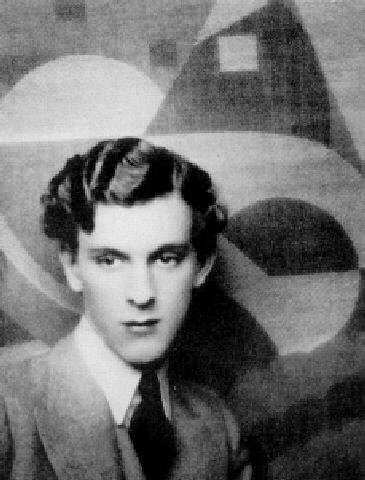
Stephen Tennant

Stephen Tennant born 21 April 1906 (d. 1987)

Stephen James Napier Tennant was a British aristocrat known for his decadent lifestyle. It is said, albeit apocryphally, that he spent most of his life in bed.

Born in England, the youngest son of a Scots peer, Lord Glenconner. His mother was the former Pamela Wyndham and a cousin of Lord Alfred Douglas (1870-1945), Oscar Wilde's lover. Tennant's eldest brother Edward 'Bim' Tennant was killed in WWI.

During the 1920s and 30s, Tennant was an important member - the 'Brightest', it is said - of the 'Bright Young Things'. His friends included Rex Whistler, Cecil Beaton, the Sitwells, Lady Diana Manners and the Mitford girls. He is widely considered to be the model for Cedric Hampton in Nancy Mitford's novel Love in a Cold Climate; one of the inspirations for Lord Sebastian Flyte in Waugh's Brideshead Revisited, and a model for the Hon. Miles Malpractice in some of his other novels.

When he was nineteen, Tennant became the lover of the poet Siegfried Sassoon. Prior to this he had proposed to a friend, the novelist Elizabeth Bowen, but had been rejected. (allegedly Tennant discussed plans with Bowen about bringing his Nanny with them on their honeymoon.) His relationship with Sassoon, however, was to be his most important: it lasted some four years before Tennant off-handedly put an abrupt end to it. Sassoon was reportedly depressed afterwards for 3 months, until he got into a short-lived and unhappy marriage.

For most of his life, Tennant tried to start or finish a novel - Lascar. It is popularly believed that he spent the last 17 years of his life in bed at his family manor at Wilsford, Wiltshire, which he had redecorated by Syrie Maugham. Though undoubtedly idle, he was not truly lethargic: he made several visits to the United States and Italy, and struck up many new friendships, despite his later reputation as a recluse. This became increasingly true only towards the last years of his life. Yet even then, his life was not uneventful: he became landlord to V S Naipaul who immortalised Tennant in his novel The Enigma of Arrival.

When Tennant died in 1987, he had far outlived most of his contemporaries.

'The Bright Young Things' at Wilsford: William Walton, Cecil Beaton, Hon Stephen Tennant, Rex Whistler, Georgia Sitwell, Zita Jungman and Teresa Jungman, 1927

Labels: , ,

Sunday, March 13, 2011

Brian Howard

Brian Howard born 13 March 1905 (d. 1958)

Brian Christian de Claiborne Howard was an English poet, whose work belied a spectacularly precocious start in life; in the end he became more of a journalist, writing for the New Statesman.

He was born to American parents in Hascombe, Surrey, and brought up in London; his father Francis Gassaway Howard was an associate of James Whistler. He was educated at Eton College, where he was one of the Eton Arts Society group including Harold Acton, Oliver Messel, Anthony Powell and Henry Yorke.

He entered Christ Church, Oxford in 1923, not without difficulty. He was prominent in the group later known as the Oxford Wits. He was one of the Hypocrites group that included Harold Acton, Lord David Cecil, L P Hartley and Evelyn Waugh. He allegedly provided the model for Anthony Blanche, the social butterfly in Evelyn Waugh's Brideshead Revisited,

At this time he had already been published as a poet, in A R Orage's The New Age, and the final Sitwell Wheels anthology. He used the pseudonyms Jasper Proude and Charles Orange. His verse also was in Oxford Poetry 1924.

Subsequently he led a very active social life, tried to come to terms with his homosexuality, and published only one substantial poetry collection God Save the King (1930). He was active as a poet during the Spanish Civil War, but did not ultimately invest in his work with seriousness.

During the 1930s he drifted around Europe. He had affairs with various young men before settling on Toni, a young blond German bisexual who he had met in Munich. In September 1935 he and Toni were staying at the same pension as Christopher Isherwood and Klaus Mann, son of Thomas Mann, in Amsterdam. At the start of the war Toni was interned in France but eventually managed to escape to the States, where he married an American, putting distance and an end to their twelve-year relationship.

In 1931, in Germany, Howard had become influenced by novelist Thomas Mann's loathing for Hitler and he filed anti-Hitler articles to the British press. His anti-Nazi stance was further informed by his Jewishness. Later, in 1939, Howard assisted the release of a number of anti-Nazi Germans imprisoned in France.

Brian Howard was often drunk throughout his adult life and alcohol began to become a problem, along with drugs, during his 30s.

In 1940, Howard was recruited into MI5 as an undercover 'outside contact' to report on pro-Nazi personalities. His political acumen must have been respected by MI5 because, in the early years of the war, Howard's dark apprehensions from the 1930s were reflected in a series of sophisticated anti-Nazi propaganda scripts that he wrote for BBC radio. These scripts were some of the earliest to broadcast the facts of the genocidal 'eugenics programme' of the Third Reich. Following his dismissal from MI5 in 1942 he served in a low-key role in the RAF.

During this time, he renewed his acquaintance with the spy Guy Burgess, a fellow Old Etonian and also a BBC correspondent. Burgess, one of the Soviet Union's 'Cambridge Five' spy ring, had studied at Trinity College, Cambridge, and he and Oxonian Howard knew each other in 1937 in Germany.

In the autumn of 1943 Brian Howard started a relationship with Sam, a nineteen-year-old Irishman, and in command of an Air-Sea Rescue Launch. In June 1944 Brian Howard began being checked over for health problems at RAF Halton, and in December 1944 he was given an honourable discharge from the RAF for being 'below Air Force physical standard, although fit for selected employment in civil life'. Sam was invalided out of the Navy because of foot trouble and he got a job at the BBC.

Brian Howard wondered what he was going to do next and spent his time writing book reviews for the New Statesman. After the war he continued to drift with Sam. They lived in France for a while but in 1950 Howard was unexpectedly expelled as an 'undesirable' and they fled to Italy and then travelled around Austria and Germany.

Brian Howard's health failed during the 1950s and he relied on sedatives. He had tuberculosis that he said he had contracted in Spain, and his alcoholism was taking its toll. He and Sam continued to wander around Europe looking for a home. They spent some time in Tangier in the spring of 1954 where Brian Howard was curing his addiction to alcohol but becoming dependent on drugs.

In June 1954 he received a letter from Paris saying that he would be allowed to return to France, although more complications arose and doubts continued about whether either Brian Howard or Sam could have a visa. Both were still keen to settle in France and Howard's mother used an inheritance to buy a house near Nice. Brian Howard and Sam moved into the house at the beginning of January 1958 but disaster struck within two weeks of their arrival. In the morning of 11 January 1958 Sam went to have a bath but workmen had removed an exhaust pipe from the bathroom and Sam died accidentally of asphyxiation from fumes from a gas heater. He was 32. Four days later Brian Howard killed himself by taking an overdose of sedatives. He was 52. After a double funeral they were buried together at the Caucade de Nice cemetery.

Labels: , , , , , ,

Friday, January 14, 2011

Cecil Beaton

Cecil Beaton born 14 January 1904 (d. 1980)

Sir Cecil Walter Hardy Beaton was an English fashion and portrait photographer and a stage and costume designer for films and the theatre.

When Beaton was growing up his Nanny had a Kodak 3A Camera, a popular model which was renowned for being an ideal piece of equipment to learn on. Beaton's nanny began teaching him the basics of photography and developing film. He would often get his sisters and mother to sit for him. When he was sufficiently proficient, he would send the photos off to London society magazines, often writing under a pen name and ‘recommending’ the work of Beaton.

Schooled at Heath Mount School (where he was bullied by Evelyn Waugh) and St Cyprian's School, Eastbourne, he went on to Harrow and finally St John's College, Cambridge, which he left without a degree. At the end of his college career in 1925, he set up his own successful photography studio. One of his earliest clients and, later, best friends was Stephen Tennant; Beaton's photographs of Tennant and his circle are considered some of the best representations of the 'Bright Young Things' of the twenties and thirties.

He was already taking photographs for the British edition of Vogue in 1931 when George Hoyningen-Huene, who was a photographer for the French Vogue travelled to England with his new friend Horst. Horst himself would begin to work for French Vogue in November of that year. The exchange and cross pollination of ideas between this collegial circle of artists across the Channel and the Atlantic gave rise to the look of style and sophistication for which the 1930s are known.

Beaton is best known for his fashion photographs and society portraits. He worked as a staff photographer for Vanity Fair and Vogue in addition to photographing celebrities in Hollywood.

Beaton was never known as a highly skilled technical photographer, and instead focused on staging a compelling model or scene and looking for the perfect shutter-release moment.

Beaton often photographed the Royal Family for official publication. Queen Elizabeth, the Queen Mother was his favorite Royal sitter. Beaton took the famous wedding pictures of the Duke and Duchess of Windsor. During World War II, he worked for the British Ministry of Information, as a documentary photographer.

Beaton had a major influence on and relationship with two other leading lights in British photography, Angus McBean and David Bailey. McBean was arguably the best portrait photographer of his era - in the second part of McBean's career (post-war) his work is clearly heavily influenced by Beaton, though arguably McBean was technically far more proficient in his execution. Bailey was also enormously influenced by Beaton when they met whilst working for British Vogue in the early 60's.

After the war, Beaton tackled the Broadway stage, designing sets, costumes, and lighting for a 1946 revival of Lady Windermere's Fan, in which he also acted.

His most lauded achievement for the stage was the sets and costumes for Lerner and Loewe's My Fair Lady (1956), which led to two Lerner and Loewe film musicals, Gigi (1958) and My Fair Lady (1964), both of which earned Beaton the Academy Award for Costume Design.

His last work for Broadway was sets and costumes for Coco (1969) starring Katharine Hepburn.

In 1972, he received his knighthood, but suffered a stroke two years later. This hindered him from photographing for five years. He picked up the camera again for a short while in 1979, but died the following year.

Though primarily homosexual — the great love of his life was the wealthy art collector Peter Watson - he did have relationships with women. Beaton also claimed to have had an affair with the American actor Gary Cooper, who was a close friend of his for many years.

Labels: , , , ,

Monday, July 05, 2010

Harold Acton

Harold Acton born 5 July 1904 (d. 1994)

Sir Harold Mario Mitchell Acton KBE was an Anglo-Italian writer, scholar and dilettante who is probably most famous for being believed, incorrectly, to have inspired the character of Anthony Blanche in Evelyn Waugh's novel Brideshead Revisited (1945). Waugh himself wrote, 'The characters in my novels often wrongly identified with Harold Acton were to a great extent drawn from Brian Howard.'

Acton was born into a prominent Anglo-Italian family. He claimed that his great-great-grandfather was Commodore Sir John Acton, who was prime minister of Naples under Ferdinand IV, and grandfather of the Roman Catholic historian John Acton. However, the basis of this has been disputed.

His father was the art collector Arthur Acton, his mother Hortense Mitchell, heiress to a prominent Chicago banking family. The Mitchell fortune allowed Arthur to buy the remarkable Villa La Pietra on the hills of Florence, where Harold lived all his life.

Acton's own works include Memoirs of an Aesthete and The Bourbons of Naples, 1734-1825, a gossipy history of the Bourbon rulers of the Kingdom of Naples in the 18th century. He also wrote Peonies and Ponies, the most popular satirical book about the clash between European and Chinese culture.

In 1974 he was named a Knight Commander of the British Empire (KBE). When he died he left Villa La Pietra to New York University.

Following Acton's death at the age of 89, DNA testing revealed the existence of a half-sister, whose heirs have gone to court to challenge Acton's $500 million bequest to New York University.

Acton was buried at the Cimitero Evangelico degli Allori in the suburbs of Florence.

Labels: , , ,

Thursday, June 24, 2010

Rex Whistler

Rex Whistler born 24 June 1905 (d. 1944)

Rex Whistler, Reginald John 'Rex' Whistler. English Artist, designer and illustrator.

Rex Whistler was the son of Henry and Helen Frances Mary Whistler. He was sent to board at Haileybury in May 1919 where he began to show a precocious talent for art, providing set designs for play productions and giving away sketches to prefects in lieu of 'dates' (a punishment unique to Haileybury, similar to 'lines' but whereby offenders are required to write out long, set lists of historical dates).

After Haileybury the young Whistler was accepted at the Royal Academy but disliked the regime there and was 'sacked for incompetence'. He then proceeded to study at the Slade School of Art where he met The Honourable Stephen Tennant, soon to become one of his best friends and a model for some of the figures in his works. Through Tennant, he later met the poet Siegfried Sassoon and his wife Hester, to both of whom Whistler became very close.

Upon leaving the Slade he burst into a dazzling career as a professional artist. His work encompassed all areas of art and design. From West End theatre to book illustration (including works by Evelyn Waugh and Walter de la Mare, and perhaps most notably, for Gulliver's Travels) and mural and trompe l'oeil painting. Paintings at Port Lympne, Plas Newydd [detail below] and Dorneywood amongst others, show his outstanding talent in this genre.

During his time at Plas Newydd he may well have become the lover of the daughter of the 6th Marquess of Anglesey, the owner of the house who had commissioned him to undertake the decorative scheme. Whistler and Lady Caroline Paget are known to have become very close friends and he painted numerous portraits of her, including a startling nude. Whether this painting was actually posed for or whether it was how Rex imagined her naked is a matter of debate.


His most noted work during the early part of his career was for the Cafe at the Tate Gallery completed in 1927 when he was only 22. He was commissioned to produced posters and illustrations for Shell Petroleum and the Radio Times. He also made designs for Wedgwood china based on drawings he made of the Devon village of Clovelly. Whistler's elegance and wit ensured his success as a portrait artist among the fashionable and he painted many members of London society, including Edith Sitwell, Cecil Beaton and the other members of the set which he belonged to and which became known as the 'Bright Young Things'.

When war broke out, though he was 35, he was eager to join the army. He was commissioned into the Welsh Guards as Lieutenant 131651. His artistic talent, far from being a stumbling block to his military career, was greatly appreciated and he was able to find time to continue some of his work, including a notable self portrait in uniform now in the National Army Museum [pictured left]. In 1944 he was sent to France following the D-Day Landings.

In July he was with the 2nd (Armoured) Battalion in Normandy as the invasion force was poised to break out of the salient east of Caen. On a hot and stuffy 18 July his tank, after crossing a railway line, drove over some felled telegraph wires beside the railway, which became entangled in its tracks. He and the crew got out to free the tank from the wire when a German machine gunner opened fire on them, preventing them from getting back into their tank. Whistler dashed across an open space of 60 yards to instruct its commander to return the fire. As he climbed down from the tank a mortar bomb exploded beside him and killed him instantly, throwing him into the air. He was the first fatality suffered by the Battalion in the Normandy Campaign. The two free tanks of his troop carried out their dead commander's orders before returning to lay out his corpse beside a nearby hedge, after first having removed his personal belongings. Whistler's neck had been broken, but there was not a mark on his body. The troop was then immediately called away to act as infantry support. When that evening permission was obtained to locate and bury Rex Whistler, they found that this had already been done by an officer of the Green Jackets, a regiment in which Whistler's younger brother, Laurence (an acclaimed glass engraver and poet) was serving.

Later the body of Rex Whistler was moved to a grave in the Banneville-la-Campagne War Cemetery in Calvados, about two miles from the place where he was killed on his first day in action. His grave can still be found there today in the immaculately kept Military Cemetery.

Because he died relatively young and his art was more decorative than 'serious' and is far from fashionable now, there is little evidence either way on Rex Whistler's sexuality. However, he moved in very 'artistic' circles, never married and many of his closest friends certainly were gay - and most of his work is decidedly camp, draw your own conclusions.

Photograph of Rex Whistler by Cecil Beaton

Labels: , , , ,

Sunday, November 02, 2008

Hugh Lygon

Hugh Lygon born 2 November 1904 (d. 1936)

Hugh Patrick Lygon was the son of William Lygon, 7th Earl Beauchamp and is generally believed to be the inspiration for Sebastian Flyte in Evelyn Waugh's Brideshead Revisited. His father has been cited as the inspiration for Lord Marchmain, Sebastian's father. The Lygon family home, Madresfield, has been referred to as the 'real Brideshead'.

Lygone was a friend Waugh's at Oxford (the don, A L Rowse, believed the two to be lovers), where both were members of the Hypocrites' Club.

In her 2009 biography of Waugh - Mad World: Evelyn Waugh And The Secrets of Brideshead - the biographer Paula Byrne claims she has unearthed definitive evidence that Waugh had a physical relationship with Hugh Lygon, including a letter written by Oxford history don A L Rowse, and an interview with a female friend. Although he never discussed it in detail, Waugh did openly acknowledge that he had had more than one homosexual relationship at Oxford.

Lygon's sisters - all of whom were close friends of Waugh's, always said their brother suffered from second-son syndrome. He was the favourite of his father, and had been popular at Eton. Owing to his beauty he was always given female parts in plays – even appearing as Helen of Troy in a production of Dr Faustus.


The Beauchamp family, 1925, when Evelyn Waugh was a new friend (l to r): Coote, Maimie, Sibell, Lettice, Lady Beauchamp, Lord Beauchamp (the 7th Earl), Elmley, Hugh, and Dickie (with family dog)

Byrne cites Lygon as the third of Evelyn Waugh's serious homosexual relationship while at Oxford. Like Charles Ryder, the semi-autobiographical Waugh in Brideshead, after this period the writer seems to have away from homosexuality, a common trend among the intellectual and/or well-heeled Oxford set at that time.

Hugh Lygon died suddenly during a motor trip to Baravaria in 1936.

Portrait of the Rt Hon Hugh Lygon by William Ranken (1881-1941)

Labels: