Monday, March 14, 2011

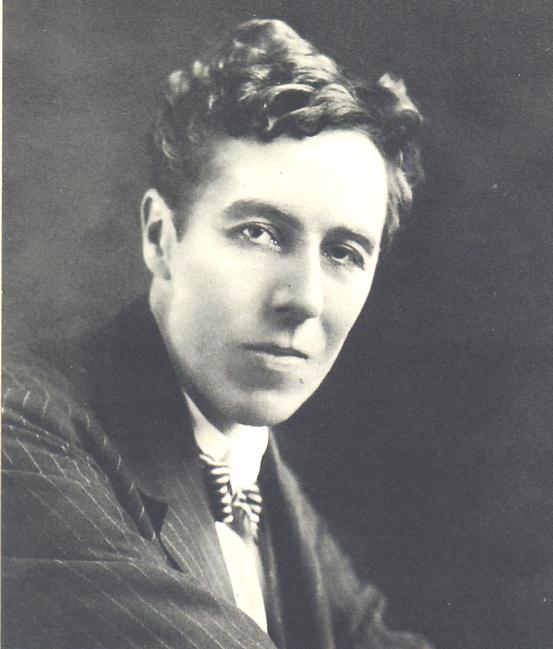
Count Eric Stenbock

Eric Stenbock born 14 March 1860 (d. 1895)

'Scholar, connoisseur, drunkard, poet, pervert, most charming of men' - W. B. Yeats.

Count Eric Stanislaus (or Stanislaus Eric) Stenbock was a Baltic German poet and writer of macabre fantastic fiction.

Stenbock was the Count of Bogesund and the heir to an estate in Estonia. He was the son of Lucy Sophia Frerichs, a Manchester cotton heiress, and Count Erich Stenbock, of a distinguished Baltic German noble family with Swedish roots.

Stenbock's father died suddenly while he was one year old; his properties were held in trust for him by his grandfather. Eric's paternal grandfather died while Eric was quite young, also, in 1866, leaving him another trust fund.

Stenbock attended Balliol College in Oxford but never completed his studies. While at Oxford, Eric was deeply influenced by the homosexual Pre-Raphaelite artist and illustrator Simeon Solomon. He is also said to have had a relationship with the composer and conductor Norman O'Neill and with other 'young men'.

In Oxford, Stenbock also converted to Roman Catholicism taking for himself the name Stanislaus. Some years later Eric also admitted to having tried a different religion every week in Oxford. At the end of his life, he seemed to have developed a composite religion containing elements of Catholicism, Buddhism and idolatry.

In 1885, Count Magnus died, upon which Stenbock, as the oldest living male relative, acceded to the status of Count and to the possession of the family's estates in Estonia. Eric travelled to and lived in Kolga, Estonia for a year and a half; he returned to England in the summer of 1887, during which time he sank deeper into alcoholism and drug addiction.

He returned to London and entered into London literary circles with the likes of W. B. Yeats, Aubrey Beardsley, Robert Ross, Charles Shannon, Charles Ricketts, Lionel Johnson and Oscar Wilde - who he rivalled for his sense of exotic decadence.

Stenbock lived in England most of his life, and wrote his works in the English language. He published a number of (now largely forgotten) books of verse (generally morbid, opium-drenched) during his lifetime, including Love, Sleep, and Dreams (1881), and Rue, Myrtle, and Cypress (1883). In 1894, Stenbock published The Shadow of Death, his last volume of verse, and Studies of Death, a collection of short (gothic gay-ish vampyr) stories that were good enough to be the subject of favourable comment by H P Lovecraft.

Stenbock died, either of cirrhosis of the liver, or from a blow to the head from a fall in Brighton. Rumour has it that on April 26th 1895, he died after a drunken incident involving taking a swing at someone with a poker and toppling into the grate. It was the first day of Oscar Wilde's trial. London's society's attention was thus focused elsewhere. His death certificate lists 'sepatic cirrhosis' as the cause of death.

In a macabre final twist, although his body is buried in Brighton, his heart was removed and sent to Estonia, where it was preserved in a glass urn in the family church.

A Secret Kept: A Brief Life of Count Stenbock

Labels: , , , , , ,

Monday, March 07, 2011

Robert de Montesquiou

Robert de Montesquiou born 7 March 1855 (d. 1921)

Marie Joseph Robert Anatole, Comte de Montesquiou-Fezensac was a French Symbolist poet, art collector and dandy. With many homosexual friends, he is reputed to have been the inspiration both for des Esseintes in J K Huysmans' À rebours and, most famously, for Baron de Charlus in Proust's À la recherche du temps perdu. He wrote the verses found in the optional choral parts of Gabriel Fauré's Pavane.

His portrait Arrangement in Black and Gold: Comte Robert de Montesquiou-Fezensac was painted by Whistler in 1891-1892. Antonio de La Gandara produced several portraits of the Comte.

His background was truly aristocratic by birth and he placed a great value on his own intellectual and literary accomplishments. Despite producing a large amount of symbolist poetry, two novels, volumes of memoirs and much literary criticism, he is best remembered for how he lived rather than for what he wrote.

He befriended and supported many artists - who immortalised him in portraiture - poets, writers and musicians, placing himself at the centre of the Parisisan social, artistic and literary worlds. He was also a keen collector of Art Nouveau and was a dandy and aesthete, extravagant in dress, behaviour and lavish living, surrounding himself with bright and attractive young men.

Montesquiou died on the French Riviera in 1921

Portraits of Robert de Montesquiou: James Whistler [top left]; Giovanni Boldini [above right]; Jacques-Emile Blanche [left]

Labels: , ,

Monday, January 17, 2011

Ronald Firbank

Ronald Firbank born 17 January 1886 (d. 1926)

Arthur Annesley Ronald Firbank was an eccentric and effete British novelist.

Ronald Firbank was born in London, the son of society lady Harriet Jane Garrett and MP Sir Thomas Firbank. He went to Uppingham School, and then on to Trinity Hall, Cambridge. He converted to Catholicism in 1907. In 1909 he left Cambridge, without completing a degree.

He published his first book, Odette d'Antrevernes, in 1905 before going up to Cambridge. From then, from The Artificial Princess (written in 1915, published posthumously in 1934) and Vainglory (1915, his longest work) to Concerning the Eccentricities of Cardinal Pirelli (1926, also posthumous) he produced a series of novels.

Inclinations (1916) takes place mainly in Greece, where 15-year-old Mabel Collins is travelling with her female chaperone, Miss O'Brookomore; Mabel elopes with an Italian conte, but the plot is of minor importance, the book's interest - as with all Firbank's work - lies in the dialogue. His next novel Caprice followed in 1917.

Valmouth (1918) is based on the activities of various people in a health resort on the West Coast of England; most of the inhabitants are centenarians, and some are improbably older. The plot, such as it is, is concerned with the attempts of two elderly ladies, Mrs Hurstpierpoint and Mrs Thoroughfare, to marry off the heir to Hare-Hatch House, Captain Dick Thoroughfare, who is engaged to a black woman, Niri-Esther, is loved frantically by Thetis Tooke, a farmer's daughter, but prefers his 'chum', Jack Whorwood, to both of them. Meanwhile Mrs Yajnavalkya, a black masseuse, manages an alliance between the centenarian Lady Parvula de Panzoust and David Tooke, Thetis's brother. A musical comedy by Sandy Wilson gave the novel some popularity in the 1960s. It has several times been revived and recorded on CD.

In The Flower Beneath The Foot (1923), the setting is an imaginary country which may be assumed to be somewhere in the Balkans. The characters include the King and Queen, sundry high-born ladies about the Court, and the usual attendant chorus of priests and nuns.

Sorrow in Sunlight, retitled at the suggestion of the publisher Prancing N*gger (1925) was especially successful in America. The scene is laid in an imagined West Indian republic. A black family, socially ambitious, move from their rural home to the capital, and the story is concerned with their attempts (which prove mainly abortive) to 'get into society'.

Concerning the Eccentricities of Cardinal Pirelli (1926) begins with the Cardinal christening a dog in his cathedral and ends with His Eminence dying of a heart attack while chasing, naked, a choirboy around the aisles.

Firbank's play The Princess Zoubaroff (1920) has been compared to William Congreve, but is rarely produced; Dame Edith Evans, perhaps the greatest English actress of her time, played the part in a radio production in 1964. The dialogue is highly characteristic: as, Princess Zoubaroff: 'I am always disappointed with mountains. There are no mountains in the world as high as I would wish...They irritate me invariably. I should like to shake Switzerland.'

His Complete Short Stories were published in a single volume in 1990 (ed. Steven Moore), and his Complete Plays in 1991 in a volume containing The Princess Zoubaroff.

He left among his manuscripts the first few characteristic chapters of a novel set in New York, The New Rythum [sic], published in 1962 after a sale of many of his manuscripts and letters.

Some critics have dismissed Firbank's novels as slight, but they have been championed by a large number of English novelists including E M Forster, Evelyn Waugh and Simon Raven. The poet W H Auden praised him highly in a radio broadcast on the BBC in 1961. Susan Sontag named his novels as constituting part of 'the canon of camp' in her 1964 essay 'Notes on "Camp"'. His writing style is sufficiently distinctive that the adjective 'Firbankian' was coined.

Living off his inheritance more than his writing, he travelled around Spain, Italy, the Middle East, and North Africa.

Ronald Firbank died of lung disease while in Rome in 1926.

Labels: , , ,

Saturday, August 21, 2010

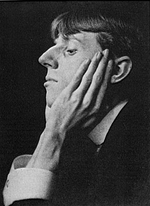
Aubrey Beardsley

Aubrey Beardsley born 21 August 1872 (d 1898)

Born in Brighton to a genteel but nearly destitute family, Aubrey Beardsley was a musical and artistic prodigy as a child who went on in his short life to become a highly original and influential illustrator, one of the greatest of the Symbolists.

He was educated at the Bristol Grammar School and later, with the encouragement of Pre-Raphaelite painter Sir Edward Burne-Jones, attended night classes at the Westminster School of Art. Although he absorbed a number of influences, including that of the Pre-Raphaelites, Beardsley was largely self-taught.

In 1892, the young artist received his first commission, an invitation to illustrate an edition of Thomas Malory's Morte D'arthur for the publisher J M Dent. The assignment entailed over 300 illustrations and chapter heads, which the artist executed in a mock-medieval, Pre-Raphaelite style.

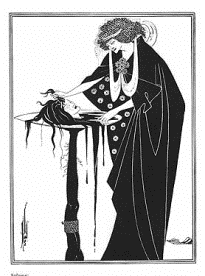
In 1893, as he was working on the Dent commission, he met Oscar Wilde, with whom he would be associated for the rest of his life, at least in the public's imagination. Beardsley was invited by Wilde's publisher to illustrate the English edition of Salome. When it was published in 1894, both the play and the witty, provocative - blatantly erotic - illustrations created a sensation.

That same year Beardsley became famous as the art editor of The Yellow Book, a new arts and letters periodical. Although Wilde never actually contributed to the magazine, it was widely assumed to be an organ for the aesthetic ideas that the playwright espoused. Beardsley's stunning black-and-white drawings, title-pages, and covers helped make the new quarterly a great success. But The Yellow Book also quickly became a site of the fin de siècle culture wars, a target of moralists concerned about the influence of the decadent movement on English society and art. One detractor described Beardsley's designs for the periodical as 'Diseased, weird, macabre, and sinister.'

In the context of the growing notoriety of Wilde and his circle, this may be seen as an attack on the newly visible homosexual subculture that emerged at the end of the nineteenth century. The culture wars culminated in Wilde's prosecution and conviction for gross indecency in 1895. One casualty of the reaction triggered by the Wilde trials of 1895 was Beardsley himself. He was summarily fired from his job as art editor of The Yellow Book. He had been too closely associated with Wilde for the publisher's comfort and his art too erotic and perverse for the new mood of conformity prompted by Wilde's conviction.

Beardsley however continued to find work as an illustrator and created many more beautiful illustrations. Unfortunately, Beardsley had been plagued by ill-health and bouts of tuberculosis since childhood and he died in the South of France, where he had gone in search of a better climate for his increasingly frail health. He was just 25.

Considering the brevity of his life, Beardsley's achievement is astonishing. A highly original creator, he transformed the art of illustration and profoundly influenced artists of his own and subsequent generations.

Labels: , , ,

Wednesday, August 04, 2010

Walter Pater

Walter Pater born 4 August 1839 (d. 1894)

Walter Horatio Pater was an English essayist and literary critic.

Among British prose writers of the Victorian era, Pater stands as the embodiment of stylistic elegance. A close student of German philosophy (particularly the work of Hegel) and well read in the French writers of the period, Pater's criticism and fiction were highly cerebral, yet embraced the purely sensuous dimensions of art and life. From the 1870s through the 1890s, he was regarded by the reading public as a major theorist and practitioner of Aestheticism and Decadence.

His stylistic elegance and his dangerous ideas about art's autonomy from morality, combined with rumours of homosexuality at Oxford, where he taught, made Pater's name virtually synonymous with gay sensibility during the late nineteenth century. He is believed to have been an influence on the work of Oscar Wilde.

In recent decades, Pater has been rediscovered by critics as one of the most important English sources of literary Modernism.

Labels: , , , ,