Thursday, January 13, 2011

Oliver Messel

Oliver Messel born 13 January 1904 (d. 1978)

Oliver Hilary Sambourne Messel was an English artist and one of the foremost stage designers of the 20th century.

Messel was born in London, the second son of Lieutenant-Colonel Leonard Messel and Maud, the only daughter of Linley Sambourne, the eminent illustrator and contributor to Punch magazine. He was educated at Hawtreys, a boarding preparatory school in Kent, Eton — where his classmates included Harold Acton, and Brian Howard — and at the Slade School of Fine Art, University College.

After completing his studies, he became a portrait painter and commissions for theatre work soon followed, beginning with his designing the masks for a London production of Serge Diaghilev's ballet Zephyr et Flore (1925). Subsequently, he created masks, costumes, and sets — many of which have been preserved by the Theatre Museum, London — for various works staged by C. B. Cochran's revues through the late 1920s and early 1930s. He socialised with London society's most glamorous and celebrated figures, including Noel Coward, Peter Watson and his one-time love rival Cecil Beaton.

In 1953, he was commissioned to design the decor for a suite at London's elegant Dorchester Hotel, one in which he would be happy to live himself. The lavishly ornate Oliver Messel Suite combines baroque and rococo styles with modernist sensibility and a considerable dose of fantasy. The suite, along with other suites that he designed in the Dorchester, are preserved as part of Britain's national heritage. It was restored in the 1980s by many of the original craftsmen, overseen by Messel's nephew, Lord Snowdon (Anthony Armstrong-Jones), the former husband of Princess Margaret.

Oliver Messel came from a wealthy, well-connected family and when his nephew, Anthony Armstrong-Jones married HRH Princess Margaret, a life-long relationship with the British royalty began. Messel was later to design Princess Margaret’s home on Mustique Island in The Grenadines. In 1959, Messel, exhausted by a demanding theatre season and recurring arthritis, retreated to Barbados and the lush beauty of the eastern Caribbean. He was 55 and at the peak of a career in which he had dazzled three decades of theatre-goers with his fantastic, romantic and inspired stage sets and costumes. The warmth, colour and vibrancy of the tropics seemed to liberate new sources of energy and imagination, leading him to what would eventually become a whole new career in designing, building and transforming homes. Not content to rest there, he also designed many furnishings for these homes, particularly for outdoor use.

Messel bought an existing house called Maddox, a simple bay house perched above a small beach on the St James coast. With the help of his companion Riis-Hansen and a Barbadian staff, he gradually transformed it using all the trademarks of his theatrical design: slender Greek columns, flattened arches, white-on-white interiors splashed with bright spots of colour, elaborate plaster mouldings - an easy mix of baroque and classical. It was his use of the materials and traditions of island architecture that was truly innovative. Wealthy friends clamoured for Messel to design houses for them, both on Barbados and Mustique He designed and supervised the renovations of many houses. He designed and built Mango Bay from scratch and was commissioned by the Barbados government to restore the old British officers' Garrison headquarters in Queens Park, creating an elegant adaptation of it to a theatre and art gallery.

He would probably have gone on to do much more on Barbados, but was lured away by his friend Colin Tennant, Baron Glenconner and his private island home, Mustique. Glenconner commissioned Messel to design all the houses built on the island. Between 1960 and 1978 Messel created some 30 house plans, of which over 18 have so far been built - a tangible and lasting tribute to his genius. But Barbados remained his first island love and his home, and he died there in 1978, at the age of 74.

One lasting legacy is that his preferred light sage green shade of paint, now known as 'Messel Green' by paint companies in the Caribbean, has been immortalised as many property owners choose this colour for the it’s quintessential Caribbean-ness.

Labels: , , , ,

Friday, September 24, 2010

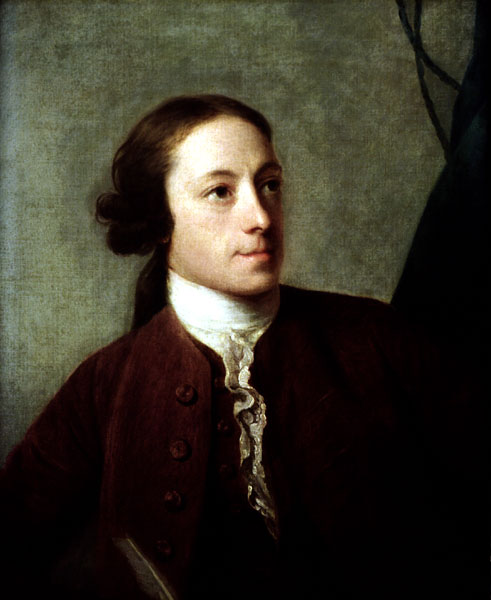
Horace Walpole

Horace Walpole born 24 September 1717 (d. 1797)

Horatio Walpole, 4th Earl of Orford, more commonly known as Horace Walpole, was a politician, writer, architectural innovator and namesake of his cousin Horatio Nelson.

He was born in London, the youngest son of British Prime Minister Robert Walpole. He was educated at Eton College and King's College, Cambridge. His homosexuality revealed itself early, and he is believed to have had affairs with the poet Thomas Gray, and with Henry Fiennes Clinton, 9th Earl of Lincoln (later 2nd Duke of Newcastle). Gray accompanied Walpole on the Grand Tour, but they quarrelled, and Walpole returned to England in 1741 and entered parliament. He was never politically ambitious, but remained an MP even after the death of his father in 1745 left him a man of independent means.

Following his father's politics, he was a devotee of King George II and Queen Caroline, siding with them against their son, Frederick, Prince of Wales, about whom Walpole wrote spitefully in his memoirs.

Walpole's home, Strawberry Hill, near Twickenham, was a fanciful concoction of neo-Gothic which began a new architectural trend. In 1764, he published his Gothic novel, The Castle of Otranto, setting a literary trend to go with the architecture. Strawberry Hill is undergoing a major restoration project.

From 1762 on, he published his Anecdotes of Painting in England. His memoirs of the Georgian social and political scene, though heavily biased, are a useful primary source for historians. In one of the numerous letters, from January 28, 1754, he coined the word serendipity which he said was derived from a 'silly fairy tale' he had read, The Three Princes of Serendip. He also authored the often-quoted epigram, 'Life is a comedy to those who think and a tragedy to those who feel'.

His father was created Earl of Orford in 1742. Horace's elder brother, Robert Walpole, 2nd Earl of Orford (c.1701–1751), passed the title on to his son George Walpole, 3rd Earl of Orford (1730–1791). When George died 'unmarried', Horace Walpole became the 4th Earl of Orford. When Horace Walpole died in 1797 the title became extinct.

[Painting Horace Walpole, Fourth Earl of Orford (1717-1797), ca 1759 by Allan Ramsay (1713-1784)]

Labels: , , ,

Thursday, July 08, 2010

Philip Johnson

Philip Johnson born 8 July 1906 (d. 2005)

Philip Cortelyou Johnson was an influential American architect. With his thick, round-framed glasses, Johnson was the most recognisable figure in American architecture for decades. Part icon, part oracle, part stand-up comic, Johnson was a reliable source of wit and provocation.

In 1930, he founded the Department of Architecture and Design at MoMA and later (1978), as a trustee, he was awarded an American Institute of Architects Gold Medal and the first Pritzker Architecture Prize, in 1979. He was a student at the Harvard Graduate School of Design. When Johnson died in January 2005, he was survived by his long time partner, David Whitney, who died only a few months later, on June 12, 2005.

Johnson was born in Cleveland, Ohio. He attended the Hackley School, in Tarrytown, New York, and then studied at Harvard as an undergraduate, where he focused on history and philosophy, particularly the work of the Pre-Socratic philosophers. Johnson interrupted his education with several extended trips to Europe. These trips became the pivotal moment of his education; he visited Chartres, the Parthenon, and many other ancient monuments, becoming increasingly fascinated with architecture.

Then in 1928 Johnson met the Bauhaus architect Ludwig Mies van der Rohe, who was at the time designing the German Pavilion for the Barcelona exhibition of 1929. The meeting was a revelation for Johnson and formed the basis for a lifelong relationship of both collaboration and competition. The pupil had finally found the master.

Johnson returned from Germany as a proselytiser for the new architecture. Touring Europe more comprehensively with his friends Alfred H. Barr, Jr. and Henry-Russell Hitchcock to examine first hand recent trends in architecture, the three assembled their discoveries as the landmark show The International Style: Architecture Since 1922 at the Museum of Modern Art, in 1932. The show was profoundly influential and is seen as the introduction of modern architecture to the American public. It introduced such pivotal architects as Le Corbusier, Gropius, and Mies van der Rohe. The exhibition was also notable for a controversy: architect Frank Lloyd Wright withdrew his entries in pique that he was not more prominently featured.

The definition of the movement as a "style" with distinct formal characteristics has been seen by some critics as downplaying the social and political bent that many of the European practitioners shared.

Johnson continued to work as a proponent of modern architecture, using the Museum of Modern Art as a bully pulpit. He arranged for Le Corbusier's first visit to the United States in 1935, then worked to bring Mies and Marcel Breuer to the US as emigres.

During the Great Depression, Johnson resigned his post at MoMA to try his hand at journalism and agrarian populist politics. His enthusiasm centred on the critique of the liberal welfare state, whose "failure" seemed to be much in evidence during the 1930s. As a correspondent Johnson observed the Nuremberg Rallies in Germany, he covered the invasion of Poland in 1939. The invasion proved the breaking point in Johnson's interest in journalism or politics - he returned to enlist in the US Army. After a couple of self-admittedly undistinguished years in uniform, Johnson returned to the Harvard Graduate School of Design to finally pursue his ultimate career of architect.

His early influence as a practicing architect was his use of glass; his masterpiece was a "Glass House" he designed as his own residence in New Canaan, Connecticut, a profoundly influential work (1949). The concept of a glass house set in a landscape with views as its real “walls” had been developed by many authors in the German Glasarchitektur drawings of the 1920s, and already sketched in initial form by Johnson's mentor Mies. The building is an essay in minimal structure, geometry, proportion, and the effects of transparency and reflection.

After completing several houses in the idiom of Mies and Breuer, Johnson joined Mies in the design of the 39 story Seagram Building (1956). This collaboration resulted in the remarkable bronze and glass tower on Park Avenue, whose strength of proportion, elegance of material, and constructional rigour led the New York Times to judge it the most important building of the twentieth century.

Completing the Seagram Building with Mies also decisively marked a shift in Johnson's career. After this accomplishment Johnson's practice enlarged as projects came in from the public realm - such as coordinating the master plan of Lincoln Center. Meanwhile, Johnson began to grow impatient with the orthodoxies of the International Style he had championed.

Although startling when constructed, the glass and steel tower (indeed many idioms of the modern movement) had by the 1960s become commonplace the world over. He eventually rejected much of the metallic appearance of earlier International Style buildings, and began designing spectacular, crystalline structures uniformly sheathed in glass.

Johnson's architectural work is a balancing act between two dominant trends in post-war American art: the more "serious" movement of Minimalism, and the more populist movement of Pop art. His best work has aspects of both movements. Johnson's personal collections reflected this dichotomy, as he introduced artists such as Rothko to the Museum of Modern Art as well as Warhol. Straddling these two camps, his work was seen by purists of either side as always too contaminated or influenced by the other.

From 1967 to 1991 Johnson collaborated with John Burgee, and from 1984 onwards with the second partner, Raj Ahuja. This was by far Johnson's most productive period certainly by the measure of scale - he became known at this time as builder of iconic office towers.

The AT&T Building in Manhattan, now the Sony Building, was completed in 1984 and was immediately controversial for its neo-Georgian pediment (Chippendale top). At the time, it was seen as provocation on a grand scale: crowning a Manhattan skyscraper with a shape echoing a historical wardrobe top defied every precept of the modernist aesthetic: historical pattern had been effectively outlawed among architects for years. In retrospect other critics have seen the AT&T Building as the first Post-modernist statement, necessary in the context of modernism's aesthetic cul-de-sac.

Johnson's publicly held archive, including architectural drawings, project records, and other papers up until 1964 are held by the Drawings and Archives Department of Avery Architectural and Fine Arts Library at Columbia University, the Getty, and the Museum of Modern Art.

Labels: , ,

Wednesday, October 01, 2008

William Beckford

William Beckford born 1 October 1760 (d. 1844)

William Thomas Beckford was an English novelist, art critic, travel writer and politician.

He was born in Fonthill, Wiltshire, in the manor house owned by his father, former Lord Mayor of London William Beckford. From him, William Jr. inherited, at the age of ten, a large fortune consisting of £1 million in cash, land, and several sugar plantations in Jamaica, which allowed him to indulge his interest in art and architecture, not to mention writing.

Three years later he married the fourth Earl of Aboyne's daughter, Lady Margaret Gordon on 5 May 1783. She later died in childbirth. Beckford was primarily homosexual, and at the age of 19 notoriously had an affair with the Hon William Courtenay, later 3rd Viscount and 9th Earl of Devon, then ten years old.

He travelled in Italy in 1782 and promptly wrote a book on the subject Dreams, Waking Thoughts and Incidents (1783). Shortly afterwards came his best-known work, the Gothic novel Vathek (1786), written originally in French and, as he was improbably accustomed to boast, at a single sitting of three days and two nights. It is an impressive work, full of fantastic and magnificent conceptions. His other principal writings are Memoirs of Extraordinary Painters (1780), a satirical work, and Letters from Italy with Sketches of Spain and Portugal (1835), full of brilliant descriptions of scenes and manners. In 1793 he visited Portugal, where he lived for a while.

Beckford's fame, however, rests nearly as much upon his eccentric extravagances as a builder and collector as upon his literary efforts. In carrying out these he managed to dissipate his fortune of £100,000 a year, only £80,000 of his capital remaining at his death.

The opportunity of purchasing the complete library of Edward Gibbon gave Beckford the basis of his own library, and James Wyatt built Fonthill Abbey, in which this and the owner's art collection would be housed; it was completed in 1807.

He entered parliament as member for Wells and later for Hindon quitting by accepting the Chiltern Hundreds, but mostly lived in seclusion, spending most of his father's wealth without adding to it, so that the great house he had built became a ruin. In 1822 he sold it to John Farquhar, and moved to Lansdown Hill, where he commissioned architect Henry Goodridge to design a spectacular folly, Lansdowne Tower.

He had a seat in parliament from 1784 to 1793, and again from 1806 to 1820.

He died on 2 May at his residence, Lansdown Crescent, age 84. He left two daughters.

He spent his elderly years living in Bath on Lansdown Terrace and built a final masterpiece, Lansdown Tower, (now known as Beckford's Tower), where he kept many of his treasures. He is buried in the grounds of this tower, now a graveyard.

Labels: , , , ,