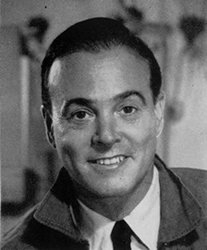
Oliver Messel
 born 13 January 1904 (d. 1978)
Oliver Hilary Sambourne Messel was an English artist and one of the foremost stage designers of the 20th century.
Messel was born in London, the second son of Lieutenant-Colonel Leonard Messel and Maud, the only daughter of Linley Sambourne, the eminent illustrator and contributor to
Punch magazine. He was educated at Hawtreys, a boarding preparatory school in Kent, Eton — where his classmates included
Harold Acton, and
Brian Howard — and at the Slade School of Fine Art, University College.
After completing his studies, he became a portrait painter and commissions for theatre work soon followed, beginning with his designing the masks for a London production of Serge Diaghilev's ballet
Zephyr et Flore (1925). Subsequently, he created masks, costumes, and sets — many of which have been preserved by the Theatre Museum, London — for various works staged by C. B. Cochran's revues through the late 1920s and early 1930s. He socialised with London society's most glamorous and celebrated figures, including
Noel Coward,
Peter Watson and his one-time love rival
Cecil Beaton.
In 1953, he was commissioned to design the decor for a suite at London's elegant Dorchester Hotel, one in which he would be happy to live himself. The lavishly ornate Oliver Messel Suite combines baroque and rococo styles with modernist sensibility and a considerable dose of fantasy. The suite, along with other suites that he designed in the Dorchester, are preserved as part of Britain's national heritage. It was restored in the 1980s by many of the original craftsmen, overseen by Messel's nephew, Lord Snowdon (Anthony Armstrong-Jones), the former husband of Princess Margaret.
Oliver Messel came from a wealthy, well-connected family and when his nephew, Anthony Armstrong-Jones married HRH Princess Margaret, a life-long relationship with the British royalty began. Messel was later to design Princess Margaret’s home on Mustique Island in The Grenadines. In 1959, Messel, exhausted by a demanding theatre season and recurring arthritis, retreated to Barbados and the lush beauty of the eastern Caribbean. He was 55 and at the peak of a career in which he had dazzled three decades of theatre-goers with his fantastic, romantic and inspired stage sets and costumes. The warmth, colour and vibrancy of the tropics seemed to liberate new sources of energy and imagination, leading him to what would eventually become a whole new career in designing, building and transforming homes. Not content to rest there, he also designed many furnishings for these homes, particularly for outdoor use.
Messel bought an existing house called Maddox, a simple bay house perched above a small beach on the St James coast. With the help of his companion Riis-Hansen and a Barbadian staff, he gradually transformed it using all the trademarks of his theatrical design: slender Greek columns, flattened arches, white-on-white interiors splashed with bright spots of colour, elaborate plaster mouldings - an easy mix of baroque and classical. It was his use of the materials and traditions of island architecture that was truly innovative. Wealthy friends clamoured for Messel to design houses for them, both on Barbados and Mustique He designed and supervised the renovations of many houses. He designed and built Mango Bay from scratch and was commissioned by the Barbados government to restore the old British officers' Garrison headquarters in Queens Park, creating an elegant adaptation of it to a theatre and art gallery.
He would probably have gone on to do much more on Barbados, but was lured away by his friend Colin Tennant, Baron Glenconner and his private island home, Mustique. Glenconner commissioned Messel to design all the houses built on the island. Between 1960 and 1978 Messel created some 30 house plans, of which over 18 have so far been built - a tangible and lasting tribute to his genius. But Barbados remained his first island love and his home, and he died there in 1978, at the age of 74.
One lasting legacy is that his preferred light sage green shade of paint, now known as 'Messel Green' by paint companies in the Caribbean, has been immortalised as many property owners choose this colour for the it’s quintessential Caribbean-ness.
Labels: Architects, Artists, Interior Designers, Socialites, Theatre Designers
 Thom Filicia born 17 May 1969
 Filicia gained great exposure when he became the interior design expert on the TV reality show Queer Eye in 2003. He and his designs have been the subject of many magazine articles and he has frequently appeared as a guest expert on many American TV shows.