Saturday, May 21, 2011

Fred Barnes

Fred Barnes born 21 May 1885 (d. 1938)

Fred Barnes was an English music hall artist.

He experienced extremes of success and failure, and as a young gay man escaped to London from his father and his father's lifestyle.

Barnes was born in a bedroom above his father's butcher's shop at number 219 Great Lister Street, Saltley, Birmingham, England.

Aged ten, after seeing Vesta Tilley, first visiting her sister who lived close to the shop, and later playing the lead in Dick Whittington at the Prince of Wales Theatre, Fred became interested in the stage. His first notable performance was playing the Duke of Solihull in Cinderella at the Alexandra Theatre, in 1906. It was while starring in the pantomime that Fred acquired his first agent and attracted the attention of another Birmingham-born music hall artist, George Lashwood, who, in Fred's own words, 'took me in hand... [placed] at my disposal, free and unasked, the lessons of his long and brilliant career'. It was following Cinderella's fourteen week run that Fred first performed in London, persuaded by fellow cast members, the Eight Lancashire Lads, to travel with them. Upon his arrival, Fred found himself playing the hated first slot on the bills. However, this was to change when he decided to try out a new song that he'd written, The Black Sheep of the Family, at the Hackney Empire in 1907. It was a huge success and was to remain Fred's most popular song.

As Fred says in his account of his life ('How success ruined me'), his name was 'made in a single night'. With this impressive start to his career he spent the next few years establishing himself. By 1911 he was top of the bill on all of the major circuits and principle boy in a number of pantomimes.

In 1913 his father committed suicide. Two weeks later, Barnes performed at the Birmingham Hippodrome, 'a place full of memories of my father. To this day I don't know how I got through that week'. The Birmingham Gazette of August 30 commented, 'Fred Barnes has this week proved the hollowness of the old saying that an artiste is never appreciated in his own town. He has gone a long way towards packing the house at every performance at the Hippodrome'. Following his father's death Fred's career continued to improve.

In an Era interview from 1914 he stated that he had no vacant dates for the next three years and held contacts for the next ten. It was when his personal problems, namely spending and drinking too much, began. He attributed these to dealing with both the death of his father and his new found success and popularity. The large sums of money he was earning and which he inherited led him to begin spending extravagantly - a habit he found hard to break when he was no longer earning any money. But it was drinking which was to ruin Fred's career. He missed performances, went on stage incapable of singing or dancing and generally put less and less care into his performances. This led to his being moved down the bills until he was finally back at first turn. Managers grew wary of him and soon his outstanding contracts were paid off and he was without work altogether.

During the twenties Fred was arrested (and later sentenced to one month in jail) for driving while drunk, in a dangerous manner and without a licence. Following the arrest, Fred, deemed a 'menace to His Majesty's fighting forces' (almost certainly because of the topless sailor who had been travelling with him at the time of the accident), was banned from attending the Royal Tournament, an annual military tattoo; he returned each year and each year successfully evaded discovery.

He was also open about his sexuality, and was one of the well-known 'twanks' of his period, unsurprisingly since he was known to pick up sailors and guardsmen in his Rolls-Royce.

It is for these reasons rather than his musical achievements (he only made ten recordings during his career), that only two biographies exist.

By the mid 30s Fred was suffering from tuberculosis. His failing health led him and his lover and manager John Senior to move to Southend-on-Sea. By this time any work consisted of playing the piano in pubs while John collected tips. Luckily for Fred and John a past manager, Charles Ashmead Watson, paid their rent, lighting and clothing costs, as well as giving them a weekly allowance of 30 shillings. Fred had made a number of attempts to return to the stage, most of which were unsuccessful; a final job in the summer of 1938, playing his songs in the lounge of a local hotel restored some of his confidence in his own ability. But by that winter he could no longer live with the pain he constantly suffered. Two and a half years after he was told he had only three months to live, Fred Barnes committed suicide.

When the Jury at the inquest into Fred's death commented that Watson had been 'wonderful' to Fred, he replied 'He was a great man'. He was not the only person who thought so. Naomi Jacob said 'he had one of the kindest hearts in the world. Moreover he was a fine artist and no mean dancer'. An Era interviewer in 1911 commented on his 'singularly pleasing popularity'. Fred's funeral on the second of July 1938, was attended by hundreds, the St Saviour's Churchyard and nearby streets crowded with mourners.

He was free with facts in interviews and in his own account of his life; his numerous publicity stunts which included announcements of his 'near-death' in a fire and a fake marriage. His appearance, he was known to walk around London at the height of his success with a marmoset perched on his shoulder (later, playing the pubs in Southend-on-Sea, he made do with a chicken).

Footlight Notes - profile of Fred Barnes with photographs

Barnes' life is featured in Three Queer Lives by Paul Bailey.

Labels: , , , , ,

Saturday, May 14, 2011

Julian Eltinge

Julian Eltinge born 14 May 1881 (d. 1941)

In the 1910s and 1920s, Julian Eltinge was one of the biggest stars of the day, the toast of Broadway and vaudeville, and an enormously popular and wealthy star of silent film. With music composed by Jerome Kern and other leading composers of the day, and lyrics often written by Eltinge himself, his theatrical farces were phenomenal critical and financial successes.

Regarded by many as the greatest female impersonator in history, today Eltinge is all but forgotten and his life and work virtually unknown to the public.

When not performing, he invested a great deal of effort into creating a masculine persona - boxing, horse-riding, (staged) bar fights, ladies' man - to deflect rumours of his homosexuality. There is no record of lovers of either sex although there were plenty of stories. He never married, as they say.

Despite great international success Eltinge's career began to fade in the 1930s. Times and tastes were changing, and alcoholism, and other personal and financial problems seemed to spin him into a decline. By the 1930s, the female impersonations that he had built his career had begun to lose popularity. Eltinge resorted to performing in sleazy nightclubs. Crackdowns on cross-dressing in public, meant to curb homosexual activity, prevented Eltinge from performing in costume. At one appearance in a Los Angeles club, Eltinge stood next to displays of his gowns while taking on his characters.

The performances in nightclubs continued and while performing in New York in 1941, Eltinge died in his hotel room of what is reported to have been a cerebral hemorrhage, though the circumstances are considered mysterious to some scholars.

Labels: , , , ,

Friday, January 07, 2011

Bert Savoy

Bert Savoy born 7 January 1880* (d. 1923)

Bert Savoy was an influential early American drag performer.

Bert Savoy - born Everett McKenzie - began his drag act 'doing a hootchie-kootchie dance at freak shows in Boston and polished it in the wilds of Alaska'. He nearly hit the big time in 1914 while understudying for James Russell of the Russell Brothers (known for their 'bitch' act: a pair of Irish servant girls) in Maids to Order when Russell dropped dead.

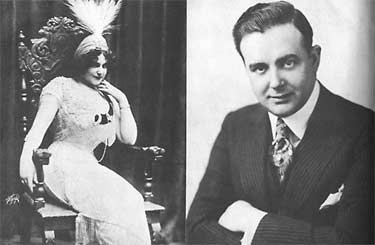
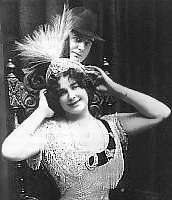
Savoy found greater success in 1915 when he begun a partnership as comedic partner to 'straight man', Jay Brennan (allegedly after Savoy had picked up Brennan on a streetcar). The team was a huge success; they headlined in the Ziegfeld Follies of 1918. Savoy & Brennan are pictured left.

Savoy was one of the first of such acts to clearly be associated in the minds of the viewing audience as being overtly homosexual in theme and content. Most other female impersonators of the day, such as the international sensation, Julian Eltinge, went to great lengths to let you know that they were engaged in painstaking artifice. Eltinge's career was accompanied by a pull out the stops public relations effort to show him in any number of traditional 'virile male' activities, when off stage.

Although drag had always been a main staple of vaudeville, it was not really performed as or perceived as 'gay' until the appearance of Savoy, who was pure camp on and off the stage. The two routines which gave rise to Savoy's catchphrases 'You Don't Know The Half Of It, Dearie' and 'You Mussst Come Over' were preserved for posterity on a rare 1923 Vocalion recording made shortly before Savoy's untimely demise.

The story of Bert Savoy's death is legendary and, by all accounts, absolutely true: on June 26, 1923 Savoy, his half-brother and two friends were walking along the shore at Long Beach watching an upcoming storm when a thunderclap prompted Savoy to squeal, 'Ain't Miss God cuttin' up somethin' awful?' or something similar. He was immediately struck dead by a bolt of lightning. How camp is that? In fact, the lighting focused on a bath house locker key around Savoy's neck. One friend, whose hand was resting on Savoy's shouder, was also killed and the other left paralysed. His half-brother survived.

Brennan continued the act quite successfully for a while with Stanley Rogers, owing much to the fact that Rogers copied Savoy's mannerisms and catchphrases to a tee. Brennan later became a scriptwriter in the movies and died in 1961 at the age of 78.

Mae West is alleged to have based much of her act on Bert Savoy.

Bert Savoy at Queer Music Heritage

*Musicals101.com list his birthdate as 1876 but most sources agree on 1880.

Labels: , , , ,

Wednesday, August 11, 2010

Ray Bourbon

Ray Bourbon born 11 August 1892 (d. 1971)

If a good deal of mystery surrounds the life and career of Ray Bourbon so many years after his death in 1971, it is probably due to the fact that Bourbon excelled at generating numerous conflicting stories about himself.

He claimed, at various times, to have been born Hal Wadell in Texarkana, TX in 1892, Ramon Icarez in or near Chihuahua, TX in 1898, and the son of Franz Joseph of Austria and Louisa Bourbon. Many 'facts' regarding Bourbon's early life­, his claim to birth of Bourbon royalty, his claim to an education at Tulane Medical School in New Orleans, his claim to have been Pancho Villa's notorious 'Señora Diablo'­ are all unsubstantiated and probably products of Bourbon's own active imagination.

He claimed to have begun in the theatre in England in 1913, and this may well be true. He returned to the US by 1917 and, as Rae Bourbon, supposedly won a Photoplay contest and was awarded a studio contract as first prize. He would say later that he worked in several silent films, and it is reported that he appeared under the name Ramon Icarez as a fire dancer at the opening of the Los Angeles Coliseum in 1923.

By the mid-20s, Bourbon was working with Bert Sherry as the vaudeville team of 'Bourbon and Sherry' and later toured with the Martin Sisters. In 1932, he was working full-time as a female impersonator at such clubs as Jimmy's Back Yard in Hollywood and Tait's in San Francisco. (At this last club, in May 1933, his Boys Will Be Girls review was raided by police during a live radio broadcast.)

In the later 30s and early 40s he headlined at the Rendezvous in Los Angeles and starred in his own revue, Don't Call Me Madam. His Insults of 1944, which began at the Playtime Theatre in Los Angeles in January of that year, caught the attention of Mae West during its New York production in May, 1944 at La Vie Parisienne. She cast him in her 1944 production of Catherine Was Great and in her 1948 production of Diamond Lil.

Throughout the 50s and 60s Bourbon entertained at hundreds of clubs throughout the US and released dozens of albums, certainly the most prolific female impersonator to have done the latter. His appearances are still fondly remembered by many who saw him when he toured in big and small towns all over the country, providing many isolated gay men with a glimpse of the loose-knit urban Gay community of the pre-Stonewall era.

Ray’s comedy was, at once, highbrow and lowbrow, overtly gay and covertly subversive. There is evidence that he had relationships with both men and women, was married twice, and fathered at least one son. In his memoirs, Ray discusses his sexual attractions and relationships to both genders with equal enthusiasm, but never called himself gay or bisexual. He worked on stage in and out of drag. Bourbon was probably cashing in on the news of Christine Jorgensen when he claimed to have had a sex change in 1956 (almost certainly not true).

After a once quite successful career, by the late 1960s Bourbon had fallen on hard times. In 1968, Bourbon was barely eking out a living, travelling through Texas and working at the Jewel Box Revue in Kansas City. During this time he was implicated in the murder of the owner of a Dog Kennel where Bourbon had lodged a collection of some 70 dogs. The circumstances alone beg many questions, but Bourbon was convicted as the mastermind of the killing along with two conspirators. The 78-year-old Bourbon was given a 99-year sentence. He died a short time later, on January 19, 1971 in the Howard County Texas prison, while penning his unfinished memoirs Daddy Was a Lady.

Don't Call Me Madam - The Life and Work of Ray Bourbon

Labels: , , , , , ,

Wednesday, November 19, 2008

Clifton Webb

Clifton Webb born 19 November 1889 (d. 1966)

Clifton Webb was an American actor, dancer and singer.

He was born Webb Parmelee Hollenbeck in Indianapolis. In 1892, his formidable mother, Mabelle, moved to New York with her beloved 'little Webb', as she called him for the remainder of her life, his father was rarely mentioned again.

Privately tutored, Webb started taking dance and acting lessons at the age of five. He made his stage debut at seven and began a successful career as a child actor on the stage and in vaudeville. In between performances, Mabelle saw to it that he studied painting and voice. By his seventeenth birthday in 1906, he was singing in operetta. Upon reaching nineteen, he had become a professional ballroom dancer and, taking the stage name 'Clifton Webb', sang and danced in about two dozen operettas before debuting on Broadway and making several appearances.

The 1920s saw Clifton Webb in no fewer than eight Broadway shows, numerous other stage appearances, including vaudeville, and a handful of silent films. Despite early film appearances Clifton Webb's mainstay was the Broadway theatre. Between 1913 and 1947, the tall and slender performer who sang in a clear, gentle tenor, appeared in 23 Broadway shows, mostly musicals, starting with major supporting roles and quickly progressing to leads.

His Broadway credentials were impressive and his London stage appearances were critically praised, but Hollywood was another story. After his early film appearances he was classified as a character actor and stereotyped as a fussy effete snob. Mother Mabelle also preferred New York to Hollywood with its 'yes men'.

Webb was in his mid-fifties when actor/director Otto Preminger chose him over the objections of 20th Century Fox chief Darryl F Zanuck to play the classy, but evil, radio columnist Waldo Lydecker, who is obsessed with Gene Tierney's character in the 1944 film noir Laura [pictured right]. His performance was showered with acclaim and made him an unlikely movie star. Two years later he had another highly-praised role as the elitist Elliott Templeton in The Razor's Edge (1946).

Webb received Academy Award nominations for Best Actor in a Supporting Role in 1945 for Laura and in 1947 for The Razor's Edge (1946). He received an Oscar nomination for Best Actor in a Leading Role in 1949 for Sitting Pretty, the first in a three-film series of comedic 'Mr Belvedere' features with Webb portraying the snide and omniscient central character.

In 1950's Cheaper by the Dozen, Webb and Myrna Loy played Frank and Lillian Gilbreth, real-life efficiency experts of the 1910s and 1920s, and the parents of twelve children.

Webb's subsequent movie roles include that of college professor Thornton Sayre, who in his younger days was known as silent film idol Bruce 'Dreamboat' Blair. Now a distinguished academic who wants no part of his past fame, he sets out to stop the showing of his old films on television in 1952's Dreamboat. Also in 1952 he was John Philip Sousa in Stars and Stripes Forever. In 1953 he had his most dramatic role as the doomed husband of unfaithful Barbara Stanwyck in Titanic and in 1954 played the (fictional) novelist John Frederick Shadwell in Three Coins in the Fountain. In 1957's Boy on a Dolphin he portrayed a wealthy sophisticate who enjoyed collecting illegally obtained Greek antiquities. In a nod to his own identity, the character's amusingly-chosen name was 'Victor Parmalee'.

Webb's elegant taste kept him on Hollywood's best-dressed lists for decades. Even though he exhibited comically foppish mannerisms in portraying Mr Belvedere and other movie characters, his scrupulous private life kept him free of scandal.

In fact, the character of Lynn Belvedere is said to have been very close to his real life — he had an almost Oedipal-like extreme devotion to his mother Mabelle, who was his companion and who lived with him until her death at age ninety-one. Although he admitted to being gay, he was actually more asexual, given that the object of his love and tenderness was his mother.

When Webb's mourning for his mother continued for a year with no signs of letting up, Noel Coward, in a fit of comic exasperation is said to have finally told Webb, tongue firmly-in-cheek, 'It must be difficult to be orphaned at seventy, Clifton.'

But the twilight had arrived for Webb's life and career. Inconsolable in his grief, he completed a final role as an initially sarcastic, but ultimately self-sacrificing Catholic priest in Satan Never Sleeps (1962).

Webb spent the remaining five years of his life as an ill recluse at his home in Beverly Hills, California, succumbing to a heart attack at the age of 76.

Labels: , , , ,