Sunday, May 15, 2011

Jasper Johns

Jasper Johns born 15 May 1930

Jasper Johns is a contemporary American artist best known for painting and printmaking and associated with the Pop Art and Neo-Dada movements.

Born in Augusta, Georgia, Jasper Johns grew up in Allendale, South Carolina. Johns studied at the University of South Carolina from 1947 to 1948. He then moved to New York City and studied briefly at Parsons School of Design in 1949. While in New York, Johns met Robert Rauschenberg, with whom he had a artistic and sexual relationship, as well as Merce Cunningham and John Cage. Working together they explored the contemporary art scene, and began developing their ideas on art. United by friendship and shared homosexuality they were to have a profound effect on the creative arts in 1950s New York - helping to define post-modernism.

In 1952 and 1953 he was stationed in Sendai, Japan during the Korean War.

In 1958, gallery owner Leo Castelli discovered Johns while visiting Robert Rauschenberg's studio.

Johns is best known for his painting Flag (1954-55), which he painted after having a dream of the American flag. His work is often described as a 'Neo-Dadaist', as opposed to pop art, even though his subject matter often includes images and objects from popular culture. Still, many compilations on pop art include Jasper Johns as a pop artist because of his artistic use of classical iconography.

Early works were composed using simple schema such as flags, maps, targets, letters and numbers. Johns' treatment of the surface is often lush and painterly; he is famous for incorporating such media as Encaustic (wax-based paint), and plaster relief in his paintings. Johns played with and presented opposites, contradictions, paradoxes, and ironies, much like Marcel Duchamp (who was associated with the Dada movement). Johns also produces intaglio prints, sculptures and lithographs with similar motifs.

Johns' breakthrough move, which was to inform much later work by others, was to appropriate popular iconography for painting, thus allowing a set of familiar associations to answer the need for subject. Though the Abstract Expressionists disdained subject matter, in the end it could be said that they simply changed subjects. Johns neutralised the subject, so that something like pure paint - painted surface - could declare itself. For twenty years after Johns painted Flag, the surface - in Andy Warhol's silkscreens or Robert Irwin's illuminated ambiances - could suffice.

In contrast to the concept of macho 'artist hero' as ascribed to Abstract Expressionist figures such as Jackson Pollock and Willem de Kooning, whose paintings are fully indexical (that is, standing effectively as an all-over canvas signature), Neo-Dadaists like Johns and Robert Rauschenberg seem preoccupied with a lessening of the reliance of their art on indexical qualities, seeking instead to create meaning solely through the use of conventional symbols, painted indexically in what some have interpreted as a rebuttal of the hallowed individuality of the Abstract Expressionists. There is also the issue of symbols existing outside of any referential context; Johns' flag, for instance, is primarily a visual object, divorced from its symbolic connotations and reduced to something in-itself.

Since the 1980s, Johns produces paintings at four to five a year, sometimes not at all during a year. His large scale paintings are much favoured by collectors and due to their rarity, it is known that Johns' works are extremely difficult to acquire.

Above, Jasper Johns, 1997 by Chuck Close

Labels: , , ,

Friday, August 06, 2010

Andy Warhol

Andy Warhol born 6 August 1928 (d. 1987)

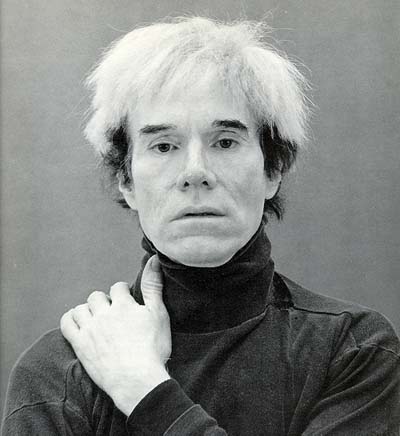
Andrew Warhola, known as Andy Warhol, was an American artist of Slovak origin and a central figure in the movement known as pop art. After a successful career as a commercial illustrator, Warhol became famous worldwide for his work as a painter, an avant-garde film-maker, a record producer, an author, and a public figure known for his membership in wildly diverse social circles that included bohemian street people, distinguished intellectuals, Hollywood celebrities and wealthy aristocrats.

A controversial figure during his lifetime (his work was often derided by critics as a hoax, or 'put-on'), Warhol has been the subject of numerous retrospective exhibitions, books, feature and documentary films since his death in 1987.

Warhol coined the phrase 15 minutes of fame, which refers to the fleeting condition of celebrity that attaches to an object of media attention, then passes to some new object as soon as the public's attention span is exhausted.

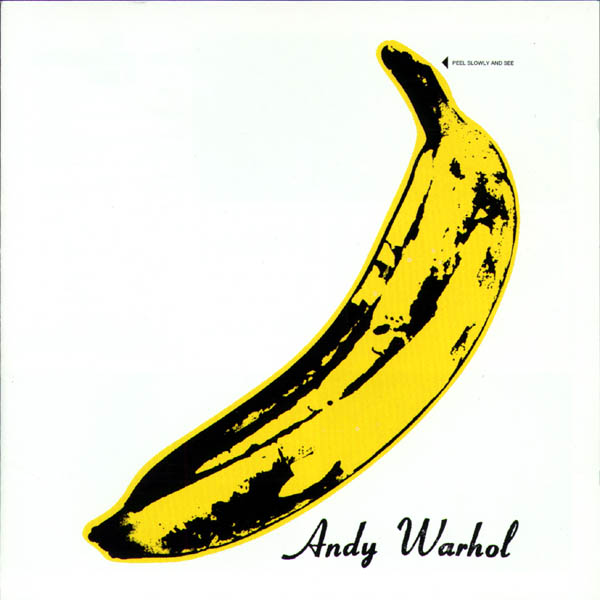
Warhol is best known for his extremely simple, larger-than-life, high-contrast colour paintings, silk-screen prints of packaged consumer products, everyday objects - such as Campbell's Soup cans, poppies and the banana appearing on the cover of the album The Velvet Underground and Nico (1967) - and for his stylised - and much pastiched - portraits of twentieth century celebrity icons - such as Marilyn Monroe, Elvis Presley, Jacqueline Kennedy Onassis and Elizabeth Taylor.

He was also a highly influential and innovative film-maker, although his work, largely controlled by his estate and commercially unavailable, has been little seen in recent years.

In many of his efforts Warhol has taken the position of a producer or director, rather than a creator. From an artist he gradually became the person that determined the direction and was the public face of a company, having a staff of sorts to do the actual labour involved in his products. He would coin an idea and oversee its execution, his Factory evolved from an atelier into an office.

In this respect Warhol talked about 'Art Business' and 'Business Art', and how he thought business was the best type of art. This was a radical new stance, as artists had always presented themselves as flamboyant, individual, visionary outsiders - commenting on the normal part of society, but never really being a part of it. And receiving appreciation for that position on the basis of their idealism, rare talents and personalities. Warhol and other pop-artists helped redefine the artist's position as professional, commercial, popular; a logical and valuable part of society. He did this using methods, imagery and talents that were (or at least seemed to be) available to everyone. Perhaps that has been the most meaningful result of (his) Pop Art: a philosophical and practical incorporation of art into society, art as a product of society.

Warhol died in New York City from a routine gallbladder surgery at the age of 58. Warhol was afraid to enter hospitals and see doctors, so he had delayed having his recurring gallbladder problems checked.

Warhol was one of the first major homosexual American artists to be open about his sexuality. Many people think of Warhol as 'asexual' and merely a 'voyeur', but these notions have been debunked by biographers, explored by other members of the factory scene such as Bob Colacello (in his book Holy Terror: Andy Warhol Up Close), and by scholars. The question of how his sexuality informed Warhol's work and shaped his relationship to the art world is a major subject of scholarship on the artist, and is an issue that Warhol himself addressed in interviews, in conversation with his contemporaries, and in his publications.

Throughout his career, Warhol produced erotic photography and drawings of male nudes. Many of his most famous works (portraits of Liza Minnelli, Judy Garland, Elizabeth Taylor, and films like My Hustler, Blow Job, and Lonesome Cowboys) draw from gay underground culture and/or openly explore the complexity of sexuality and desire. Many of his films premiered in gay porn theatres. That said, some stories about Warhol's development as an artist revolve around the obstacle his sexuality initially presented as he tried to launch his career. The first works that he submitted to a gallery in the pursuit of a career as an artist were homoerotic drawings of male nudes. They were rejected for being too openly gay.

To an extent, the evolution of his Pop style can be traced to the years when Warhol was first dismissed by the inner circles of the New York art world and thus created his own.

Labels: , , , , ,

Friday, July 09, 2010

David Hockney

David Hockney born 9 July 1937

Born and educated in Bradford, Yorkshire, David Hockney studied at Bradford College of Art and the London College of Art, where with his contemporary, Peter Blake, he was one of the most significant stars of British Pop Art. In 1963, a visit to New York brought him into contact with Andy Warhol.

He has produced a series of paintings, portraits - mostly of his friends - prints, lithographs, photocollages, commissions and theatrical stage designs. He has also experimented with using computers and other technology to create art. Much of his work is representative of his life in his adopted home of California, especially his landscapes and pool pictures.

The film A Bigger Splash (1974) about Hockney and named after one of his most famous paintings, creates the definitive image of this distinctive Yorkshireman and his life and work up to that point.

Hockney, who has always been openly gay, is regarded as one of the greatest painters of the twentieth century and his best canvases now sell for millions. The distinctive style of his work - in whatever form it takes - and his trademark mop of blonde - now white - hair and round spectacles identify him as a unique and popular cultural figure.

In October 2006 the National Portrait Gallery in London organised one of the largest ever displays of Hockney's portraiture work. The collection consisted of his earliest self portraits up to his latest work completed in 2005. The exhibition proved to be one of the most successful in the gallery's history, and Hockney himself assisted in displaying the works.

His most recent work has seen Hockney undertaking a series of large-scale landscapes of his native Yorkshire.


Labels: , ,